Sunday, March 31, 2019
Wilson's Creek visitor center to expand
A $4.5
million project will make room for more Civil War-era artifacts at the site of
the first major battle west of the Mississippi River. The project will add
1,873 square feet of exhibit space to the visitor center at the Wilson’s Creek
National Battlefield in southwest Missouri. There were an estimated 1,200 Union
and 1,100 Confederate casualties at the site in August 1861. Fundraising got a
major boost last week when Bass Pro Shops donated $25,000 to help jump-start a
$300,000 local campaign, the Springfield News-Leader reported. • Article


Thursday, March 28, 2019
Re-enacting garrison life at Fort Monroe
As many as 175
living historians -- donning Civil War uniforms, other period attire and stances
-- will set up camp on Fort Monroe in Virginia this weekend to pay tribute to
the garrison life on the former military post. The National Park Service is
hosting the festival called “The Garrison Life at Fort Monroe: A
Gathering of Steel for the Peninsula Campaign, 1862.” The event, in its fourth
year, will be staged on the parade grounds near Quarters No. 1 and other areas
within the 565-acre property. • Article
Tuesday, March 19, 2019
Treasured chest: Maj. Gen. James B. McPherson items, long kept at an Ohio farm, are part of new Atlanta Cyclorama exhibits

 |
| Chest and belt plate (Courtesy of Perry Adams Antiques) |
 |
| Maj. Gen. McPherson |
That promise died on July 22, 1864, when McPherson, 35,
was shot from his saddle by a Confederate infantryman during the Battle of
Atlanta.
His remains were returned to his hometown of Clyde, Ohio,
amid great national mourning that extended to the White House. Many foes in the
Confederate army, including West Point classmate John Bell Hood, also expressed
grief.
McPherson’s 87-year-old grandmother wrote to Gen. Grant: “His funeral
services were attended in his mother’s orchard, where his youthful feet had
often pressed the soil to gather the falling fruit; and his remains are resting
in the silent grave scarce half a mile from the place of his birth. His grave
is on an eminence but a few rods from where the funeral services were attended,
and near the grave of his father.”
In addition to a grieving family and a
fiancée, Emily Hoffman – who would never marry – McPherson left behind a number
of personnel effects, including a travel (or campaign) chest, a captured
Confederate canteen and the model 1851 belt plate he was said to be wearing on
the day he died.
Now, nearly 155 years after those items
made the sad journey to Ohio, they are back in Atlanta, exhibited with the
newly restored Battle of Atlanta Cyclorama. The Atlanta History Center purchased the items late last year and the three artifacts are among the
McPherson-associated artifacts on display in a gallery outside the painting
rotunda.
 |
| New exhibit at the Atlanta History Center (Picket photo) |
Gordon Jones, senior military historian
at the history center, said McPherson was venerated across the country,
including in Atlanta, where he led the Army of the Tennessee in battles that
collectively spelled doom for the South’s military cause.
 |
| (Courtesy of Perry Adams Antiques) |
“The first Civil War
monument of any kind placed on an Atlanta battlefield was placed in his honor
in 1877 by U.S. soldiers. That monument was adopted by the city of Atlanta to
represent not only an iconic event, but also the unique wartime history of the
city,” Jones told the Picket.
The monument to McPherson
lies in the East Atlanta neighborhood, at the corner of McPherson and Monument
avenues.
“Note Fort McPherson also
named in his honor. Now you could say some of that was Southern bragging
about killing the top U.S. general -- but a lot more of it was because of the
story of his death, his friendship with Sherman, his fame and popularity, and
the post-war desire in Atlanta for reconciliation between North and South.”
 |
| Exhibit includes bullet some say killed the general (Picket) |
Final resting place for artifacts
The Atlanta History Center
made the purchase through Perry Adams Antiques in Petersburg, Va., which
detailed the fascinating postwar history of the trunk and other items on its
website.
After McPherson’s death, the
effects transferred to one of his brothers. Upon the latter’s death in 1877,
the general’s nephew acquired them. But that man, in need of money, sold the items in 1924 to a family that lived outside Clyde.
Perry Adams Antiques acquired the grouping when it attended the Ohio Civil War
& Artillery Show and traveled to the family farm to view it.
“These effects are amongst
the most important of Civil War artifacts we had the pleasure of offering,” the
company said.
 |
| Detail of the Rebel canteen (Courtesy of Perry Adams Antiques) |
Neither would disclose the
sales price.
The small McPherson exhibit
also includes the bullet that reputedly killed him and a post card with a
photograph of the general, inset with a postwar scene of his death location.
Those were already in the history center collection.
“We assume that McPherson had the trunk
with him during the Atlanta Campaign; there is no provenance on the Confederate
canteen, although it was not unusual for upper echelon officers to be presented
with war souvenirs,” said Greenbaum.
 |
| Belt plate, canteen and campaign chest (Picket photo) |
The trunk is similar to others in the history
center’s holdings, down to the hardware and stencil lettering.
“It has obviously seen heavy use, has
been repaired and has been in the family,” Jones said. “I don’t know for sure,
but it probably (was) sent back to the family with his personal effects after
he was killed.”
The cedar canteen, which has the
original leather strap and roller buckle, features on one side the carved letters "McP.”
“That suggests to me that
the general kept it as a souvenir much the same way a private soldier would,”
Jones said. “On the other side of the canteen, someone has written ‘McPherson’
in pencil -- looks like a child's writing -- so I think that lettering was put
there by a family member well after the war.”
 |
| Reverse side of the belt plate (Perry Adams Antiques) |
Did bullet hit his belt plate?
One of the more curious items in the case is the belt plate
(or buckle) that McPherson was wearing when he was killed, according to family
tradition.
Slips of paper that came with the collection have
handwritten notations indicating the triangular nick in the plate came from the
fatal bullet.
It is known that McPherson was surprised to encounter Rebel troops as he rode to inspect the position of troops relatively early in the
battle. He was said to have tipped his hat before swinging his horse around in
order to make his escape.
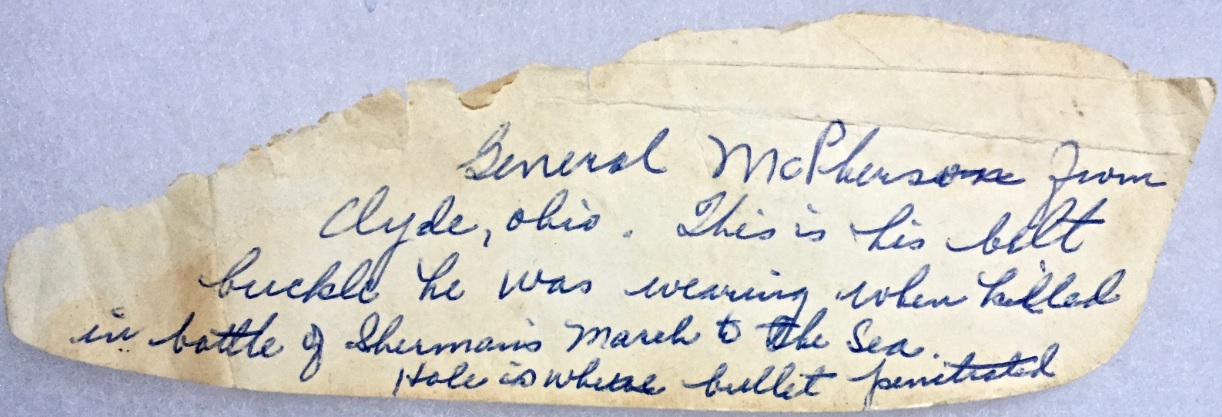 |
| Old note claims belt was hit by bullet (Perry Adams Antiques) |
Charlie Crawford, president of the Georgia Battlefields Association, said McPherson was leaning forward on his horse when a Cpl. Robert Coleman of the 5th Confederate (Cleburne’s Division) fired a single
shot. The bullet went upward and hit McPherson’s lung and heart or aorta,
exiting the chest.
A placard at the Atlanta History Center says the nick did
not come from the bullet.
“It may have resulted from the impact of a rock or other
object when McPherson’s body hit the ground.”
Other items in the collection
The general’s hat, some papers he was carrying in his
pocket and watch were believed to have been taken by Confederates.
 |
| (Perry Adams Antiques) |
The collection once included a frock coat, which was sold
years ago to an Ohio antiques dealer. (Greenbaum says he has no idea what
became of it.)
It also has a carte de visite signed by McPherson, his
mother’s wedding band and an earring, along with several postwar items.
Regarding the image of McPherson (right), Jones said that while
it is not currently on exhibit, it will be rotated with the post card. “That's so we can keep the exhibit fresh but
also to limit prolonged light exposure on these paper items.”
The 1886 painting only a
few yards from the McPherson depicts Federal soldiers rushing to plug a gap
made during a brief Confederate breakthrough. An ambulance bearing McPherson’s
body slowly makes its way to Sherman’s headquarters, where he had visited with
his boss in the morning on the day of his last ride.
What the nation lost
McPherson remains an
example of young talent that seems snuffed out to early.
“He benefited from being a protege of Halleck and Grant, which is not a
bad thing, but his daily interactions with both made his talents more readily
observable and more quickly rewarded then perhaps some others,” said Crawford.
 |
| (Courtesy of Perry Adams Antiques) |
McPherson had performed well under Grant
in the Fort Donelson, Shiloh and at Vicksburg, where he was a corps commander.
By April 1864, he joined Sherman’s forces during the Atlanta Campaign. At
Resaca he received some criticism for not making a vigorous attack on a smaller
foe. Sherman said afterward, "Well, Mac, you've
missed the chance of a lifetime."
But he was a favorite of Sherman and Grant -- who called him one of the army's "ablest, purest and best generals" -- until the end.
Sherman cried upon
hearing the news of his death. A letter he wrote to authorities about the loss included
these lines:
“I, his associate and commander, fail in words adequate to
express my opinion of his great worth. I feel assured that every patriot in
America, on hearing this sad news, will feel a sense of personal loss, and the
country generally will realize that we have lost, not only an able military
leader but a man who, had he survived, was qualified to heal the national
strife which has been raised by designing and ambitious men.”
 |
| Cyclorama detail shows ambulance with body (Atlanta History Center) |
Monday, March 18, 2019
Flag carried by Maine regiment returns home
An American
flag that a Maine regiment brought into battles in Louisiana and Texas during
the Civil War has returned to its home state. The Portland Press Herald reports
the torn and tattered 156-year-old flag has been delivered in a wooden frame to
the Maine Military Museum in South Portland. The flag had been stored for years
at the home of a Colorado woman who was married to the regiment commander's
great-grandson. • Article
Saturday, March 9, 2019
They'll pay tribute to the famed 69th Infantry, Irish Brigade with cemetery ceremony

One week before it leads New York City’s St. Patrick’s Day Parade, the National Guard’s 69th Infantry Regiment on Sunday morning (March 10) will honor those who fought for the famed Irish Brigade during the Civil War.
Current and
past soldiers of the 1st Battalion will mark the graves of veterans
who served in mostly Irish regiments with U.S. and Irish flags. The ceremony at
Albany Rural Cemetery’s Soldiers’ Lot in Menands will include a wreath-laying
ceremony at a Grand Army of the Republic monument.
A press release say the ceremony is meant to honor “the
Irish immigrants that served in the Civil War's 69th Regiment, the Irish
Brigade, and the Irish Legion to support their adopted country.”
The Soldiers’ Lot was chosen because it bears the remains of several
veterans, including Pvt. Bernard Trainor, who fled Ireland during the Great
Famine.
He enlisted in the 69th one month before it fought at Antietam. According to the release half of the 69th New York Volunteer Infantry was killed or wounded in the battle. Trainor had a slight leg wound. He made it through Fredericksburg without injury amid high casualties.
He enlisted in the 69th one month before it fought at Antietam. According to the release half of the 69th New York Volunteer Infantry was killed or wounded in the battle. Trainor had a slight leg wound. He made it through Fredericksburg without injury amid high casualties.
“His luck
finally ran out at Gettysburg in June 1863. By that time, the 69th was a shadow
of its former self, deploying with less than one hundred soldiers. Trainor was severely wounded fighting in the
notorious Wheatfield. He was discharged as a result of these wounds. He was
likely sent to Albany to convalesce, where he died in 1868.”
Subscribe to:
Posts (Atom)