Showing posts with label maine. Show all posts

Wednesday, January 24, 2024

Gettysburg hopes Little Round Top will reopen before 161st anniversary events in early July. The site has undergone improvements over the past two years.

A new retaining wall is built at the 91st Pennsylvania monument (GNMP)
Gettysburg National Military Park estimates Little Round Top will reopen to the public in late spring or early summer, nearly two years after a massive rehabilitation project began, according to a park spokesman.

The popular site closed on July 26, 2022, to the disappointment of visitors who planned trips but welcomed by others who lauded the project.

The hill is where Union forces fought off a furious Confederate assault on July 2, 1863, during the three-day battle in Pennsylvania.

Park officials have said they are addressing ongoing problems at the overcrowded site. They cited erosion, overwhelmed parking areas, poor accessibility and related safety hazards, and degraded vegetation.

“This project will also enhance the visitor experience with improved interpretive signage, new accessible trail alignments, and gathering areas. These improvements will allow visitors to better immerse themselves into the historic landscape that is essential to understanding the three-day Battle of Gettysburg,” a 2022 news release said. 


A park page on the project says the aim is to “reestablish, preserve, and protect the features that make up this segment of the battlefield landscape.” 

Some 164 feet above the Plum Run Valley to the west, the hill became the anchor of the Union’s left flank and a focal point of Confederate attacks on the afternoon of July 2. The 4th,15th and 47th Alabama regiments made a series of legendary assaults against the 20th Maine.

“The (Maine) regiment’s sudden, desperate bayonet charge blunted the Confederate assault on Little Round Top and has been credited with saving Major General George Gordon Meade’s Army of the Potomac, winning the Battle of Gettysburg and setting the South on a long, irreversible path to defeat,” according to the American Battlefield Trust.

Wednesday’s update on social media indicated Little Round Top may be open in time for 161st anniversary programs and events in early July. The Picket reached out to park spokesman Jason Martz..

"Maybe. That is our hope, but it's too soon to speculate," Martz said in an email.

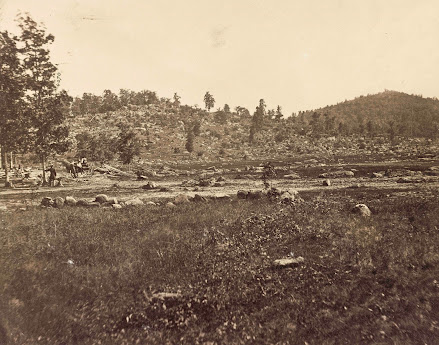
Little Round Top seen from Plum Run Valley (Library of Congress)
Little Round Top traditionally is the top destination for park visitors, he said, followed by the visitor center and museum and Devil's Den.

When asked about archaeological investigations during the work, Martz said a lot of battle material was found, including “a few unique items, but nothing that would move the needle too much one way or the other. The archaeological process is long and drawn out and final details won't be available for quite some time.”

A Dyer artillery round was found in February 2022, with park officials saying then they believe a Confederate cannon fired at Federal position and mistakenly dropped them on friendly Texas regiments trying to navigate the difficult terrain.

Martz said officials have enough details to largely close the loop on that story and will provide an update in the future.

Tuesday, April 30, 2019

Visitors at fort near Savannah can see flag returned by descendant of Yankee officer, personal items of Rebel officer who grew up nearby

Emmett Rifles flag (left, Georgia State Parks)
For reasons I cannot fully explain, a Civil War artilleryman I blogged about years ago occasionally saunters back into my mind. I find him fascinating.

Maj. William Zoron Clayton joined the Federal army while living in Minnesota, served in numerous campaigns – including Shiloh, Vicksburg, Atlanta and the March to Sea – lost his first wife during the war and moved to his native Maine afterward. He operated several businesses and died at age 94 in Bangor on the eve of the 1929 stock market crash.

The reason I first wrote about Clayton was the decision by his great-grandson, Robert Clayton, of Isleboro, Maine, to return a flag that his ancestor took home as a war trophy. 

Bob Clayton mailed the flag to coastal Georgia -- 147 years after Fort McAllister’s capture.

W.Z. Clayton at some point had expressed hope that the Emmett Rifles flag “be return(ed) to Savannah or Atlanta sometime.”

The flag was unveiled to much fanfare in April 2012 at Fort McAllister State Historic Park, where the Emmett Rifles, a Savannah militia unit, served during the war

I recently called Bob Clayton, 74, to reminisce and to learn more about his ancestor’s siblings who also served during the war.

While W.Z. joined the 1st Minnesota Light Artillery, three brothers served with the 1st Maine Cavalry. Rufus ended up in Minnesota, where he died in 1900. Collamore died in Minnesota, apparently in 1936. Edmund did not survive the conflict. Wounded at Brandy Station, he was captured two years later and shipped to Andersonville prison in Georgia, where he died of disease in 1864.

Lt. Col. McAllister items
Bob Clayton said his father recalled conversations with an elderly W.Z. Clayton.

“He told me how his grandfather was chasing a Confederate on horseback and the Confederate galloped off the road and came back on it. Because he did that my great-grandfather was able to capture him.”

The veteran spoke about landmines that were placed around Fort McAllister.

“He remembered seeing a train with a bunch of Confederate prisoners heading somewhere and he really felt sorry for them.”

According to a 1900 Grand Army of the Republic account of the Atlanta campaign, Clayton was the chief of artillery for the 4th Division of the 17th Corps. He and a signal officer were the first to enter Fort McAllister after its surrender on Dec. 17, 1864, and the Rebel commander surrendered the flag that Clayton kept.

Bob Clayton has a few relics from the war, including a guidon of the 1st Minnesota and a Bible that belonged to W.Z. The Bible was captured during battle and returned to him decades after the war. Bob has a map of his great-grandfather’s travels during the Civil War, letters and insignia.

Jason Carter, park manager at Fort McAllister, says the Emmett Rifles flag “is kind of a highlight of the tour.” Staff members tell visitors about how the banner disappeared for 150 years and was returned by Clayton, who stopped by the park one day while on vacation and mentioned having it.

Exhibits in museum (Georgia State Parks)
“It’s probably by far the most valuable thing in there,” Carter said of the site’s museum.

The flag is directly across from an exhibit that opened in December 2017.

A saber, spurs, uniform vest and other items belonged to a Confederate officer who served at the fort early in the conflict and is from the family that owned the surrounding property.

The items, including a photograph of Lt. Col. Joseph Longworth McAllister, were donated by descendant Carolyn C. Swiggart, an attorney in Greenwich, Conn.

McAllister, 43, died June 11, 1864, at the Battle of Trevilian Station, a Confederate victory in central Virginia. The lieutenant colonel with the 7th Georgia Cavalry fought to the last, throwing an emptied gun at Federal troops just before he was cut down by bullets.

Like Bob Clayton, Swiggart has not returned to McAllister since the dedications of their gifts. I am happy that the objects are ‘back home’ and on display,” she told the Picket this week.

Panorama showing the two exhibits (Georgia State Parks)

Monday, March 18, 2019

Flag carried by Maine regiment returns home

An American flag that a Maine regiment brought into battles in Louisiana and Texas during the Civil War has returned to its home state. The Portland Press Herald reports the torn and tattered 156-year-old flag has been delivered in a wooden frame to the Maine Military Museum in South Portland. The flag had been stored for years at the home of a Colorado woman who was married to the regiment commander's great-grandson. • Article

Saturday, August 25, 2018

Remembering the boys of Maine's 5th and 8th: On Peaks Island near Portland, you can visit their summer retreats, spend the night at one

Guests can rent rooms at the 8th Maine lodge and museum
... where veterans met more than a century ago (8th Maine OL&M)
Striking windows at the 5th Maine Regiment Museum (Picket)
From wrap-around porches or chairs perched on back lawns, the graying veterans of two Maine infantry regiments could see or hear all manner of water craft plying Casco Bay.

There were the lobstermen, or couples out for a leisurely sail. During the summer, ferries brought throngs of passengers who might stay the week on Peaks Island, just a few miles east of Portland.

In the late 19th and early 20th century, Peaks Island was a draw, too, for a number of Civil War veterans, who would enjoy clam bakes, suppers and poetry readings with their families. They built clapboard retreats, two of which survive – the 5th Maine Regiment Museum (1888) and 8th Maine Oceanfront Lodge & Museum (1891).

While they enjoyed the natural beauty and the island’s many attractions, including the Gem Theatre, gardens and a Ferris wheel (Peaks was called the Coney Island of Maine), these men mostly came to spend time with their comrades – those who understood what they had endured.

Gem Theatre and one of many piers on the island (Maine Historical Society)
They would reminisce about the bloodbaths at Drewry’s Bluff, Antietam, Gettysburg, Cold Harbor or the Wilderness. Some, no doubt, suffered from post-traumatic stress syndrome.

Today, visitors to Peaks Island can stop by both Queen Anne-style sanctuaries, which feature three-story observation towers that rise like sentinels.

Relic at the 5th Maine
The 5th Maine Museum is operated by a nonprofit group that showcases the unit’s history, relics and other prize possessions. The building also serves as an island community and cultural center, offering music, art and photography shows and exhibits on other facets of the island’s past.

While the 5th Maine association counts a few descendants, the 8th Maine, just 100 yards away, is operated by lineal descendants, a situation it calls unique.

Visitors to the island can delve into the regiment’s history and rent rustic rooms that -- while lacking air conditioning and television sets – offer coziness and simplicity during the tourist season, which lasts generally from Memorial Day into September.

“What we tell people who have never been here before … I want you to understand when you step over the threshold you are stepping back to 1900,” says Bill Hackett, 8th Maine lodge manager and descendant of Sgt. Lorenzo W. Hackett.

5th Maine veterans, families in 1912 (5th Maine Regiment Museum)
A docent provides a tour of the 5th Maine main hall (Picket photo)

5th Maine Regiment Museum

Known as the Forest City Regiment, the 5th had three companies from Portland and served in 22 battles, from First Manassas to Petersburg, mustering out in July 1864.

“The Fifth was known as one of Maine’s fighting regiments,” says the museum’s website. “It captured more prisoners than the number of men who served in the regiment and three times the number of battle flags than any other Maine regiment captured.”

5th Maine front yard (Picket photo)
The veterans began holding reunions elsewhere shortly after war’s end and participants would stay in tents. A perhaps apocryphal story holds that wives and children became tired of camping and demanded a building, says museum curator Holly Hurd-Forsyth.

“Some were farmers, businessmen and Bowdoin graduates,” she said of the veterans. “There must have been some means and motivation. Building a permanent structure was a pretty rare thing to do.”

The 5th Maine Regiment Memorial Hall held its first reunion on July 4, 1888, and the meetings continued until 1940 (By then, most of the soldiers had died and activities were organized by descendants). The annual reunions had a military air, with rules and regulations.

The regiment formed a memorial association, required dues and members rented 15 “sleeping rooms”; proceeds went for maintenance and operations. A cot might go for 50 cents a night. The room at the top of tower went for $9 a week.

Picket photo of porch overlooking Casco Bay
Windows in the main hall remain the building’s most striking feature. My wife and I visited this summer, and gazed upon the hand-blown flash glass engraved with the names of soldiers serving in the unit. The purchase of the windows was another way the men funded the lodge’s upkeep.

The Sixth Corps’ red-cross insignia is painted above the doors. The hall includes memorabilia and relics from battlefields in the South.

An upstairs view (Picket photo)
The hall went through some challenges as soldiers died and descendants increasingly jumped into cars -- rather than a ferry -- and vacationed elsewhere. The association began renting out rooms. “Their families didn’t have the strong ties they used to. Peaks Island itself was not as much as a destination,” said Hurd-Forsyth.

Fires during the 1930s destroyed many vacation properties and venues on the island. The room rentals at the 5th Maine ended in 1947.

The all-volunteer 5th Maine Regiment Community Association has operated the building since 1954 and rents out space, including its downstairs dining room. Programming includes Civil War talks, and musical and arts programs. Keeping up the grounds and building are priorities, and the museum hopes to repair and reopen the observation tower.

Dining area downstairs (5th Maine)
Peaks Island is a popular day trip for Portland visitors and about 900 residents live there year-round, embracing the isolation brought by winter. More than 5,100 people visited the museum during last year’s season. The venue will close this year on Columbus Day, Oct. 8.

David Johnston, who lives in New Hampshire and has a place on the island, can often be seen at the 5th Maine Museum.

“Having salt in my veins, I go there all the time on the weekends and volunteer at the pancake breakfast,” he told the Picket. “(Other breakfast volunteers) think it is really cool that I have blood ties to the establishment.”

Lt. Dexter
His great-great-grandfather, Lt. Charles B. Dexter, served in Company A and was active after the war in the Grand Army of the Republic. Dexter died in Norwood, Mass, in 1914, at age 76.

Memorial hall includes a photograph of Dexter and other 5th Maine veterans.

“They volunteered. It wasn’t a draft. It is standing up and believing in what you think is the right choice,” said Johnston.

8th Maine Oceanfront Lodge & Museum

Old-timey living is alive and encouraged at the lodge, which rents rooms to the public from mid-June into September. Along with their stay, guests can learn about the rich history of the Maine regiment.

The rentals cover much of the maintenance for the old building – replacing the roof, for example, may cost $70,000. Guests share bathrooms, jigsaw puzzles, ping pong table and other amenities. Rates for the 14 rooms start at $109 an evening. There are no TVs sets or AC, but fans help on the warmest days.

A $129 a night room with a view (8th Maine OL&M photos)
And a dining area below the main floor
“Yes, we do have Wi-Fi. We couldn’t survive without it,” says Dawn Hackett, guest host and wife of Bill Hackett. The couple lives in York, Maine, during the offseason.

The communal spirit at the Peaks Island lodge extends to dining downstairs. Every table has a two-burner gas cook top.

“Traditionally, the 8th Maine veterans, when they stayed at the lodge would always share meals. After each meal, each soldier family would reset their table,” says the museum’s website. “The message to each other was clear and emotional; we will be back and we will not forget. The 8th Maine staff encourages all its guests to continue that practice if they cook or use our dishes.”

8th veterans swap stories back in the day 
Of course, the descendants association stresses the regiment’s history and sacrifice made by its members. A large, open hall showcases that and the building includes artifacts and a library. Participants in a daily tour will see emblems for the 18th and 24th Corps, under which the 8th Maine boys served.

Most of the men who enlisted in the regiment were from upstate. The unit drew from Aroostook and Piscataquis counties and Penobscot. “Anything north of Bangor is Canada,” quipped Bill Hackett.

The 8th served in the Carolinas, Georgia (Fort Pulaski) and at Petersburg and Cold Harbor in Virginia, among other campaigns and battles.

Courtesy of 8th Maine OL&M
Although the regimental association goes back to 1871, its big boost came after Col. William M. MacArthur won $75,000 in the 1885 Louisiana State Lottery. He used some of the winnings to buy property on Peaks Island and build the 8th Maine memorial lodge, which opened in 1891 as a regimental meeting place and vacation spot.

“It was quite the scam, but someone did benefit – the 8th Maine,” Dawn Hackett says of the lottery.

Lorenzo Hackett
Sgt. Lorenzo W. Hackett was one of five brothers to serve in the Civil War.

“Lorenzo was a color bearer. That puts him up right and center in his company wherever they went,” said Bill Hackett. “He never got shot in the entire war. He got hit in the backpack with a Minie ball that spun him around.”

The soldier was taken prisoner and was exchanged later in the war.

For years, the veterans of the 8th Maine slept on the floor in the main hall, or elsewhere in the building. As they died off, the association began renting rooms to the public in the mid-1920s.

Today, the descendants group – which allows members to join at age 16 – holds an annual reunion in June. The association also welcomes birthday parties, weddings and other community events. The last nights for guests this year is Sept. 22.

Relics in the great hall (8th Maine OL&M)
Belfast Historical Society via Maine Memory Network
The lodge wants guests to enjoy the veranda and everything inside, including the Civil War history. A recent review on TripAdvisor captured the appeal, at least for some.

On the water, with a killer balcony to read, write or take in the salt air. The lodge is an old time-y wood lodge that yanked me back to my childhood in Maine. If you need all the high end comforts or a lot of TLC give this place a miss. If you want to dial down the stress and enjoy life before it went off the rails....you can't go wrong.”

Sunday, October 15, 2017

Hero's gravestone corrected in Maine

The city of Auburn, Maine, has rededicated the corrected gravestone of a Civil War hero. Union Cpl. Moses C. Hanscom captured a Confederate flag on Oct. 14, 1863, at the Battle of Bristoe Station in Virginia, but his name was misspelled on the marker in Oak Hill Cemetery after his death in 1873. • Article

Monday, December 2, 2013

Wall of names has unexpected power

The Maine Historical Society has visually represented the deaths of members of Maine regiments with a memorial wall that is part of the society’s exhibit, “This Rebellion: Maine and the Civil War,” on display through May 26. Inspired in part by the Vietnam Memorial in Washington, D.C., the wall is 40 feet long, 7 feet high, and, on nine panels with four columns on each, contains the names of more than 8,500 members of Maine regiments who died during the war, as well as names of those missing in action. Among those listed on the wall are four brothers. • Article

Friday, July 6, 2012

1864 recipes updated in new cookbook

Taste the Civil War as the Bangor Museum and History Center unveils “The Bangor Sanitary Fair Cookbook Bangor 1864.” The group sent wine, brandy, whiskey, jellies, and pickles, things that would make the trip to Virginia or other Southern states where Maine units were stationed. The recipes in the publication have been updated for the "modern cook." • Article

Wednesday, May 23, 2012

When the war struck home in Maine

For 11 Bangor High School students, Tuesday afternoon’s re-enactment of a mob attack on a Bangor newspaper publisher 150 years ago was a living history lesson. On Aug. 12, 1861, residents destroyed the office of The Democrat, a Bangor newspaper published by Marcellus Emery, a Southern sympathizer. • Article

Tuesday, May 1, 2012

Video: Descendant describes Bible's journey


Robert Clayton of Islesboro, Maine, provides an overview of the fascinating history that goes with this small New Testament. It belonged to his great-grandfather, William Z. Clayton. For photos and details, read the Picket article.

Monday, April 30, 2012

Amazing story of captured Bible's return to soldier from Maine -- 60 years later

The following is among my favorite stories in the nearly three-year existence of the Civil War Picket.

On April 21, 2012, Robert Clayton of Islesboro, Maine, returned a Confederate battle flag to Fort McAllister, Ga., 147 years after its capture by his great-grandfather, Capt. W.Z. Clayton. There's a side story that may be even more incredible.

Robert Clayton has in his possession the Bible that belonged to W.Z. Clayton. The Union soldier lost the Bible at a battle and it went into the hands of a Confederate. A Union officer "recaptured" it two years later in fighting near Atlanta. After a lot of twists and turns, the Bible got back to W.Z. Clayton in late 1923 or early 1924 -- 62 years after he had last seen it. Robert Clayton provided most of the following information, and I've done as much additional research as I practically can at this moment. I'd love to be able to fill in the gaps:


William Zoron Clayton, a native of Freeman, Maine, was 25 when the Civil War began. He joined the 1st Minnesota Light Artillery. His wife, Elizabeth "Lizzie" Rice Clayton, gave him this small Bible. She inscribed (above, click to enlarge) the first verse of a popular 1830s song, "Sweet Memories of Thee." The words are: "When soft stars are peeping, Through the pure azure sky, And southern gales sweeping, Their warm breathings by -- Like sweet music pealing Far o'er the blue sea, there comes o'er me stealing Sweet memories of thee."

Another inscription in the Bible (click to read) tells the bearer to keep it close. The penmanship does not appear to be Elizabeth's. At the time, the verse was commonly written in Bibles.

W.Z. Clayton, while a sergeant, wrote the following message to whomever might come in possession of his Bible. (click below to enlarge) The remainder of the message will be presented later in this post.


The 1st Minnesota Light Artillery saw its first significant action of the Civil War at Shiloh on April 6, 1862. Clayton was wounded in the great clash at the Hornet's Nest. It's not clear how he lost custody of the Bible. Perhaps the sergeant dropped it or the Rebel found it in the battery's camp, forward of the Peach Orchard. Clayton's unit barely escaped capture that day.

The Bible was then signed by L. Herndon, Co. I, 1st Regiment Mississippi Cavalry. Sgt. Lucien (possibly) Lucius Herndon was a member of the Pontotoc Dragoons. (Click photo below to enlarge)

On April 6, at Shiloh, the 1st Mississippi Calvary advanced on the left flank of Cheatham's Division. One of their officers captured a different Union battery that was poised to retreat to the Tennessee River at Pittsburg Landing. The Mississippi unit later fought in Louisiana, Alabama, middle Tennessee and Georgia.

Sadly, Clayton's wife, Lizzie, died on May 10, 1864, according to ancestry.com. W.Z. Clayton at that time was in North Georgia taking part in the Atlanta Campaign, serving with 1st Minnesota Light Artillery.

I do not know what became of Herndon and whether he or the 1st Mississippi Cavalry were at the Battle of Jonesboro, a Union victory south of Atlanta Aug. 31-Sept 1, 1864. But I think it's likely they did.

At Jonesboro, the Bible came into possession of 1st. Lt. Obed Sherwin of the 47th Ohio Volunteery Infantry (click photo to enlarge, who added his name. Sherwin, of Jefferson Township, Ohio, was wounded some time during the war by a round that killed another soldier.

The 47th OVI saw early service in Virginia. The regiment transferred west and joined the 15th Corps in time for the 1863 Vicksburg operation. Later in the fall, the Buckeyes joined the Chattanooga-Ringgold campaign and took part in Georgia operations. Sherwin mustered out in January 1865.

Above Sherwin's notation is the balance of W.Z. Clayton's note to whomever might find his New Testament. It asks it be returned to his father, Bartholomew, in Freeman, Maine. It also notes W.Z.'s membership in a masonic lodge.

From here, the story of the recaptured Bible becomes murky, with few details.

Robert Clayton said the Bible eventually to a Capt. Thomas, who moved to Texas and held the Bible for about 40 years. Mrs. Thomas gave it to a J.A. Creath in Gurdon, Ark., in December 1923 (click photo to enlarge). Someone saw the inscription that indicated W.Z. Clayton was a Mason, and through that fraternal order, was able to locate the former Union officer and send the Bible to him.

After the war, Clayton married Laurette E. Knowles and they had six children. He passed away in October 1929 in Bangor, Maine, at 94.

Thursday, April 26, 2012

This soldier actually was a sailor

Almost 150 years after George Adams Harriman of Orland, Maine, enlisted to fight the Confederacy, descendants have confirmed which military service he joined. They have marked his grave with a memorial stone that honors his service. • Article

Tuesday, February 14, 2012

Love endured 33-month separation

After Sarah Long kissed her husband, Hezekiah, goodbye in late summer 1862, he seldom penciled romantic prose to her. The 37-year-old Hezekiah joined the 20th Maine Infantry Regiment in August 1862. They communicated only by letter, and Hezekiah wasted little pencil lead on amorous passages. Yet, in his taciturn way, he reminded Sarah that he loved and missed her. • Article