Tuesday, December 17, 2024

Pieces of a Civil War statue pulverized by big rig in an Ohio township were reassembled. Now the old soldier is guiding efforts to build a new monument

The Sherman statue was reassembled piece by piece to serve as a guide (Photos Nicholas Fairplay)
English-born Nicholas Fairplay has carved gargoyles, lions and even the severed head of John the Baptist -- providing museum-quality creations to cathedrals and historic buildings around the world.

But it is the replica of a simple statue of a Civil War soldier that now has the attention of Fairchild, who has toiled for years in the Cleveland area.

A tractor trailer rig struck the monument in the rural village of LaGrange, Ohio, on June 28, 2022. The granite memorial, which was made up of several pieces, was shattered. Even the soldier's head was broken off.

The community’s spirit, however, was not squashed.

After finalizing a $923,244 settlement with the trucking company’s insurance company, LaGrange Township hired Fairplay and Cleveland Quarries to make new versions of the statue and other parts of the monument. (At left, the monument before its destruction, photo LaGrange Township)

They are working from the original statue -- painstakingly glued together by Fairplay and an assistant to use as a template for the new one. “We saved every shard of granite we could possibly pick up,” said LaGrange Township trustee Rita Canfield.

The township hopes the fixture at the intersection of routes 301 and 303 (Main Street) will be back up for Memorial Day 2025. That coincides with the 200th anniversary of the township and the 150th for the village. (They are separate political entities).

To say the Sherman monument, as locals call it, is vital to the area’s identity might be an understatement. It sits smack dab in the middle of the community, which has about 2,500 residents.

Fairplay says you can drive through LaGrange in about two minutes. “When you are at the statue in the middle, you drive an eighth of a mile, you are out of the town either way.”

The township is determined that the new Sherman is faithful to the old one in every way, from the pose and flag of the Federal soldier to the stacked blocks below him that feature battles and the names of area men who served and died in the war.

There was discussion on where to get the granite, with Georgia as an option. Forget that.

“The community said it could not get it from the South. They had to get it from the North,” said Canfield. The decision was to procure it again from a quarry in Vermont. Another operation in that state provided the stone for the original 1903 statue.

The piece was shattered into dozens of pieces, including its head (Photos LaGrange Township)
Fairplay told the Picket the Sherman monument was nicely done. He has worked on a couple other Civil War memorials.

“These little towns, when you go to them, it is shocking how many died,” he said.

The master carver is working in a studio at Cleveland Quarries, which is milling the soldier for carving by Fairplay. The company also is producing all the pieces below the figure at its operation in Vermilion.

“There has been a lot of surprise from people when they hear the monument would be rebuilt,” said Cleveland Quarries president Zach Carpenter. “They assume (that) after some of the controversy with different historical monuments in other parts of the country. We are very proud to be a part of this project and are extremely happy it is being returned to its original state.”

Nicholas Fairplay will work from this milled granite once it is complete (Cleveland Quarries)

Statue was turned around to face the South

The monument is owned by the township and is the center point of the village.

The base carried the names of LaGrange area residents who served during the Civil War, the names of a few battles and of Union generals Ulysses S. Grant, William T. Sherman, Philip Sheridan and George Thomas. Though the statue is not of Sherman – who was from Ohio – his name stuck.

The township points out that Sherman faced north for the first decade of his life. He was turned around, with the explanation that “a good solider never turned his back on the enemy.”

After the traffic accident, officials ensured that virtually every piece, down to chips, of the monument were stored so they could serve as a guide for the replica.

Before and after the truck crash that took out the monument, flagpole and more
Truckers often use Route 301 through town. A series of crashes, culminating with the loss of the soldier, prompted officials to place bright yellow metal poles – known as bollards – to warn motorists of the vulnerable circle.

Cleveland Quarries will donate large sandstone blocks to replace the bollards. “We are pretty confident if someone fails to stop, if they hit the couple tons they will come to a stop,” Canfield said in a bit of understatement.

There are aesthetic reasons, too, said Carpenter.

“In doing site visits, we thought would be far more attractive to have natural stones in place of the yellow bollards,” he said. “I personally am from a community very near LaGrange and wanted to be sure that the monument would look as best (as) possible when complete.”

One of the Civil War campaigns being noted in the new monument (Cleveland Quarries)
Canfield said the settlement will fund the monument, a new flagpole, lights and other infrastructure on the circle. “It could not be better spent. The insurance settlement was an attempt to make this community whole. We are not using taxpayer money,” she said.

They scanned original as guide to cutting block

While New Hampshire is known as the Granite State, its neighbor Vermont has plenty for sale.

Cleveland Quarries and Fairplay will work with Stanstead grey stone from Polycor. “We are part of an enduring Vermont industry centered in Barre, dating back to the period just after the War of 1812,” Polycor says on its website.

“The most challenging part of this project so far has been the size and weight of the granite. One of the blocks procured was well over 50,000 pounds at the start,” Carpenter said. “We had the blocks cut at the quarry and then had to cut them two more times in several cases to get the pieces required. While we have some of the largest CNC stone saws available certain parts of the project pushed our capacity to the limit.” (At right, Nicholas Fairplay shows off the reassembled statue. Photo LaGrange Township)

A 10,000-pound block of granite was shipped for the soldier’s statue. Incidentally, the design of the soldier came from a pattern used to produce similar pieces across the North.

Craftsmen used a wand to scan the glued-back soldier and that was projected into a computer. “They kind of stitched it together. They put it into a 3D model you can rotate,” said Fairplay.

Cleveland Quarries is milling the statue, using a router to cut out the basic form. Carpenter said he expects to finish that piece this week and have it ready for Fairplay to get to work. “It comes off like a blob,” said the carver.

From there, he and an assistant will use a pneumatic chisel to do the exacting details. It will take them several months, while Fairplay splits time with a project for the Hellenistic Preservation Society of Northeastern Ohio.

The benefits and risks of using granite

I asked Fairplay, 67, to extol the virtues of various stone used in carving larger pieces.

While marble is gorgeous, it has a hard time standing up to Ohio’s climate. Marble really needs to be inside.” Limestone, he says, is durable.

Granite is the most durable, being impervious to water. Carvers, however, crave a very fine form of the stone. “You can’t quite get as fine a detail as marble.” (At left, preparing to mount the head of the original Civil War statue. Photo Nicholas Fairplay)

“The granite tools are much blunter” and the material is not as forgiving, said Fairplay, who has plied the trade since he was 16. The dust from granite is carcinogenic so he and the assistant will be wearing a mask and using extraction fans.

The carver will work on the statue and crossed rifles on a block below.

Fairplay describes the soldier as having undersized feet and hands. “I think his legs are a little shorter for this height.”

“He is carved quite simple but (is) a heroic, nostalgic statue. It is not a Greek or Roman statue emphasizing portraiture.” The work will include the U.S. flag leaning out and a tree stump next to the right leg. “Most have tree stumps or drapery because the weight of the statue will not be (supported) by the ankles,” said Fairplay.

“The only tricky bit is the piercing between the hands and legs.”

Carver decries removal of Civil War monuments

The monument very much harkens the Victorian age of sentimentality and pride. “The eyes are done very deep,” Fairplay observed.

Canfield, the township trustee, says local folks strongly support veterans, including the display of honor wreaths and related events.

And Fairplay feels strongly about historic monuments, citing the removal of Civil War statues, mostly in the South.

“To lose that kind of history is a big mistake. I get really angry at them taking Confederate ones down, too. It is ridiculous.” He says art is an easy target.

As for Cleveland Quarries, craftsmen will ensure pieces are identical to the original. (At right, rubbings of the words on the monument to be used for replica stones. Photo LaGrange Township)

“Most important and detailed will be the list of names that was damaged,” said Carpenter. “We have already gone to great lengths to reassemble the broken pieces and cross reference historical documents to make sure the names will appear exactly as they did.”

As for the original Sherman once his replica is made? There’s talk of him being saved, perhaps on display somewhere.

Saturday, December 14, 2024

Amid construction of new Sultana Disaster Museum, executive director envisions exhibits that will capture chaos and heroism during the Mississippi River tragedy

A building addition provides an entrance to the main gallery (Sultana Disaster Museum)
Construction in Marion, Ark., of a larger museum commemorating the Sultana maritime disaster at the end of the Civil War is moving full speed ahead, though new exhibits won’t open until April 2026, a year later than first estimated.

Crews are building a more dynamic Sultana Disaster Museum than the current small location a few blocks away. It will be housed in the gymnasium of an old high school, with a couple additions. (A temporary gallery about music in the Arkansas Delta will open in October 2025).

Marion, close to where the side-wheeler Sultana exploded and caught fire in the Mississippi River, will honor soldiers who died in the disaster and residents who helped save others who were plunged into the river in late April 1865.

A Harper's Weekly depiction of the April 1865 disaster in the Mississippi River
About 1,200 passengers and crew perished. Hundreds of Federal soldiers, many recently freed from Confederate prisons, including Andersonville and Cahaba, were on their way home.

Earlier this year, the Sultana Historical Preservation Society brought on Jeff Kollath, former longtime executive director of the Stax Museum of American Soul Music in Memphis, Tenn., as executive director.

Museum officials say the exhibits will build off the full story of the Sultana, with information about the importance of the river, Confederate POW camps, the bribery and corruption that led to the overcrowding of the boat, the explosion and fire, and the creation of the Sultana Survivors Association. The vessel’s boilers are considered to be the main cause of the catastrophe.

The Civil War Picket, which has followed the city’s efforts for more than a decade, recently reached out to Kollath (left) for an update. His e-mailed responses are below.

Q. Please summarize where the project is now. I know the leaky roof needed replacing, the foundation was added for the gym addition and work is ongoing.

A. At present, contractors are bricking the exterior walls of the new addition. They have completed the west side and have moved to the main entrance. Sheetrock has been installed in probably 80-85% of the old building. The crew is doing a wonderful job floating each piece and creating what will be a beautiful surface for paint, murals, large format graphics, etc. What was once a vast, open, and cold space has now tightened up significantly -- even drywall can add intimacy sometimes! The new roof installed on the old building and has nicely cured. 

Q. Are you now expecting completion in late 2025, or have an estimate?

A. Our building will open in late October 2025 with the lobby, gift shop, auditorium and temporary exhibition gallery available for the public to see. Admission will be free, but we will highly encourage donating to help the cause. The main exhibition gallery will open in late April 2026 to coincide with the 161st anniversary of the disaster.

Design for the front of larger museum in Marion (Courtesy Sultana Disaster Museum)
Q. Will the temporary exhibition gallery that opens in October be comprised mostly of what is in the current Sultana museum? 

A. No, the temporary gallery will not be exclusive to the Sultana nor the Civil War. We view this space as a way to highlight compelling regional, national and global arts, histories and cultures. Our location, just outside of Memphis, and our position as the only large arts, culture and humanities organization and space between Helena and Jonesboro provides us with an opportunity to create exhibitions that have wide appeal to a variety of audiences. Our first temporary show will be a collaboration between the Sultana Disaster Museum and Arkansas State University to highlight the impact and significance of music from the Arkansas Delta, from Al Green and Johnnie Taylor to Johnny Cash and Sonny Burgess. That exhibit will open in October 2025. 

Q. You have said the exhibits were to be bid separately and as of earlier this year they had not been designed. Can you please update me on all this? What part does Haizlip Studio (of Memphis) continue to have?

A. We are currently in the exhibition design process with Haizlip and will be selecting an exhibition fabricator within the next 30-45 days. Haizlip is both the architect and exhibition/graphic designer.

Interior of planned exhibit gallery at old gymnasium (Sultana Disaster Museum)

Q. I understand you like to tell stories in a compelling way.  At the Sultana museum, that would include looking at individual soldiers. What does that look like to you?

A. There are more than 2,000 individual stories to be told, and we're not going to be able to tell all of them. Chester Berry's compendium of stories, first published in the 1880s, is always going to be the go-to for that. However, we will always use the stories of individuals to foreground all the important aspects of our narrative, from the story of the Sultana as the "fastest boat on the Mississippi River," all the way through the kindness and care of the Memphis medical community, to what happened to many of the survivors in the decades following the disaster. History from 10,000 feet down is not compelling; history from the bottom up is, and always will be, the most interesting way to tell a story. 

Q. There has been discussion of the big attraction being a mock-up of the forward part of the Sultana, which will include the boilers. Is that still the case?

A. We will likely be budget-limited, but there will be some large-scale representation of the Sultana, the paddlewheel, lower deck, and, yes, the boiler area. (At left, photo of 1891 reunion banner, courtesy of SHPS)

Q. What do you think will be the coolest use of technology in the museum? What will be the top interactive feature?

A. Our biggest challenge is going to be how to highlight the true chaos of the moments following the boiler explosion: the mad dash looking for anything to float on, working together and working independently to survive, and dealing with the temperature and fury of a river above flood stage in the early spring. We have some cool ideas of how to do this so we're excited to see how they come to fruition. As I've been saying lately, we only get one chance to "blow up" the Sultana, so it needs to be impactful and memorable for our guests.

Q. Since you came on board, what has been your prime focus: Construction, future interpretation, marketing – all of that?

A. It has been a little bit of everything, with the focus turning almost exclusively to interpretation, design and writing the exhibitions. I'll be relying on the experts on our board to answer questions and guide us along the process. The construction process is moving along apace, and we're at the point where we need to locate cameras, wireless access points, A/V hookups, etc. That means we're getting down to "IT," which is a good sign. We want our space to be welcoming, clean and intentional, meaning we have answers for why things are the way they are. Thankfully, our contractor and architect are excellent at answering my questions. There are about 2,781 things to consider when building a museum from scratch, and we won't hit all of them, but we're doing a good job so far.

Q. Any recent acquisitions for the artifacts collection, or anticipated? 

A. Nothing of note. We are not actively collecting at the moment, but certainly have hopes that more survivors' families will entrust us with their materials after we open to the public in 2026. 

Q. How is the city of Marion financially and otherwise contributing to the project? What are the townspeople saying?

A. The Marion Advertising & Promotion Commission has been incredibly generous for the last couple of years, providing funding for marketing and operational support for the current museum. That funding is locked in through 2026 and will cover a fair amount in terms of operations even in the new space.

----

After years of planning, the site is beginning to shape up. (Sultana Disaster Museum)
Finance update: The current anticipated cost for the endeavor is roughly $7.25 million (including fundraising expenses), said John Fogleman, president of the Sultana Historical Preservation Society. The exhibits are still being developed but they will cost $1.5 million to $2.5 million exclusive of design costs. “The cost also depends on our ability to raise an additional $1 million for exhibits,” Fogleman told the Picket.

Previous Sultana coverage:

Wednesday, December 4, 2024

A coastal Georgia warehouse survived the 1863 burning of Darien, a scene in the movie 'Glory.' The tabby building fell on hard times, but after a long restoration it's again a center of commerce -- as a brewery

In July 2023 (Picket photo) nearing completion (Marion Savic) and side view (Ethos Preservation)
This is a classic story of standing the test of time. The Adam Strain Building was at a crossroads at the time of a 2011 talk about historic structures along the Darien, Ga., waterfront.

One of just a few tabby structures remaining on the Georgia coast, the weathered warehouse had survived a controversial fire during the Civil War, hurricanes, economic downturns, Father Time and decades of emptiness. 

A Brunswick News article previewing the event had this prophetic line: “Today the building sits in its solemnity, waiting for an adventurous soul or business to once more give life to the building that would not die.”

Now, nearly five years after they invested a lot of money and heart into the project, entrepreneurs Milan and Marion Savic. working with a team of specialists, have completed the painstaking restoration of the Adam Strain Building and turned it into an aptly named business: Tabby House Brewing Company. The two-story building perched above a waterfront bluff has literally been saved from falling in on itself. And part of its charm is that the venue still shows its age in places, including curved walls.

The main floor of Tabby House Brewing (Courtesy Ethos Preservation)
The nanobrewery – through word of mouth and social media – had a soft opening November 15. Visitors have posted favorable comments on the beer, food and the building’s features and atmosphere.

A Darien-McIntosh County Chamber of Commerce ribbon cutting is set for 11 a.m. Dec. 13.

Patrons can sample cocktails and a red ale, “The Altie,” an IPA, “The Double Darien,” and a stout, “The Celtic Cross,” inside the stylish interior or a rooftop patio that overlooks the Darien River. The food menu includes sandwiches, flatbreads and grazing boards. The brewery, working from two tanks, will eventually produce six beers in a rotation. Chef Jack Persinger is handling the brewing and food service.

“We’ve had a great reception,” wrote Marion Savic in an email to the Civil War Picket. ”It’s been a great journey. We have an excellent team, all experts in their respective fields. The building has been restored so people can see what it would have looked like back in the 1800s. We are thrilled with how it turned out and with the support we have received from the community.” (Photo of patio overlooking Darien River by Joe Kasper)

I have written about the daunting project since April 2020 and I paid a visit to the circa 1815 building to check the work on a sultry day in early July 2023.

The commerce building’s connection to the Federal burning of Darien in 1863 first drew me to its story. My current interest is a museum the Savics hope to open by February. They are currently devising exhibits for the second floor, which includes an event space.

“The museum will house a rotating display of our artifact finds and some things that have been given to us from locals,” Savic said. “We also have a few things that were found in the building. There are old newspapers from the Darien News and we’ll have a couple of those scanned and framed.”

Scenes of the Adam Strain interior and roof in 2020 (Courtesy Landmark Preservation)
The aim is to spotlight the Georgia town’s rich maritime history – from rice, cotton and lumber to fishing and shrimping, architecture and stories from local people.

Savic told the Picket last year they want to present it in an inclusive way. Some have suggested mention of Gullah-Geechee culture and history passed down by descendants of enslaved people who for years were the backbone of the Darien economy.

“It certainly would be asset to the Darien waterfront section to have a museum focused on the 19th century maritime history of the town,” said Buddy Sullivan, a coastal Georgia historian and author. “Something like that has long been needed.”

The venue now is a financial and cultural anchor in the small downtown.

"Considered a public safety hazard at project outset, the resolve to stabilize the building and preserve as much historic material as possible was not an easy endeavor but rather one that took extra thought and creative solutions from experts and dedicated craftsmen," said Rebecca Fenwick of Ethos Preservation, one of several firms that worked with the Savics.

"Historic buildings are community assets that contribute significantly to sense of place and serve as storytellers of the past. Without them, a place's history becomes less tangible and authenticity is lost. The Strain Building project embodies these values and, collectively, we all benefit," Fenwick wrote in an email.

Infamous burning of town earned scene in 'Glory'

The Strain has stood amid palm trees on a bluff of the small, interior port city above St. Simons Island for more than two centuries. Tabby ruins of other businesses lie just below the site and Darien’s famous shrimp fleet is just to the east.

Scene from "Glory" shows troops arriving in Darien in June 1863.
Tabby is a type of cement made from crushed oyster shells, lime and other materials and was popular in Georgia and Florida for several centuries leading up to the Civil War. Stucco was placed on the exterior to protect it from water damage.

The warehouse was used to store cotton prior to shipment in 1861 and 1862 before the Union naval blockade clamped down on Georgia’s coast during the Civil War. The downtown area was a much busier place than it is today, though the Strain and other projects signal a small, but growing resurgence.

In June 1863, Darien held little strategic value to the Union, but Col. James Montgomery, (left) commanding the African-American 2nd South Carolina Volunteers, supposedly believed it was a safe haven for blockade runners.

He had another reason for shelling, looting and burning Darien, leaving only a few buildings standing among the charred ruins. The destruction was depicted in the award-winning 1989 film "Glory."

Steven Smith, site manager for nearby Fort King George Historic Site in 2013 when the Picket first wrote about the town’s burning, said Montgomery “wanted to make a political statement. Here was a town built on the backs of slaves.”

After most townspeople had fled, Montgomery ordered Col. Robert Gould Shaw and the famed 54th  Massachusetts Infantry to participate. While Shaw didn’t mind the looting to help resupply his troops, he opposed setting the town to torch. He apparently relented under threat of court-martial.

The Strain survived the fire but much of its interior was destroyed. The episode caused a howl of protest across the South and even in newspapers in the North.

Bullet made for Enfield rifle was found along bluff

Civil War bullet found during archaeological dig (Courtesy Marion Savic)
Among the items found by an archaeological team in 2020 was a Civil War-era bullet -- likely an Enfield round. The team found it on the bluff, Savic told the Picket. The so-called Pritchett bullet was used in the Pattern 1853 Enfield rifle. The rifle was used by both sides during the conflict, and the Confederacy imported thousands from England.

It’s not known how the bullet came to be there, when it was deposited and to whom it belonged. The building did not come to be named for businessman Adam Strain – a Civil War veteran of the 5th Georgia Cavalry -- until after the conflict.

Another find during the project were Savannah grey bricks behind the walls of a small building that adjoins the Strain. It had been used as a bank and law offices following the Civil War and now houses the business' kitchen, bathrooms and brewery.

The rear of the former bank building, which adjoins the Strain (Courtesy Ethos Preservation)
The Savics turned to the Savannah-based Coastal Heritage Society to catalog the numerous artifacts found during the work. A 2021 report listed hundreds of items.

“Much of the research that was successfully carried out at the Strain Site was unantici­pated, to say the least,” said a report. “Evidence of prehistoric occupations, some dating 5000 years to the Late Archaic Period is found throughout the site.”

Over the years, the Strain was used for a variety of purposes, including a ship's chandlery, a pharmacy, and a mercantile (hardware) business, the last of which was as a clothing manufacturer or storage site, according to the report. At some point over the years, it was used to store antiques and house or produce shoes. 

Fenwick, with Ethos Preservation, said the restoration offers a visual representation to visitors of Darien's life in the 19th century.'

"Evidence of the building's craftsmanship, to include brick lintels embedded in the tabby above door and window openings and even the buttresses added to the west elevation to prevent earlier decay, are significant and worthy of celebration," she said. 

(Example of tabby in the building, Picket photo, and supports used to stabilize the west wall, courtesy Marion Savic)

Missy Brandt Wilson, who grew up in Darien and still owns a home there, has long supported the revitalization of the Strain building. She loves how an old pulley has been retained.

“I went into the building before restoration and now I can actually see how the warehouse worked on the Darien riverfront,” the Athens, Ga., resident said.

New life after sitting empty for about 55 years

The Strain Building survived the 1863 flames, was repaired after the Civil War and saw a rebirth for several decades before it was used for storage following World War II. It then sat empty for about 50 or so years, said Savic.

Downtown has grown since this view of the Strain (Courtesy of Kit Sutherland)
The structure, perhaps the oldest surviving in Darien, was beloved by its 2,000 residents, who worried for its future as its appearance worsened. The years rolled on. The building’s condition had become so precarious by 2008 that the Georgia Trust for Historic Preservation placed it on its "Places in Peril" list.

It came within whiskers of being demolished before the Savics stepped in and bought the property in January 2020. Local residents were integral in the effort to save the Strain, and there was a Facebook page dedicated toward saving the landmark.

Two hundred-plus years had done its damage. A wall had a pronounced lean, the back wall facing the river was hanging by a prayer and other areas were in need of structural stability. The building was at risk of being toppled by strong winds.

In the 1920s, five years ago and a few weeks ago (Courtesy Ethos Preservation)
The Atlanta-area couple turned to an array of contracted historic preservation experts to shore up the building and create something new, and also pursuing innovative tax credits. The work often had to break for permits, updated engineering plans and supplies. (The Savics have kept the leaning wall to emphasize its story and durability.)

Research and close attention to what the old building had to say has paid off. Fenwick said missing elements were discovered during construction, including a central warehouse style opening on the front façade. That was restored during the project.

The Strain Building has become a good example of how the historic tax incentives in Georgia make such projects possible, said Fenwick.

“A combined 45% back on rehabilitation expenses from state and federal credits plus a 8-year tax freeze alleviated some of the cost associated with a project that had a significant financial burden. Structural costs for stabilization alone were substantial. Labor of love is fitting.”
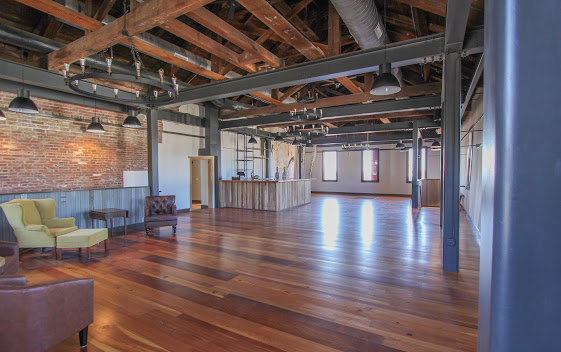
Upstairs area will feature event space and museum, note figures on back left wall (Courtesy Ethos Preservation)
The Savic family operates a nearby modern-day general store and restaurant in Darien, about 60 miles below Savannah. They also have operated businesses in Marietta, near Atlanta.

The preservation of the Strain building, which sits on the southeast corner of Broad and Screven streets, is just one piece – albeit a significant one – in plans to boost the small downtown district.

Darien, hit hard by the economic slowdown about 15 years ago, wants to attract more retirees who live along coastal Georgia and motorists who get off Interstate 95 to take in history, the small shrimping fleet and the natural beauty of the area.

Ben Sutton, director of preservation for the Georgia Trust, told the Picket the Strain Building is significant due to its age, size and method of construction.

“The Savics have been strong supporters of the Georgia Trust, so we are even more excited that the project has been done by such good friends. It is a fantastic example of reimagining a use for a historic building -- and just goes to show that a building is rarely too far gone to be brought back into useful service,” he said.

After many years, she feels good about Strain's future

I spoke this week by phone with Joe Kasper, a home builder and carpenter who showed me around during my 2023 visit to Darien. He did wood work at the Strain for Savannah contractor Landmark Preservation, and found the restoration to be challenging and rewarding.

About 75 percent of the wood – mostly Southern yellow pine – is original. Two sets of stairs he built had to be customized because of the age of the building. “Because the building is not level, I made it work with the building.” He said that was among the most enjoyable of his tasks. (Photo courtesy Joe Kasper)

And there were other challenges. “All the walls are bowed out, out of plumb and they just changed from foot to foot,” he said.

The crews made the Strain stable by building an interior steel frame, reinforcing the walls and using rods and stars to strengthen the structure. Crews paid as much attention to detail as possibly, including taking apart the main floor and reassembling it for a modern finish.

They were able to retain much of the original tabby but some eroded areas were reworked with new oyster shell and material, Kasper said.

Fenwick said historic material was salvaged whenever possible, including framing, flooring, ceiling boards, tabby, trusses and other details such as a mural painted on plaster and a hoist system on the second floor.

"Additionally, in order for the building's structural system to be successful, additional tie rods were installed, in keeping with those visible on the exterior at the start of the project. This is a great example of the addition of new elements designed to be harmonious with the historic building."

The rear of the Strain in 2020 (Landmark Preservation and post-restoration (Ethos Preservation)
Tabby House Brewing features a ground-floor brick patio in the back and a patio deck upstairs. Both command a view of the Darien River, which connects the city to the Atlantic Ocean and the world.

Wilson, former chairman of the McIntosh County Historic Preservation Commission, told me several years ago she used to pray over the building before the Savics stepped in.

“I hope it’s the economic engine the vast economic reports have predicted if it was restored,” she said recently. “I can honestly say for the first time since I’ve been a child in Darien, I can drive by the building and not hold my breath waiting for something bad to happen. It’s lovely seeing the people who said there was no hope to see hope happen.”  

Tabby House Brewing Company is at 111 Broad St. in Darien. Click here for hours and more.