Tuesday, January 18, 2022

Fire marshal investigates arson attack on Hazen Brigade Monument at Stones River National Battlefield in Tennessee

Monument was built in summer/fall 1863 (Library of Congress)
Arson investigators are asking the public for information that may help them determine who threw Molotov cocktails at the Hazen Brigade Monument – the oldest Civil War memorial still standing on its original battlefield location – at Stones River National Battlefield near Murfreesboro, Tenn.

The Rutherford County Fire Marshal’s Office said Monday the incident likely took place in mid-December, but went unreported due to the time of day of the incident and the relatively remote location of the monument.

The office said it was made aware of the incident by Florida investigators with a similar investigation in their jurisdiction. “We are hoping someone may have information that would be helpful to our ongoing criminal investigation,” Rutherford County Fire Marshal Joshua Sanders said in a news release. Officials provided no information on any findings thus far.

Stones River National Battlefield said on Facebook that it was aware of the incident and cooperating with the investigation. A staffer who answered the phone Tuesday morning said officials were gathering information and had no comment.

Historic photo shows grave markers near monument (NPS photo)
The cube-shaped limestone monument has inscriptions carved on each side. It stands in the brigade’s cemetery marking the unit’s location during the Battle of Stones River on Dec. 31, 1862. Col. William B. Hazen’s brigade played a central role during the Union victory and withstood four Confederate attacks, according to the National Park Service, and he was promoted to brigadier general.

“The brigade's determined resistance ended the advance of the Confederate Army of Tennessee and kept it from pushing the Union Army of the Cumberland back to Nashville,” the park says.

Construction of the monument by soldiers took place in 1863. It is nestled among the graves of 55 soldiers. A battlefield historic resource study detailed repairs of the monument in the mid-1980s and some interesting findings from an archaeologist. Park staffers found Confederate cannon balls, another shell, two rifle barrels and a cedar staff rested on the same level within the monument.

“(Archaeologist) John W. Walker identified the artillery shells as being of Confederate origin and suggested that the other items found in this cache were also representative of weapons used by Confederates attacking Hazen’s brigade during the crucial engagement in the area known as the Round Forest, where the monument is located. During this series of Confederate artillery and infantry assaults, even the trees surrounding the Union troops became dangerous projectiles as cannon balls and shells tore through them, dangerously raining sharp fragments of shattered branches upon the troops below.”

William B. Hazen
The National Park Service has a video describing Walker’s work on an online page about the monument. The video is narrated by Alissa Kane, a community volunteer ambassador.

Kane writes further about it on the Murfreesboro Monuments web site, saying the artifacts found in Hazen memorial were considered by Walker to be symbolic and served as a time capsule.

She said Walker could not determine the true meaning of the items.

The fire marshal’s news release has an email and phone number the public can use to provide any tips.

Monday, January 17, 2022

Building may house veterans, honor Black regiment in Civil War

A vacant building in Hartford, Conn., could become a museum honoring a famed Black Civil War regiment. Army veteran Bridgitte Prince is spearheading a project to raise $35 million to tell the story of the 29th Regiment Connecticut Infantry (Colored), the first Union soldiers to enter the defeated Confederate capital of Richmond near the war's end. The city-owned building was built in 1920 and once housed city offices, but has been vacant for a decade. Prince and her partners also want to convert it into subsidized housing for low-income veterans. -- Article

Wednesday, January 12, 2022

He teaches people about battlefield sites that are not recognizable. Georgia Historical Society honors Charlie Crawford for marker efforts

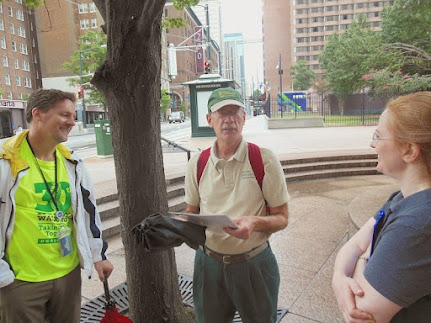
Crawford leads a 2014 tour of downtown Atlanta Civil War site (Picket photo)
Charlie Crawford believes that making people aware of historic sites – through roadside markers, site tours and presentations -- increases the likelihood that they will support preservation.

Crawford, president emeritus of the nonprofit Georgia Battlefields Association, is the recipient of the Georgia Historical Society’s 2021 John Macpherson Berrien Award for a lifetime of achievement in and service to the state’s history – particularly in support of the society’s Civil War markers.

“All of us at GBA are so pleased on his behalf,” organization secretary Mary-Elizabeth Ellard told the Picket in an email.”

Crawford, 72, served 24 years in the Air Force, including service in Vietnam, and worked nearly the same amount of time at an information technology and consultant company in Atlanta. History has been his lifelong and passionate avocation.
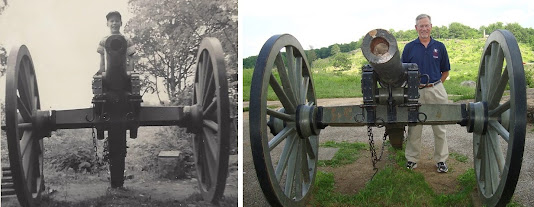
Charlie Crawford at Gettysburg in 1956 and in later years (Courtesy of GBA)
The bug bit him early while he grew up outside Philadelphia, visiting the Liberty Bell, Valley Forge and Gettysburg. And he got deeper into it during his service at the Pentagon, where he lived near Civil War sites in Virginia.

“Historical markers are important because so many battlefields and historic sites are no longer recognizable as such,” said the retired colonel. “Peachtree Creek [Atlanta] is a prime example. Tens of thousands of people traverse (on foot but mostly in vehicles) that battlefield every day, but they would never know they were on a battlefield except for the historical markers.”

“Further, historical markers will sometimes prompt anyone who notices them to find out more about the site,” he said, mentioning the society’s online database of thousands of markers.

The state of Georgia ran the Georgia historical marker program from the 1950s until the mid-1990s. The historical society began to erect new markers in 1998 and Crawford has been involved in researching several of them.

“A key player in the Civil War 150 Initiative, Charlie and the association helped fund 10 historical markers and advised on the overall project,” GHS market manager Elyse Butler wrote in an article about the award.
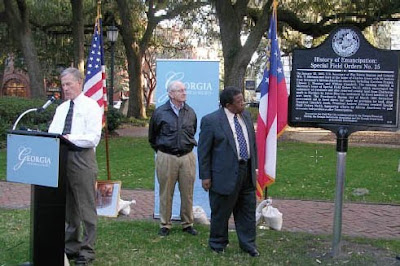
Crawford at a 2011 marker dedication  in Savannah.
“Since the end of the Civil War sesquicentennial, the friendship between GHS and Charlie has grown. Charlie's interest in preserving Georgia's Civil War battlefields to educate the public naturally lends itself to the Georgia Historical Marker Program,” Butler wrote. “The marker program provides an opportunity for place-based learning, and often, as Charlie says, ‘tells the stories to the uninitiated.’”

The GBA and volunteers have assisted the historical society by reporting missing or damaged markers and assisting in repairs. 

Crawford, a graduate of Georgia Tech, has given over 100 presentations and led over 50 tours relating to battlefield preservation and has been a member of the American Battlefield Trust and its predecessor organizations since 1991. The trust honored him in 2011 for preservation efforts. "Charlie Crawford is an indispensable source of information on all aspects of the preservation movement in the state," the trust said.

Since 2000, Crawford has been a member of the Atlanta Civil War Round Table and is the group’s trivia master. He served as GBA president for nearly two decades and still produces its monthly newsletter and is a trustee.
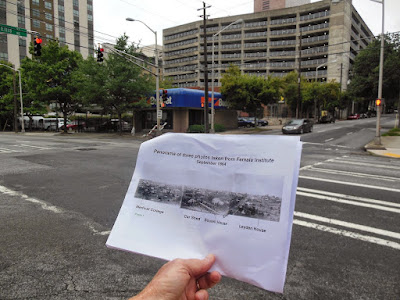
Crawford uses period photos to help in interpretation (Picket photo)
Regarding the status of battlefield preservation in Georgia, Crawford said Covid-19 has restricted GBA trustees from freely traveling to sites “and the dearth of in-person county commission meetings has dampened our ability to interact with local decision makers.  We have five projects in the hopper, so to speak, but our preservation efforts depend primarily on willing sellers. We don’t have eminent domain power and don’t advocate for the state government to use it.”

High selling prices can make efforts difficult.

“If I had to characterize the current state of preservation, generally, I’d have to say it was frustratingly stalled. On the other hand, a frustrating stall is a recurrent theme in preservation efforts. As long as a battlefield is not permanently lost to development, we remain hopeful and persistent.”  

Crawford leads downtown Atlanta tours for the Atlanta Preservation Center and he shows period photos to participants so that they can envision the sites. “On many tours, especially around Atlanta, people will tell me they had no idea they lived on a battlefield.”

Most of the GBA tours are attended by participants who have much more Civil War knowledge than the average citizen,” he told the Picket.

“We also have many repeat participants, who unsurprisingly are some of our most steadfast supporters, not only with memberships and donations but also with (communication) to state representatives and county commissioners and media reporters. We’re not making these folks aware of historical sites as much as providing depth and context to their existing knowledge, which they also spread by word of mouth.”

Friday, January 7, 2022

'I am willing to die': Kepi worn by Georgia officer who fell near Kennesaw Mountain undergoes preservation work, to be displayed

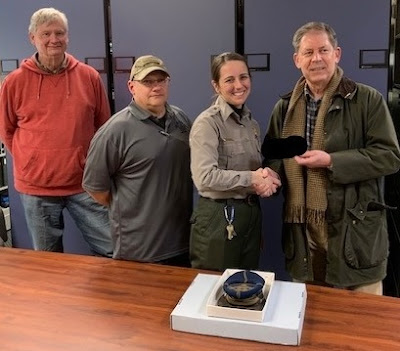
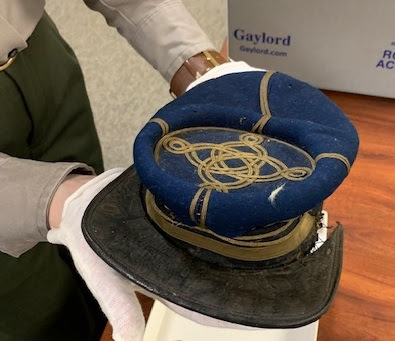
Capt. George T. Burch's kepi after extensive treatment (NPS photo)
A kepi worn by a Civil War officer who was mortally wounded while leading a charge in northwest Georgia has undergone conservation and preservation treatment and is back in the collection of Kennesaw Mountain National Battlefield Park, officials announced Friday.

The hat belonged to Capt. George Tilley Burch of Company I, 29th Georgia Infantry. In the years following his death in July 1864, the cap's interior -- from its leather and lining to delicate silk -- had deteriorated to the point of being a pile of fabric. Small holes perforated the woolen exterior and the stitching connecting the brim to cap was loose, allowing a partial separation.

Now it has received some TLC.

The artifact was sent a couple years back to the National Park Service’s Harpers Ferry Center. Museum Conservation Services worked to stabilize the material and make some repairs and corrections. 

(NPS photo)
In a Facebook post Friday, the park described a partial list of the work:

“The sweatband and cardboard internal backing band were both humidified and reshaped, tears in the cardboard internal band were repaired, the sweatband was reattached using an edged lining of toned spun bond polyester, other sections were re-stitched and re-stabilized, and the visor was reattached and re-stabilized using the original stitching holes.”

The park near Atlanta received an $8,000 donation from the Artist Preservation Group to have the item – considered to be in poor condition -- sent off.

“Due to the generous support of the Artist Preservation Group, Inc., this artifact will be able to continue to tell the story of this individual soldier for current and future generations,” the park said in Friday’s post, adding it plans to put it on display at some point.

Wear, damage in kepi's interior before conservation (NPS photo)
The kepi and a sash worn by Burch were donated to the park in 1978 by George Burch Fisher, his daughter Jenny Cummins of Seattle told the Picket. The Confederate soldier is her great-great uncle, Cummins said, and her father, brother and nephew were named for him.

The sash (below) has been on display at the Kennesaw museum, while the kepi had long awaited conservation.

(NPS photo of George T. Burch sash)
Burch’s headgear had been stored in a humidity-controlled environment, away from UV light, before it was sent away for work. Park ranger and curator Amanda Corman believes most of the damage and wear occurred before the donation.

She told the Picket in 2020 she felt it was a suitable candidate for conservation.

Cummins’ late brother, George Fisher Jr., a few years ago donated a portrait of the soldier to the park, Corman told the Picket in an email this week. “Unfortunately, due to a backlog the portrait has not been completely processed into the collection.”

Corman said the park eventually would like to display the kepi at its visitors center buts plans have not been firmed up. It’s possible it could be paired with a Confederate butternut kepi.

Amanda Corman, members of Artist Preservation Group, before hat sent off (NPS photo)
This kepi has a compelling story. Burch, 23, likely wore it during the Atlanta Campaign, which for him, ended in a charge on Union entrenchments at Pine Mountain near Kennesaw Mountain. He got within 30 feet of enemy lines before he was shot through both knees on June 15, 1864. He was taken to City Hall Hospital in Atlanta.

"He lingered four weeks, during which time his sufferings were frequently excruciating, but the Christian grace which sustained him on that bed of languishing far outshone his heroism on the battlefield," said this obituary, which noted the officer’s last words were, “I am willing to die, I am willing to die.” He passed away on July 13.

According to documents kept by the Gilder Lehrman Institute of American History, Burch was a graduate of central Georgia’s Mercer College – the class of 1861 had lost eight members in battle by summer 1864 -- joined the Confederate army in Savannah in August or September 1861 and fought in Mississippi and Georgia. He was elected captain in May 1862.

Another view of the kepi before treatment (NPS photo)
While a junior officer, Burch was in command of the 29th when it made its assault near Pine Mountain.

“In that fatal charge he was among the foremost and scorned to screen himself the hated foe, preferring rather to face them bravely in death, rather than cower and tremble before their approach,” the memoriam recounts. The 29th Infantry fought until war's end -- through the Atlanta Campaign, Hood's winter operations in Tennessee and at the Battle of Bentonville, N.C., in March 1865.

“In his disposition he was most affectionate, gentle in his manner, firm in action, incorrupt in principle, and pure in spirit," Burch's obituary reads. The officer is buried with family members in Newnan, about 40 miles southwest of Atlanta.

Like other family members, Cummins hails from Newnan, but she has lived in Seattle for decades. Her father told her the portrait of Burch at left may have been painted posthumously, perhaps from a photograph.

Cummins said she does not know what the star on the lapel represents. (Portrait courtesy of Jenny Cummins)

She was unaware of the work on the kepi until her daughter came across a February 2020 Civil War Picket article about it. Cummins said she in the past year has donated George T. Burch’s diary to a historical society in Newnan.

 “I am delighted they have done it and they are taking care of it,” she said of the kepi conservation and preservation effort.

29th Georgia marker at Chickamauga (Library of Congress)

Wednesday, January 5, 2022

H.L. Hunley: Knife, field glasses and other items belonging to submarine's commander are on display at conservation center

Field glass before and after conservation (Courtesy Friends of the Hunley)
The third and final skipper of the Confederate submarine H.L. Hunley was second to none when it came to stylishness. Capt. George E. Dixon wore a cashmere suit and brought along a gold coin and jewelry on the February 1864 voyage that made history.

Some of the other conserved items belonging to the dapper Dixon – such as a knife and binoculars -- have been on special display since Thanksgiving at the home of the Hunley -- the Warren Lasch Conservation Center in North Charleston, S.C.

“This is the first time (Dixon) artifacts other than the gold coin and jewelry have been displayed,” said Kellen Butler, executive director of the Friends of the Hunley, who support ongoing conservation efforts on the vessel and thousands of crew artifacts found inside. The coin and jewelry are in a separate case and have been displayed for many years.

“The reception has been very positive,” Butler told the Picket this week of the “War & Wardrobe” exhibit case. “Visitors are excited to see personal artifacts of a Hunley crew member.”

On Feb. 17, 1864, H.L. Hunley made history by becoming the first submarine to sink an enemy warship. The 40-foot iron vessel -- bullets pinging off its iron exterior -- planted a torpedo in the hull of the Union ship USS Housatonic in Charleston Harbor, setting off a charge that sent the Federal vessel and five crew members to the sandy bottom within minutes.

But Dixon and seven volunteers on the Hunley also perished. The Hunley was recovered in 2000 and the remains of the crew were buried in 2004.

Dixon carried this knife on mission (Courtesy Friends of the Hunley)
Dixon-associated items in the revolving exhibit are the field glasses, an antler and silver pocketknife, silver suspender buckles and loops, copper alloy suspender buttons, copper vest and trousers buckles, decorative buttons and metal alloy coat buttons likely fabric covered at the time.

“Like his gold watch’s fob and life-saving coin, he had (the suspenders) engraved with his initials. He was the only one of the eight-man crew who had any items engraved, perhaps indicating he was proud of his name and wanted to be remembered,” the Friends group says.

Dixon’s 4-inch wide field glasses are among items that underwent extensive conservation and must be checked often so that they do not degrade while on exhibit. “The exhibit case is constantly monitored for humidity and any changes,” said Butler.

Suspender loops were found by conservators (Courtesy Friends of the Hunley)
According to the Friends group, historical accounts say Dixon would lie on the beach and use the field glasses and use them to survey the Union blockade and select the best target.

“While commanding the submarine, he likely opened the forward hatch periodically to give the crew fresh air. Dixon no doubt took this opportunity to stick his head out and use the binoculars to help gain his bearings. The binoculars were partially disassembled for conservation, and the result is a beautiful example of the capabilities of conservation science.”

The conservation team may eventually add another display to include leather objects and other fragile pieces, the Post and Courier reported in November.

The $20 gold coin is the most famous Dixon item from the mission. Dixon carried the disfigured item, which absorbed a bullet during the Battle of Shiloh in 1862 and saved his leg. “My life Preserver” was engraved on one side of the coin.