Showing posts with label iron works. Show all posts

Thursday, December 19, 2019

In hindsight, this failed Confederate breech-loading gun may have been a bit ahead of its time (or improved technology)

Firing mechanism of Columbus breech loader (Picket photos)
The road to innovation is lined, shall we say, with disappointments.

A double-barreled cannon on outdoor display in Athens, Ga., is one such example. Its inventor hoped to convince the Confederate army that the two rounds, joined by a chain, would mow down infantry and cause chaos.

It did cause chaos. Test-fired in April 1862 in the early months of the Civil War, the gun turned out to be a flop. On one try, the chain holding the two rounds broke -- with one ball hitting a chimney and another killing a cow, according to observers. Another firing resulted in the rounds going off-center and plowing “up about an acre of ground, tore up a cornfield, mowed down saplings, and then the chain broke, the two balls going in different directions.”

About a year later and 140 miles to the southwest, innovators at the Columbus Iron Works on the banks of the Chattahoochee River were experimenting with another relative oddity at the time: breech-loading artillery.

Manufacturers in Europe were trying their hand with such technology, including production of the Whitworth, an English rifled gun that saw limited use during the Civil War. Benefits of such guns included protection for the crew by being behind the weapon, accuracy of fire and faster reloading. Southern breech-loading guns included the Williams and Hughes models.

Designers and craftsmen at the Columbus Iron Works, a large war materials, steam engine, iron cladding and artillery manufacturer for the South, decided to build and test a breech loader.

According to its history, the Columbus piece was designed by engineer and steamboat Capt. W.J. McAlister and Freeman C. Stewart, who worked for the iron works, which was then under command of the Rebel navy.

Prior to the war, some 200 steamboats traveled between Columbus south and the river’s exit in the Florida Panhandle, carrying cotton, crops and other items. Like other captains, McAlister lived near the riverfront and main wharf.

The barrel was fashioned from the wheel shaft of the steamer John C. Calhoun, which had its own misfortunate history. In 1860, its boilers exploded and the mail vessel caught fire, sinking near Ridleyville, Fla. At least one man died and others suffered horrible burns.

A 1978 article in the Columbus Ledger-Enquirer newspaper gave a brief description of how McAlister and Stewart fared in 1863.

The lathe work on the gun was done by Jacob G. Burrus. His sibling, George, paid a visit to the site, which was close to a naval yard.

"On a visit to my brother at the Columbus Iron Works, I found him engaged at the lathe turning the gun. When completed, it was tested three times, but the recoil broke the stirrup through which the breech screws passed for holding the breech plug in place.

"It was finally pronounced a failure. The federal raiders broke off a trunnion to prevent its further use. But it did service as a corner post at Springer's corner."

At this time in their development, breech loaders were fickle and presented some challenges.

An article in Wikipedia says: “The major problem to be solved with breech-loading artillery was obturation: the sealing of the breech after firing to ensure that none of the gases generated by the burning of the propellant (initially gunpowder) escaped rearwards through the breech. This was both a safety issue and one of gun performance – all the propellant gas was needed to accelerate the projectile along the barrel.

“The second problem was speed of operation – how to close the breech before firing and open it after firing as quickly as possible, consistent with safety.”

Eventually, designers came up with ways to create a safe seal and mechanisms that made the technology work. Along, the way they perfected what became forerunners of modern artillery. This Encyclopedia Brittanica article details how changes were made to improve breech-loading artillery, including increasing the strength of certain parts of the barrel to handle the pressure from firing of the weapon.

Today, the iron works gun sits outside the Columbus Museum on Wynnton Road. A sign affixed to its stand calls it “the first breech loading cannon.” It notes that Federal Wilson’s Raiders broke the trunnion when they took the city in April 1865.

(Picket photos)
The website for an auction house that sold a small replica outlined the concept: “This gun has a simplistic ingenious swiveling strap breech that allows easy access to bore for projectile and powder bag. Strap is then returned to position and screw is turned which closes breech, then friction primer is positioned through breech seal for firing.”

The Columbus Museum’s website says: “The breech-loading cannon is a testament to Columbus residents’ ingenuity and innovation in time of war.” It notes the North did not develop such a weapon, instead using a few imported Whitworths.

What became of the investors of the Columbus breech-loader? I have had no luck on McAlister, but Freeman died in February 1908 at age 77. He was superintendent of the Columbus Iron Works for 30 years after the war.

The W.C. Bradley Co. donated the cannon to the museum in 2016.

Thursday, September 19, 2019

Red Jacket: A reconstructed cannon, a colorful coat, a high school and a beer tell the story of the Columbus Guards, a Georgia militia unit

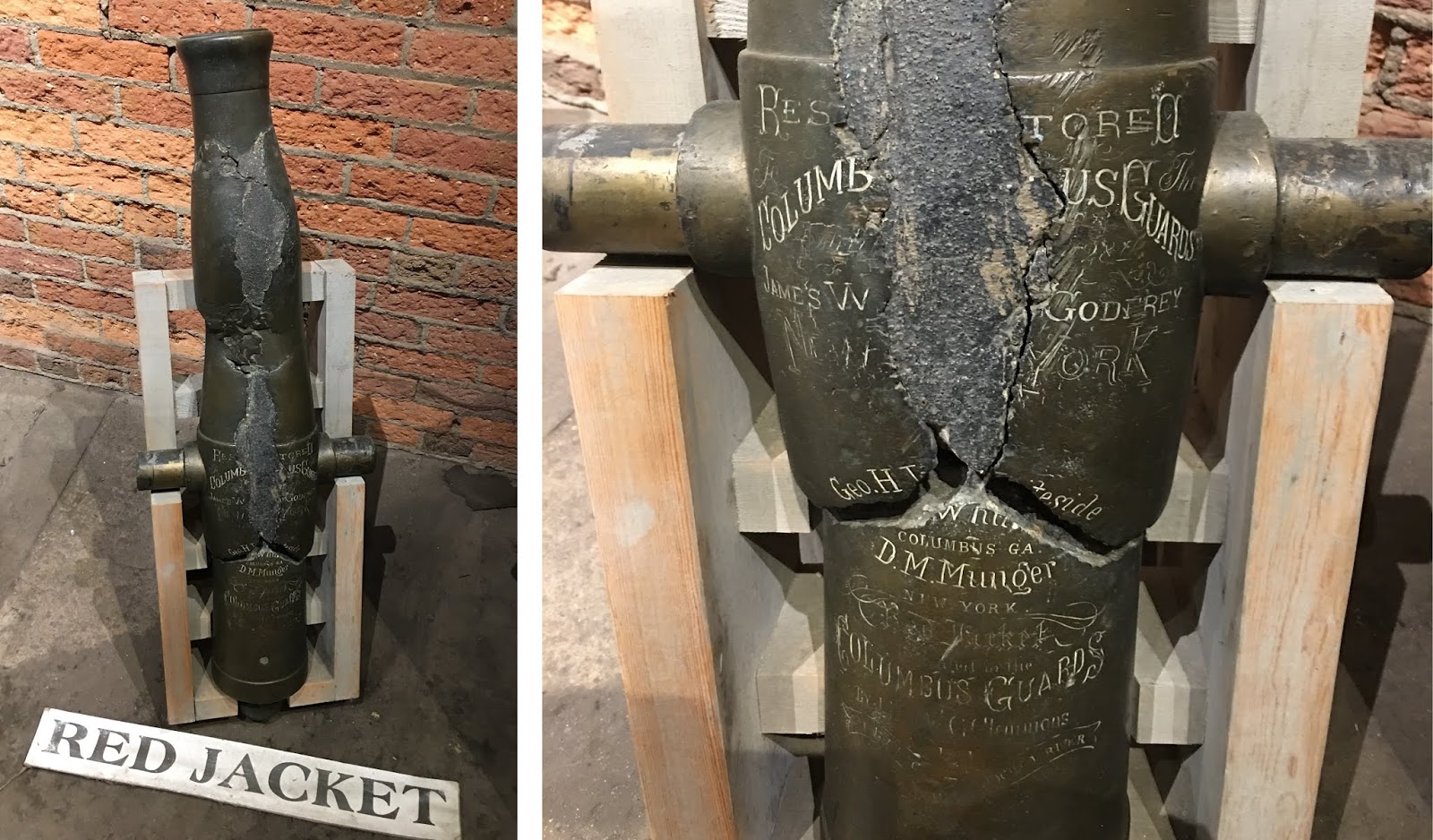
The Red Jacket cannon (Courtesy of Columbus Georgia Convention & Trade Center)
You have to look closely to spy it near the corner, but there it is – a small brass cannon propped between a pair of iron wheels and a Char-Broil barbecue grill topped with a spatula, tongs and fork.

Named for the bright red coat worn by members of a 19
th century militia unit that used the artillery piece to fire salutes, “Red Jacket” rests in a brick room at the Historic Iron Works, also known as the Columbus Georgia Convention & Trade Center. The room showcases items important to the city’s history and growth.

Courtesy of the Columbus Museum
What the visitor can’t fully make out is the fractured condition of Red Jacket, which belonged to the Columbus Guards and was fired during celebrations. In its early days, Red Jacket fired a salute when Georgia seceded from the Union and was hauled to Montgomery, Ala., for the February 1861 inauguration of Jefferson Davis as president of the Confederacy.

An historical marker not far from the Iron Works, which was a major manufacturing site for the South, summarizes the gun’s rather unique story:

“Red Jacket was purchased by Mrs. Laura Beecher Comer in 1861 and presented to the Columbus Guards. During the war period it was used to fire salutes to Confederate victories in the Army and Navy. When a Federal army approached Columbus in 1865, some members of the Columbus Guards, fearing the little gun would be captured, threw in into the Chattahoochee River near the city wharf. Four years later, it was accidentally drawn up on the fluke of an anchor. The finders sold it as junk and it was carried to New York City and bought by J. W. Godfrey, an armorer. A newspaper reporter saw Red Jacket and wrote a description of it in a New York paper. The clipping was sent to L.H. Chappell, then Captain of the Columbus Guards, in 1884. Correspondence ensued and Mr. Godfrey restored the gun to the Columbus Guards. In 1930 Red Jacket was stolen from its carriage on Upper Broad Street and conveyed to the river bank. When fired, it burst into many pieces. Alva C. Smith, secretary-treasurer of the Historical Society of Columbus, found all the pieces and had the gun mended and rebuilt.”

Whew.

Today, the Red Jacket name lives in several places in this west Georgia river city that borders Phenix City, Ala. There are the Jordan Vocational High School Red Jackets, a replica cannon and Red Jacket beer at a brew pub not far from the Iron Works, and the sole surviving example of the Red Jacket coat itself, on rotating display at the Columbus Museum.

City provided much to Confederacy, fell at war's end

The Columbus Guards, local histories say, provided more men for Confederate service than any other local militia unit and its members took part in more than 30 battles with the Army of Northern Virginia.

One of the giant halls at the Iron Works in Columbus (Picket photo)
Apart from that, Columbus was an important manufacturing site for the Confederacy, second only to Richmond, Va.. Factories and shops produced cannon, engines, guns, swords, textiles and more. The Confederate navy had a shipyard just below the Iron Works. The ironclad CSS Jackson (Muscogee) was built and tested on the Chattahoochee River, only to be burned by Union forces after they took the city.

Columbus fell in April 1865 in what is believed to be the last battle in the Federal campaign through Alabama and Georgia.

Today, the rebuilt Iron Works, the Columbus Museum and the National Civil War Naval Museum on Victory Drive are the principal reminders of the Civil War.

Replica of the Red Jacket and beer bearing its name (Picket photo)
Cannon Brew Pub, one of many restaurant and retails establishments on Broadway in downtown Columbus, sports a replica of the Red Jacket cannon out front.

The restaurant (above), which opened in the mid-1990s, serves several brews, including Red Jacket Ale, which features “the rich taste of extra malt and hops.”

You can sample that along with the Red Jacket Monte Cristo sandwich. The cannon is fired for the start of road races and other special events, managers say. The business has numerous other artifacts and references to the Civil War.

Jacket makes a statement: 'It's quite striking'

Photos Courtesy of the Columbus Museum
A few miles inland along Wynnton Road, at the Columbus Museum, is the only known surviving jacket from the militia unit. Made from wool and featuring a cotton lining, the garment was worn by Watkins Banks, one of seven local brothers who fought for the Confederacy and one of three to die.

The Columbus Guards formed in 1835 and served in several conflicts, most notably the Civil War. It was considered among the best-drilled militia units in the South and was an integral part of upper-class society.

The museum’s website says this: “Banks wore this jacket at Davis’ inauguration in Montgomery, Alabama, and also during the Guards’ departure from Columbus to join the Confederate army.

Banks identified his jacket by writing ‘Wat. Banks’ and ‘1861’ on the coat’s interior lining, notations which are still clearly visible.

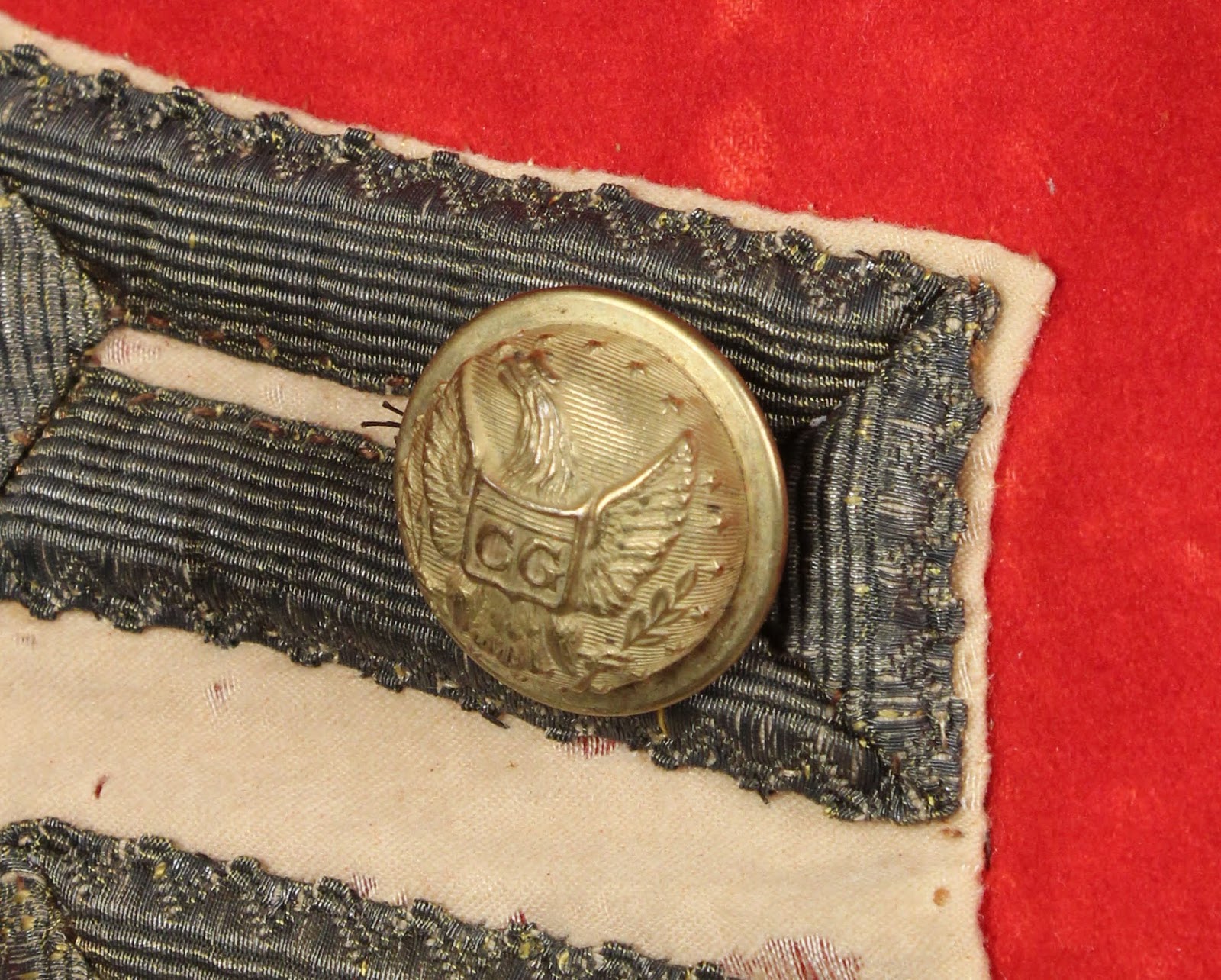
Six original buttons remain, the rest were likely cut as mementos for the family after he was killed near Atlanta in 1864. New buttons were cast. The buttons bear the initials “CG” and an eagle.

Button from Watkins Banks' jacket
The garment is featured in an exhibit about this Chattahoochee Valley city’s history.

“It’s quite striking in the gallery, where it rotates with Confederate Col. Peyton Colquitt’s gray coat,” said Rebecca Bush, curator of history and exhibitions manager at the museum.

“Inevitably, some people are happy to see whichever jacket is currently on view, while others are disappointed that the other jacket is resting to give it a break from potential light damage,” she said. “In a way, it’s a nice problem for the museum to have.”

According to one history, Banks and about 135 others joined Company G of the 2nd Georgia Volunteer Infantry when the war broke out. The unit wore the jacket for a few months before receiving their new issue of gray. The regiment, which served in Lee’s Army of Northern Virginia, had its most famous moment at Antietam, where it held the heights above Burnside’s Bridge with the 20th Georgia.

Banks’ great-great-great nephew, John Sheftall, who lives in the old family home in Columbus, says Banks fought in Virginia, returned home and at some point joined Nelson’s Rangers with a brother. He was the son of John and Sarah Banks, who lived with their large family in a home called The Cedars in the Wynnton area.

Watkins Banks (left) and cousin Willis Butt (Courtesy of Columbus Museum/John M. Sheftall)
In 1863, Watkins Banks paid for a substitute, lived in Columbus and then returned to service during the Atlanta Campaign. The private was killed in August 1864 outside Atlanta. The bachelor’s obituary states the 31-year-old was then serving with Georgia State Troops, Sheftall told the Picket.

These Red Jackets try to sting sports foes

The town’s Civil War history also is represented at another site a few miles from downtown.

During the 1940s and 1950s, Jordan Vocational High School, a fixture in a middle-class Columbus neighborhood, displayed two cannon that came from the CSS Jackson.

They were moved to the old Confederate Naval Museum in the 1960s, said Jeffrey Seymour, director of history and collections at the National Civil War Naval Museum on Victory Drive.

Courtesy of the National Civil War Naval Museum
“These are the two VII in. Brooke Rifles that we have,” he said. “One of these is the one that we fire (above). The other is sitting out in front of the building. Both were recovered from the river.”

“There is a belief held by many Jordan people that the Red Jacket was named for the iron guns overheating. Not sure where that story came from,” said Seymour, adding that the small gun was associated with the Columbus Guards, not the Confederate navy.

Jordan HS has used the Red Jackets name and logo for years (Picket photos)

A page on the school’s website says Red Jacket was placed outside of the old city library and the Muscogee County Courthouse, where it remained many years before the 1930 caper. Another Civil War weapon, a brass cannon made in Columbus and dubbed the Ladies Defender, also was placed at the courthouse after the war. Today, the Ladies Defender is in the same room as the Iron Works as Red Jacket.

Jordan’s sports teams, along with the marching band, still feature the Red Jackets name and wear maroon and white uniforms. The school’s alma mater appears to capture the spirit of the little cannon and the Columbus Guards.

With the Carmine and
the Grey afloating,
On high JVHS.
Your name and fame we’re shouting
As we cheer you to success.
As you march unfaltering forward,,
your future great we hail.
May your glory never lessen
And your courage never fail.

Courtesy of Columbus Georgia Convention & Trade Center)

Tuesday, March 5, 2019

This ironclad's fantail is an example of pure craftsmanship. The National Civil War Naval Museum wants to conserve it and the engines of another Confederate vessel

Inverted fantail of the CSS Jackson (Picket photos)
A Georgia museum is raising money to conserve the precisely built curved rear deck, or fantail, of the Confederate ironclad CSS Jackson. The section of armor and wood, which protected the vessel’s propellers and rudder, is a remarkable example of design and construction prowess.

The National Civil War Naval Museum has received the offer of a grant that will match up to $250,000 in contributions, said Jeff Seymour, director of history and collections.

Officials would like to conserve the fantail and build a replica to place near the remains of the giant hull. They also want to conserve the engines of the Rebel gunboat CSS Chattahoochee, the museum’s other star attraction.

Both ships were lost in April 1865 at war’s end -- the Jackson set afire by Federal captors and the Chattahoochee scuttled by its own crew. Neither vessel fired upon the enemy in their relatively short history.

CSS Chattahoochee engines (Picket photo)
The fantail and the Chattahoochee engine components are in an open pole barn outside the museum, where they have long been exposed to the elements and are slowly deteriorating. (Officials last year told the Ledger-Enquirer newspaper they didn’t have the money to bring them inside. The hulls of the two ships have been in the main building for nearly 20 years.)

Seymour calls the fantail “a very unique piece of naval architecture” that’s believed to be the only Civil War example currently out of the water. Because the rear deck was curved, builders had to customize the length of the armor and timber.

“All of these pieces are cut into a pie shape to make it fit,” he said.

The remnants of the Jackson’s fantail are inverted. It’s fascinating to study up close how it was put together. Near it is a long row of the ironclad’s armor and other pieces of the two ships.

Bob Holcombe, a naval historian and former director of the museum, says besides the CSS Georgia in Savannah, it may be the only piece of wood from a Confederate ironclad with iron plating still attached.

Jeff Seymour shows area where fantail was built
While some fantails were pointed and straight across, this one needed to be round. “It is so complex to build, particularly the iron plating,” Holcombe said.

The Picket spoke recently with Seymour and Holcombe about the rare artifacts and the history of the vessels.

CSS JACKSON: Locally built

Museum visitors can gaze at the hull of the flat-bottom ironclad from a viewing platform and on the floor. A section is missing, but you get a true sense of the vessel’s enormity – it was about 222 long and 57 feet across. Above the hull is ghosting framework intended to show how the warship appeared above the water line. The rudder is missing.

I discerned smoke on the day I visited. Was that the result of burned longleaf pine and more than 150 years of aging? “We cannot chemically explain it,” said Seymour. “Every once in a while you get a rich pungent river odor.”

Picket photos show stern and ghost framing above hull
The Jackson (originally named the Muscogee) was designed to protect Columbus – a critically important industrial center for the Confederacy -- from Union navy marauders and blockaders. Neither ship was intended to leave the shallow river system that continues south to Florida and Apalachicola Bay. Construction on the Jackson began in early 1863.

While some infantry generals thought the South put too much time, money and material into ironclads – or “ram fever” – they became a high priority. “The fact that Confederates had ironclads was a force in being that you have to deal with them,” said Holcombe.  “It is symbolic of what was largely an agrarian country in shifting their meager industrial resources… to build what was a pretty modern navy.”

CSS Muscogee, later dubbed Jackson (Wikipedia)
The CSS Jackson was built entirely in Columbus, on the Chattahoochee River and just below the Iron Works. The original design based on the CSS Missouri called for a central paddle wheel, but the Confederate navy determined that would not generate enough power, so it shortened the casemate, lengthened the hull and installed twin propellers. The vessel had an iron ram on the bow and an 8-foot draft.

The Jackson’s casemate had a 35-degree slope and featured nearly two feet of wood and two layers of plating, mostly manufactured at the Scofield and Markham mill in Atlanta.

The Jackson, armed with six Brooke rifles (two of which rest outside the museum), was finally launched -- after earlier unsuccessful attempts -- on Dec. 22, 1864, to local fanfare. 

“This splendid ram was successfully launched yesterday at about 11 o’clock and now sits as calmly upon the Chattahoochee as a duck upon a pond,” the Columbus Daily Enquirer reported. Eventually, the Jackson was meant to have a crew of about 200.

Sections of CSS Jackson armor (Picket)
The two engines and four boilers – manufactured in Columbus – were not operational when the city fell, and there’s a question about how well they would have performed, anyway. At best, the Jackson would have done about 5 knots, said Seymour. The ship still needed armor and was unfinished when the Federal cavalry arrived on April 16, 1865.

“The following day the nearly completed ship was set ablaze and cut loose by her captors,” a panel at the naval museum says. “After drifting downstream some 30 miles, the Jackson ground on a sandbar and burned to the waterline.”

Holcombe said the wreckage apparently smoldered for weeks.

There were some salvage and recovery attempts in the early 20th century. The engines and boiler (which no longer survive) were pulled out before World War I along with some guns.

The push for the recovery of the two ships came during increased interest going into the Civil War centennial. The wreck was found in 1960 and a variety of funding sources paid for the 1962-1963 recovery.

Seymour shows area where fantail would have been built
Crews needed to break the hull in two for the trip upriver. They used dynamite -- that’s why the CSS Jackson is missing 10 to 12 feet in the center.

“There was a massive groan when I showed a photograph of the explosion to archaeologists,” Holcombe said.

CSS CHATTAHOOCHEE: Bottled up

If the Jackson was jinxed, the Chattahoochee had a true hard-luck story, according to the museum.

The Chattahoochee was a sail and steam gunboat, said Seymour, and was constructed on the Chattahoochee River in Saffold, Ga., about 10 miles north of the Florida border. Its engines were manufactured in Columbus “without most of these guys having laid their eyes on the ship itself,” said Seymour.

After numerous construction delays, the three-mast ship – 140 feet long and featuring six guns -- was commissioned on Jan. 1, 1863. While the Confederate navy intended the Chattahoochee for river and coastal defense, “everyone in command wants to get battle and win glory for themselves,” according to Holcombe.

Some of the crew had served on the CSS Virginia (Merrimac), which famously tangled with the USS Monitor in early 1862.

The vessel was plagued by engine and other problems from the very beginning. It became apparent because of a new Confederate strategy and obstructions in the Apalachicola River, the gunboat would not be able to do any raiding in the Gulf of Mexico.

The stern of the CSS Chattahoochee (Picket photo)

The Chattahoochee’s only attempt to engage the enemy, with the aim of recapturing a blockade runner, ended in disaster on May 24, 1863, near Blountstown, Fla., as a storm approached. The boiler exploded as it was raising steam and about 18 men succumbed immediately or died from hideous scalding injuries. (Some histories say there was an argument of how much water to put into the boiler and the pipes burst when the water hit the red-hot iron)

“Thus ends this fated and useless craft,” skipper George Gift wrote.

Seymour explains the working of the gunboat engines (Picket)

The ship sank and was not raised for several months. It was towed to Columbus, where it was repaired and recommissioned in mid-1864, but the machinery was not operable and it often ran aground. Its crew made a separate failed raid using small boats on a Federal ship off Apalachicola, Fla.

The CSS Chattahoochee returned from Eufaula, Ala., to Columbus for repairs and the replacement of the boiler with one from the CSS Raleigh. But the work was not a priority, as builders were trying to finish the CSS Jackson. “She was pretty much an obsolete ship by that time,” Holcombe said of the wooden gunboat.

Model of CSS Chattahoochee at museum (Picket photo)
As Federal cavalry entered the city, its crew towed the CSS Chattahoochee 12 miles below the city.

“They probably saw the hulk of the Jackson float by. They set her afire and cut intake pipes and she sank downriver,” said Holcombe.

The remains lie on the river bottom until the early 1960s, when volunteers, governments and the U.S. Army Corps of Engineers tried to recover them. Cables were placed under the hull, but a 30-foot stern section broke free; that’s the part that was taken to Columbus. The forward two-thirds of the gunboat remain in the river. The bow is gone, but there are some places where 8 feet or more of the hull are intact.

The original engines were recovered. They were built to provide basic screw propulsion for the two screws. The gunboat could make about 12 knots during the short time it had a working boiler.

Stern is prepared for recovery (Photos courtesy Bob Holcombe)
A jumble of machinery inside the recovered hull 
“They are the only Confederate-made naval steam engines on display, even if they are in the shed,” said Holcombe.

The recovery yielded other artifacts and many are on display today alongside the Chattahoochee or in exhibit cases. Seymour would like to “reverse engineer” the engines to better understand how the propulsion system worked and put them on display inside.

A monument to those killed in the 1863 explosion can be seen in Chattahoochee, Fla., where memorial events are held annually.

As for the big picture

The museum has begun raising $250,000 to match the grant from the unnamed source. Seymour would like to exceed that, for a total of $750,000. Although the museum has brought in some funds, it has only begun a very challenging fund-raising journey.

Seymour and other museum officials would like to eventually see a redo of the CSS Jackson exhibit – with better lighting, 3D pop-outs, interactive kiosks and a revamped mural, among other efforts.

All of this would better engage visitors about the histories and salvage of the ships and the importance of Columbus as a Southern manufacturing center.

“We want to improve the story,” said Seymour.