Showing posts with label Columbus Guards. Show all posts

Friday, October 16, 2026

Watkins Banks wore this red jacket while in a Georgia militia unit. The excitement of impending war faded to gray, and he was one of three brothers killed in battle

Georgia Pvt. Watkins Banks' red jacket, his name written on interior lining (Courtesy Columbus Museum) and an ambrotype of him, at left, with first cousin Willis Butt, who also served (Courtesy John Sheftall)
Dashing young men from high society filled the ranks of volunteer militia companies across the South in the decades leading to the Civil War. They dressed smartly in stylish uniforms, rubbed elbows at social events and trained for whatever military purpose they could fulfill for their states.

The Columbus Guards in the west Georgia city by that name were considered among the best-drilled in the region. They formed in 1835 and provided more men for Confederate service than any other militia unit in the city. Its members participated in more than 30 battles as part of the Army of Northern Virginia. 

A Columbus Guards ”Red Jacket” worn by Watkins Banks at the beginning of the war is the only such jacket known to still exist. I admit to never tiring of gazing at it whenever I stop by the Columbus Museum on Wynnton Road, not far from where Banks grew up.

The bright red jacket features insignia, brass buttons and, as I noticed last week, small faux epaulets.

Banks was one of seven brothers who fought for the Confederacy and one of three to die, within months of each other, in 1864. 

There were no signs of the coming sacrifice when the Columbus Guards – who fired a small brass cannon for salutes -- traveled to Montgomery, Ala., in February 1861 for the inauguration of Confederate President Jefferson Davis.

Banks wore this jacket in Montgomery and during the Guards’ departure from Columbus to join the Confederate army.

“It’s quite striking in the gallery, where it rotates with Confederate Col. Peyton Colquitt’s gray coat,” Rebecca Bush, curator of history and exhibitions manager at the museum, told me several years ago.

Banks identified his jacket by writing ‘Wat. Banks’ and ‘1861’ on the coat’s interior lining, notations which are still clearly visible.

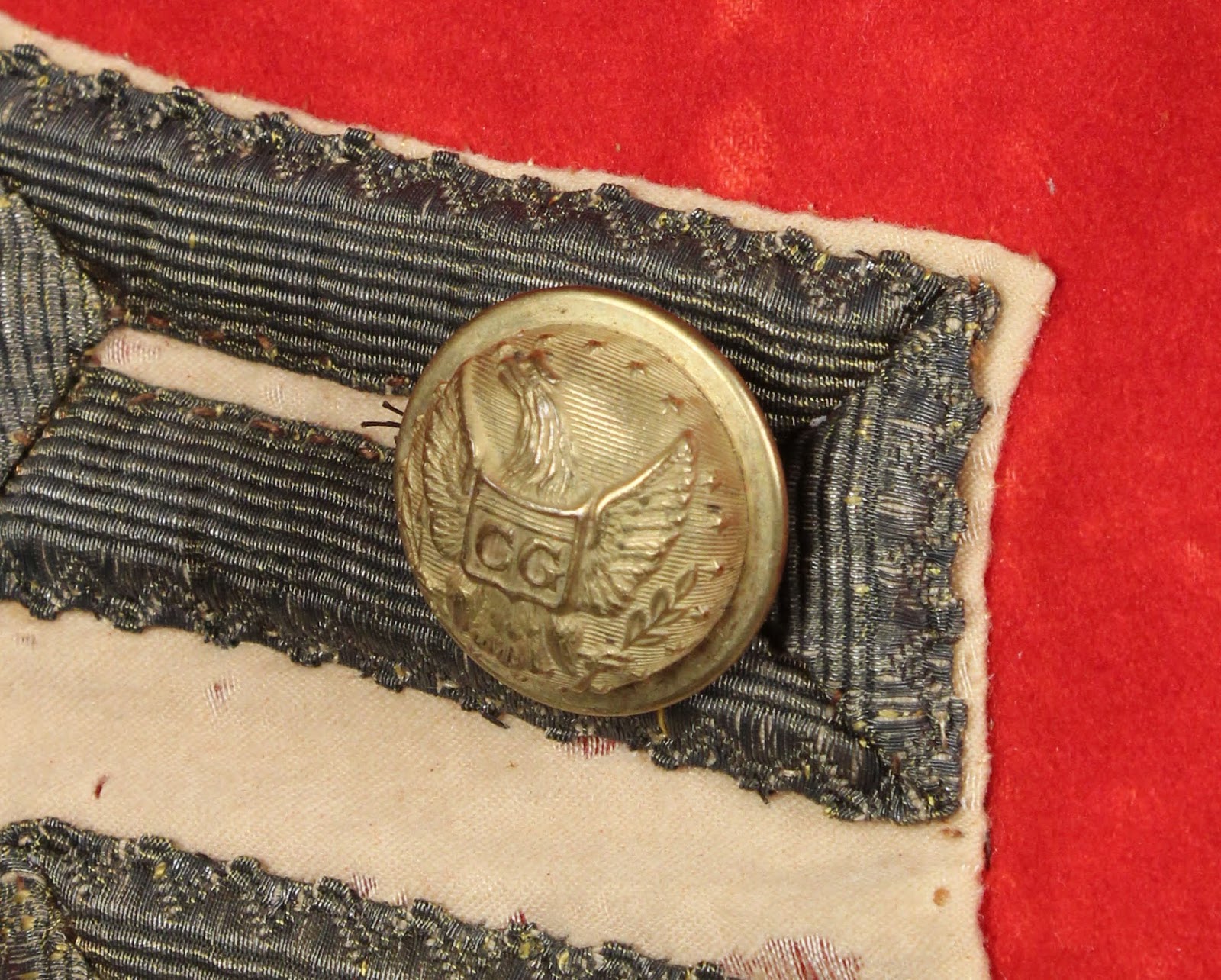
Six original buttons remain, the rest were likely cut as mementos for the family after he was killed near Atlanta in 1864. New buttons were cast. They bear the initials “CG” and an eagle.

The buttons have drawn scholarly interest, as they have never been identified on any other militia or federal uniform, despite extensive research, according to the museum.

Bush told me this week the Banks jacket has been on view since late May and will remain out for about a year.

“Most of the jacket is made of Melton cloth (or Melton wool) with white cotton lining and, of course, the brass buttons,” she said in an email. “We do not have one known maker for the jackets. In December 1861, a notice appeared in the local newspapers that ‘the goods for the uniforms’ of the Guards had arrived at the store of Ellis & Livingston, with instructions that family members should pick up ‘the goods, have the suits made and returned for packing.’ I suppose it’s possible that a similar home manufacture model was used before the war as well.”

Watkins paid a substitue, but returned to service

John and Sarah Banks, both from Elbert County, Ga., came to Columbus in the 1830s. They built The Cedars in 1836.

John Banks was a successful businessman and lawyer who owned plantations in Georgia and Alabama and about 200 enslaved people.

Photo of The Cedars in Columbus by David Seibert, HMdb.org
Columbus attorney John Sheftall, who lives in the Banks family home called The Cedars, said the couple had nine sons and three daughters. One of them, Josephine, is his great-great grandmother. (Watkins Banks is his great-great-great uncle.) Sheftall said his children are the eighth generation to live at the stately home.

Only two of the Banks boys did not serve with the Confederacy (all nine are buried in the Banks family lot at Linwood Cemetery in Columbus.)

According to one history, Watkins Banks and about 135 others joined Company G of the 2nd Georgia Volunteer Infantry when the war broke out. The unit wore the red jacket for a few months before receiving their new issue of gray. The regiment, which served in Lee’s Army of Northern Virginia, had its most famous moment at Antietam, where it held the heights above Burnside’s Bridge with the 20th Georgia.

Sheftall said Banks fought in Virginia, returned home and at some point joined Nelson’s Rangers with a brother.

In 1863, the bachelor paid for a substitute, lived in Columbus and then returned to service during the Atlanta Campaign. The private was killed during a skirmish on Aug. 11, 1864, outside Atlanta. He was 31.

An obituary in the Columbus Sun newspaper (right) said Watkins had a “lofty sense of honor.”

“A brother, Lt. Eugene Banks, as noble hearted a young man as ever lived, was killed in May, at Resaca, another Capt. Willis Banks, fell at Atlanta the latter part of July – three brothers killed in three months – and all young men of the finest mould. Is it not folly to speak of reconstruction or affiliation with a hated foe who thus daily is robbing the South of her noblest sons?”

Eugene and Willis Banks – also unmarried -- served with the 39th Alabama Infantry.

A funeral for the three siblings was held Aug. 14, 1864, at St. Luke Methodist Church in Columbus.

After the Battle of Columbus in April 1865, which saw the city fall to Union forces, a potion of occupying troops camped for a few days east of The Cedars, Sheftall wrote in an email this week.

"There was one particular marauding party of soldiers who came to the house, took away lots of supplies, food, and livestock, ransacked things inside to some extent, stole some silver, and insulted John Banks, who was by that time partially paralyzed and sitting on the front porch while all of this was going on.

"(None of the sons were there, four already being dead, only John and Sarah and their three daughters, plus the slaves.) When one soldier insulted John Banks and knocked his hat off, daughter Lucy blessed them out and they left.  Subsequently, her mother, Sarah Watkins Banks, paid a call on the commanding officer at the nearby camp, and he agreed to post a guard at The Cedars, which resolved things until the Union forces left and moved east toward Macon."

The end of the war brought an end to slavery and that was keenly felt by John Banks, who wrote about his losses in an autobiography. (HMdb.org photo, left; click to enlarge)

Sheftall said about 27 enslaved people had been at The Cedars. Others worked at a plantation south of Columbus on the Chattahoochee River and at three locations in Russell and Macon counties in Alabama.

Some of the formerly enslaved stayed on with the family as laborers.

Family papers are at the University of Georgia

The Columbus Museum acquired the red jacket from Sheftall through a partial gift and purchase in 2012.

The letters CG are part of the brass buttons on the Watkins Banks' jacket (Courtesy Columbus Museum)
“After acquisition, the Museum sent the jacket to the Williamstown Art Conservation Center in Massachusetts for stabilization and restoration. This process included the insertion of a red cotton interlayer to disguise losses in the original red wool, as well as the casting of replacement buttons,” says a page about the garment.

The University of Georgia Libraries has a John Banks papers collection, including his autobiography, at the Hargrett Rare Book and Manuscript Library in Athens, Ga. The collection includes letters from Watkins during the Civil War.

Sheftall has an ambrotype (top of this post) showing Watkins Banks on the left with his first cousin, Willis Banks Butt.

“He was the son of Moses Butt and Priscilla Banks, sister to John Banks, said Sheftall. “Willis survived the Civil War, married Julia Treutlen of Eufaula, and settled there.They both lived a reasonably long life but had no children.”

Willis Butt died in 1899 at age 59.

Thursday, September 19, 2019

Red Jacket: A reconstructed cannon, a colorful coat, a high school and a beer tell the story of the Columbus Guards, a Georgia militia unit

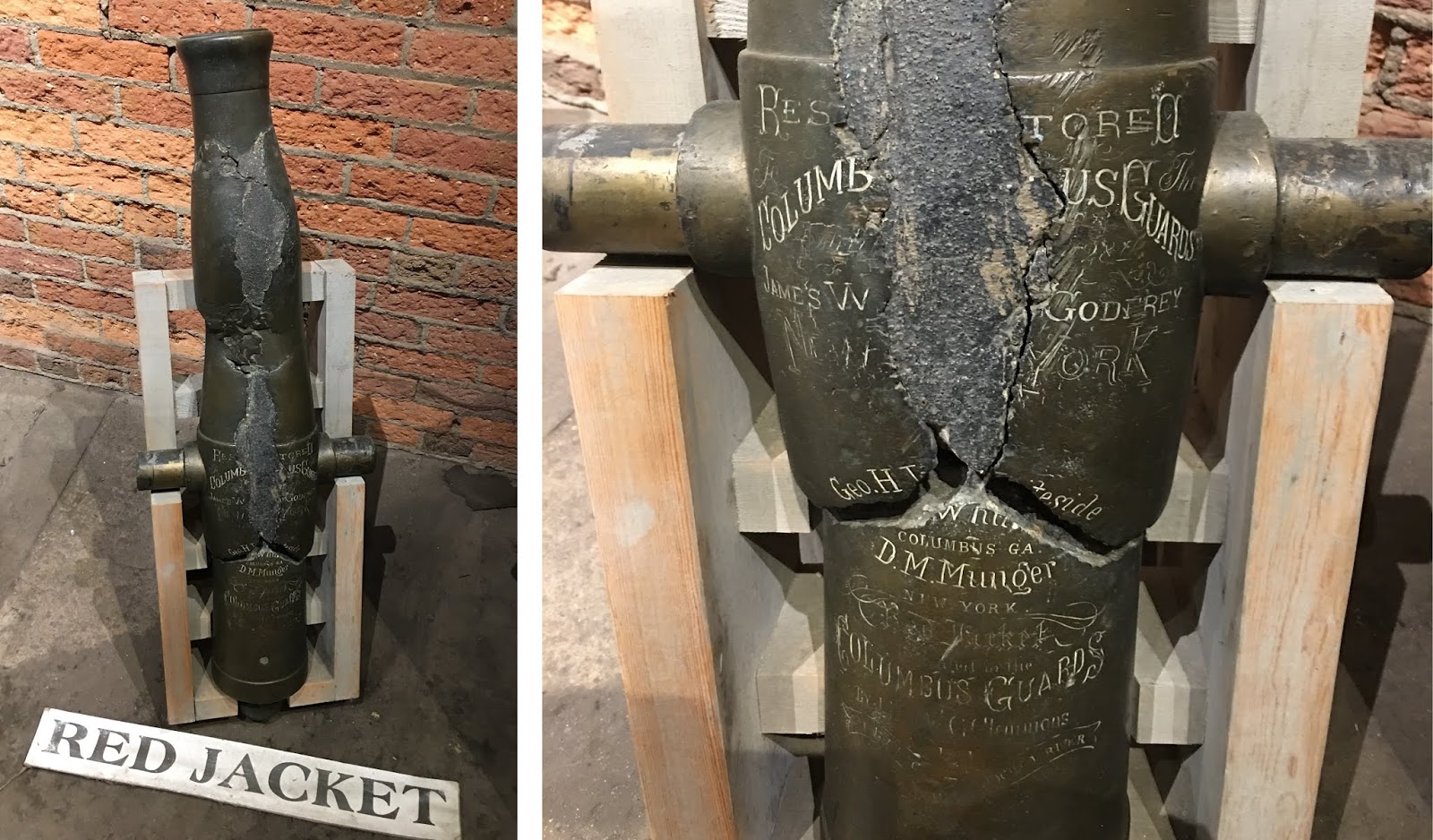
The Red Jacket cannon (Courtesy of Columbus Georgia Convention & Trade Center)
You have to look closely to spy it near the corner, but there it is – a small brass cannon propped between a pair of iron wheels and a Char-Broil barbecue grill topped with a spatula, tongs and fork.

Named for the bright red coat worn by members of a 19
th century militia unit that used the artillery piece to fire salutes, “Red Jacket” rests in a brick room at the Historic Iron Works, also known as the Columbus Georgia Convention & Trade Center. The room showcases items important to the city’s history and growth.

Courtesy of the Columbus Museum
What the visitor can’t fully make out is the fractured condition of Red Jacket, which belonged to the Columbus Guards and was fired during celebrations. In its early days, Red Jacket fired a salute when Georgia seceded from the Union and was hauled to Montgomery, Ala., for the February 1861 inauguration of Jefferson Davis as president of the Confederacy.

An historical marker not far from the Iron Works, which was a major manufacturing site for the South, summarizes the gun’s rather unique story:

“Red Jacket was purchased by Mrs. Laura Beecher Comer in 1861 and presented to the Columbus Guards. During the war period it was used to fire salutes to Confederate victories in the Army and Navy. When a Federal army approached Columbus in 1865, some members of the Columbus Guards, fearing the little gun would be captured, threw in into the Chattahoochee River near the city wharf. Four years later, it was accidentally drawn up on the fluke of an anchor. The finders sold it as junk and it was carried to New York City and bought by J. W. Godfrey, an armorer. A newspaper reporter saw Red Jacket and wrote a description of it in a New York paper. The clipping was sent to L.H. Chappell, then Captain of the Columbus Guards, in 1884. Correspondence ensued and Mr. Godfrey restored the gun to the Columbus Guards. In 1930 Red Jacket was stolen from its carriage on Upper Broad Street and conveyed to the river bank. When fired, it burst into many pieces. Alva C. Smith, secretary-treasurer of the Historical Society of Columbus, found all the pieces and had the gun mended and rebuilt.”

Whew.

Today, the Red Jacket name lives in several places in this west Georgia river city that borders Phenix City, Ala. There are the Jordan Vocational High School Red Jackets, a replica cannon and Red Jacket beer at a brew pub not far from the Iron Works, and the sole surviving example of the Red Jacket coat itself, on rotating display at the Columbus Museum.

City provided much to Confederacy, fell at war's end

The Columbus Guards, local histories say, provided more men for Confederate service than any other local militia unit and its members took part in more than 30 battles with the Army of Northern Virginia.

One of the giant halls at the Iron Works in Columbus (Picket photo)
Apart from that, Columbus was an important manufacturing site for the Confederacy, second only to Richmond, Va.. Factories and shops produced cannon, engines, guns, swords, textiles and more. The Confederate navy had a shipyard just below the Iron Works. The ironclad CSS Jackson (Muscogee) was built and tested on the Chattahoochee River, only to be burned by Union forces after they took the city.

Columbus fell in April 1865 in what is believed to be the last battle in the Federal campaign through Alabama and Georgia.

Today, the rebuilt Iron Works, the Columbus Museum and the National Civil War Naval Museum on Victory Drive are the principal reminders of the Civil War.

Replica of the Red Jacket and beer bearing its name (Picket photo)
Cannon Brew Pub, one of many restaurant and retails establishments on Broadway in downtown Columbus, sports a replica of the Red Jacket cannon out front.

The restaurant (above), which opened in the mid-1990s, serves several brews, including Red Jacket Ale, which features “the rich taste of extra malt and hops.”

You can sample that along with the Red Jacket Monte Cristo sandwich. The cannon is fired for the start of road races and other special events, managers say. The business has numerous other artifacts and references to the Civil War.

Jacket makes a statement: 'It's quite striking'

Photos Courtesy of the Columbus Museum
A few miles inland along Wynnton Road, at the Columbus Museum, is the only known surviving jacket from the militia unit. Made from wool and featuring a cotton lining, the garment was worn by Watkins Banks, one of seven local brothers who fought for the Confederacy and one of three to die.

The Columbus Guards formed in 1835 and served in several conflicts, most notably the Civil War. It was considered among the best-drilled militia units in the South and was an integral part of upper-class society.

The museum’s website says this: “Banks wore this jacket at Davis’ inauguration in Montgomery, Alabama, and also during the Guards’ departure from Columbus to join the Confederate army.

Banks identified his jacket by writing ‘Wat. Banks’ and ‘1861’ on the coat’s interior lining, notations which are still clearly visible.

Six original buttons remain, the rest were likely cut as mementos for the family after he was killed near Atlanta in 1864. New buttons were cast. The buttons bear the initials “CG” and an eagle.

Button from Watkins Banks' jacket
The garment is featured in an exhibit about this Chattahoochee Valley city’s history.

“It’s quite striking in the gallery, where it rotates with Confederate Col. Peyton Colquitt’s gray coat,” said Rebecca Bush, curator of history and exhibitions manager at the museum.

“Inevitably, some people are happy to see whichever jacket is currently on view, while others are disappointed that the other jacket is resting to give it a break from potential light damage,” she said. “In a way, it’s a nice problem for the museum to have.”

According to one history, Banks and about 135 others joined Company G of the 2nd Georgia Volunteer Infantry when the war broke out. The unit wore the jacket for a few months before receiving their new issue of gray. The regiment, which served in Lee’s Army of Northern Virginia, had its most famous moment at Antietam, where it held the heights above Burnside’s Bridge with the 20th Georgia.

Banks’ great-great-great nephew, John Sheftall, who lives in the old family home in Columbus, says Banks fought in Virginia, returned home and at some point joined Nelson’s Rangers with a brother. He was the son of John and Sarah Banks, who lived with their large family in a home called The Cedars in the Wynnton area.

Watkins Banks (left) and cousin Willis Butt (Courtesy of Columbus Museum/John M. Sheftall)
In 1863, Watkins Banks paid for a substitute, lived in Columbus and then returned to service during the Atlanta Campaign. The private was killed in August 1864 outside Atlanta. The bachelor’s obituary states the 31-year-old was then serving with Georgia State Troops, Sheftall told the Picket.

These Red Jackets try to sting sports foes

The town’s Civil War history also is represented at another site a few miles from downtown.

During the 1940s and 1950s, Jordan Vocational High School, a fixture in a middle-class Columbus neighborhood, displayed two cannon that came from the CSS Jackson.

They were moved to the old Confederate Naval Museum in the 1960s, said Jeffrey Seymour, director of history and collections at the National Civil War Naval Museum on Victory Drive.

Courtesy of the National Civil War Naval Museum
“These are the two VII in. Brooke Rifles that we have,” he said. “One of these is the one that we fire (above). The other is sitting out in front of the building. Both were recovered from the river.”

“There is a belief held by many Jordan people that the Red Jacket was named for the iron guns overheating. Not sure where that story came from,” said Seymour, adding that the small gun was associated with the Columbus Guards, not the Confederate navy.

Jordan HS has used the Red Jackets name and logo for years (Picket photos)

A page on the school’s website says Red Jacket was placed outside of the old city library and the Muscogee County Courthouse, where it remained many years before the 1930 caper. Another Civil War weapon, a brass cannon made in Columbus and dubbed the Ladies Defender, also was placed at the courthouse after the war. Today, the Ladies Defender is in the same room as the Iron Works as Red Jacket.

Jordan’s sports teams, along with the marching band, still feature the Red Jackets name and wear maroon and white uniforms. The school’s alma mater appears to capture the spirit of the little cannon and the Columbus Guards.

With the Carmine and
the Grey afloating,
On high JVHS.
Your name and fame we’re shouting
As we cheer you to success.
As you march unfaltering forward,,
your future great we hail.
May your glory never lessen
And your courage never fail.

Courtesy of Columbus Georgia Convention & Trade Center)