Four
historians on Wednesday rotated turns in front of a cameraman, providing
play-by-play accounts of the fighting -- strategies, missteps, near misses and
bloody clashes – during the Battle of Fredericksburg 155 years ago. Slaughter
Pen Farm was one of several stops as they hopscotched around the Virginia city as part of a live Facebook video presentation. • Article
Showing posts with label facebook. Show all posts
Showing posts with label facebook. Show all posts
Thursday, December 14, 2017


Monday, December 15, 2014
310,000 photos -- and counting: NPS team captures 150th for social media, posterity
 |
| The cornfield at Antietam (Photo courtesy of National Park Service) |
 |
| Jason Martz |
Q. How did you become involved in the
effort?
A. I came onboard and started focusing on the Civil War 150th
in 2010. At the time, the NPS had not jumped into social media pool just yet.
That occurred in 2011 after First Manassas (Bull Run).
Q. How does the team
work?
A. We are basically serving as the live news media on
behalf of that park and are following the park’s schedule and framework and
putting the content on social media live as it happens. Our objective is to
chronicle the events by taking pictures and video of everything and turning
that around and telling a story, interpreting it as it is happening or within a
couple of hours. (For Facebook or Twitter) the night before we put a final
picture that says tomorrow the park will do this, beginning at this time. We
are using social media as a platform to advertise what is coming. We want
readers to know this is happening live.
Even if you are not here right now, you
feel you are part of it. Gettysburg was the most intense of the 150th Civil War
events. It had the largest crowds, the most programs, a very well-oiled
machine. Everything went off by most accounts without a hitch. I had a
large team to shoot and then edit. We were turning around content by the first
day or so in two hours, which was unheard of. It used to be four to six hours. At
a place like Gettysburg, to turn around content and push it out in two hours --
I still marvel at that.
 |
| A moment at Fredericksburg (Photos courtesy of NPS) |
 |
| And at Vicksburg |
Q. What are some of the sites at which
the team has covered events?
A. They include first and second Manassas; Richmond – the
1862 and 1864 sites; Petersburg, with a focus on the Crater; the four
Fredericksburg-based sites, Cedar Creek, Chickamauga, Chattanooga, Shiloh,
Vicksburg, Kennesaw Mountain, Antietam, Harpers Ferry twice, Fort Stevens,
Monocacy and Gettysburg. We are going to Appomattox in 2015, and possibly
Sailor’s Creek and Petersburg and Richmond again.
 |
| Capturing the action at Gettysburg (Photo courtesy of NPS) |
Q. How many staff members have been
involved?
A. We’ve probably have had about 30, including six volunteers.
Some of these were temporary/seasonal NPS photographers.
Q. How many images have you collected?
A. Up to this
point, with the Cedar Creek numbers not added, we have taken 310,000 photos.
We’ve had about 90 videos, ranging from 30 seconds to five to six minutes.
Q. What were some of the most
memorable moments?
 |
| Marchers at Gettysburg (Photo courtesy of NPS) |
 |
| (Photo courtesy of NPS) |
At Cold Harbor-Richmond, they did a candlelight program. As it got darker there would
be interpretive stations, and people would walk from point A to point B. A
Confederate or Union soldier would be talking about what was going on at that
moment: what those people were doing, thinking and planning. There were two
camps and candles. The atmosphere was unlike any other program I have seen. That
was one of those spine-chilling things. Shiloh had great programs – the tour of
the Hornet’s Nest was also spectacular.
Q. Tell us a little about online
readership and page views during events.
A. It was phenomenal. Take Facebook, for example. Whatever
it was in the weeks leading up to the event, on average, during the
anniversary, when we were throwing up a ton of content, the average increase
was tenfold.
Q. What was it like to cover this many
events?
A. In some cases there would an event once a week, but not another
for three months. That’s what happened in 1862 -- gaps in campaigns. For the overland
campaign, Fredericksburg, Richmond and Petersburg, there was virtually no time
off in between. That was the case for a large part of 2014. Plus you had Kennesaw, Fort Stevens, Monocacy.
Though there were no monster battles, it was overwhelming by the sheer number
of them going back-to back or on top of each other.
Q. Were there ever any limitations or
resource issues?
A. In a couple
instances, I wish I had a couple more people. We could have done things to
strengthen coverage -- maybe six videos instead of three. Sometimes there are budgetary constrictions and dealing with sequesters. And it was easier to get
folks around D.C. and Gettysburg, where travel was not such an issue.


 |
| Fort Stevens, Shiloh, Chancellorsville (Photos courtesy of NPS) |
Q. Any other singular moments?
A. One came without crowds, when there was an off day at
Chickamauga. We went to Chattanooga and got permission to go to the summit of
Lookout Mountain when the park was closed.
We wanted to get these pictures for advertising purposes for the Battle of Chattanooga
in a couple of months. We had multiple cameras and were shooting at various
locations. That was one of those days
I will never forget. Four of us were up there and we were in awe of the day.
There was a spectacular sunrise and footage and camaraderie. Without saying it,
we were all saying: “How lucky are we to be here right now?”
Q. What has the sesquicentennial
experience been like?
A.
Unprecedented. Everything came to together just at the right time. Once we had
covered Manassas in July 2011, the park chiefs and superintendents began to
quickly talk about programs for their sites. What always came up was … the work
the team was doing for social media and web and video. It was not only great
for the moment, but has a lasting legacy that would not have been recorded if
the team had not been there.
 |
| Gathering around campfire at Wilderness (Courtesy of NPS) |
Monday, October 13, 2014
Camp Lawton website will feature 'artifact of the week' during 150th anniversary
 |
| 3D of Union brass button |
Georgia Southern University in Statesboro is updating a website that documents students’
archaeological work at the site of a Confederate military prison that was open
for six weeks in autumn 1864.
The new features and Facebook
posts with quotes from Union prisoners are timed to the 150th
anniversary of Camp Lawton, which began operations about Oct. 10, 1864.
The website, which has a brief history of the camp and the Civil War prison experience, now has an
“artifact of the week.” The first
item, posted Monday, is a 3D Union brass coat button. "Several of these buttons have been recovered from the prisoners' encampment at Camp Lawton, and probably represent a trade item or form of currency in the camp," the page says.
 |
| (Courtesy GSU) |
A descendant’s page includes information on individuals
related to a Confederate guard and two Union soldiers. Nina Raeth, whose great-grandfather, an German immigrant,
was held captive at Lawton, and Doug Carter, whose Georgia ancestor guarded the
prisoners, have become fast friends in recent years.
GSU is seeking other descendants who might share their stories.
Lance Greene, assistant professor of anthropology, said the related
Facebook posts about camp life will last through November 22, the last day of the prison’s existence. Greene said future website upgrades will feature more
information on archaeology and artifact conservation, including a lab at GSU that includes water and alcohol baths, electrolysis and air abrasion.
Thursday, September 25, 2014
Andersonville 'announces' death of Union soldier who kept compelling diary
 |
| (Civil War Picket photo) |
His hopes are dashed. His agony is over. Samuel Melvin has
died.
Funeral arrangements are pending. Burial will be at Camp
Sumter.
Melvin’s death was “announced” Thursday morning via
Facebook, 150 years to the day after he succumbed to severe diarrhea at the
prison hospital in Andersonville, Ga.
The 20-year-old’s passing is sure to cause heartbreak for readers
who have followed the Facebook page since early June, when the staff of Andersonville National Historic Site began posting Melvin’s daily diary entries.
"Oh no, I was so hopeful he would make it," one Facebook comment read after Thursday's post. Another wrote: "Thank you so much for posting his diary. I had avoided spoilers and hoped for the best as I waited for an update. So sad to hear he never made it home."
"Oh no, I was so hopeful he would make it," one Facebook comment read after Thursday's post. Another wrote: "Thank you so much for posting his diary. I had avoided spoilers and hoped for the best as I waited for an update. So sad to hear he never made it home."
 |
| Samuel Melvin |
Melvin, a private with the 1st Massachusetts
Heavy Artillery, and 32,000 others were at Andersonville in August 1864, the
darkest month and the apex of misery at the Confederate prison. By then, he was
often sick.
His last journal entry was Sept. 15, 1864: "... As things look now, I stand a good chance to lay my bones in old Ga., but I'd hate to as bad as one can, for I want to go home."
He died 10 days later.
He died 10 days later.
Facebook readers have wondered about the gap in postings,
hoping that Melvin would beat the illness. Of course, they could search for his
fate on the Internet, but many opted not to, wanting to follow along in “real
time” – only decades later.
“A lot of our virtual visitors were Samuel’s family,” said
acting Superintendent Eric Leonard, who like others, has “adopted”
individual American POWs in the park’s “Story in Stone” multimedia tributes to service and sacrifice. Staff members have made
emotional connections with their subjects.
Nearly 13,000 men died at Andersonville over 14 month. But each of them had a story.
Nearly 13,000 men died at Andersonville over 14 month. But each of them had a story.
The staff wanted to feature the stories of prisoners and decided
to go with Melvin because he went beyond the perfunctory. He talked about camp life, other soldiers and the experiences of hope and despair.
“He clearly describes how he feels about it,” said Leonard.
June 25: “… Sam is in
poor spirits, but I am getting as well as could be expected. But then, I am
almost distracted, for things are dubious here indeed, and all we have to
console us is to hope for better things. The seeming joy is great, that I have
in thinking of the joy that I will have when I see the Stars & Stripes, for
then I soon will see my friends. Orders came to give back the money taken from
old prisoners. That is [a] good indication, but money nor anything can ever
compensate us for one week's stop here.”
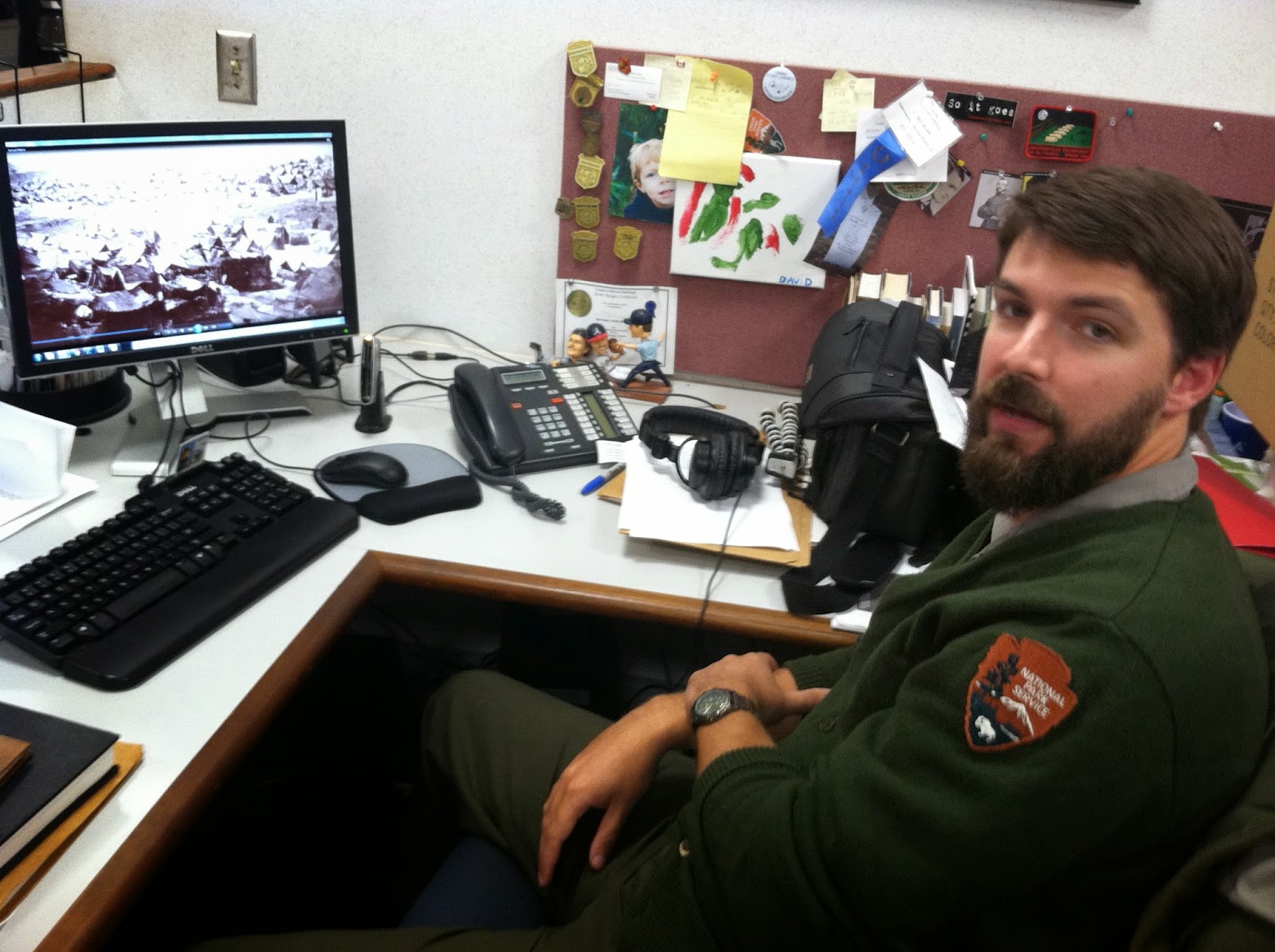 |
| Chris Barr produces "A Story in Stone" videos (Picket photo) |
July 7: “… I dreamed last night of being paroled and seeing Dow, and the disappointment when I awoke & found myself still in Hell! — I have given up all hopes of hearing from home, likewise of their hearing from me. But while there is life there is hope, and that consoles me.”
Sept. 2: “Today I have
another sad duty to perform, and that is to record the death of Friend Jonas
Learned. He was sick only since last Wednesday with the sore throat, but they
say it is not diphtheria, and for the life of me I do not know what it was. He
died very easy, said nothing of his friends, and was but a little out of his
head during his whole sickness. I took his things, and will see them safe with
his folks, in Oxford, N. Y. Perhaps I would not like to see my folks!”
The Facebook video posting Thursday was accompanied by the 12th
of the park’s “Story in Stone” series, which is produced by park guide Chris
Barr.
Each features a voiceover and details of an American
prisoner’s ordeal, about half from the Civil War. A piano version of “My
Country Tis of Thee” that begins each clip was performed by Barr’s wife. “We
didn’t want to do just short biographies,” said Barr of the ongoing project.
 |
| Samuel Melvin's last diary entry |
Melvin, 20, was captured at Spotsylvania, Va., on May 19 and arrived at Andersonville on June 3. His diary, while relatively little-known, is rich with detail and observations on the human condition.
The young soldier, like others, held on to hope of exchange
or parole. He boarded a train to leave Andersonville on Sept. 10, but the train
wrecked and he returned to the prison.
What he didn’t know on Sept. 10 was that the Confederates were actually
moving thousands of men after Union Maj. Gen. William T. Sherman took Atlanta and there was fear Federal troops
would march on the camp. There we no plans then to free or exchange the Union prisoners.
“He is convinced he is going home,” said Leonard.
Four Melvin brothers went off to war. Only one came home.
"I almost feel like I lost a friend I never met..." wrote another Facebook commenter.
Four Melvin brothers went off to war. Only one came home.
"I almost feel like I lost a friend I never met..." wrote another Facebook commenter.
Monday, April 9, 2012
At Civil War sites, social media and relevance
National Park Service rangers were armed -- with cameras -- on the rolling battlefield at Shiloh last week, snapping photos of guided tours and other programs marking the 150th anniversary of the deadly engagement.
 Like orderlies carrying urgent messages, they rushed the images to a webmaster who posted them on Shiloh National Military Park's Facebook page. Take a look you will see an impressive collection of photos, videos and vignettes.
Shiloh was the third stop, after Fort Sumter and Manassas, for a group of NPS employees who are shaping the agency's social media engagement during the sesquicentennial.
They gave out cards bearing addresses for Shiloh's website, YouTube, Flickr and Twitter accounts.
This week's focus will be at Fort Pulaski National Monument near Savannah, Ga.
It comes amid reports of increased attendance at some Civil War sites. But as USA Today pointed out in an article last Friday, the average visitor to the nation's parks is getting grayer.
 According to the article, visitors ages 16-24 are most underrepresented. James Gramann, a Texas A&M professor writing a book on people and parks, said his concern is that the NPS "is maintaining a 21st-century relevance."
I did notice young people at Shiloh while I was there a day and a half. Several asked questions of rangers and expressed knowledge of what happened there in April 1862.
But as at other Civil War events I've attended, there were few people of color.
That's where the relevance comes in. The park service has attempted to bridge this gulf with its "From Civil War to Civil Rights" theme.
Twenty miles away from Shiloh, the NPS's Corinth Civil War Interpretive Center provides a deeper look at the "war's meaning and significance."
 David Vela, Southeast regional director for the National Park Service, told a crowd attending a program at Shiloh that the NPS has published "Hispanics in the Civil War," which tells stories of those who served, including Union Adm. David Farragut.
About 20,000 Hispanics served in the Civil War, Vela said.
Parks, museums and other venues increasingly are looking at the role of African-Americans in the Civil War.
"Our aim is to make this period relevant in our lives," Vela said.
 Like orderlies carrying urgent messages, they rushed the images to a webmaster who posted them on Shiloh National Military Park's Facebook page. Take a look you will see an impressive collection of photos, videos and vignettes.
Shiloh was the third stop, after Fort Sumter and Manassas, for a group of NPS employees who are shaping the agency's social media engagement during the sesquicentennial.
They gave out cards bearing addresses for Shiloh's website, YouTube, Flickr and Twitter accounts.
This week's focus will be at Fort Pulaski National Monument near Savannah, Ga.
It comes amid reports of increased attendance at some Civil War sites. But as USA Today pointed out in an article last Friday, the average visitor to the nation's parks is getting grayer.
 According to the article, visitors ages 16-24 are most underrepresented. James Gramann, a Texas A&M professor writing a book on people and parks, said his concern is that the NPS "is maintaining a 21st-century relevance."
 I did notice young people at Shiloh while I was there a day and a half. Several asked questions of rangers and expressed knowledge of what happened there in April 1862.
But as at other Civil War events I've attended, there were few people of color.
That's where the relevance comes in. The park service has attempted to bridge this gulf with its "From Civil War to Civil Rights" theme.
Twenty miles away from Shiloh, the NPS's Corinth Civil War Interpretive Center provides a deeper look at the "war's meaning and significance."
 David Vela, Southeast regional director for the National Park Service, told a crowd attending a program at Shiloh that the NPS has published "Hispanics in the Civil War," which tells stories of those who served, including Union Adm. David Farragut.
About 20,000 Hispanics served in the Civil War, Vela said.
Parks, museums and other venues increasingly are looking at the role of African-Americans in the Civil War.
"Our aim is to make this period relevant in our lives," Vela said.
Thursday, May 20, 2010
Facebook helps soldier get Medal of Honor
 Seven score and seven years ago, a Wisconsin soldier stood his ground on the Gettysburg battlefield and made a valiant stand before he was felled by a Confederate bullet. Now, thanks to the dogged efforts of modern-day supporters, 1st Lt. Alonzo Cushing shall not have died in vain, nor shall his memory have perished from the earth. • Article
Subscribe to:
Posts (Atom)