Showing posts with label Georgia Southern. Show all posts

Friday, July 1, 2022

Percussion caps and friction primers: Q&A on students in Georgia who found evidence of wild cavalry chase, valiant rearguard stand

Big Buchkead Church, percussion cap (top right) and artillery primer (Camp Lawton project)
Members of the archaeology program at Georgia Southern University have pinpointed where a Ohio cavalry regiment helped successfully hold off charging Confederate horsemen during Sherman’s March to the Sea, the head of the project says.

Students at the university in Statesboro participated in a summer field school from May 15-June 16 at the site in Jenkins County.

Associate professor Ryan McNutt, who heads up the school’s Camp Lawton Archaeological Project, said about 1,000 artifacts were recovered. “I think we’ve made a very good start to confirming the location of portions of the Buckhead Creek battle lines, and this is something that future work will only develop and refine.”

The project for several years has been researching the remains of a nearby Confederate prison camp that was in operation for several weeks in fall 1864.

In 2020, the university was awarded a $116,247 grant from the National Park Service’s American Battlefield Protection Program to document and evaluate the archaeological integrity of two skirmish sites toward the end of Gen. William T. Sherman’s march to Savannah: Buckhead Creek and the subsequent Lawton (Lumpkin’s) Station.

Students tackled the Lawton Station fight first, finding evidence in early 2021 of an engagement.

The program decided to study Buckhead Creek this year, concentrating on property around an historic church caught up in the fighting.

The Battle of Buckhead (or Buck Head) Creek on November 28, 1864, involved cavalry forces under Union Brig. Gen. Judson Kilpatrick and Confederate Maj. Gen. Joseph Wheeler (below, right). It took place across what are now Jenkins and Burke counties.

Kilpatrick (above, left) was in the area to destroy railroad between August and Millen and burn a trestle. Another objective was to release the Camp Lawton prisoners, but Union forces discovered they had been moved to other sites. Federal forces were able to destroy a mile of track.

On the 28th, Wheeler “almost captured Kilpatrick, and pursued him and his men to Buckhead Creek. As Kilpatrick's main force crossed the creek, one regiment (the 5th Ohio Cavalry), supported by artillery, fought a rearguard action severely punishing Wheeler and then burned the bridge behind them,” says a National Park Service summary of the fighting. “Wheeler soon crossed and followed, but a Union brigade behind barricades at Reynolds' Plantation halted the Rebels' drive, eventually forcing them to retire.”

The Picket’s questions about Buckhead Creek and McNutt’s written responses below have been edited for brevity and clarity.

Q. Was all of the work at the church? Why there -- any particular historical accounts you wanted to map?

A. All of our work took place around the Big Buckhead (Baptist) Church, on property owned by the Jenkins County Historical Society, for which we had permission to conduct archaeology on. This was for a few reasons. First, primary sources mention the church extensively as a landmark during the conflict over the creek crossing, and the Union withdrawal to Reynolds' Plantation. Secondly, the church’s property encompasses the end point of the causeway from Buckhead Creek Bridge, on line with the historic pilings visible from the modern bridge, and straddles the route of the historic road Gen. Kilpatrick and his 3rd Cavalry Division retreated along. The (Federal) rear guard artillery action is the bit that likely occurred around the church.

Q. What date was the skirmish or skirmishes your team was studying? Were most of those engaged cavalry?

A. The battle occurred November 28, 1864 -- the action at the church occurred at noon on this date, which we know from a letter from the colonel commanding the 5th Ohio Volunteer Cavalry who documented the regiment’s involvement in his report. All troops engaged were cavalry, with one light artillery regiment (the 10th Wisconsin) on the Union side as part of Kilpatrick’s 3rd Cavalry Division. Wheeler’s Confederate forces are less clear. He seemed to have some artillery attached, and we found some potential evidence of ad hoc Confederate canister shot that seems similar to items recovered from the Battle of Pea Ridge, but this is very tenuous at the moment and needs more lab analysis and documentary research. (Photo of left, Camp Lawton project)

Q. One of your Facebook posts said "pistols were used in the skirmish at Buckhead Creek Church alongside long arms and artillery pieces." Did you find artifacts from all three?

A. We found evidence of .22-caliber rimfires from a Smith & Wesson Model 1, and a lone percussion cap that fits a Colt Army 1860 .44-caliber revolver (or its equivalent). Artillery was identified primarily through fired friction primers, which were all localized in one area of the grid, in a position to deliver enfilading fire on the causeway and bridge across the road. We have some potential evidence of canister tins, and one possible piece of canister shot, but confirming the identification of these is an ongoing process tied to their conservation. Evidence of long arm use so far comes from exclusively percussion caps, in the top hat style, but there are some odds and ends that might be arms-related as well.

Brass rimfire casing for a revolver (Camp Lawton Archaeological Project)
Q. How far below the surface were the artifacts typically found?

A. Fairly deep -- almost all the munitions were recovered between 20 and 25 cms (8-10 inches below surface.

Q. How many in total were recovered? Any personal items or were all arms-related?

A. We recovered probably around 1,000 individual artifacts, and this included some historic glass, lantern parts, ceramics, numerous machine-cut nails, several boot nails and a few potential horse shoe nails, as well as the arms related items.  Many of these domestic items likely relate to the use of the site by the church, which has been continually used a place of worship since before the Revolutionary War and was certainly in existence from 1787. There were no clearly identified personal items from soldiers, but that may be a result of a long-term metal detector activity on the site.

Q. Any related to horse tack?

A. We almost certainly have some iron items that are related to horse tack, but they’re not obviously military in origin.

Reproduction percussion caps have maker's mark less patina (Camp Lawton project)
Q. You found lots of percussion caps. Were those mostly from pistols?

A. In fact, they’re almost all from long arms, and likely Sharps, which were the carbines the 5th Ohio was issued with -- we found about 23 top hat style percussion caps, in a distinct line with several clusters, that likely indicates a skirmish line (given that the clusters are about 3-4 meters apart across the site, and in an angled line facing the causeway and old bridge site).

Q. The friction primers – Union or Confederate? Their use?

A. These are likely all Union, given their location. Friction primers were a gunpowder-filled copper tube inserted into the touchhole in the rear of the cannon barrel into the gunpowder charge. A roughened wire was fixed into a spur that was filled with antimony sulfide and potassium chlorate, which essentially acted like a matchhead when the wire was pulled through the spur.

A lanyard would have run from the wire to the hands of the gunner and yanking the lanyard pulled the wire out, ignited the friction primer, and fired the gun. The used exploded copper tube was then explosively hurled into the air and to the rear of the gun (depending on the cannon tube’s elevation).

For our purposes, the exact location of these friction primers is quite important, because we have primary accounts describing the presence of artillery at the Battle of Buckhead Creek Church, and general indications of their positioning.

Wartime photo of 5th Ohio Cavalry (Library of Congress)
The 5th Ohio Cavalry Regiment, Company G, had obtained two 12-pound mountain howitzers, and these were positioned to the right and left of the road running from the bridge at Buckhead Creek past the church and were loaded with canister to sweep the causeways leading up to, and away from the bridge. Another possibility is the 10th Wisconsin Light Artillery, who were attached to Kilpatrick’s 3rd Division, and were also involved in the rear-guard action at the creek, and who were also armed with mountain howitzers. Using the location of these friction primers and working out the potential distance these would have been hurled from where the guns were fired, we may be able to actually identify where precisely the Union artillery pieces were placed next to the church and add these to the battle interpretation. Moreover, these small copper pieces of conflict also indicate that there is quite a lot of integrity of the battlefield surviving.

Q. You posted on social media the discovery of buck and ball loads (left). What are those?

A. We found two, possibly three pieces of shot from buck and ball loads. Buck and ball loads were essentially two or more .32-caliber shot loaded into a paper cartridge with a .69-caliber ball. When fired, it had the effect of a shotgun, spreading the lethality of impact across a wider target.

Both of our shot has banding from the barrel of the firearm, and impressions from the .69-caliber ball, which is how we know they’ve been fired, since shot can only pick up those alterations from contact when it goes semi-molten from the powder charge when fired.

Wheeler himself requested buck and ball cartridges to be sent to Millen for his resupply, and when Sherman’s army took Savannah at the end of the campaign, part of the captured Confederate munitions included a total of 11,500 buck and ball cartridges.

Q. What types of equipment were used during the school?

A. We used exclusively metal detecting. There are several potential earthwork features that might be ad hoc Union fortification -- rifle pits, a potential tiny lunette -- that we need to return to and examine with GPR (ground-penetrating radar).

Q. Regarding open and public days, any particular questions or themes raised by visitors?

A. One of the consistent themes raised is how heavily metal detected the area has been in the past, and how surprised they were that were finding items. And also a deep appreciation for us working in the area, and raising the profile of both the battlefield, and the church. Despite its great historical importance, it’s not listed on the National Register (of Historic Places), and part of the final reporting of this project will be to nominate the church itself to the National Register as historically significant.

Dr. McNutt with visitors to the excavation site (Camp Lawton Archaeological Project)
Q. I imagine is analysis is to come, but do you have any takeaways from what was found/observed during the five weeks? Anything become clearer about the fighting around the church?

A. I think we’ve likely pretty much confirmed that we uncovered evidence of the 5th Ohio Volunteer Cavalry’s actions at Buckhead Creek. They were a regiment who served in the 2nd brigade of General Kilpatrick’s 3rd Division. Originally, the entire 5th Ohio formed the rear guard, dispersing Confederate attempts to cross the bridge over the creek with canister shot from two 12 pounder mountain howitzers from Company G commanded by Capt. John Pummill.

John Pummill may be individual at left with 5th Ohio howitzer (Library of Congress)
At noon on November 28 , 1864, they opened fire at the charging Confederates charging over the bridge and ‘when the smoke of [their] discharge cleared away’ the causeways were swept clean. Co D of the 5th Ohio destroyed the bridge, but Wheeler himself said his command used the pews from Buckhead Creek Church to rebuild it.

The 5th Ohio began a slow withdrawal to join Kilpatrick at Reynolds' (Bellevue) Plantation, leaving the 3rd battalion consisting of companies E, I, H, and K lead by Capt. (Alexander) Rossman to defend the rear at the creek crossing. Finally, only Company K was left, fighting dismounted as skirmishers. By this point in the war, Company K held only 61 men, who tenaciously held off Wheeler’s forces. And this accords well with what we’re uncovering in the archaeological record. Contrary to popular belief, only three regiments in Kilpatrick’s entire 3rd division were armed with Spencer repeating rifles. All the rest possessed either Springfield rifle muskets, or carbines of various effectiveness.

The 5th Ohio, which is our most likely candidate for the troops whose positions we’re investigating, were armed with Joslyn carbines at the start of their service, transitioning to Burnsides and then Sharps. As well as the standard issue Colt Army 1860 .44-caliber revolver, most importantly for our purposes, all of these carbines used top hat style percussion caps to ignite their breech loaded cartridges -- the exact style we’re finding in abundance, spaced at regular intervals facing the still visible causeway, strongly indicating a skirmish line. Potentially, the line of Company K. I think we’ve got really good evidence for the position of at least one of the 5th Ohio’s artillery pieces, and accompanying skirmish line. (Damaged percussion cap in photo)

Q.  What do you think students most experienced/learned at this field school?

A. I think we’ve made a very good start to confirming the location of portions of the Buckhead Creek battle lines, and this is something that future work will only develop and refine. Most importantly, I think we’ve clearly demonstrated that portions of the creek battle site have really good archaeological integrity, with surviving artifacts, battle lines and detritus from the action, despite the extensive metal detecting activity in the area. This is incredibly important for these aspects of the conflict that spun off from Sherman’s March to the Sea, given that the battle of Waynesboro, and so many other of the smaller skirmish sites have vanished under development and urban expansion. I think this publicity and confirmation of intact historic terrain and battlefield material should help heighten the visibility of the battle, and encourage tourism to Jenkins County to witness a landscape in very good condition for visualizing one of the last major battles in Sherman’s March to the Sea.

Dr. McNutt (back row, left) with members of the summer field school team
Our students learned how important this local history is to the people of Jenkins County, and how it intersects with heritage tourism and real world impact. And of course, they also learned the value of hard work in 111 degree heat, and how much team work and strict scientific approaches are necessary to uncovering the past. Most of our percussion caps were in areas that were untouched because they covered over with extensive modern garbage, and it’s only through dedication and discipline that we uncovered them.

Moreover, I think the battle at Buckhead Creek Church really drove home to the students the concept of the Civil War as the first industrialized war, with a stark contrast between black powder muzzle loaders and buck and ball loads utilized by the Confederates, and breech-loading carbines and lever action repeaters and pistols with cased ammunition being used by the Union.

Friday, May 11, 2018

Camp Lawton: Dig will continue efforts to learn more about stockade, Confederate captors

Possible Confederate shelter (Georgia Southern University photos)
3D scans of painted and unpainted bullets

Saturday’s (May 12) archaeological dig at the site of a Confederate prison near Millen, Ga., will be an opportunity for visitors to help excavate and screen soil at the southwest corner of the stockade.

The “public day” at Magnolia Springs State Park will include a 2 by 2 meter unit that has not been excavated, said Ryan McNutt, who oversees Georgia Southern University’s Camp Lawton project.

McNutt said he’d like to get a better sense of the construction method for anchoring corners of the wooden stockade.

Is it similar to Andersonville? A different method?” he told the Picket. “Are they reinforced via joints and carpentry or were brackets and nails used?”

Cut nail and piece of horse tack (Courtesy of GSU)

Camp Lawton operated for about six weeks in autumn 1864 before the guards took Federal soldiers to other prisons as the Union army approached Savannah. Many of the POWs were transferred to the site from Camp Sumter, also known as Andersonville.

Saturday’s event, set for 10 a.m. to 3:30 p.m., will include artifacts previously excavated and 3D printed replicas.

“Since this is part of Georgia archaeology month, we're going to have a range of objects, both from Camp Lawton and from Georgia archaeology in general, ranging from zooarchaeological collections to 3D prints of artifacts including Union buttons, the modified tobacco pipe, as well as Minnie balls, nails, and projectile points from Georgia collections” McNutt said.

He said the project in 2017 located the potential remains of two Confederate structures. One may have been a builder’s trench with posts. ”The second, however, is a basin-shaped pit with two angled postholes on one side, which clearly looks like the remains of an ad hoc Confederate structure.”

3D scan of button
McNutt describes it as an “A” frame made of two angled posts, with potentially an eaves pole resting in the center, and a tarp, blanket or canvas thrown over it to make a lean-to.

The feature includes a subterranean pit dug not that different from a prisoner shebang (shelter) uncovered on the north side of the prison site.

Recovered artifacts include part of a frying pan, a cone cleaner for a percussion firearm, and various cut nails, brick fragments and some horse harness parts.

“These are all located in our search area close to the existing earthworks of Camp Lawton,” said McNutt.

More 3D replicas (GSU)
Previous excavations on the prisoner side of the relatively undisturbed site have yielded hundreds of Civil War artifacts that help illustrate daily life. Officials have a good idea of where the stockade walls were erected, having found some post remains. The project’s work in the past couple years has concentrated on improving knowledge of the Confederate side of the prison, which falls within the state park boundary.

The 10,000 Federal prisoners were to the west and across a creek, on a hillside that later became a federal fish hatchery. That side of Camp Lawton is on property managed by the U.S. Fish and Wildlife Service.

“I think with successive field seasons, especially the coming 2019 one, we'll find more and more evidence of the Confederate occupation, and be able to generate a dataset of artifacts and structural information that we can compare to the already rich record for the POW occupation,” McNutt said.

McNutt, like Lance Greene, his predecessor wants to know more about what life was like for both guards and prisoners “in that extremely turbulent year of 1864.”

The event is free, but entrance into Magnolia Springs State Park is $5, or free with a Park Pass.

Tuesday, April 18, 2017

Camp Lawton: Public welcome Friday to pitch in on excavation, learn prison's history

POW Robert Knox Sneden's map of Lawton shows the fort in the upper left, but the map is reversed. (Library of Congress)

Have a hankering to use a metal detector or take part in an archaeological excavation?

Friday’s “Public Day” at Magnolia Springs State Park near Millen, Ga., will allow visitors to get their hands dirty at the site of a large Civil War prison.

Ryan McNutt, who oversees Georgia Southern University’s Camp Lawton project, said students will be working just east of Fort Lawton, the Confederate earthworks that defended against attack on the camp and as a warning to prisoners.

“The public is welcome to participate however they want,” said McNutt. “They can try their hand at metal detecting survey, and excavating the hits, or assisting with excavating our open 1x2 meter test unit, which has some interesting features in it.”

Visitors also can see 3D printed artifacts or talk with Nina Raeth, whose ancestor was a Federal POW at Lawton, which operated for six weeks in late 1864. Many of the POWs were transferred to the site from Camp Sumter, also known as Andersonville.

GSU students have been working on two large grids east of the fort to see whether there is any sign of Confederate activity or occupation.

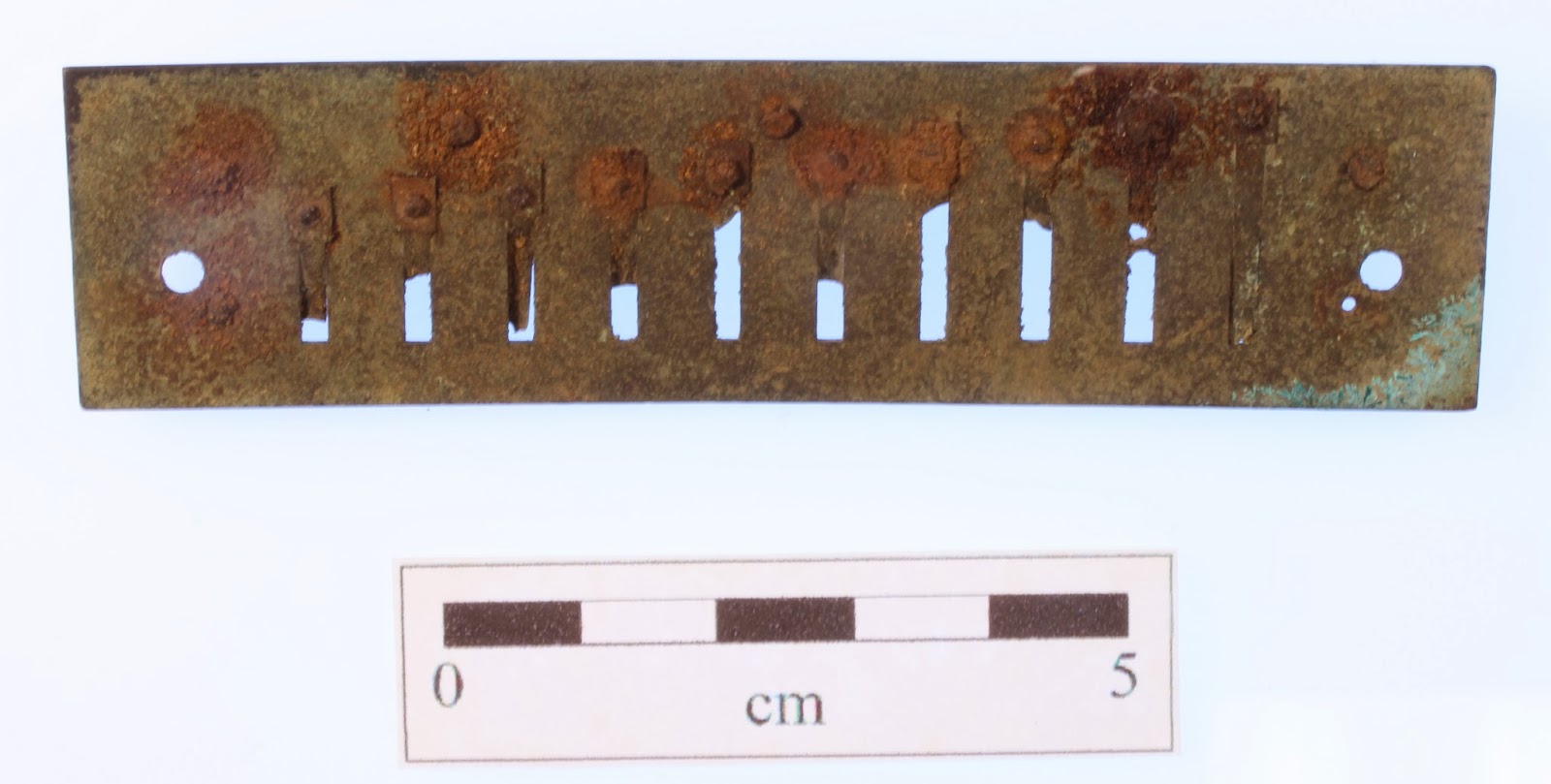
One of two brass harmonica reeds found at Lawton (GSU)

“The Confederate side of the story is largely unknown from an archaeological standpoint, and the area we're surveying to the east of the fort would be an ideal location for rifle pits, potential camp sites and so on,” said McNutt.

The 10,000 Federal prisoners were to the west and across a creek, on a hillside that later became a federal fish hatchery. That side of Camp Lawton is on property managed by the U.S. Fish and Wildlife Service.

The project has located Civil War period cut nails, a buckle from a horse harness and other items near Fort Lawton.

“We've also found good evidence of the land around the fort being used for hunting during the 1890s to 1900s, with numerous shotgun shell bases turning up, all with head stamps that date solidly to the period between 1890-1902,” McNutt told the Picket.

“None of the artifacts we've recovered are really military in nature, aside from a possible cone cleaner. But it is adding to the story of Camp Lawton, both during its occupation, and what it was used for afterwards.”

Previous excavations on the prisoner side of the camp have yielded hundreds of Civil War artifacts that help illustrate daily life. Officials have a good idea of where the stockade walls were erected, having found some post remains.

Friday’s public day is from 10 a.m. to 3:30 p.m. at Magnolia Springs State Park. Entrance to the park is $5 for parking or free with a park pass. Sponsors are Georgia Southern University, the Georgia Department of Natural Resources and the U.S. Fish and Wildlife Service. Look for tents after the attendant’s hut and a volunteer will take you to the work area.

Saturday, January 28, 2017

Georgia's Camp Lawton: Archaeology students back on POW site to unlock mysteries

Work several years ago in presumed barracks area (GSU photo)

After a year and a half absence, archaeology students are back on the site of a Civil War prison near Millen, Ga. Their prime objective this year is to locate more evidence of the structures and features used by Confederate troops to guard 10,000 Federal soldiers.

Ryan McNutt, assistant professor of historical archaeology at Georgia Southern University in Statesboro, has been teaching newer students the proper use of metal detectors in the dappled light of Camp Lawton.

“For spring, our initial focus is on potential rifle pits around the earthworks of Lawton. This may expand to the potential barracks area, depending on progress and what we discover around the fort,” said McNutt.

The Confederate camp broke into the news in 2010 when federal, state and campus officials announced that its location had been confirmed and the site already was yielding a trove of artifacts. Lawton was only open for about six weeks in autumn 1864. It held POWs moved from Andersonville and other sites as Union troops moved into central and south Georgia after taking Atlanta.

A major challenge is the lack of photos and plans of the camp, and archaeologists working the site know very little about the location of Confederate structures.

McNutt met last year with officials from the U.S. Fish and Wildlife Service and the Georgia Department of Natural Resources about long-term plans for surveying and excavating the pristine site.

Prisoner map of Camp Lawton (Library of Congress)

Why two agencies? The federal prisoners were in a stockade that extended to a hillside that later became part of a now-closed fish hatchery. The Rebel captors were based on the other side of a spring, in what is now Magnolia Springs State Park.

Field school students this spring (Jan. 13-April 28) and summer (May 15-June 16) will be focusing their efforts on the state side of the site. McNutt wants to them to concentrate on areas that may contain remnants of defense and support structures.

Camp Lawton was last excavated in summer 2015 by students working with then-project director Lance Greene, who left soon after for a teaching position at Wright State University in Ohio. That summer, they concentrated on the Federal area, continuing the excavation of a prisoner hut and brick oven. The gap in field work at the site from summer 2015 to this month was attributable to finding a new director and McNutt studying past analysis and plotting new and revised objectives.

Over three years, Greene and his students also excavated what may be the Confederate officers’ barracks, but were unable to identify other Rebel portions of the site, including where the enlisted men lived.

Harmonica reed found in possible barracks area (GSU photo)

Like Greene, McNutt is interested in understanding the difference in the quality of life and the relationship between prisoners and guards.

Students in the spring field school are only at Camp Lawton on Fridays. The summer session will be Monday-Friday.

“The summer field school will focus in the main on the barracks area itself, though this is tied to the information gathered this spring,” McNutt told the Picket.

Students are using metal detectors to search grids.

“If we find concentrations of period artifacts, or changes in soil color in holes where metal detector hits are excavated, these may be indicative of high-activity areas in the past, or surviving archaeological features under the plow zone. In this case, we'll examine them through small 1x1 meter units to determine what's going on,” McNutt said. “We can then continue excavating if it seems small enough to tackle for the spring field school, or record the location, photograph and map whatever is there, and then return in the summer.”

Ryan McNutt (left) explains metal detector techniques (GSU photo)

“The summer will be a mix of this metal detector survey, and excavation in 2x2 meter units of areas of interest, like a chimney fall and concentrations of potential Confederate artifacts in the barracks area initially investigated by Dr. Greene.”

Those interested will have an opportunity to witness the work or, on a few days, help out. Volunteer days are May 27, June 3 and June 10.

A public day will be held in late March or early April. McNutt said those interested can contact him to arrange a visit during either field school. “The park staff can direct any visitors to our work area, and someone will give them a tour and explain what's going on.”

Saturday, August 20, 2016

What new Camp Lawton dig director wants to learn about Union POWs, Rebel guards

Ryan McNutt
Ryan McNutt found that when one door closes, a really cool one opens.

The conflict archaeologist’s teaching contract at the University of Glasgow was coming to an end late last year. McNutt had earned his master’s degree and doctorate at the UK university and while in Europe had done research on the locations of battlefields from the Middle Ages. Through the school's Centre for Battlefield Archaeology, McNutt had helped excavate a World War I site (Somme in France) and others from World War II (Stalag Luft III in Poland and aircraft crash sites in Scotland).

McNutt, 33, ran across a job posting back in the States. Georgia Southern University in Statesboro was looking for an assistant professor of anthropology. Duties include overseeing the school’s Camp Lawton project.

“Lawton was the main thing that attracted me to the job,” said McNutt, who will oversee GSU research and archaeological excavations at the Confederate prison site a few miles north of Millen.

The camp broke into the news in 2010 when federal, state and campus officials announced that its location had been confirmed and it was already yielding a trove of artifacts.

But there’s been no activity on the site in more than a year. McNutt’s predecessor, Lance Greene, took a position at Wright State University in Dayton, Ohio, after the summer 2015 field school.

Excavation at Camp Lawton (Courtesy of Hubert Gibson)

For McNutt, who worked on projects in the U.S. Southeast before going abroad, serving as the Lawton director is an opportunity to continue Greene’s work and explore some of his own questions about the prison, which was open for only six weeks in fall 1864.

“Preservation is so bad on U.S. Civil War prison sites, especially Confederate ones,” said the Alabama native. But not at Camp Lawton. Archaeologists have been helped by the remote location of the stockade and relatively minor disturbances of the soil.

McNutt told the Picket about some of his objectives:

-- Prisoner of war camps are “excellent places to hide contraband, personal items you are not supposed to have. If you are rousted in camp, left on a train early in the morning, as they were (at Lawton) those are the kinds of things that are to be left behind.” McNutt wants to know whether some of the shelter areas include digging tools, stashes of forbidden resources or items used in trade with guards. “That leads back to what are these guys doing to cope with aspects of confinement and how are they resisting. How are they mentally resisting the fact they are stuck here in this camp.” Contraband, McNutt said, can be “a relatively powerful victory.”

-- He wants to document how the 10,000 Union soldiers divided themselves up. The men were to be grouped by regiments and companies. “That is the official standpoint of Confederacy.” But there are good indications that at nearby Andersonville (Camp Sumter), there was internal sorting by ethnicity. European coins or tokens have been found at Camp Lawton and it is known there were many prisoners of Irish descent.

Friendship ring found at Lawton (Courtesy of Georgia Southern U.)

-- McNutt wants to learn more about how prisoners used the space available to them. It was a cold, wet autumn and hundreds died. Getting the perspective from the fort (Confederate) side of the camp will allow students to ascertain places that could not be seen by guards.

Over three years, Greene and his students worked on confirming the location of the stockade walls and spent a lot of time in the prisoner area, uncovering a communal brick oven and a dwelling hut. They excavated what is believed to be a Confederate officers’ barracks, but were not able to identify other Rebel portions of the site, including where the enlisted men lived.

Greene told the Picket last summer that a big focus of the Camp Lawton project is understanding the difference in the quality of life and the relationship between prisoners and guards. McNutt concurs.

“There is no glass or ceramics in the prison area. They are having to do with tin cups,” Greene said. “The Confederacy is giving them nothing and they are getting bad cuts of meat if they get anything at all. A tin cup was used for water and to eat soup. They have nothing else. They reused items, railroad piece and metal scrap.

McNutt said he, too, will concentrate on the precise locations of Federal and Confederate structures, including the stockade. He wants to find and excavate potential corners.

Brass keg tap (Courtesy of Georgia Southern U.)

The presumed Confederate barracks “is in the gray area.” Artifacts fit the time period. “They are of a high-quality enough goods they were likely from the kind of stuff the officers would have had around them.” Accounts by Union prisoner Robert Knox Sneden indicate that the area should have been surrounded by kitchens, cookhouses and cabins.

McNutt said conflict or battle archaeology can be tough. The 1745 Battle of Prestonpans in Scotland was over in hours. But such locations, where activity occurred in a single day or over a few weeks, can provide exciting research opportunities, he said.

“It is such a short burst of activity; they are almost perfect time capsules. You get these really nice frozen moments in time. The occupation is so short you can tie this down to specific weeks. Sometimes to specific regiments. I think there is a lot of that at Camp Lawton.”

So a relatively short time capsule may demonstrate how the prisoners coped with food shortages, boredom and loneliness.

McNutt expects to meet next month with Georgia and U.S. Fish and Wildlife Service archaeologists about objectives and research designs for the next phase of archaeology. (A portion of the prison is in Magnolia Springs State Park and the remainder is on the fenced site of an old federal fish hatchery.)

Barracks excavation a couple of years ago (Courtesy of Georgia Southern U.)

The Camp Lawton director would like to see the earth turned again sometime in 2017 and a campaign launched to renew public interest. “When exactly that starts is kind of up in the air.”

McNutt has written what he loves about archaeology: “Researching the past, thinking about the way people interact with each other, how we use objects, and objects use us. How we create the present from the past, and craft national and group identities from these created pasts. And how as archaeologists, we can pick these themes apart.

He’s conscious of Camp Lawton’s ties to other prison sites in Georgia, including Blackshear and Thomasville. Lawton was evacuated during Sherman’s March to the Sea and prisoners were sent elsewhere. “I see all three of those sites interlinked. They are all part of the same story. Camp Lawton can inform on them and Thomasville and Blackshear can inform back to Camp Lawton.”

McNutt also wants to restore public days at Magnolia Springs. Visitors can help in the archaeology on certain weekends and visit a Camp Lawton museum just yards away.

“I believe archaeology … should exist for education of my students and education of the public at large,” he said.

Monday, October 13, 2014

Camp Lawton website will feature 'artifact of the week' during 150th anniversary

3D of Union brass button
Georgia Southern University in Statesboro is updating a website that documents students’ archaeological work at the site of a Confederate military prison that was open for six weeks in autumn 1864.

The new features and Facebook posts with quotes from Union prisoners are timed to the 150th anniversary of Camp Lawton, which began operations about Oct. 10, 1864.

The website, which has a brief history of the camp and the Civil War prison experience, now has an “artifact of the week.” The first item, posted Monday, is a 3D Union brass coat button. "Several of these buttons have been recovered from the prisoners' encampment at Camp Lawton, and probably represent a trade item or form of currency in the camp," the page says.

(Courtesy GSU)
A descendant’s page includes information on individuals related to a Confederate guard and two Union soldiers. Nina Raeth, whose great-grandfather, an German immigrant, was held captive at Lawton, and Doug Carter, whose Georgia ancestor guarded the prisoners, have become fast friends in recent years.

GSU is seeking other descendants who might share their stories.

Lance Greene, assistant professor of anthropology, said the related Facebook posts about camp life will last through November 22, the last day of the prison’s existence. Greene said future website upgrades will feature more information on archaeology and artifact conservation, including a lab at GSU that includes water and alcohol baths, electrolysis and air abrasion.