After four
years of conservation in North Charleston, the three massive cannons of the Confederate
cruiser CSS Peedee have been returned to Florence County, S.C. The cannons were
installed at the Florence County Veterans Affairs Center, adding to the area’s
rich history of artifacts from the Civil War, reported TV station WMBF. • Article
Thursday, June 13, 2019


Wednesday, June 12, 2019
UPDATE: Rare flag carried by Pennsylvania African-American regiment sold for $196K to Atlanta History Center
 |
| (Courtesy of Morphy Auctions) |
Acclaimed
African-American artist David B. Bowser created the banner for the 127th
U.S. Colored Troops. It depicts a soldier waving
farewell to Columbia, a symbol of the United States, with the words “We Will
Prove Ourselves Men.”
Of the 11 such flags Bowser painted, the 127th flag is the only known to survive.
“Seven others
are known only from photographs. Those seven flags were sent to the military
museum at West Point in 1906, but incredibly, were thrown out in the 1940s,”
said Dan Morphy, president of Morphy Auctions, in a press release, before the sale. The auction house had said the banner might go for as high as $250,000 on Thursday.
 |
| D.B. Bowser (Wikipedia) |
The 1864 flag
in recent years has belonged to the Grand Army of the Republic Civil War Museum
and Library in Philadelphia. But the museum, which had the 6-by-6-½-foot silk flag restored a couple years ago, decided to part with it to help bolster the venue’s finances, the Associated Press reported. The Picket reached out to the museum for comment.
The Atlanta History Center, which recently restored and reopened The Battle of Atlanta Cyclorama, said the purchase was the most it has ever spent on a single artifact. "It's one of those things that doesn't need words to tell you what it is and what it represents," said center president and CEO Sheffield Hale.
Bowser, the son of a fugitive slave whose home was a stop on the Underground Railroad, designed banners and flags for a variety of clients. He helped recruit black soldiers and was commissioned to paint 11 flags for African-American regiments, which trained at Camp William Penn outside Philadelphia. The segregated units were led by white officers.
Bowser, the son of a fugitive slave whose home was a stop on the Underground Railroad, designed banners and flags for a variety of clients. He helped recruit black soldiers and was commissioned to paint 11 flags for African-American regiments, which trained at Camp William Penn outside Philadelphia. The segregated units were led by white officers.
"Bowser's works were the first widely viewed, positive images of
African Americans painted by an African American," according to the Pennsylvania Historical and Museum Commission.
Joseph Becton of the African American Museum in Philadelphia told the
Associated Press that Bowser’s flags were meant to be provocative.
According to the AP: “The
banner for the 22nd regiment showed a black Union soldier pointing his bayonet
at the chest of a fallen Confederate soldier who is tossing aside his sword,
beneath a banner reading ‘Sic semper tyrannis,’ which translates into ‘thus
always to tyrants.’ That was also the motto of Virginia at the time, so it was
likely meant to enrage the enemy, Becton said.”
 |
| 127th USCT flag detail (Courtesy of Morphy Auctions) |
The 127th
was organized in late summer 1864 and
took part in siege operations against Richmond and Petersburg until the end of
the Civil War. Part of the Army of the James, it participated in one battle and
several other actions. The regiment was at Appomattox for the surrender of the Confederate Army of Northern Virginia.
"With meticulous attention to detail in restoration, the vibrant banner represents the epic struggle, valor and patriotism of the African-American troops during the Civil War," Morphy Auctions said.
Gordon Jones, senior military historian and curator at the Atlanta History Center, said in a statement: “It’s an iconic knock-your-socks-off artifact. Even an enlisted man’s USCT uniform wouldn’t be as historically significant as this flag.”
Gordon Jones, senior military historian and curator at the Atlanta History Center, said in a statement: “It’s an iconic knock-your-socks-off artifact. Even an enlisted man’s USCT uniform wouldn’t be as historically significant as this flag.”
The history center’s collection includes a brass drum belonging to a
drummer boy of the all-black 55th Massachusetts Regiment, a knapsack used at the Battle of Olustee, Fla., by a soldier in the 8th USCT and a recently acquired canteen bearing the stencile mark of the 15th USCT, which guarded railroad lines in Tennessee during the 1864 Atlanta Campaign.
Sunday, June 9, 2019
Maine's official state ballad honors the 20th Maine and the bad-ass color bearer who rallied them at Little Round Top
A song told from the point of a view of a color bearer who
rallied a regiment that famously saved the Union’s left at Gettysburg has been designated
the official state ballad of Maine.
The Portland folk band The Ghost of Paul Revere performed
“Ballad of the 20th Maine” on Friday during bill-signing ceremonies
led by Gov. Janet Mills.
Sgt. Andrew J. Tozier of the 20th’s
Company I received the Medal of Honor in 1898, 35 years after the battle. His
citation reads: “At the crisis of the engagement this soldier, a color bearer,
stood alone in an advanced position, the regiment having been borne back, and
defended his colors with musket and ammunition picked up at his feet.”
The song lyrics include this verse:
If we should die today, dream a dream of heaven
Take your northern heart with you to the grave
Be proud and true you are a union soldier
Stand fast, ye are the boys of Maine
Take your northern heart with you to the grave
Be proud and true you are a union soldier
Stand fast, ye are the boys of Maine
On July 2, 1863, the 15th Alabama made its way to Little Round Top and made a series
of legendary assaults against the 20th Maine, led by Col. Joshua Chamberlain.
 |
| The family of Andrew J. Tozier; his son is second from right, top (Wikipedia) |
Tozier, 25, was with the 2nd
Maine Infantry, and been wounded and made prisoner in 1862. He returned to
service and eventually was transferred to the 20th Maine.
The 2nd Maine was pressed into service with Chamberlain’s
unit at Gettysburg. That’s because the unit had been disbanded and those who
were not able to go home did not want to fly under another flag.
 |
| Chamberlain |
According to the American Battlefield Trust: “Color sergeant
was a dangerous but coveted position in Civil War regiments, generally manned
by the bravest soldier in the unit. As the 20th Maine’s center began to break
and give ground in the face of the Alabama regiments’ onslaught, Tozier stood
firm, remaining upright as Southern bullets buzzed and snapped in the air
around him. Tozier’s personal gallantry in defending the 20th Maine’s colors
became the regimental rallying point for Companies D, E and F to retake the
center. Were it not for Tozier’s heroic stand, the 20th Maine would likely have
been beaten at that decisive point in the battle.”
The Trust article said a desperate bayonet charge that followed blunted
the Confederate assault on Little Round Top and saved the Army of the Potomac,
which went on to win the battle and the war.
The Ghost of
Paul Revere performed its song during the ceremony. The lyrics include these
verses:
Well, our western flank was missing
As the Confederates pushed on
And we fought them tooth and nail
Our ammunition all but gone
Alone I stood with colors
Flying proud and true
For to let my northern brothers know
the battle was not through
As the Confederates pushed on
And we fought them tooth and nail
Our ammunition all but gone
Alone I stood with colors
Flying proud and true
For to let my northern brothers know
the battle was not through
Then appeared our lion roaring bayonets
Charging down the mountain with what soldiers we had left
We were steadfast as Katahdin, hard as winters rain
Take that rebel yell with you to hell
We are the 20th Maine
Charging down the mountain with what soldiers we had left
We were steadfast as Katahdin, hard as winters rain
Take that rebel yell with you to hell
We are the 20th Maine
The ballad was written by band member Griffin Sherry because he’s a
history buff and has interest in the 20th Maine, according to the Press-Telegram newspaper. Tozier died in 1910 at age 72.
 |
| View from Little Round Top, with statue of Brig. Gen. Gouverneur Warren (NPS) |
“Music
transcends the bounds of time, distance, language, and culture to bring people
together,” Mills said of the state ballad. “The ‘Ballad of the 20th Maine’ does
just that by reminding us of our proud heritage, the role our great state has
played in the history of our nation, and to be forever grateful to those who
served and saved our country.”
This post has been updated to correct errors on Tozier's birthplace and the family photo.
This post has been updated to correct errors on Tozier's birthplace and the family photo.
Wednesday, June 5, 2019
'In the silent camping ground of the dead': Sons of Union Veterans help dedicate grave site of soldier resting beneath Long Island church
 |
| Some of the SUVCW contingent (Courtesy of Patrick Young) |
 |
| SUVCW members conduct ceremony near plaque above grave (Trinity Episcopal) |
The singing
of the “Battle Hymn of the Republic,” words from clergy and a ceremony conducted by the Sons of Union Veterans of the Civil
War were highlights of the rededication of the burial site of a Civil War soldier who
rests beneath a New York church.
Eight members
of Moses A. Baldwin Camp #544,
SUVCW, participated in Sunday morning’s ceremony at Trinity Episcopal Church in
Roslyn on Long Island.
“This is the
main mission of the Sons of Union Veterans of the Civil War -- to find the
final resting place of every single Union veteran and make sure the grave is
properly marked,” said Dennis Duffy, secretary-treasurer for the camp.
Parishioners had long known that Pvt. John Codman Pollitz’s 1863 grave was incorporated
within the current building during construction in 1906. But most of them had
no idea where; there was no recorded location.
That changed last summer, when the congregation
fixed a longtime problem: The floor of the nave had been deteriorating and
sinking. During the floor-replacement project, rotting wooden joists were
removed and Pollitz’ headstone was exposed; it was lying flat in a crawlspace
area.
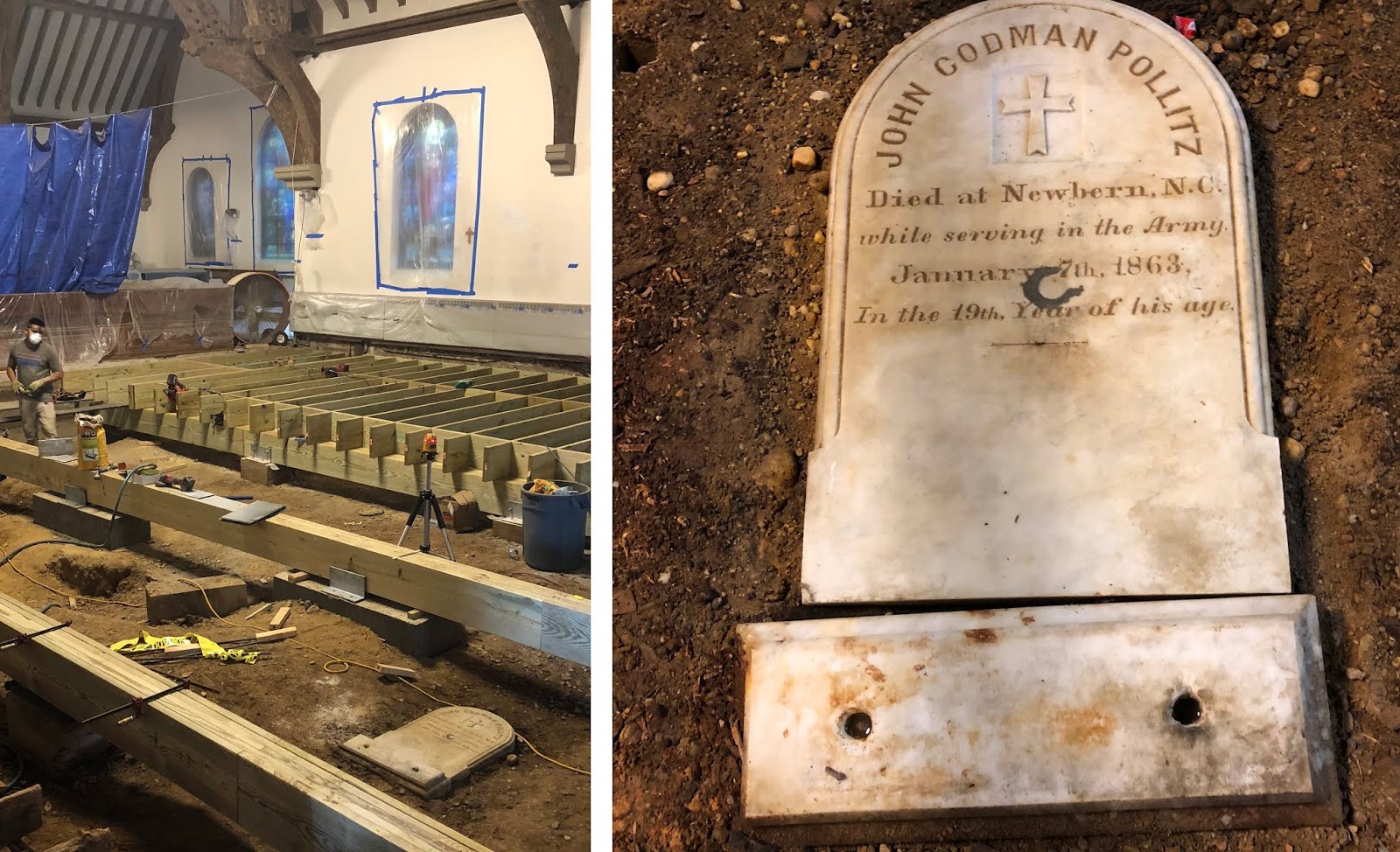 |
| Exposed church floor in 2018 and Pollitz headstone flat on ground |
 |
| (Photos courtesy of Trinity Episcopal Church, Roslyn) |
A new plaque marks the spot on the floor under which Pollitz rests. Sunday's dedication took place near the back of the nave, next to the small plaque.
Duffy told the Picket this week that the SUVCW
has a database listing hundreds of thousands of graves.
He cited the work of the local Cemetery
Restoration Committee of Pachogue, which last year dedicated new headstones for
six Civil War veterans at historic cemeteries. Leaders at Trinity moved the
Pollitz headstone from the floor area and are trying to determine where to
place it.
It’s believed that the young Pollitz was living in Boston and
barely 18 when he joined up with the 44th Massachusetts, ostensibly in the summer of fall of 1862. The regiment, which took part in skirmishes and sieges across North Carolina before it was mustered out in June 1863, was in New Bern for several months before transfer to Plymouth, N.C.
A history of the regiment detailed disease and illness that stalked the troops during campaigning and at their quarters. Pollitz, who served in Company F, died on Jan. 7, 1863.
According
to the “Record of the Service of the Fourth-Fourth Massachusetts Volunteer Militia
in North Carolina, August 1862 to May 1863,” Pollitz and 13 other soldiers in the regiment died from cerebrospinal meningitis.

 |
| (Photos courtesy of Patrick Young) |
Pollitz’s
father was an immigrant and businessman; a history of Roslyn indicated he
immigrated from Northern Ireland. But an online search of ancestry-related pages
shows Otto W. Pollitz was from Hamburg, Germany, and John’s mother was born in
Massachusetts. Church members are unaware of any living descendants.
According to Duffy, John C. Pollitz attended Brooklyn Collegiate and Polytechnic Institute (now part
of NYU) and had moved on to college in Massachusetts, where he enlisted with the
44th.
"John did not have to go to war. There was no draft at the time and when the draft would come six months after John's death, his family could have afforded to pay a substitute under the rules then in effect," Duffy wrote this week to other members of the SUVCW camp.
The Picket is grateful to Patrick Young, author of the Immigrants' Civil War Facebook page, for the use of several photos. He attended Sunday's event.
Saturday, June 1, 2019
Stone Mountain Village near Atlanta notes its Civil War history, but wants to shed reputation and promote its black history, too
 |
| The Mayor's House in Stone Mountain Village |
This site (top), built in the mid-1830s by
slaves, has seen several uses, including the home of Stone Mountain's first
mayor, a Civil War hospital and other businesses, including restaurants.

A coffee bar co-owned by Brown is on the ground floor of what's called "The Mayor's House."
It's believed the second floor housed wounded Confederate troops. The current
owner wants to open a restaurant and the building is being renovated.
For several years, the Sycamore Grill restaurant
was in the building, named for the huge tree out front.
A fundraising page for the renovation effort says:
"The Mayor’s House is valuable in our vision for reconciliation in Stone
Mountain, due to its history and its undeniable location. Built in the very
center of a town historically known to separate and mark boundaries between
blacks and whites, the reclamation of Stone Mountain Village’s flagship
building for a modern vision of community and economy will breathe life and
restoration for this area."


Nearby is the old railroad depot. A marker recalls July 1864 Federal cavalry raids during Sherman's campaign against Atlanta.
Scores of Confederate soldiers killed in
combat or who died in old age rest at an old cemetery near downtown. New
headstones for unknown dead were installed in 2011 and 2012 by Confederate
Memorial Camp 1432, Sons of Confederate Veterans.
Established circa 1850, the cemetery is
the final resting place for the villages’ settlers, granite cutters, farmers
and townspeople.

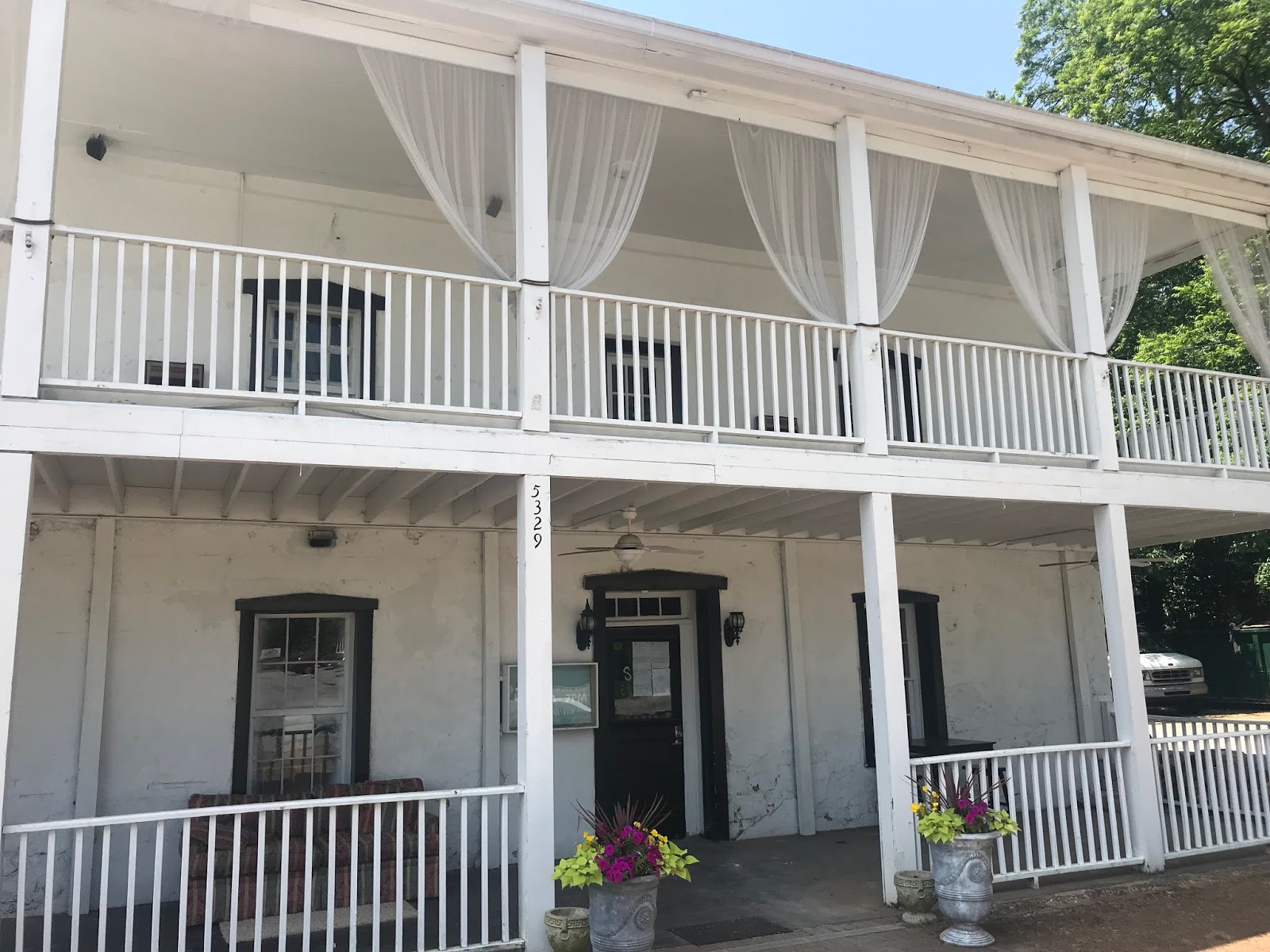 |
| This house was one of several Confederate hospitals. |
 |
| The old railroad depot, which was closed during my visit |
According to an article last month in
The Atlanta Journal-Constitution, the state of Georgia wants to help the majority-black city
shed its "Old Stone Mountain" image -- which included the resurgence
of the Ku Klux Klan a century ago and white supremacy.
City officials hope a new tourism office will help the city
attract new businesses and visitors, developing its image as an inclusive,
diverse community. Currently, many storefronts are vacant.
Subscribe to:
Posts (Atom)