Showing posts with label city. Show all posts

Thursday, March 12, 2026

Built by Black laborers, Nashville's Fort Negley -- now getting improvements -- yields a trove of Civil War-era artifacts, including doll's head, percussion caps and glass

Matthew Malone digs in; doll's head and rifle percussion caps were found in that unit (Picket photos)
Above swaths of yellow flowers, known locally as Nashville Mustard, and within sight of the city’s downtown skyline, a small team conducting archaeological digs on the heights of Fort Negley was having a glorious day.

Metro Nashville Historical Commission archaeologist Adam Fracchia and three volunteers worked in two excavation units within the remains of the fort, which was largely built in 1862 by free Blacks and “contrabands” – formerly enslaved people who fled to Nashville during the Civil War.

For all its public appeal, archaeology is especially tedious work. Everything must be recorded and sifted carefully. Some days you come up empty.

But not on this recent Friday.

Liana Blackburn sifts the Tennessee clay as Patrick O'Sullivan works in Unit 6 (Picket photo)
While I soaked up the sunny weather, steady breeze and the great views from St. Cloud Hill, the group – made up of Fracchia, Liana Blackburn, Matthew Malone and Patrick O’Sullivan -- was hitting pay dirt within minutes of setting up shop.

In the few hours that I drifted between the two open pits, the team collected several rifle percussion caps, shards of glass, bricks, cow bones, charred wood from fires and the head of a tiny doll – all likely tied to the time of the fort, which troops left in 1867.

“This is a very exciting day,” said Fracchia, who has been doing archaeological work at the city’s 64-acre historic park for a couple years. “It is unusual to get that many deposits.”

Federal army used string of forts to hold Nashville

Nashville was the first Confederate state capital to fall to the Union, and it didn’t take long for the army to build defensive fortifications to protect access to railroads and the Cumberland River.

Fort Negley during the war (Library of Congress) and Matthew Malone and Adam Fracchia, background (Picket photo)
Later in the war, regiments with the U.S. Colored Troops were among those occupying Negley, which fired on Confederates during the Battle of Nashville in December 1864. It was spared a direct assault; U.S. Colored Troops did fight elsewhere in Nashville during the battle.

Fracchia on most Fridays welcomes the public to take part in the excavations at Fort Negley, which was picked over by relic hunters for a long time. Signs warn visitors it is unlawful to bring metal detectors, dig or remove artifacts.

Still, compelling artifacts such as those uncovered when I was there are still to be found by archaeologists. Fracchia spoke about them with a few visitors who meandered into the project area from time to time.

Park upgrades will honor Black laborers, USCT soldiers

Fort Negley has recently begun the first phase of a major upgrade to the park, which is largely surrounded by highways and commercial development that have largely supplanted the African-American  Bass Street neighborhood.

Many elements of the venue have deteriorated. A key aim is honoring the Black laborers who built the fort.

Site manager Tracy Harris said the work will include improved walkways, interpretive signage, a new overlook structure, a memorial lawn on the site of a former baseball field, Greer Stadium (Background in Picket photo at right) and a Freedom Plaza.

Fracchia and volunteers have been working only in areas that would be disturbed by new walkways and interpretive signs.

The first phase includes an archaeological investigation at the site of the historic Bass Street community along with a public history component, as well as a large-scale mural designed and installed by a local artist, the city says.

Many of the USCT veterans and Black civilian workers settled in the area following the war. The latter were forced to work at Fort Negley, and many died during construction.

Davidson County historian and Tennessee State University professor Learotha Williams said in a February social media post:

African-Americans pressed into building Nashville forts for Union (Annals of the Army of the Cumberland)
“This project and specifically the new memorial lawn will honor all those who came here during the Civil War and, through their service and sacrifice, compelled the city and the nation to redefine citizenship and the meaning of freedom in America.”

Many artifacts seem to be evidence of camp life

On the day I was in town, O’Sullivan and Blackburn worked in Unit 6, which is near what was once a large palisade wall. Much of Civil War-era Fort Negley is gone; young men with the Works Progress Administration (WPA) reconstructed the site during the Depression.


Large stones and walls were set in place, though they have shifted or fallen down in some areas since. (Above, Picket photos from March 2026) City funding for the enhanced park does not include repairing the walls.

Fracchia said the team gets a mix of Civil War and postwar items and it is difficult to tell whether the items we saw that day were deposited during the fort’s construction or later in its service.

Unit 6 might have been a trash pit – inside were livestock bones signifying possible rations for Federal soldiers, bricks and broken bottles, including what may be part of a pickle jar. Fracchia said a wooden post may have been placed within that unit.

Glass jar lid, volunteer Patrick O'Sullivan with cattle rib, fragment of bottle (Picket photos)
The archaeologists became excited upon seeing what appeared to be upside-down bottles.

“I’m excited to see if they are intact,” said O’Sullivan before he and Blackburn carefully dug around them.

The items were not complete – one appeared to be a lid to a jar already collected and the other was the bottom of a bottle believed to be hand-blown.

Fracchia worked with Malone a hundred yards away in Unit 10. While they did not find as many artifacts, they discovered a few percussion caps and the doll’s head, made of either china or bisque.

“We find these mass-produced dolls at domestic sites often,” Fracchia later told me. “I do not know why it was a Fort Negley.” (National Park Service photo, left, from Fort Stanwix)

He made a reference to it possibly being a “Frozen Charlotte,” small, usually unclothed dolls popular during the mid-19th century until about 1920. If you want to know more about how they got their name, click here.

The short version, according to the National Park Service: The name “Frozen Charlotte” was associated with the dolls once they were gaining in popularity. It is inspired by a folk ballad about an underdressed “Young Charlotte” or “Frozen Charlotte” who froze to death while on a carriage ride to a winter’s ball.

The find was especially exciting, with Malone carefully walking it over for Blackburn and O'Sullivan to see.

Perhaps surprisingly, not many personal items have been found in recent years.

Hey, public: This is your chance to join a dig

The Metro Nashville Historical Commission works out of the restored Sunnyside Mansion in Sevier Park, a few miles southwest of Fort Negley.

Following a disastrous loss at the Battle of Franklin in November 1864, Confederate Lt. Gen. John Bell Hood moved upon Nashville, digging in below the city. Federal Maj. Gen. George Thomas attacked about two weeks later, sending Hood’s battered army off the field on Dec. 16.

One of the master plan renderings of the upgraded Fort Negley (Picket photo)
It has long been known that dozens of bullets, including Minie balls, were left on the porch door and columns on the big house at Sunnyside. Fracchia showed me evidence of those before I traveled to Fort Negley. The restored mansion includes display areas showing where some of the bullets or cannon rounds hit.

Fracchia said officials don’t have detailed descriptions of what happened on the property during the battle, but they believe Confederates must have been a significant target because of the number of bullets and holes. They eventually were forced to retreat.

The commission has found rifle pits and entrenchments on the land. 

Fracchia’s work extends other sites. The commission recently won a grant to fund a website where Nashvillians can upload photographs of artifacts they find on their property.

Adam Fracchia and Liana Blackburn show off Unit 6 to visitors (Picket photo)
Fracchia maintains a laboratory with items from Fort Negley and Sunnyside (I will report more on the latter in a subsequent post).

On the day I was in Nashville, a woman visiting Sunnyside Mansion asked about helping with the archaeological work.

“You have to show the public this is yours,” said Fracchia.

Site grid and Liana Blackburn and Adam Fracchia (Picket photos)
Editor's note: Please contact Nashville archaeologist Adam Fracchia at adam.fracchia@nashville.gov if you have questions about the project or want to join the work on site.

Friday, June 16, 2023

Huzzah! A busy and scary Atlanta road is finally being repaved. It played a prominent part in 1864 Battle of Atlanta, is depicted in Cyclorama

A stretch of potholes, a view of Decatur Road in Cyclorama (Picket, AHC photos)
For many in the Atlanta area, the only thing as exciting as the first-place Braves ballclub is the current resurfacing of a vital road connecting the city and nearby Decatur, Ga.

Commuters and residents in the Inman Park and Candler Park and other neighborhoods have long bemoaned the potholes, reversible lanes and too-scary-for-bicyclists conditions. Maintenance was never a word associated with DeKalb Avenue.

“A drag strip in a warzone,” the website Urbanize Atlanta observed, perhaps ironically, in a reference to car crashes and mishaps.

War zone indeed. Motorists who zip along the road might notice a half dozen or more historic markers describing what happened during the Battle of Atlanta in 1864.

Project overlaid on 1964 DOT map showing Battle of Atlanta (rendering W.D. Gast)
The avenue back then was called Decatur Road, and it’s depicted in the Atlanta Cyclorama painting and has a reference in “Gone with the Wind.”

The Atlanta project -- which includes bike and turn lanes and intersection improvements -- stretches from Jackson Street near downtown Atlanta to Ridgecrest Road, several miles to the east. The road was in the thick of things before, during and after the battle.

The avenue is bordered by the CSX (formerly Georgia Railroad) and MARTA lines on one side, and residential neighborhoods and scattered businesses on the other.

Site of artist tower at left looking at center of paintingk Atlanta skyline behind (Courtesy AHC)
(Full disclosure: I have traveled DeKalb Avenue for years to work in downtown Atlanta and am very aware of the potholes).

Decatur Road featured prominently in the July 22, 1864, battle, says Charlie Crawford, president emeritus of the Georgia Battlefields AssociationOf course, it was a dirt road during the Civil War, and had it owns share of potholes and ruts. Commanders used the road to carry men, materiel and artillery.

The view toward Stone Mountain in Cyclorama; Decatur Road to right (Courtesy AHC)
The circular Cyclorama shows the road stretching to Atlanta and Decatur. It was a mere block from the Troup Hurt House, the focal point of the painting depicting a brief Confederate breakthrough.

“It was also a main approach route for the Army of the Tennessee prior to the battle,” says Crawford, referring to a large Federal unit under the command of Maj. Gen. James B. McPherson, who moved his troops from Decatur toward advancing Confederates.

Charlie Crawford drew red lines showing road in Cyclorama
“As the Cyclorama illustrates, it wasn’t nearly as straight as it is now, curving to the south of the railroad and then curving back north at certain spots, including just east of the Confederate breakthrough,” he says.

Mary-Elizabeth Ellard, GBA secretary and trustee, operates a veterinary practice along DeKalb Avenue. “Many people forget that they live/work/play on a battlefield,” she says.

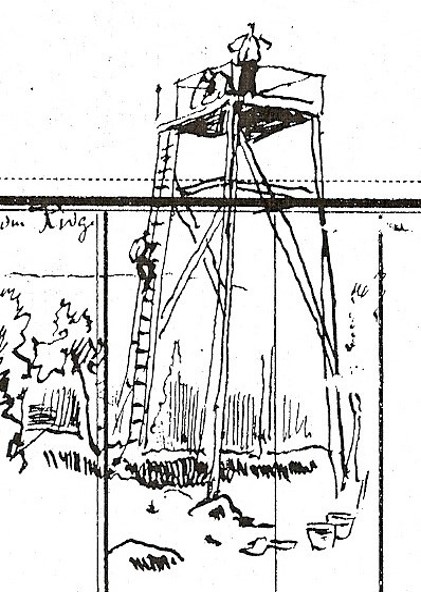
German artists who created the Cyclorama in 1886 erected a tower on DeKalb Avenue near the current Inman Park MARTA station.

To obtain perspective, they were able to see the road, the railroad and the site of a former Confederate iron rolling mill.

The Troup Hurt House was burned a day or two after the battle and the artists did not know its precise location 22 years later, said Gordon Jones, senior military historian and curator for the Atlanta History Center, which houses the giant painting. The home was located on what is now Degress Avenue.

(The sketch at left, courtesy of the AHC, shows a similar tower in Chattanooga, Tenn.)

I turned this week to the Atlanta Campaign History and Discussion Group Facebook page for feedback on the road’s Civil War history.

Admin Brad Butkovich mentioned fighting in what is now called the nearby Little Five Points neighborhood and the various markers that indicated troop positions and action.

“Many markers have been moved as roads and intersections have expanded and changed over the years,” one Facebook reader says.

Much of the Battle of Atlanta occurred along and near the north-south Moreland Avenue, which cuts under DeKalb Avenue and through Little Five Points. (Moreland Avenue is depicted in a 1964 map above that has an overlay of the repaving project.)

MARTA rail line (left) along DeKalb Avenue (Picket photo)
Georgia State University details the histories of streets during the Battle of Atlanta. Of Moreland Avenue, its website says:

“While this route may be a high-traffic residential road today, in 1864 it was little more than undeveloped farmland -- unremarkable in every way except its role as the dividing line between Fulton and DeKalb counties. However, as Sherman’s Federal armies made their way towards Atlanta, this undistinguished strip of land would become the site of some of the fiercest fighting experienced by participants of the Atlanta Campaign in the American Civil War.” 


A military map in
the Library of Congress collection (above, click to enlarge) clearly shows Decatur Road and the Georgia Railroad, troop positions and a spot labeled “Rebel Barracks.”

The road was mentioned during the 1939 film “Gone with the Wind.” The fictional Frank Kennedy, a business owner and Klansman, took part in a raid on a shantytown, ostensibly as revenge for an attack on Scarlett O’Hara.

O’Hara asks Rhett Butler about the whereabouts of her second husband.

“He’s lying out on the Decatur Road,” Butler replies. “Shot through the head. He’s dead.” 

The $5.4 million project aims to make everyone safer, especially with the formal end of reversible lanes. I drove the stretch this week and was heartened to see much of it already paved. Work is expected to be completed in August.

Road work near old textile mill in Cabbagetown area (Picket photo)
Troup Hurt House is focal point of the Cyclorama (Picket photo)

Saturday, June 1, 2019

Stone Mountain Village near Atlanta notes its Civil War history, but wants to shed reputation and promote its black history, too

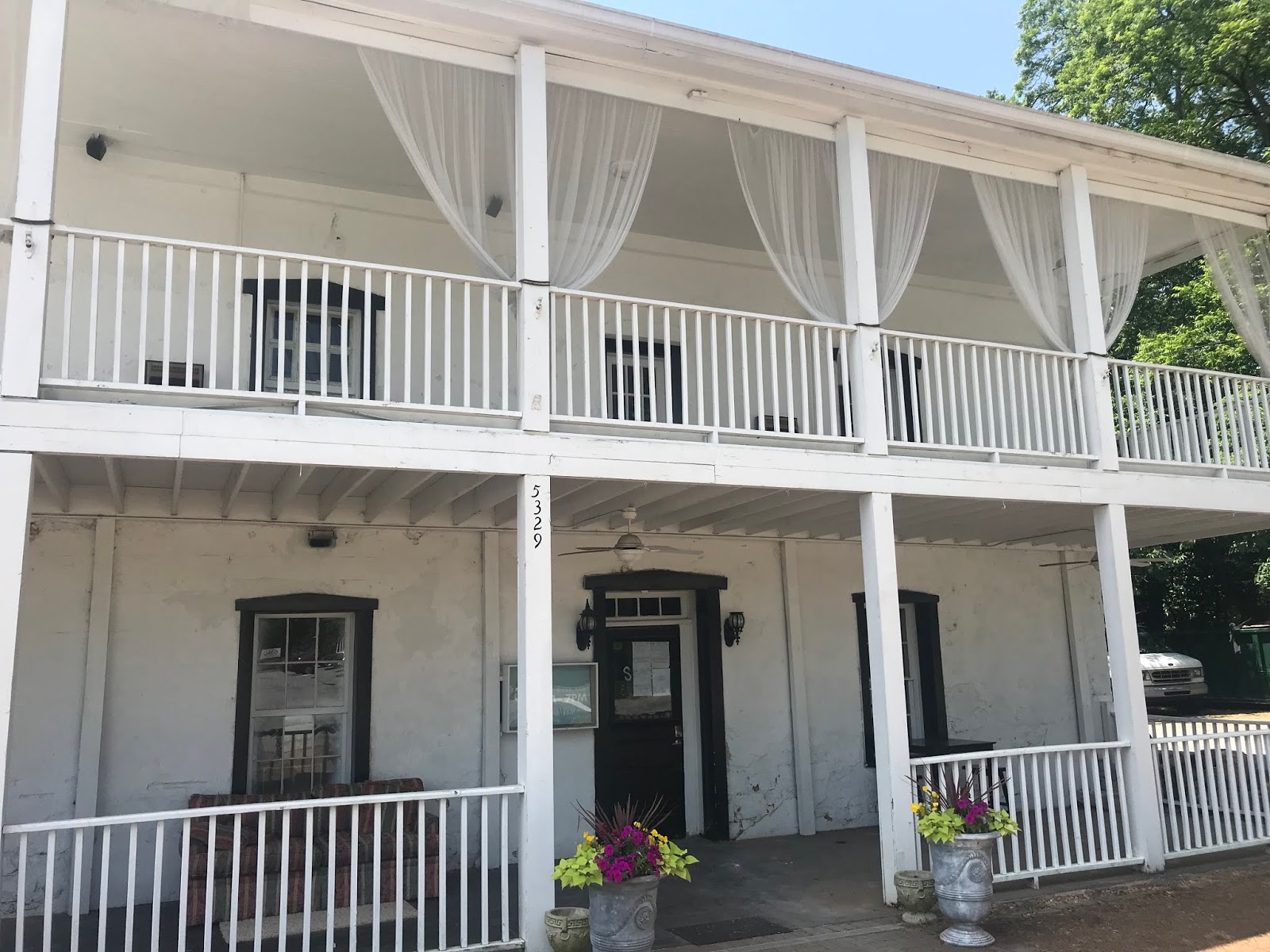
The Mayor's House in Stone Mountain Village

Only a couple miles from Georgia's Stone Mountain Park and its carving of Confederate leaders, Stone Mountain Village is a very diverse community with tributes to its Civil War past and dreams for a robust future that blends what one businessman, Daniel Brown, calls "community revival, history and opportunity."

This site (top), built in the mid-1830s by slaves, has seen several uses, including the home of Stone Mountain's first mayor, a Civil War hospital and other businesses, including restaurants.

A coffee bar co-owned by Brown is on the ground floor of what's called "The Mayor's House." It's believed the second floor housed wounded Confederate troops. The current owner wants to open a restaurant and the building is being renovated. 

For several years, the Sycamore Grill restaurant was in the building, named for the huge tree out front.

A fundraising page for the renovation effort says: "The Mayor’s House is valuable in our vision for reconciliation in Stone Mountain, due to its history and its undeniable location. Built in the very center of a town historically known to separate and mark boundaries between blacks and whites, the reclamation of Stone Mountain Village’s flagship building for a modern vision of community and economy will breathe life and restoration for this area."


Nearby is the old railroad depot. A marker recalls July 1864 Federal cavalry raids during Sherman's campaign against Atlanta.

Scores of Confederate soldiers killed in combat or who died in old age rest at an old cemetery near downtown. New headstones for unknown dead were installed in 2011 and 2012 by Confederate Memorial Camp 1432, Sons of Confederate Veterans.

Established circa 1850, the cemetery is the final resting place for the villages’ settlers, granite cutters, farmers and townspeople.

This house was one of several Confederate hospitals.
The old railroad depot, which was closed during my visit

According to an article last month in The Atlanta Journal-Constitution, the state of Georgia wants to help the majority-black city shed its "Old Stone Mountain" image -- which included the resurgence of the Ku Klux Klan a century ago and white supremacy.

City officials hope a new tourism office will help the city attract new businesses and visitors, developing its image as an inclusive, diverse community. Currently, many storefronts are vacant.

Wednesday, July 23, 2014

Atlanta Cyclorama is getting a new home: Leaving Grant Park for Buckhead

(MSTSD and R.L. Brown & Associates)

The Atlanta Cyclorama, a cultural and historic city landmark, is moving from its longtime Grant Park home to the Atlanta History Center's campus in Buckhead, according to an announcement made Wednesday after years of study and discussion.

The 19th century painting-in-the-round of the Battle of Atlanta will still belong to the city, Mayor Kasim Reed said in a joint statement, but will be restored under the stewardship of the AHC. Plans must be approved by Atlanta City Council.

The Cyclorama was last overhauled 30 years ago. Some observers have said the mural, painted in 1885-86, is deteriorating and needs significant work.

"The move, which will take two years to complete, will relocate The Battle of Atlanta painting, the locomotive Texas and other Civil War artifacts to the Atlanta History Center where they will be restored and housed in a new state-of-the-art facility," a statement from the city and Atlanta History Center said. "The existing Cyclorama building will be developed into a premier community and event space as part of upgrades by Zoo Atlanta."

Zoo Atlanta is adjacent to the Cyclorama.

"There has been overwhelming positive reaction and it is a win-win situation," Gordon L. Jones, senior military historian and curator at the AHC, told the Picket this afternoon.

Construction will begin in summer 2015 on a custom-built annex at the Atlanta AHC to house the painting. The move will take two years to complete and restoration will begin at the painting's current location. The 23,000-square foot addition is planned for the northeast corner of the AHC campus, officials said, and will connect to the current museum.

(MSTSD and R.L. Brown & Associates)

The AHC location apparently won out over the option of moving the painting to Centennial Olympic Park in downtown Atlanta.

The AHC has already committed to $32.2 million for the project. Jones said about $10 million will be spent on the new building and about $11 million for the restoration. The project will include a $10 million endowment.

"The History Center intends to restore the painting to its full size and overall height, and to re-create the 128-year-old painting’s original visual perspective – both of which have been lost for nearly 100 years," the statement says. It says the AHC will create a 3-D experience for visitors who will see the mural "as it was originally intended to be viewed in the 19th century."

A December 2011 Civil War Picket article reported on a task force set up by Reed to look into the painting's future. Attendance at the Cyclorama had flagged in recent years, though there had been a recent increase, and the city was concerned about funding and the condition of the mural and related exhibits.

Areas under consideration for a possible move were the Atlanta History Center campus, the former World of Coca-Cola site in Underground Atlanta and a stretch of popular venues at or near Centennial Olympic Park in downtown.

The Atlanta Journal-Constitution said the AHC moved to the front when an Atlanta couple, Lloyd and Mary Ann Whitaker, offered $10 million in support of a relocation to Buckhead.

Grant Park has housed the massive work of art since 1921. It covers 15,030 square feet and is 42 feet tall and 358 feet in circumference

Figures in the foreground of the Atlanta Cyclorama.
Anticipated attendance for the Cyclorama was not a part of the financial calculus, said Jones. The prime factor was ensuring the 360-degree painting's long-term care, he said.
"It is an artifact. It is not an attraction," he said. "In the 1880s it was the IMAX theater."

Still, Jones expects visitors will learn much about earlier forms of entertainment and how the Civil War was interpreted well more than a century ago.

"This is Atlanta. This is the thing you went to see when you were a kid. Now it will be able to tell some new stories."

Long before motion pictures, "The History Channel" and 3D – cycloramas were the storytelling spectacles of the time. The huge murals presented sweeping historical scenes and singular moments of intense personal bravery or sacrifice.

European artists in the late 19th century created the building-sized round paintings. The artists often traveled to the locales to ensure historical accuracy.

Most of the paintings are gone – lost to time, the elements and the evolution of mass entertainment.

Only two remain in the United States. They feature scenes from the battles of Gettysburg and Atlanta in the Civil War. 


Wednesday's announcement coincides with the 150th anniversary of the Civil War's Atlanta Campaign. Most of the reaction on the AHC's Facebook page was positive. "Wow this is great news, I can think of no better place for it. We went a year or so ago and noticed it needs work," said one commenter.

Critics of the move hoped that the city would upgrade the current site.

Jones acknowledged many will be sad to see the painting leave Grant Park. But the neighborhood and city will benefit from the boost the building will give to Zoo Atlanta, he said.

"It has been there a very long time," Jones said of the mural. "I am going to hate to see it go on that level. Nostalgia is not going to save this painting. This is one of the world's greatest artifacts."

Paul Simo, historic committee chairman with the Grant Park Neighborhood Association, said Wednesday was a "bittersweet day."

“No, we are not surprised," he told the Picket. "We are extremely sad to see the Cyclorama painting move from Grant Park."

But residents believe the Atlanta History Center is the proper steward for the painting. “We know the AHC will take good care of the resource. They are the right entity to care for it and give it the right exhibit that it deserves."

Simo said the association has a good relationship with the zoo and looks forward to the new use of the building, including an overlook area over the African savanna exhibit. "Any traffic in the neighborhood is good for our local businesses."

• The Atlanta Journal-Constitution coverage
• Details from the Atlanta History Center