|
| Clamshell prepares to lift mud (and possible artifacts) to deck |
 |
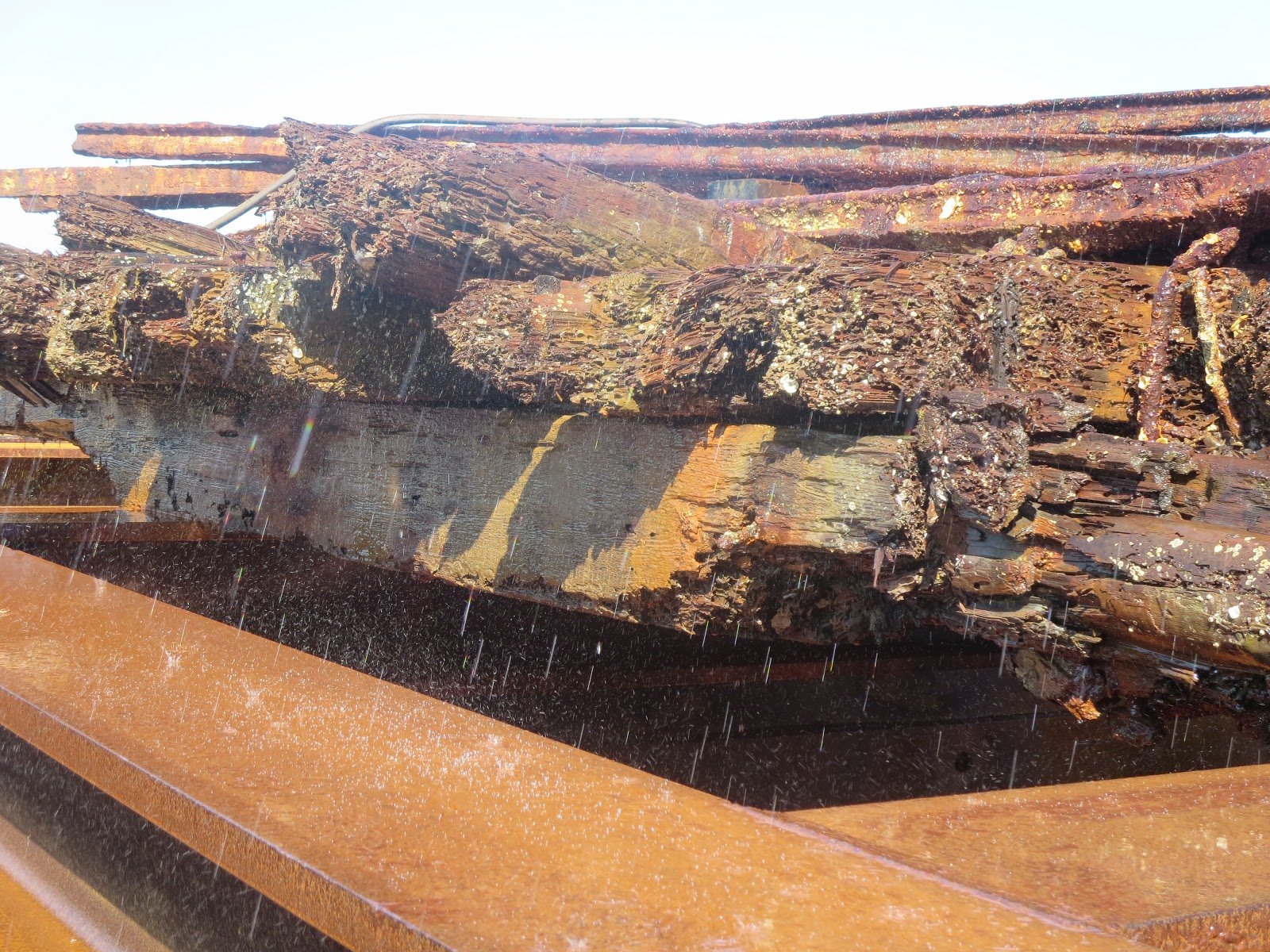
| Spikes used to join armor components (Picket photos) |
I couldn’t let a narrow window of
opportunity close, so I drove most of the night to Savannah, Ga., to spend a
few hours Saturday aboard barges recovering the last significant portions of
the Confederate ironclad CSS Georgia. That on-site project will be completed
in the coming days. Thanks to the Savannah office of the U.S. Army Corps of
Engineers for having me on board. All photos by the Picket unless noted otherwise.
Protected
by railroad iron
I finally got
face-to-iron with two large casemate sections that were lifted from the
Savannah River this summer (by the way, they are being placed in a different
spot back river this weekend for safekeeping).
I still am trying to get my head
around this innovative way of building armor when you don’t have more raw
resources and manufacturing capabilities.
 |
| Sprinklers are used to keep casemate safe from corrosion |
Jim Jobling,
with the Conservation Research Laboratory at Texas A&M University -- which
is conserving much of the CSS Georgia’s 16,200 artifacts -- said each rusted rail
is 4 inches by 4 inches, 24 feet long and weighs about 400 pounds. The iron is
backed by 8 inches of pine and another 12 inches of heavy lumber.
Archaeologist
Gordon Watts, who has dived and studied the wreck site for decades, said there
were at least seven patterns of interlocking railroad iron used to make the casemate in
1862.
Where did the
ship builders get the railroad iron?
 |
| Two rail pieces, lower right, with tar used to stop leaks (USACE) |
“They were
likely to be confiscated,” Watts said – specifically from Northern-owned
companies, including a line from Brunswick, Ga., to Jacksonville, Fla. The
nephew of US Navy Secretary Gideon Welles came to Savannah after the war to try
to recover iron and other material, he said.
The CSS
Georgia was prone to leaking, from above and below, and crew members used tar,
plaster and other materials to fill gaps in the armor. Experts believe the engine was in service at all times, to power pumps that kept the leaky gunboat from sinking.
“It was obviously a pretty miserable place,” said Watts.
Detailed
drawings bring artifacts to life
 |
| Gordon Watts measures portion of casemate armor ... |
 |
| ... and documents the different patterns of railroad iron used for armor |
Gordon Watts, a
contract archaeologist from North Carolina, has produced numerous detailed sketches of CSS Georgia
components, something I first noticed during a visit to the 2015 recovery
operation involving U.S. Navy divers.
“If I draw it, than I have to think about it,” Watts said
of each item. He said he can get more interpretation that way than from just
observing mosaic images.
 |
| He points to components of engine (Picket photos) |
Find of the summer: Engine cylinders
They are not
exactly sexy, but two steam cylinders brought up by a grappling hook will tell
a lot about the ironclad’s propulsion. It’s known the CSS Georgia was underpowered
and thus became a floating battery near Fort Jackson to repel any Federal naval
advance on the city.
 |
| Jim Jobling washes off engine cylinders, frame mount (USACE photos) |
Officials don’t
know where the engines made; it’s possible they were taken from another vessel.
The cylinders were part of the piston system that drove shafts for two
propellers (only was of the props has been found and brought up).
Watts said he is aware of two or three other Confederate vessels, including the Arkansas, that featured railroad iron armor.
Now there’s enough of the machinery – with boiler and
shaft parts – to get a better sense of the power and speed capabilities of the
ironclad. Jobling said propeller and engine data, along with photos, are being
sent to the U.S. Naval Academy for analysis.
“We can then figure out how strong the engine
was, how efficient the propeller was and figure out the size and weight it
carried,” he said. “How underpowered was she?”
Gun port
and end piece
 |
| Note openings near rope that were part of a gun port |
 |
| Casemate end piece had angle at top (Picket photos) |
Three fascinating
sections of casemate headed for conservation in Texas rested on the end of one
barge. Sprinkler water kept them protected from corrosion until they can be
placed in tanks.
One was a
portion of a gun port. Five guns, including 9-inch Dahlgrens and a 6-pounder,
were recovered in 2015, but others were brought up earlier. The CSS Georgia
could carry 10, but it probably carried fewer when it was scuttled in December
1864.
The end piece
could be used in a museum exhibit that
explores the design of the vessel. There are no surviving plans, and
archaeologists are not even sure of the ironclad’s size or weight. Watts said
evidence points to it being 45-50 wide at the beam and between 180 and 200 feet
long. Officials said with five guns in service, a crew of between 100 and 125 was likely serving the CSS Georgia.
Buckets
of artifacts
 |
| Wood roller with brass fitting. Its use? Not yet known |
 |
| Piece of artillery grapeshot (Picket photos) |
During this
past month’s mechanized recovery, archaeologists have placed smaller finds in water-filled
white buckets lining the side of one barge.
Crews this year, unlike in 2015 and earlier, have
found very few personal items beyond uniform buttons and a couple bullets, but
it was interesting to see what was in the buckets: Various CSS Georgia
artifacts, including parts of a pulley/rigging, and pre-Columbian pottery that washed into the salvage site.
Clamshell,
shovels and hard labor
A dozen or so
archaeologists worked the hot deck of a barge on Saturday, using large fire
hoses and shovels to go through hundreds of pounds of mud placed in separate
bays by a crane.
Each bay
featured a screen on one end that would trap possible artifacts as the
high-volume water cut through the muck. On this half day, 13 dips of the
clamshell were made (repairs on the crane reduced the haul); there were as many
as 80 scoops performed on longer days.
 |
| Screen on right traps artifacts during washing |
 |
| Zones used by grapple and clamshell device (Picket photos) |
Will Wilson of Panamerican Consultants utilized USBL, a method of underwater acoustic positioning,
to direct the crane where to drop a large clamshell device to pick up the
scoops from grid squares.
The recovery operation also has used a large grapple
to pick up bigger items from the river bottom 40-45 feet down.
Replicas
made from 3D plastic
 |
| Jim Jobling with replica of propeller recovered in 2015 and since conserved |
Jobling, Watts and Stephen
James, lead archaeologist on-site for Panamerican Consultants, will speak at a
Corps public event in Savannah on Aug. 2.
The program includes portions of a
documentary, "Dredging
up the Past: Recovery of the CSS Georgia Shipwreck."
 |
| Columbiad gun sight, but not the gun, was pulled up. |
 |
| Replica of pre-Civil War artillery sword hilt (Picket photos) |
Jim Jobling of the Texas A&M conservation lab has procured small educational replicas of some of
the artifacts found in recent years. “I scanned the artifacts
using an accurate laser scanner” and they were sent to a printer to have them rendered
in plastic.
Dealing with recovered
ammo
The last part of this year’s final CSS Georgia recovery will be the deactivation of artillery shells
found in the muck. Thus far, a Brooke shell with an Archer fuse and a 9-inch Dahlgren round rest in baskets below the surface awaiting this operation. But more rounds could be
found in coming days.
The CSS Georgia may have had 500 shells for the
five recovered guns. But how many went down with the ship and are still in the
Savannah River? Jobling said 99 were brought up and saved in the 1980s, 240 in
2015, and two thus far this year. All precautions are being taken.
… And a couple not so
cool things
The Georgia’s hull is gone, eroded by time,
dredging and destructive teredo worms.
That makes it extremely difficult to configure components.
“If we had a hull, we could tell how things were arranged,” said Watts.
While finds in 2015 and this year have added to the CSS
Georgia’s story, Watts said, the absence of the hull and other information may
leave many mysteries unanswered.
 |
| (Picket photos) |
Jobling, on a tour of the casemate sections, pointed to
the myriad holes (above) left by teredo worms. Crews were asked to gain wood samples
from the casemate for dendrochronology – to learn the age and condition of the
trees cut for the job in 1862. But given the damage, they had to get samples
from other CSS Georgia lumber.
“There was a lot of old-growth wood in Georgia
in that time period,” said Jobling. “They were probably cut in early 1862 … she was built with green
wood. They had to cork her and fill the cracks between the timbers.”
 |
| Sections of rusting railroad iron (Picket photo) |
The ‘Mud Tub’ a winner
after all?
A 2015 article by the Army Corps of
Engineers details frustration among the ironclad’s crew, relegated to the back
lines and on a vessel that was stationary, and residents of Savannah who raised
money to build a ship that didn’t have much engine power. The lure of desertion
and drinking were common on the CSS Georgia.
One woman wrote: “Our iron floating battery is a splendid failure. She has been
taken down between the forts and they are obliged to keep her engines at work
the whole time to prevent her sinking, she leaks so badly. The officers had a
consultation, a day or two after she went down, to decide on the propriety of
throwing over her coal to keep her afloat. During the long storm last week, she
leaked also from the roof, so that there was not a dry spot for the men or
anything else in the vessel, even their beds were wet.”
 |
| Gordon Watts takes break from examination of casemate |
But Watts has a more forgiving view. The CSS Georgia was a valuable
part of the city’s defenses for two years, in concert with Fort Jackson,
torpedo mines, pilings and other vessels.
“When you get down to it, it was really effective,” he
said.
 |
| Casemate section stays cool in summer heat. (Picket photo) |