The Medal of Honor awarded to Wisconsin native Alonzo Cushing
for heroism at Gettysburg is on temporary loan to Delafield, where he lived several years. Though he died in 1863, Cushing didn't receive the nation's highest honor
for valor until last November during a ceremony at the White House with members
of his extended family present. • Article
Monday, May 11, 2015


Thursday, May 7, 2015
150 years ago: Arrest of Capt. Henry Wirz began assignment of blame for Andersonville
 |
| Harper's Weekly illustration of Capt. Wirz stomping on prisoner, based on testimony at his trial in 1865 (NPS) |
On this day, 150 years ago, the commandant of the stockade at Andersonville prison was arrested, setting off a chain of events that remains controversial to this day.
Union cavalry Capt.
Henry Noyes took Confederate Capt. Henry Wirz into custody at the site at war’s
end. Wirz was sent to nearby Macon, Ga.; Nashville, Tenn.; and then Washington, D.C.,
where he was tried and convicted of conspiracy and murder.
Accounts by prisoners during the Civil War are full of stories of horror, heroism and
extraordinary efforts to survive. At
Andersonville alone, nearly 13,000 men died over 14 months -- an average of
more than 30 a day.
Conditions
at Andersonville deteriorated quickly by the summer of 1864. Food often was
scare and the staff was always short of supplies – matters not directly under
Wirz’s control. And the Union army had largely ended prisoner exchanges.
But Union survivors testified he was cruel and would order some
of them shot when he became enraged, or did the shooting himself.
“Wirz was unable to control the
bureaucracy that plagued the Confederate military prison system, so he
controlled the prisoners in the only way he could – through intimidation and
punishment,” says a National Park Service article.
The officer was hanged on Nov. 10, 1865,
after insisting those higher up the chain of command were responsible for the
prison’s appalling conditions. He was punished for matters he could control –
his own inconsistent behavior, actions and dehumanizing of prisoners.
Wirz has his defenders, and a statue in
his memory still stands in the small hamlet of Andersonville near the national
site.
The Georgia
historian for the United Daughters of the Confederacy wrote an essay in 1921
about what she termed an injustice – suborned testimony and exaggerations at
the trial.
She wrote
that Wirz did not fearing going to Macon with Noyes because “he was conscious of having
done all for the prisoners that was possible under the conditions.”
Before they left, Wirz invited Noyes to share a small meal of bacon and
cornbread with his family.
“With a
woman's instinct, Mrs. Wirz did not like the ominous silence of Captain Noyes,
and became greatly agitated when her husband bade her goodbye. Wirz tried to
comfort his weeping wife and children, assuring then that all would be well.
After an affectionate goodbye, he left for Macon.”
This
portrayal of a hospitable man just following orders did not match the memories
of many who were guards or prisoners at Andersonville.
One Confederate soldier testified that Wirz ordered a prisoner into the
stocks during a rainstorm. The soldier, observing the prisoner was drowning,
placed an umbrella over the prisoner and approach Wirz, who was said to reply,
"Let the damned Yankee drown."
Monday, May 4, 2015
Kennesaw Mountain Trail Club honored for heavy lifting before, during 150th events
 |
| Volunteers at 24-Gun Battery Trail construction (Photos: KMTC) |
A club that maintains 22 miles of trail within Kennesaw Mountain National Battlefield Park near Atlanta will receive a National Park
Service award for its extensive volunteer efforts leading up to and during last year’s
sesquicentennial events.
The NPS, in conjunction with the National Park
Foundation, will bestow the 2014 George and
Helen Hartzog Awards for Outstanding Volunteer Service at a
June program in Washington, D.C.
The Kennesaw Mountain Trail Club will receive the volunteer group award. It is being
recognized for:
-- Taking a large role in
the park’s commemoration last year of the 150th anniversary of the
Battle of Kennesaw Mountain by recruiting,
training and directing 500 volunteers who contributed 3,000 hours to make the
visitor experience more enjoyable; and by raising more than $100,000 -- making it
possible for prominent historians, authors, and performers to participate in
commemorative events. The club also maintained a website intended to build interest and volunteer and sponsorship
opportunities.

-- Working closely with the park staff, spending two years planning
and constructing the reroute of the Assault Trail (above), to follow the approximate
path that Union soldiers took to engage Confederate troops at Cheatham Hill and
past the McCook monument, which sat alone on the ridge for years;
-- Building the 1.5-mile long 24-Gun Battery Trail, along the
spot where Federal artillerymen opened up on Confederate positions in the
heights above at the June 1864 clash;
-- Creating school programs
to bring children into the park for interpretive sessions about the history of
the battle and the Civilian Conservation Corps camp.
-- Creating the “Hunt for
History” scavenger hunt and holding a movie premiere to generate public
excitement about the sesquicentennial.

 |
| Work along the 24-Gun Battery Trail (Photos: KMTC) |
Members of the trail club, which was
formed in 2002, have given about 28,000 hours of service. It has
between 50 and 100 active members, with hundreds of other volunteers helping from time to
time on work days.
Kennesaw Mountain’s trails draw a range of visitors, from
out-of-state war buffs to locals who enter the park from subdivisions to get
some exercise. There are runners, walkers, horseback riders and hikers
preparing for strenuous endeavors around the world.
The awards are named for former
National Park Service Director George B. Hartzog, Jr. and his wife Nancy. In 1970, the Volunteers-In-Parks (VIP) was
launched.
Saturday, May 2, 2015
Live blog: Lincoln funeral re-enactment
The State Journal-Register
newspaper in Springfield, Ill., is live blogging and posting compelling photos
from this weekend’s re-creation of the funeral procession and burial of
President Abraham Lincoln, 150 years ago this month. • Article
Friday, May 1, 2015
New CSS Georgia artifacts: Bayonet hilt, grapeshot, gun sight and much more
 |
| Stand of artillery grapeshot with cap (All photos U.S. Army Corps of Engineers) |
While TV
cameras and the public may be more interested when the big stuff – cannon, the propeller
and pieces of casemate – are lifted from the Savannah River, it may be the
smaller items currently being carried up by divers that tell the bigger story
about the operation and crew life on the Confederate ironclad CSS Georgia.
“The
artifacts have just been more fascinating than I would have expected, and I
think they are telling a better story than what people realized at first,” said
Russell Wicke, a spokesman for the U.S. Army Corps of Engineers office in the
Georgia city.
More than
1,000 artifacts have been recovered so far from the 1864 wreck site. The
underpowered CSS Georgia ended up serving as a defensive floating battery off
Fort Jackson, just east of the historic waterfront. It was scuttled hours before Union forces took Savannah.
The dive area
is about 150 feet by 250 feet. Visibility is near nil. Interestingly, pieces of
pottery that pre-date the Civil War have been recovered from the debris field.
The current
dives will continue into June, when a Navy barge and crane arrive on scene to
begin the heavy lifting.
Wicke this
week gave the Picket an overview of some of the items divers recovered in
April.

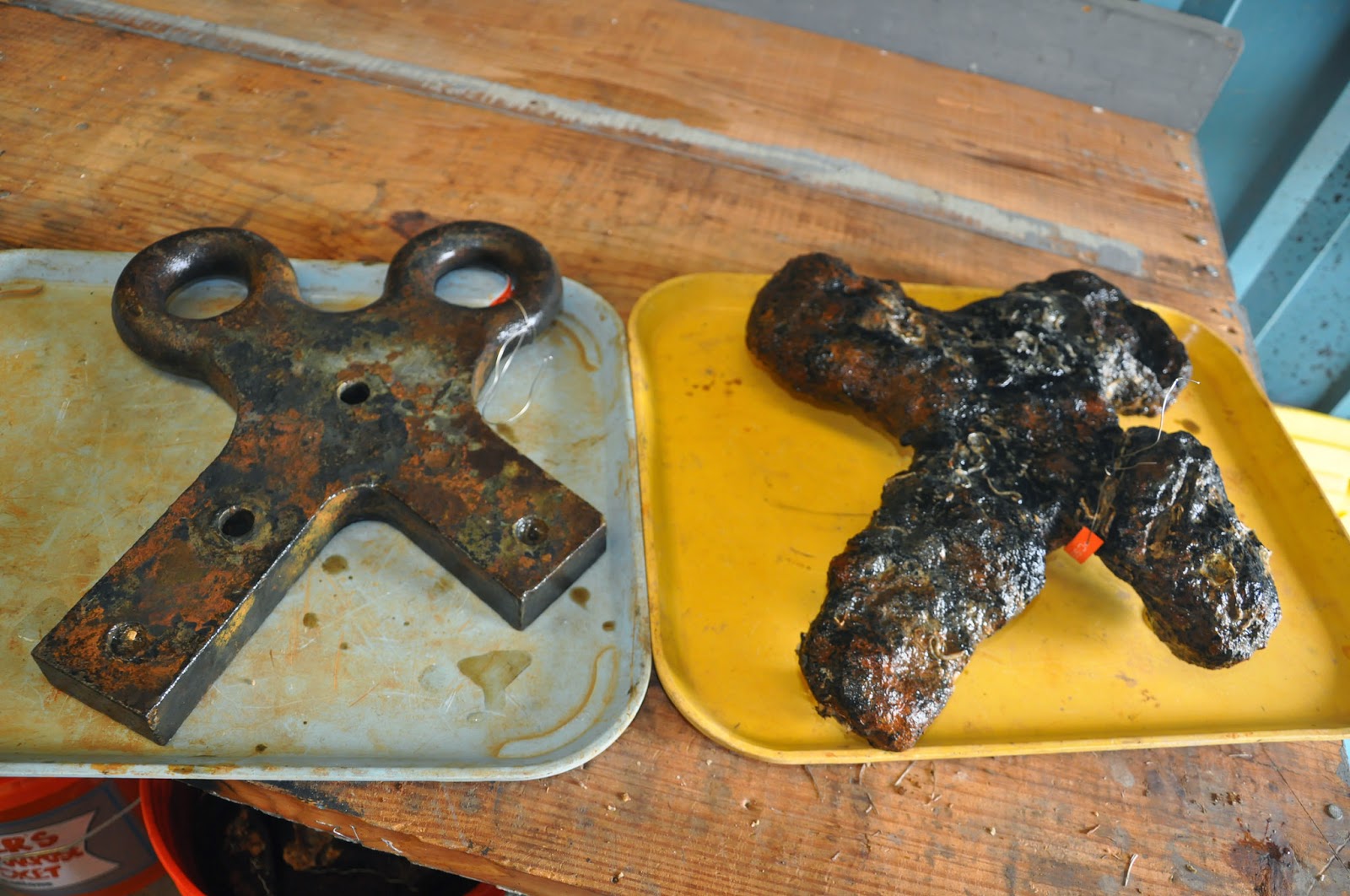
Misbehave? Watch out for the leg irons
Divers have recovered two sets of these contraptions, intended either for prisoners or crew members that were in trouble or prone to desert. The image in the center is an X-ray and the one at right an epoxy mold that can be referred to while the actual artifact undergoes extensive conservation.

Remnants of a bayonet hilt
According to a Corps article, the P.S. Justice rifle bayonet, model 1861, type II, was not of the highest quality. The company was based in Philadelphia.
Eyes for tackle from pivot gun
carriage
These shaped
pieces of brass (left) and iron were part of the rope and wood assembly used to
aim and direct fire (though the ironclad never fired a combat shot). Wicke said
research by Texas A&M University showed the cannon were not fixed in
position, as once believed. These eyes for tackle allowed the crew to fire the
cannon from different articles.

Grapeshot and stand
Here’s one of
the more remarkable finds. Wicke says the crew wrapped these pieces with
leather straps, which have long ago disintegrated in the river. He likens the
golfball-sized grapeshot to giant shotgun pellets – able to clear the deck. A cap was placed at the top.
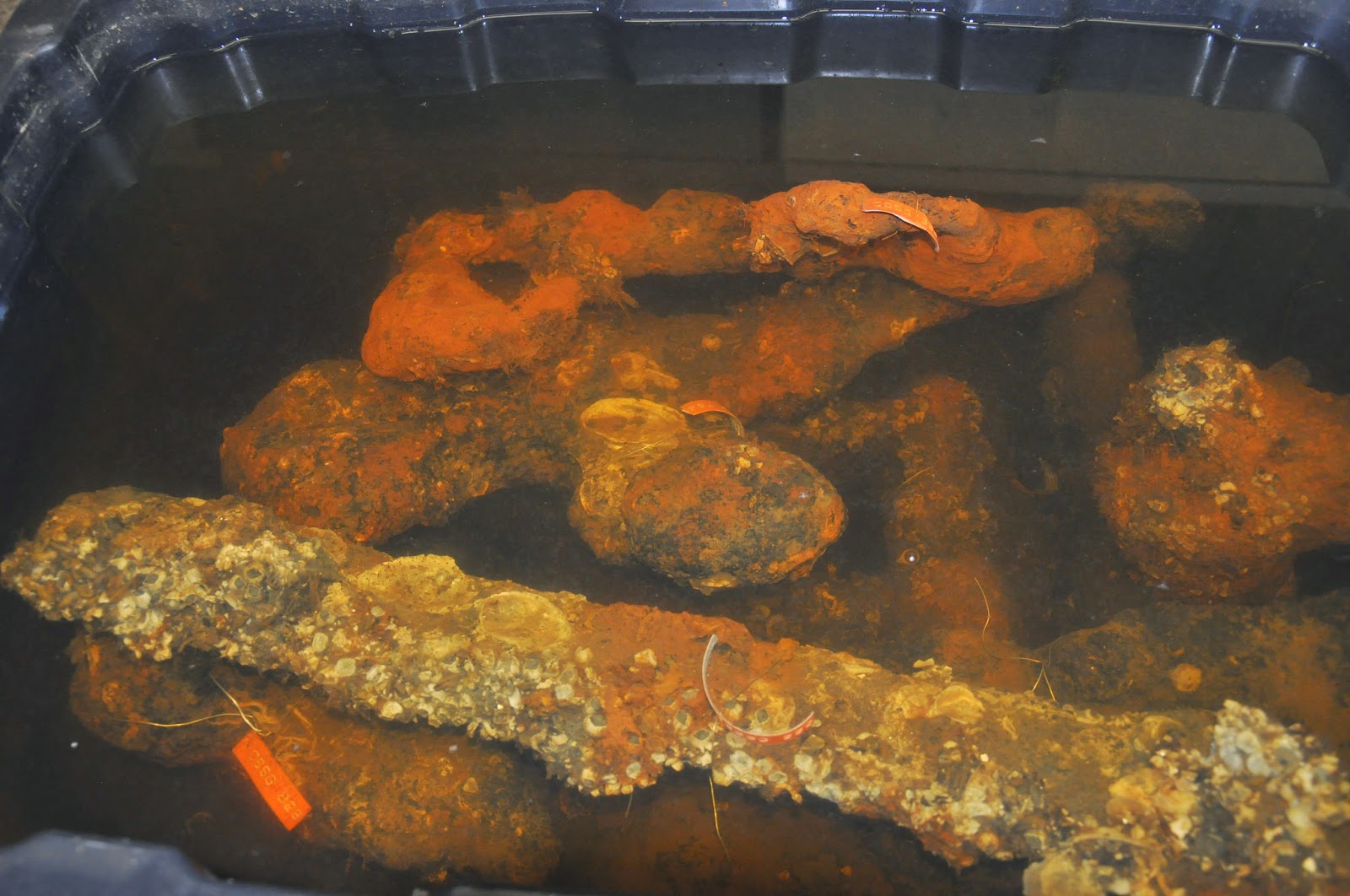
Assorted fasteners and spikes
The CSS Georgia was believed
to have about 24 inches of pine and oak beneath her iron cladding. These
metal items were used to link the railroad track armor to the protective wood
and other components of the vessel. Many of these pieces are covered in
concretion, the result of sand and shell forming sediment. Wood used on the ironclad is now largely “mush,” said Wicke, because of ravenous worms.

Rear gun sight
Jim Jobling, a project
manager with Texas A&M’s Conservation Research Laboratory, looks over a sight
for a 32-pound rifled cannon on the CSS Georgia. He noticed the faint presence
of a serial number.

Ever hear of a sabot?
This small metal disc was at
the back end of artillery shells and helped in the rifling process, says Wicke.
Subscribe to:
Posts (Atom)