Showing posts with label capitol. Show all posts

Thursday, April 9, 2026

As fundraising intensifies to fix up Dawkins House in Union, S.C., a university prepares to identify, learn and teach about those enslaved at Civil War landmark

Dawkins House awaiting next phase of work (Picket photo), Mary Poulton Dawkins and part of slave schedule
Mary Poulton Dawkins was many things in her 86 years, the majority of which were ensconced in a Union, S.C., home that was dubbed “The Shrubs” in honor of a family estate by the same name in her native England.

Dawkins, who in 1845 married a prominent South Carolina judge 14 years her senior, was described by relatives as headstrong and proud of her imported furniture and Queen Victoria. She was determined to see the Poultons restored to their former position of wealth and prominence, whether in the United States or England.

There was another side of the Englishwoman, however, that doesn’t project well these days.

While of the “highest culture,” Mary had a tendency toward bigotry, an observer wrote, and a paternalistic view of slavery. The 1850 federal slave schedule indicates husband Thomas Dawkins enslaved about 30 persons.

One of several fireplaces on the main floor of the dwelling; the library is nearby (Picket photo)
Following the South’s loss in the Civil War, and the Dawkins’ fortune largely gone, Mary lamented Reconstruction and the brief political power accorded to Black people.

The negroes on the plantation had really no ill feeling, but poor ignorant creatures, they were intoxicated with the idea of power and always fond of idleness; began to steal and destroy property, scarcely a night without a burning,” Mary wrote in a memoir penned late in life. “There was no redress, no law, and the ‘Ku Klux’ was formed to frighten the negroes, so sensational, supersti­tious.”

Some 120 years after Mary’s death, the nonprofit Preservation South Carolina is raising money for the next phase of the restoration of the dilapidated Dawkins House. The dwelling is destined to become an alumni and corporate center for the University of South Carolina Union, a small campus in the heart of the Piedmont city. (Picket video below of Bill Comer of PSC)


At the same time, USC-Union is establishing a genealogical and archives course that will focus on the history of the house and its occupants and visitors, including the identification of the enslaved, who – with a few exceptions -- currently are known only by their age and gender. The goal is to offer the class this fall.

It is anticipated that the course will be open to students and Union County residents who have an interest in ancestry research and history.

Backers of the Dawkins House project have said it is important the whole history of the home – warts and all – be told. That's the aim of other sites in Union County, including Rose Hill, former home of the Gist family.

Andrew Kettler, an assistant professor of history, told the Picket the aim of the course is less about assigning blame than moving toward acknowledgement and reconciliation. He describes it as a public history course; the syllabus is still being finalized.

“We are going to run … grants this summer that focus on finding sources related to the Dawkins House,” Kettler said (left, Picket photo). “We are currently recruiting two students and will apply for that funding at the end of April. The grant students will assist with identifying materials that focus on the Dawkins House held in local archives.”

Annie Smith, director of development on the campus, said the course also will seek to identify those individuals who lived in the original structure between 1765 and the early 1800s, before Thomas Dawkins bought and expanded the residence.

Bill Comer, a Union native who is heading up the Dawkins House rehab project for Preservation South Carolina, previously said the refurbished site will provide lessons from the past once it reopens.

“Those who were slaves should be identified and recognized, just as much as the Dawkins family and their prominent guests. Going forward, people of all races and religions should pass through the Dawkins House's doors and occupy its spaces, to do good without discrimination and to learn.”

Thomas Dawkins' property is listed on two pages of the 1850 schedule (click to enlarge)
Fireplaces apparently burned more than wood

The Dawkins House is a terminus residence situated on the campus at the end of Church Street. The property is best known for several weeks in spring 1865.

Union, which is south of Spartanburg, briefly served as the capital of the state after Columbia fell to Union forces in 1865 and Gov. Andrew Magrath fled to Union.

Gov. Magrath, before leaving Columbia, got in touch with college chum Thomas Dawkins (right) about using the home and others nearby to conduct business amid the chaos.

From about Feb. 15, 1865, until early April, Magrath ran the state from the Dawkins House. He apparently worked in an informal library near the drawing room, which survives today. Chaos ruled across South Carolina.

According to histories and local legend, Magrath and his subordinates burned possibly incriminating documents and correspondence in the fireplaces. (The home served as South Carolina's capitol while the city was briefly its capital.)

Amid the panic, Mary P. Dawkins later wrote, folks in Union tried to stay upbeat.

The young people were hopeful to the last, so when soldiers were with us music, dancing, charades, etc. made such enjoyable eve­nings, never to be forgotten. There was bon amie, a comradeship born of the situation, very fascinating and rare.”

Recollecting the great silver tea set caper

The house has had several additions and changes over the centuries (Picket photo)
Upon learning of Rebel Gen. Robert E. Lee's surrender at Appomattox, Magrath and his staff raced away from Union as Maj. Gen. William Tecumseh Sherman's Federal troops moved in. He was eventually captured on May 25 and imprisoned at Fort Pulaski near Savannah, Ga., until release that December. 

Magrath apparently hid a silver tea set at the Dawkins' home while he was based there. Mary Dawkins wrote the couple took the set to Mills House in Charleston after Magrath was released and they gave it to him.

The silver tea set story is covered in the book "South Carolina's English Lady," compiled and edited by the late Sarah Porter Carroll in the 1980s. You can read the text on Family Search.

Mary wrote that a few months after hostilities ended, "our servants (were) free and sought for by (Union) soldiers.” One book says she presented a paternalistic view of slavery.

Enslaved people had become a majority in Union County during the 1840s, and the area became a hotbed of Ku Klux Klan activity during Reconstruction.

Letters and accounts written by relatives of Mary Dawkins -- and included in Carroll's book -- suggest slaves at “The Shrubs” and any other land owned by Thomas were treated more kindly than at other plantations. But that view belies the fact the institution was inherently cruel and violent.

Widow stayed proud of her English roots

During most of their 25-year marriage, Thomas and Mary Dawkins lived the good life. They were well-known in society, had amassed a fortune and were active in local civil and social affairs. They were key supporters of the Church of the Nativity, about a half mile from their home. Mary enjoyed traveling to Charleston and Edisto Island on the Atlantic Ocean.

Things went south after 1861.

 The left rear of the house dates back to the 1760s or so (Picket photo)
“When the war closed every servant Judge and Mrs. Dawkins owned left them, with the exception of ‘Aunt Sophia,’ who showed she appreciated their many kindnesses to her by remaining loyally with them for years as their cook, then, after a long period, going out and doing private nursing,” wrote one relative, as related in Carroll’s collection.

Mary Dawkins wrote that, actually, a few other servants, as she called the enslaved, stayed faithful to the household.

She said that a few months after hostilities ended, "our servants (were) free and sought for by (Union) soldiers.” 

Thomas Dawkins died in 1870. Mary wrote of experiencing sadness after the war while she allowed several relatives to live at The Shrubs. She said she occasionally helped her former servants. Most of her extended family had remained in England, rather than move to New York as she had in the 1830s.

While left with some money when Thomas died, Mary went through it and was almost penniless when she died at 86 in November 1906. Relatives remained in the house for years.

“Mrs. Dawkins was a woman of broad and rare culture, and not so long ago compiled some very interesting reminiscences of her life,” her obituary read. “She was a charming conversationalist, and she numbered many young friends as well as older ones, who considered it a great pleasure to spend an hour in her society. In her death Union loses a gentlewoman, whose presence and quiet influence will be greatly missed.”

In the end, Mary Poulton Dawkins’ story is well-known.

Those of the enslaved in the household she managed are not. (Above, Picket photo of Bill Comer and Robert Schmitt on front porch of The Shrubs)

'The integrity will stand on its own merit'

Curtiss Hunter, tourism director for the county and a member of the Union County Community Remembrance Project (UCCRP), which documents racial violence and lynching and promotes healing through preservation, previously told the Picket restoration of the Dawkins House will boost tourism and community engagement.

Hunter (left) said its full history should be part of its interpretation. “I believe … the story of the Dawkins House should be told as authentic as there is history to prove the content. The integrity will stand on its own merit.”

Hunter’s group in 2021 put up three marker detailing racial injustices in the county. Among them was Sax(e) Joiner, who was hanged by white men just before Union fell during the Civil War. He allegedly wrote an insulting letter to a white woman and was taken from the jail by a mob.

Kettler, the professor at USC-Union, said faculty and students will turn to the census, the Union Country Museum, Rose Hill Plantation State Historic Site, diaries and other papers.

“We are also accessing the University Archives, which have been in storage for a time. As well, part of the PURE grant work over the summer will be to try to find other archives in the state that might have reference to the Dawkins House and its inhabitants.”

Tour of home took me way back in time

The Picket attended a January meeting at USC-Union at which Comer and Joanna Rothell, director of outreach and preservation for Preservation South Carolina, made a pitch to area corporations and businesses to donate money for work on the Dawkins House.

I later saw the inside of the house, which has some wonderful architectural elements, timbers dating to the 1700s and windows undergoing conservation.

Comer reiterated the project will attempt to identify those who lived in or worked at the home in the 1700s and 1800s. Hopefully, he said, the team will be able to contact descendants. “We are going to do the right thing,” he told the audience.

The $300,000 state-funded Phase 1 shored up the building. (At right, Robert Schmitt, who was worked on the home's windows, shows where the spiral staircase once rose. Picket photo)

Phase 2 of the ambitious project will be much more extensive and expensive. The aim is for PSC to eventually hand over the house to the university for finishing and customization.

Rothell said Phase 2 will include:

-- Installation of new piers on concrete footings in the crawlspace;

-- Strengthening of porch, first and second floor framings, the roof system and all walls;

Rendering of the finished house, complete with landscaping (Preservation SC-USC Union)
-- Installation of the required framing for a new interior staircase where the original historic, spiral staircase was located in the central hall. This will entail strengthening the floors and walls in this area, including any necessary new footings in the crawlspace.

Name of house will honor famed black coach

PSC said they need at least $845,000 for the next phase of work. About $206,000 has been raised or been committed. Donations to the project can be made here.

“Fundraising is through personal outreach to corporations, organizations and individuals and participation in local meetings,” Comer told the Picket.

Construction could start in September or October, if enough money or promises come in.

PSC put out a fundraising brochure that includes “premier naming opportunities” for portions of the house, including the library, front porch, main hallway and the original 1700s home that was incorporated into later additions. Organizers hope one day to rebuild a spiral staircase that once joined the first and second floors.

The restored residence will be known as the Willie and Mary Jeffries’ Commons at Dawkins House. (PSC photo, right)

Willie Jeffries  played for the all-black Sims High School in Union and is the legendary former football coach of South Carolina State University. He was inducted into the College Football Hall of Fame in 2010 and is a member of the South Carolina Athletic Hall of Fame.

In 2023, the South Carolina High School League recognized the Sims football squad’s 96-game unbeaten streak from 1946-1954 as the longest in state history. 

According to PSC

"The 'Commons' represents a shared and vibrant space—one designed to bring people together. Located on the USC Union campus, it will serve as a hub for connection and collaboration, where students, faculty, and corporate partners can gather for networking, professional development, meetings, and special events. It will a place where ideas are exchanged, partnerships are formed, and innovation is fostered."

The library remains where Gov. Magrath worked in spring 1865 (Picket photo)

Monday, November 17, 2025

These Vermont soldiers staved off further defeat at Chancellorsville. The return of a 'lost' painting depicting them is a win-win for Green Mountain State, Texas students

Lyman Orton surrounded by Vermont Civil War Hemlocks (Photo courtesy Mary Admasian)
The story of a 155-year-old Civil War painting and its return to Vermont involves a compelling cast of characters, including a rich Texas oilman, a prominent businessman and an intrepid teacher who discovered the whereabouts of the work.

The canvas depicting soldiers in the Chancellorsville Campaign was produced by Medal of Honor recipient Julian Scott, a 3rd Vermont Infantry fifer and drummer who took up the brush after the war.

Dubbed “The Fourth Vermont Forming Under Fire,” the painting joins four others made by Scott (below) -- all featuring soldiers from the Green Mountain State – on display in the Cedar Creek Reception Room in the State House in Montpelier. The unveiling occurred Oct. 29.

Remarkably, this is the first time “The Fourth Vermont” has been in the state since shortly after its creation.

Lyman Orton, who heads up The Vermont Country Store and is an avid art collector, purchased the work at auction earlier this year for $110,000. Orton has loaned it to the state for a year. Orton was on hand that day with the Vermont Civil War Hemlocks, a reenactment group.

Vermont historians and others enlisted Orton’s help after Champlain Valley Union High School social studies teacher Tyler Alexander learned the University of Houston was planning to sell the painting to create an endowed scholarship.

The painting’s journey involved several parties, so let’s start from the beginning.

Julian Scott was dedicated to showing valor of soldiers

Scott, a native of Johnson, Vt., received the Medal of Honor for helping to rescue wounded men at Lee’s Mill in Virginia while “under a terrific fire of musketry.” The soldier was just 16 during the April 1862 battle.

Scott was known to make battle and camp sketches during the war. He mustered out in 1863, enrolled in art classes, studied in Europe and became a professional artist upon return. He had a keen eye for detail and dramatic depictions of blue-clad Vermonters.

Lewis A. Grant is believed to be at far left, wearing broad hat and holding sword (Vermont State Curator's Office)
State curator David Schutz provided some context.

“His career as a painter took off with an 1869 battle scene, ‘Rear Guard at White Oak Swamp’ which was purchased by the Union League Club of New York City. That in turn led to a commission by the Vermont Legislature for the large painting (‘The First Vermont Brigade at the Battle of Cedar Creek’) and completed four years later, to be hung in the Vermont State House."

The recently acquired painting apparently features the valor of the 4th Vermont Regiment as it helped counter Confederate Gen. Robert E. Lee’s attempt to wipe out the rest of the Union army as it retreated from the 1863 defeat at Chancellorsville.

The plucky Vermonters protected the 6th Corps, led by Maj. Gen. John Sedgwick, as it fled across the Rappahannock River at Bank’s Ford, Schutz said.

Click to enlarge text and illustrations (Courtesy Vermont State Curator's Office)
An interpretive panel below the painting says First Vermont Brigade – which included the 4
th Infantry – fought a rearguard action and was the last to cross to safety, “as dawn came to the smoky countryside with artillery striking all around.”

The painting, Alexander and others learned, was commissioned by wealthy New York patent attorney and diplomat Edwin Stoughton to honor his nephews, Charles and Edwin Stoughton, both of whom commanded the 4th Vermont Regiment. The painting seems to feature brevet Maj. Gen. Lewis A. Grant, commander of the First Vermont Brigade, standing on the left with his drawn saber, according to officials.

Vermonters rallied around plan to buy painting

The painting stayed in the Stoughton family into the 20th century, said Schutz, adding its provenance is unknown until Texas oilman and cattleman Patrick R. Rutherford bought it for his Houston home in 1983.

A University of Houston spokesperson told the Picket the estate of Rutherford, who died in 2020, donated the “Fourth Vermont” to its Department of History. The aim was for it to be displayed for a time in the department’s office before it could be sold to fund history student scholarships.

The school placed it on auction earlier this year.

Enter Alexander, the school teacher and author.

He was looking for suitable image for the cover of his new book, “If I Can Get Home This Fall: A Story of Love, Loss, and a Cause in the Civil War,” based on letters from Dan Mason, a soldier from the state’s Northeast Kingdom.

Alexander became aware of the painting but apparently no one else in Vermont knew where it was, said Schutz, the state curator.

The University of Houston history department gave Alexander permission to use the image, but told him they planned to sell the original work.

“He alerted us -- and we gathered a group of supporters to come up with a plan that would bring the painting to Vermont,” said Schutz.

That group included Vermont historians Howard Coffin and Kevin Graffagnino. There was no time to secure state funds, so Orton came through with the winning bid.

The businessman is the benefactor of the "For the Love of Vermont" art collection.

Auction proceeds will benefit UH history students

The university had commissioned Simpson Galleries of Houston to sell the work.

Online, the painting was entitled “Vermont Division at Battle of Chancellorsville,” but as Coffin points out, there was no Vermont Division. Instead, the First Vermont Brigade comprised the 2nd, 3rd, 4th, 5th and 6th Vermont regiments.

Grant (right), the brigade commander, won plaudits for his leadership in the Peninsula Campaign, Fredericksburg, Gettysburg, Cedar Creek, the Wilderness and Petersburg.

He received the Medal of Honor for “personal gallantry and intrepidity displayed in the management of his brigade at Chancellorsville and in leading it in the assault in which he was wounded” on May 3, 1863.

The University of Houston spokesperson told the Picket gains from auction will be used to create an endowed scholarship, “which means it will benefit students in perpetuity.” The first recipients should receive funds in 2027-28, once the endowment fully vests. 

Prof. Catherine F. Patterson, chair of UH's Department of History, said in a statement: “The University of Houston History Department is pleased that this generous gift will both provide scholarships for our students and return this important painting to Vermont, where it holds ties to the state’s Civil War history.

Scott is best known for his depiction of the Battle of Cedar Creek (NPS photo)

Friday, August 30, 2024

Forgotten no more: Robert Smalls seized a Confederate ship and led people to freedom. Now, South Carolina will build a monument to the civil rights champion

Gov. Henry McMaster signs Robert Smalls legislation (S.C. governor's office)
As speakers pointed out Thursday at a South Carolina State House bill-signing ceremony, Robert Small’s legacy was not contained to a single act of bravery during the Civil War.

The African-American, born a slave, in March 1862 commandeered a Confederate ship in Charleston Harbor, sailed people to freedom and became a hero to the Union cause. In the 50 years following, he accomplished even more by helping to advance civil rights.

Now the state that was the first to secede from the United States, and was ruled for generations by white supremacists, will place its first monument to a single African-American individual on the Capitol grounds. Gov. Henry McMaster signed a bill setting up a commission that will come up with a design, location and private funding for the Smalls memorial.

 “A monument to honor Robert Smalls would represent the remarkable contributions, achievements, and accomplishments of this forgotten son of South Carolina and would serve as an overdue tribute to the many slaves who sacrificed alongside him,” asserts the legislation.

Smalls’ contributions to the Palmetto State are incalculable.

A Harper's Weekly article on Smalls' daring escape in Charleston (Library of Congress)
At the start of the Civil War, Smalls, 23, was a pilot on the steamship CSS Planter. On the morning of May 13, 1862, Smalls led the takeover of the ship by its slave crew, sailed past the harbor's formidable defenses and surrendered the vessel to the Union blockade fleet. His wife and children were among those on board who gained freedom.

Smalls met with President Abraham Lincoln and lobbied him to recruit black men to serve in the Union army. The former slave served as a pilot on the ship USS Crusader.

Smalls returned to his hometown Beaufort and bought his former master’s home. After the war, he served in South Carolina’s Legislature, was elected to the U.S. House of Representatives and served several terms.

The congressman fought against the disenfranchisement of black voters across the South, according to the American Battlefield Trust. He also fought against segregation within the military, advocated for compulsory education in South Carolina, opened a school for black children and published a newspaper, among other accomplishments.

“My race needs no special defense for the past history of them and this country,” Smalls said. “It proves them to be equal of any people anywhere. All they need is an equal chance in the battle of life.”

After serving as collector of customs duties, he died in his Beaufort home at age 75 in 1915.

Smalls purchased this Beaufort home that belonged to his enslaver (NPS)
The legislative committee has a few months to make key decisions about the monument. It met for the first time on Wednesday.

As the Post and Courier newspaper pointed out, the monument will be on a 22-acre property in Columbia dominated by Confederate memorials.

“A towering obelisk to veterans of the Confederate army sits directly in front of the Statehouse steps. J. Marion Sims, a pioneer of gynecology who experimented on enslaved women without anesthesia, has a statue in a quiet corner of the grounds,” said the newspaper.

“Confederate Gen. Wade Hampton, who enslaved people, has a statue, as does Benjamin Tillman, the former governor and white supremacist whose brother George used violence and intimidation to rob Smalls of his seat in Congress before his colleagues eventually removed him from office.”

Speakers at Thursday’s ceremony talked about how South Carolina has changed, through racial reconciliation and, in the case of the Small bills, bipartisanship. State Sen. Gerald Malloy said the effort showed progress by citizens “building a more just and equitable society.”

Smalls has gained national stature in recent years, with buildings and a US Army vessel named for him.

State Sen. Chip Campsen said Smalls fought in three different arenas as a slave, pilot and statesman.

“His life was best described as a fight for freedom. And he knew that his freedom would only endure through law,” Campsen said, according to The State newspaper.

Friday, March 17, 2023

After a lengthy campaign, Kansas will create a mural to honor the sacrifice and service of the first black regiment to fight in the Civil War

(Courtesy of Kansasmemory.org, Kansas Historical Society; copy/reuse restrictions apply)
A 20-year effort finally met success Monday when Kansas’ governor signed a bill calling for the creation of a mural honoring the first African-American regiment to be raised in the North and to see combat during the Civil War.

“It is well past time we pay tribute to the contributions the 1st Kansas Colored Voluntary Infantry Regiment made to Kansas and to our country as they fought valiantly to defeat slavery,” Gov. Laura Kelly said in a news release. “Once this mural is complete, all who enter the Statehouse will be reminded of the sacrifice and service these soldiers made for our nation’s progress.”

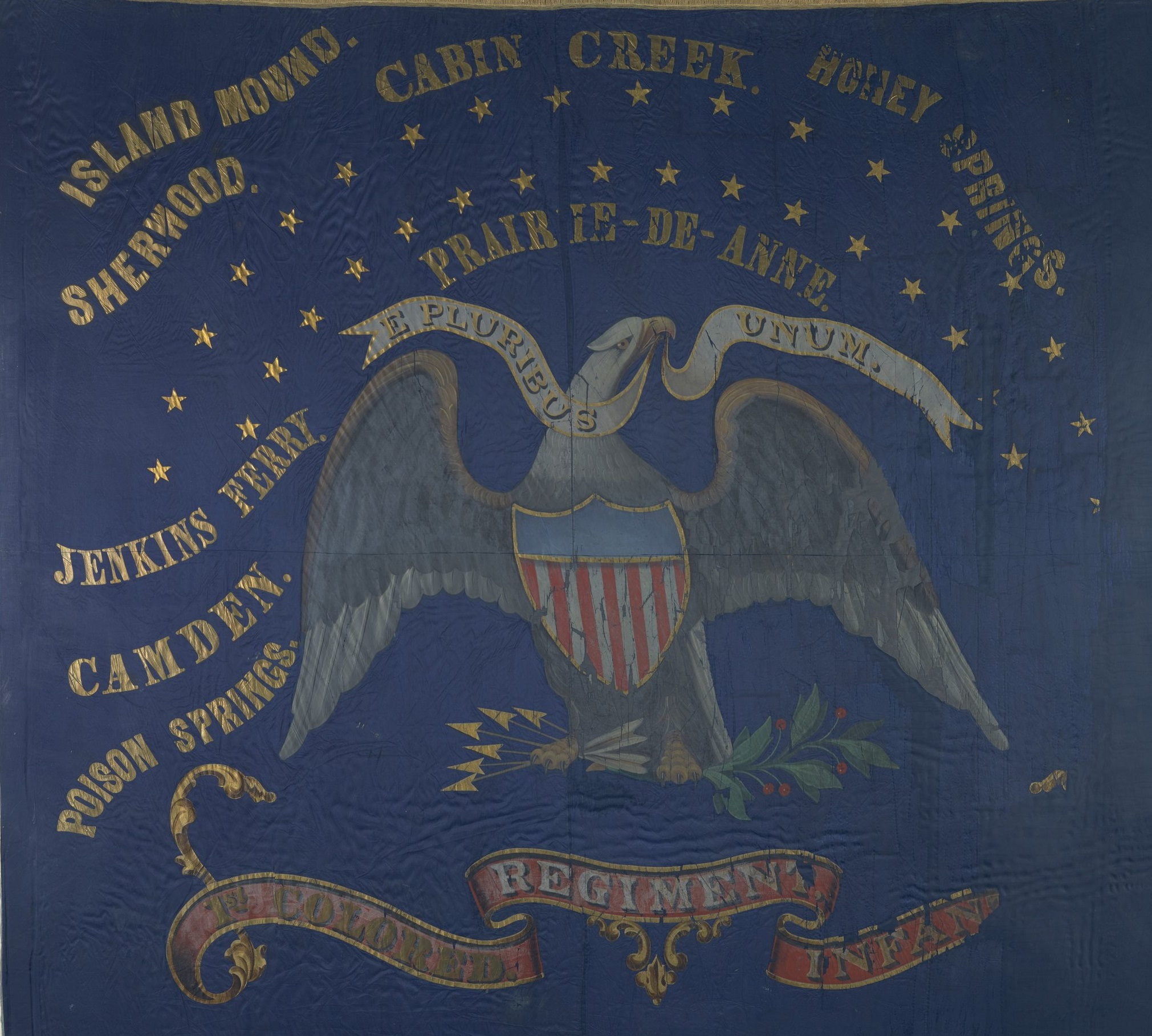
The unit first saw combat at the Battle of Island Mound in Missouri on October 29, 1862. In this skirmish, roughly 225 black troops drove off 500 Confederate guerillas, according to the National Park Service. The Nov. 10, 1862, edition of the Chicago Tribune reported: “The men fought like tigers, each and every one of them.”

The regiment was organized a few months earlier but they were not at first accepted into Federal service.

“The delay was due to an opposition to the arming of black troops among many in the North and federal policy that reflected this prejudicial attitude. This would not deter them from training or seeing action. Despite the existence of a widespread national reticence, many Kansans advocated the use of black troops early on,” says the Kansas Historical Society, which has the regiment’s preserved flag.

Slavery was prohibited in Kansas, which endured intermittent violence following it becoming a territory in 1854. Sen. James Lane pushed for the formation of the unit despite concerns by President Abraham Lincoln that their formation would push border states away from Union loyalty.

Fort Scott in Kansas served as the home base for both the 1st and 2nd Kansas Colored Infantry, with both regiments being mustered into federal service on its former parade ground. They were composed largely of free blacks and former slaves. The regiment was formed several months before the more famous 54th Massachusetts.

On Jan. 1, 1863, during a celebration of the Emancipation Proclamation, Capt. William D. Matthews, who led Company D of the 1st Kansas Infantry, declared, "Today is a day that I always thought would come …Now is our time to strike. Our own exertions and our own muscle must make us men. If we fight we shall be respected. I see that a well-licked man respects the one who thrashes him." (Photo of Matthews courtesy of Kansasmemory.org, Kansas Historical Society; copy/reuse restrictions apply)

The regiment’s combat history includes Reeder Farm near Sherwood, Mo., Honey Springs in Indian Territory (both 1863) and Poison Spring in Arkansas (1864). The latter fight included allegations that Confederates killed wounded and captured 1st Kansas soldiers. The regiment lost nearly 120 men at Poison Spring.

The regiment late in the war became part of the 79th U.S. Colored Infantry. About 180,000 African-Americans served in the US Army during the conflict.

Plans for the mural at the Capitol in Topeka have been in the works since 2000, but funding issues stalled the project, according to the Kansas Reflector.

With the passage of the bipartisan bill, the Capitol Preservation Committee will begin raising money from donors and procuring an artist for the mural.

Rep. Valdenia C. Winn (left), a member of the committee, said, “A mural honoring this Regiment will not only honor the sacrifices of the 1st Kansas Colored Infantry but will also further recognize Kansas’ role in holding the Union together. This story and its inspiration are more relevant than ever today – and long overdue.”

Wednesday, August 12, 2020

Museum offers to display toppled Colorado monument

A history museum in Colorado has offered to display the Civil War statue toppled by protesters outside of the state Capitol earlier this summer. History Colorado said it would display the statue, which depicts a Union cavalryman, along with an explanation for why it was created, KUSA-TV reported. A petition to remove the statue in 2017 falsely claimed it depicted Col. John Chivington, who orchestrated the Sand Creek Massacre, which killed more than 150 people, including Native Americans. • Article

Monday, April 29, 2019

American flag that flew over Lincoln mourners in 1865 dedicated at Ohio Statehouse

The flag is 22 feet long and 9 feet high (Ohio Statehouse)
A large US flag that was among several that flew over Ohio’s Capitol Square during the April 1865 repose of President Abraham Lincoln was dedicated Monday morning in Columbus.

The family of David Nevin Murray of Portsmouth, Ohio, whose foundry and machine shop produced cannon balls for the Federal army, donated the 22 feet by 9 feet banner to the state in 2016. Murray was presented the flag for his contributions to the war effort.

The dedication in the Ohio Statehouse rotunda was held on the 154th anniversary of the eight-hour repose of Lincoln’s remains following his assassination. The Statehouse was draped in black crepe on April 29, 1865, when thousands filed by the president's coffin.

This 36-star flag, made of wool bunting, was among several that flew in the square in Columbus for the solemn occasion. It will return for further conservation after its display for several hours Monday.

Burt Logan, executive director and CEO of the Ohio History Connection, told the audience that the flag is an important part of the state's history. But it saw happier times following the national mourning. In subsequent years, the family would allow the banner to fly at special events and be used in parades.

Conservators said 22,000 stitches were used to stabilize the massive flag.

Columbus was along the route of the Lincoln funeral train that left Washington, D.C. and passed through seven states, culminating near his Springfield, Illinois, home on May 4 for burial, according to NBC4.

"It is estimated that 50,000 mourners turned out at Capitol Square for the repose of Lincoln," Chris Matheney, historic site manager at the Ohio Statehouse, told the station.

This banner is one of the five depicted here (Library of Congress)
Mary Van Tilburg and other descendants of Murray donated the flag to the Ohio History Center. It had flown during numerous events following Lincoln's death but ended up in a Tyson chicken cardboard box in Oklahoma for 45 years before the family decided to have it returned to Ohio.

“I am just so grateful that it is OK and back home in Ohio where it belongs,” Van Tilburg said in 2016, according to the Columbus Dispatch. Conservators said at the time that the flag was in remarkable shape, though it needed some repairs.

Emma Lou Normand, a great-great granddaughter of Murray, spoke Monday on behalf of the family. "This beautiful Old Glory ... I think of family. Family that have gone on before, that are here today." She said David Nevin Murray came from Scotland and worked hard at his foundry and machine shop. To old to go to war, Murray "wasn't too old to serve."

The 1st Ohio Light Artillery, Battery A, a group of Civil War re-enactors, will provide an honor guard in the rotunda for a replica of Lincoln’s casket from 10:30 a.m. until 3 p.m. Monday.