Thursday, January 17, 2019
Confederate symbols fade from NC sites
North
Carolina officials don't have an official policy addressing the sale of
Confederate flag merchandise at Civil War battlefield gift shops, but the
products' future is unclear. The chief of staff for North Carolina's Sons of
Confederate Veterans division tells The Wilson Times the group has heard the
battle flag merchandise is unavailable at several state-maintained sites. • Article


Thursday, January 10, 2019
Lawmakers hope fourth time a charm in bid to expand Kennesaw battlefield, add house
 |
| The Wallis House about 13 years ago (Georgia Battlefields Association) |
Federal lawmakers
from Georgia are trying again to get Congress to add eight acres containing one
of the oldest remaining buildings on the Kennesaw Mountain battlefield to the Civil
War park.
U.S. Sen.
Johnny Isakson and others announced Thursday they have launched the fourth legislative
effort to enlarge Kennesaw Mountain National Battlefield Park near Atlanta.
“Expanding the
Kennesaw Mountain National Battlefield Park to include the Wallis House and
Harriston Hill will add to the historical significance of the park by giving
visitors an opportunity to experience key strategies and positions of troops
during the Civil War,” Isakson said in a statement. “I hope both the House and Senate will act
quickly to allow this expansion.”
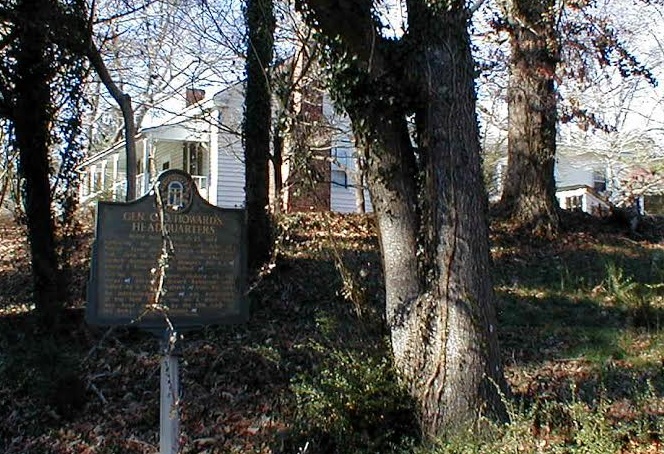 |
| (Courtesy of Georgia Battlefields Association) |
Park and
local officials are hoping the Wallis home, a dilapidated 1853 farmhouse that at
one point was in imminent danger of being demolished, will eventually be used
to more fully tell the story of Union strategy in the battle and perhaps the
role of African-Americans in the war. The clash was a costly, but brief setback during the Federal advance on Atlanta.
The
two-bedroom home, built by Josiah Wallis, had several uses during the Kennesaw
campaign in June 1864. It was first used as a Confederate hospital, then was
the headquarters for Union Maj. Gen. O.O. Howard. His boss, Maj. Gen. William
T. Sherman, was at the house during the Battle of Kolb’s Farm to the south.
“Adjacent to the Wallis house is Harriston Hill, which offers a
sweeping vista of the valley leading to the Confederate line atop Kennesaw
Mountain,” a National Park Service official said in 2010. “From this position,
it is clear why General Howard picked this site for his headquarters and
signaling position.”
Amanda Maddox, communications
director for Isakson, told the Marietta Daily Journal this week that the National Park
Service would need to spend about $1 million to restore the house and $1
million over the next five years for upkeep. Maddox
said lawmakers hope that $2 million will be raised by the community. She told the newspaper that the spending bill has come close to passing in previous congressional sessions.
The campaign
to save the house, give it permanent protection and have it help tell the story
of the battle during the Atlanta Campaign is a long one.
 |
| O.O. Howard |
Cobb County,
just northwest of Atlanta, for years saw an incredible housing boom and
development. While that was a boon for newcomers, preservationists and
historians decried the loss of Civil War sites or land to development.
The county,
working with the Georgia Civil War Commission and the Cobb Land Trust, spent $320,000
to buy the property in early 2004 so that 43 homes could not be built on it and
adjoining parcels, park Superintendent Nancy Walther told the Picket in 2016.
The park
needs congressional approval in order to expand its boundaries and accept the donation
of the house and hill from the county.
Several years
ago, then-Superintendent Stanley Bond helped lead a community effort to
recommend ways to increase African-American visitation to the park – and tell
the story of slaves, freed individuals, U.S. Colored Troops and more.
Bond told the Picket in February 2011 that he hoped the Wallis House could house an expanded exhibit on African-American soldiers and civilians. There’s a direct connection, because of the home’s association with Gen. Howard.
Howard University, a historically black
school in Washington, D.C., was named for the white officer, founder of the
university and commissioner of the Freedman’s Bureau.
In 2016, Walther said while there were no formal plans for interpretation of the Wallis House, the park wanted to widen interpretation of what happened on and near the battlefield.
Sword belonging to Shiloh veteran donated
A Portage
County (Wisc.) sheriff came home from the Civil War and became a lawman.
When he was killed trying to intervene in a feud between neighbors, his wife
gave his Civil War sword to a chapter of the Freemasons. It has been
more than 143 years since the widow of Sheriff Joseph H. Baker gave the sword. On Wednesday, the organization in a special ceremony handed it to
the Portage County Sheriff's Department. • Article
Thursday, January 3, 2019
Jamie Brandon, archaeologist who led student excavations at Pea Ridge, is remembered for outreach, mentoring
 |
| Jamie Brandon at Pea Ridge in 2017 (University of Arkansas) |
I was saddened to read about the recent passing of Dr. Jamie Chad Brandon, who was of invaluable assistance to the Picket in our coverage of ongoing archaeological investigations at Pea Ridge National Military Park.
Brandon, 47, was a professor and station archaeologist with the Arkansas
Archeological Survey, which has sent staffers and employees to work with the
National Park Service on excavations at the site of the 1862 Civil War battle. He died on Christmas Eve after a battle with cancer.
According to his obituary, Jamie’s three decades of
experience covered many topics, including Caddoan cultures in Arkansas, ethnicity
and race relations. He also focused on land use through time and historical memory in the pre-industrial South.
I last communicated with Brandon in April.
Over nearly three years, I would check in with he and other survey staffers
doing work at Pea Ridge. Among the subjects we discussed were digs at a hamlet
that endured combat and a study of artifacts and whether they could show the
locations of artillery positions. Brandon also did research connected with Prairie Grove Battlefield State Park, site of a December 1862 Civil War battle.
One of his colleagues, Carl Drexler, posted on
social media that “no single person in archaeology has been a greater mentor, friend, and colleague."
A University of Arkansas article Thursday said: "In addition to producing an impressive record of scholarly research, Brandon is remembered for his unparalleled devotion to outreach activities to the general public about archeological discoveries and their relationship to understanding modern society. He was also a popular teacher and mentored a host of students through internships, theses and dissertation projects."
The Picket extends condolences to Brandon’s wife, Lydia Rees, and other survivors.
Wednesday, January 2, 2019
Civil War horses and mules: Talk will focus on their 'sorrowful' treatment and care
 |
| Edwin Forbes sketch of a "played-out mule" (Library of Congress) |
We usually hear about human loss during the Civil War. But more horses and mules fell -- casualties to battle wounds, disease and poor care.
The
National Museum of Civil War Medicine estimates about 1 million succumbed. Other sources place the toll much higher, at about 1.5 million.
Their
critical service to the armies made these animals primary targets, particularly
when hauling artillery. Still others were killed instead of being allowed to
fall in enemy hands.
Atlanta
veterinarian Mary-Elizabeth Ellard, vice president of the Georgia Battlefields
Association, will discuss their plight in a Jan. 14 talk entitled “A Sorrowful
War: Veterinary Medicine during the Civil War.”
 |
| Dr. Ellard |
“Despite the
vast numbers and critical role of horses and mules used in 19th century
warfare, neither the U.S. nor the Confederate militaries had sufficient
knowledge or veterinary personnel to provide for effective care,” the GBA says.
“Dr. Ellard will review the needs of working animals to explain why far more
animals died of disease than injury, even compared to human deaths.”
Horses
and mules were, in many ways, the muscle of the armies. They pulled artillery
pieces, food and other equipment. While considered largely expendable, the beasts were loved by their riders and caretakers.
Most that died fell to illness, starvation and
exhaustion, said Ellard. Only 10 percent died of their battle wounds. Animals often were
beset by highly contagious Glanders, a disease that causes respiratory and skin
lesions. It could spread quickly when horses shared water and feed troughs.
Ellard
told the Picket this week that “breakthrough
research by two Civil War veterinarians on Glanders forever changed
our ability to control the spread of infectious diseases.” She
identified them as Drs. John Terrell and John Page, who worked at a Confederate
horse infirmary in Lynchburg, Va.
 |
| A casualty at Gettysburg (Library of Congress) |
Horse and cattle “doctors” who cared for military animals generally had no formal training. Veterinarians used poultices, linament and other remedies to stave the losses – but they had no antibiotics. Eventually, Union cavalry had veterinary medicine chests.
Despite
some improvements in military equine care later in the war, it wasn’t until World
War I that the Army created a formal veterinary service, according to Gerleman.
Ellard
says the role of horses and mules, their needs and the paucity of care remain understudied
aspects of the war. She first gave the presentation in 2014 and adapts it for
her specific audience.
The
aim is for attendees to gain new insight into the “inestimable role” of equids
and reflect on the impact that human crises can have on animal welfare.
Dr. Mary-Elizabeth
Ellard will speak at 7 p.m. on January 14 at Oak Grove United Methodist Church,
1722 Oak Grove Road, Decatur, Ga. Click here for more details. The 6:15 p.m.
preceding dinner costs $8.
Subscribe to:
Posts (Atom)