Showing posts with label Wallis House. Show all posts

Tuesday, October 8, 2024

Kennesaw's Wallis house and Civil War signal station: Georgia Tech student creates 3D drawings to help in new interpretation of field hospital, HQ site

The side and front of the closed Wallis house (Picket photos) and Union Maj, Gen. O.O. Howard
Maj. Gen. Oliver O. Howard made a wise choice by picking the Josiah Wallis house for his headquarters during the Union advance on Kennesaw Mountain in Georgia. Rising near the circa 1853 dwelling is Harriston Hill, which was a perfect spot for a signal station because of its sweeping view of the valley leading to the Confederate lines atop the mountain.

The Wallis House, which served as a field hospital for both sides in June 1864, survives today. though it is in pretty rough condition. Harriston Hill, also known as Signal Hill, includes remnants of Confederate earthworks. Now part of Kennesaw Mountain National Battlefield Park, the two sites – separated by a subdivision -- await new use. The park says they can add a largely missing element: interpreting to visitors the Federal strategy at the Battle of Kennesaw Mountain.

There’s a lot of work being conducted before that goal is accomplished.

A master of architecture candidate at Georgia Tech in Atlanta has used LiDar (remote sensing technology) and a drone to create a model of the Wallis House for the National Park Service, which operates the park. He is wrapping up drawings for use in a historic structure report (HSR) that will be completed by the park next spring and used as a launching point on recommendations for use of the properties.

The two marked park parcels at left, features of the Wallis house at right (NPS, click to enlarge)
“Any time you have a chance to get to know a building is exciting, to understand it’s story a little more,” said Danielle Willkens, an associate professor of architecture at Georgia Tech. “You are on hallowed ground and that is palpable. There is another level of responsibility attached to the site.”

Willkens and student Thomas Bordeaux have been working with Suzanne Roche, the park’s first archaeologist. She told the Picket officials would like to see the two-bedroom Wallis house available to park visitors at some point, but it will require repairs and upgrades.

“Everyone is excited about having this house,” Roche said during a recent phone call. “They (park rangers) have been incorporating some interpretive information in their talks.”

It took years to protect and transfer site to park service

The Georgia Tech survey and a November 2021 NPS cultural landscape report on the Wallis farm and Signal Hill have brought new energy to the site, which has largely been out of the headlines in recent years.

The Wallis house was in “imminent danger” of being demolished, according to an NPS official who provided a statement to Congress in June 2010 in support of enlarging the park to include the sites. A developer had purchased 27 acres, including Harriston Hill and the Wallis homestead, in 2002, according to the official. 

Charlie Crawford, president emeritus of the Georgia Battlefields Association, recalls arguing against a rezoning for much of Signal Hill. “Although the Wallis house parcel was not part of the rezoning application, I said that the house and Signal Hill were both parts of a whole, both contributing to the site’s significant history.

Working with the Cobb Land Trust, the Cobb County government acquired seven acres from the developer, including the farm and hill. About 43 homes are in the subdivision.

The land was donated to the federal park years later, in 2019, after Congress finally permitted expansion of the boundaries. (At left, entrance to the subdivision, Picket photo). The Covid crisis slowed action in 2020.

“I certainly agree this has been a long struggle,” Crawford told the Picket in an email.

“The inherent problem is making the building safe to visit (and up to code on electric, plumbing, HVAC) while still restoring its historical appearance.”

The house is off-limits, but that may change one day

Today, the setting is hardly bucolic. Cars whizz by on two busy highways – Burnt Hickory Road and Ernest W. Barrett Parkway – and the 41-home subdivision separates the Wallis house and Signal Hill. The park has no trespassing signs around the house, which is largely obscured by trees and vegetation. It allows no visitors to the property, citing safety and security concerns. Walking along Burnt Hickory is not recommended.

The 2021 cultural landscape report details ways to interpret the sites. At Signal Hill, some of the trees could be thinned so that visitors could get a view of Big and Little Kennesaw mountains. A trail to the entrenchments, which need to be stabilized, and other features could be built, along with interpretive markers. The Wallis farm could feature an outdoor education area, parking, restroom and signs.


The clash at Kennesaw Mountain
was a costly, but brief setback during the Federal advance on Atlanta. Maj. Gen. William T. Sherman, commander of Union forces, was at the Wallis house during the Battle of Kolb’s Farm to the south.

Park and local officials are hoping the home can tell several stories, possibly featuring an exhibit on the role of African-American soldiers and civilians during the Civil War.

“General Howard is an important historical figure because of his successful leadership on the battlefield and his post-Civil War support of former slaves as head of the Freedmen's Bureau and founder of Howard University,” says the NPS.

His grandpa got tired of relic collectors

The Wallis house has been vacant for more than two decades. The site includes the home, original well and remains of two chicken coops and a smokehouse.

Commentary on a Historical Marker Database page about the dwelling includes a description by a Georgia man who said his grandfather acquired the land in the 1940s or 1950s.

“At the time of the purchase there were still doors inside the home with damage from a small skirmish fought on the property and within the home itself. Many floor boards were missing, and the house was in a general state of disrepair,” wrote Martin Jordan.

“It was not uncommon at all during the ‘60s and on for my grandfather to have to chase off relic seekers from the property surrounding the house, which was lined with trenches and earthworks,” Jordan added.

They don't build 'em like they used to

Willkens, the Georgia Tech professor, said the project has provided an ideal way for students to engage in preservation work. Bordeaux spent several days scanning the site, which was “very difficult” because of tree cover. The lack of other historic buildings nearby provided challenges on context.

Willkens (right) describes the house as a standard vernacular cottage, though its construction is a bit of a mystery. She thought at first it may have been a gable and saltbox style, but that is not the case. “It has some atypical arrangements.”

For some reason, the builders did not remove a massive tree stump before construction, she said.

The team took paint samples, ascertaining the original colors and is working with experts at the Smithsonian Institution to learn more about wood used in the dilapidated building.

“That house was probably built a lot better than something built five years ago,” said Willkens. “They have old growth trees, some additional redundancy in the structure.”

Postwar additions include a kitchen, laundry room, bathroom and back porch. Roche said no decision has been made about their fate, though the 2021 report suggests removing modern features.

The park would not provide photos of the home’s interior or Georgia Tech’s model and drawings, saying it wants to be careful in disseminating information and to safeguard the integrity of the site. Roche would not speak to the condition of the house. “You can walk inside it.”

The archaeologist and Willkens believe the structure can be saved.

Next steps in making the idea a reality

As stated earlier, the effort to save the house, give it permanent protection and have it help tell the story of the Atlanta Campaign is a long one.

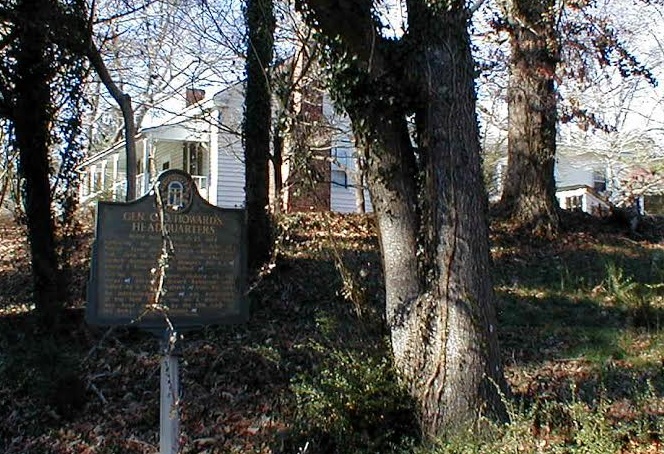
A 1953 Wallis house marker along busy Burnt Hickory Road (Picket photo)
Cobb County, just northwest of Atlanta, for years saw an incredible housing boom and development. While that was a boon for newcomers, preservationists and historians decried the loss of Civil War sites or land to development.

Now there’s an opportunity to offer something new in the telling of the battle.

“We are excited things are going on at the house,” said Roche. NPS historians visited the site just last week.

Much remains to be done. An engineer will need to study the feasibility of making repairs and restoring the Wallis house to its wartime appearance.

Thousands of cars travel past the house each day (Picket photo)
And officials will need to consider the cost of the project, its risks (concerns about vandalism) and rewards (enhanced interpretation). Major improvements on both sites could run into the millions of dollars. One feature now in place is a parking lot at the entrance of the subdivision allowing access to Signal Hill.

All of this will go in to the historic structure report (HSR), which is an involved process involving a lot of back and forth. “When we receive the recommendations from the HSR on how to proceed with either rehabilitation or restoration of the house, we will release the plans to the public for comment,” said Roche.

The archaeologist said acquiring such a historical treasure this many years later is not common, “which is why it is exciting.”

“We are really excited about hopefully being able to interpret this to the public,” said Roche.

Thursday, January 10, 2019

Lawmakers hope fourth time a charm in bid to expand Kennesaw battlefield, add house

The Wallis House about 13 years ago (Georgia Battlefields Association)

Federal lawmakers from Georgia are trying again to get Congress to add eight acres containing one of the oldest remaining buildings on the Kennesaw Mountain battlefield to the Civil War park.

U.S. Sen. Johnny Isakson and others announced Thursday they have launched the fourth legislative effort  to enlarge Kennesaw Mountain National Battlefield Park near Atlanta.

“Expanding the Kennesaw Mountain National Battlefield Park to include the Wallis House and Harriston Hill will add to the historical significance of the park by giving visitors an opportunity to experience key strategies and positions of troops during the Civil War,” Isakson said in a statement. “I hope both the House and Senate will act quickly to allow this expansion.”

(Courtesy of Georgia Battlefields Association)

Park and local officials are hoping the Wallis home, a dilapidated 1853 farmhouse that at one point was in imminent danger of being demolished, will eventually be used to more fully tell the story of Union strategy in the battle and perhaps the role of African-Americans in the war. The clash was a costly, but brief setback during the Federal advance on Atlanta.

The two-bedroom home, built by Josiah Wallis, had several uses during the Kennesaw campaign in June 1864. It was first used as a Confederate hospital, then was the headquarters for Union Maj. Gen. O.O. Howard. His boss, Maj. Gen. William T. Sherman, was at the house during the Battle of Kolb’s Farm to the south.

“Adjacent to the Wallis house is Harriston Hill, which offers a sweeping vista of the valley leading to the Confederate line atop Kennesaw Mountain,” a National Park Service official said in 2010. “From this position, it is clear why General Howard picked this site for his headquarters and signaling position.” 

Amanda Maddox, communications director for Isakson, told the Marietta Daily Journal this week that the National Park Service would need to spend about $1 million to restore the house and $1 million over the next five years for upkeep. Maddox said lawmakers hope that $2 million will be raised by the community. She told the newspaper that the spending bill has come close to passing in previous congressional sessions.

The campaign to save the house, give it permanent protection and have it help tell the story of the battle during the Atlanta Campaign is a long one.

O.O. Howard
Cobb County, just northwest of Atlanta, for years saw an incredible housing boom and development. While that was a boon for newcomers, preservationists and historians decried the loss of Civil War sites or land to development.


The county, working with the Georgia Civil War Commission and the Cobb Land Trust, spent $320,000 to buy the property in early 2004 so that 43 homes could not be built on it and adjoining parcels, park Superintendent Nancy Walther told the Picket in 2016.

The park needs congressional approval in order to expand its boundaries and accept the donation of the house and hill from the county.

Several years ago, then-Superintendent Stanley Bond helped lead a community effort to recommend ways to increase African-American visitation to the park – and tell the story of slaves, freed individuals, U.S. Colored Troops and more.

Bond told the Picket in February 2011 that he hoped the Wallis House could house an expanded exhibit on African-American soldiers and civilians. There’s a direct connection, because of the home’s association with Gen. Howard.

Howard University, a historically black school in Washington, D.C., was named for the white officer, founder of the university and commissioner of the Freedman’s Bureau.

In 2016, Walther said while there were no formal plans for interpretation of the Wallis House,  the park wanted to widen interpretation of what happened on and near the battlefield.

Wednesday, February 24, 2016

Kennesaw battlefield a step closer to expanding, adding historic Wallis House

The Wallis House about 10 years ago (Georgia Battlefields Association)

A dilapidated 1853 farmhouse that at one point was in imminent danger of being demolished may soon became part of Kennesaw Mountain National Battlefield Park, which could use it to more fully tell the story of Union strategy in the battle and the role of African-Americans in the Civil War.

Efforts to have eight acres containing the Wallis House and Harriston Hill added to the park in north Georgia have been more than a decade in the making. The U.S. House of Representatives on Feb. 24 voted in favor, with a similar bill to be considered next by the Senate.

“It is very exciting for us. We know that once this happens this is just a first step,” said park Superintendent Nancy Walther. “We are really thrilled about the opportunity and it is nice to ride the surf in.”

The two-bedroom home, built by Josiah Wallis, had several uses during the Kennesaw campaign in June 1864. It was first used as a Confederate hospital, then was the headquarters for Union Maj. Gen. O.O. Howard. His boss, Maj. Gen. William T. Sherman, was at the house during the Battle of Kolb’s Farm to the south.

“Adjacent to the Wallis house is Harriston Hill, which offers a sweeping vista of the valley leading to the Confederate line atop Kennesaw Mountain,” a National Park Service official said in 2010. “From this position, it is clear why General Howard picked this site for his headquarters and signaling position.”

The campaign to save the house, give it permanent protection and have it help tell the story of the battle during the Atlanta Campaign is a long one.

(Courtesy of GBA)

Cobb County, just northwest of Atlanta, for years saw an incredible housing boom and development. While that was a boon for newcomers, preservationists and historians decried the loss of Civil War sites or land to development.

The county, working with the Georgia Civil War Commission and the Cobb Land Trust, spent $320,000 to buy the property in early 2004 so that 43 homes could not be built on it and adjoining parcels, Walther told the Picket.

The park needs congressional approval in order to expand its boundaries and accept donation of the house and hill from the county.

Several years ago, then-Superintendent Stanley Bond helped lead a community effort to recommend ways to increase African-American visitation to the park – and tell the story of slaves, freed individuals, U.S. Colored Troops and more.

O.O. Howard
Bond told the Picket in February 2011 that he hoped the Wallis House could house an expanded exhibit on African-American soldiers and civilians. There’s a direct connection, because of the home’s association with Gen. Howard.

Howard University, a historically black school in Washington, D.C., was named for the white officer, founder of the university and commissioner of the Freedmen’s Bureau.

Walther said while there currently are no formal plans for interpretation at the Wallis House, she cited Bond’s efforts to more fully tell the stories of African-Americans and people who lived near Kennesaw Mountain. “We want to tell the whole story,” she said.

The Wallis House, near a subdivision, is just west of the main park on Burnt Hickory Road near Barrett Parkway. A paved parking lot and a sidewalk leading up to the property line were put in several years ago.

Vegetation has grown up around the house and while relatively structurally sound, the residence would need a lot of work before opening. People in the community have wanted the park to clean it up, but that could not be done because the land was in a holding pattern until congressional action.

The superintendent said she has been inside the structure.

“When it was still inhabited it was a nice enough home. It’s not large, maybe 1,200 to 1,500 square feet. There are outbuildings. It has been vacant for so long it is very dilapidated. We want to take it back to the original structure. Part of the house is (postwar) additions. We would be ripping those out.”

The cost of restoration and other aspects of the project could be about $1 million, said Walther. “There is a lot of support to help with the renovation of the house.”

That’s considerably less than a previous $5 million estimate.

It could be five years or more before the Wallis House is open for interpretation.

First will come the submission for federal funding, which could take two to three years. “The first matter is to formulate a plan of action,” Walther said. “Funding will be the backbone of everything that will happen.”

Walther said the staff is excited about the opportunity to provide students and others more education. That can be done through Kennesaw Mountain’s natural and manmade features – and the Wallis House.

“When you can touch history, it can have a lasting impression on you.”