Showing posts with label donation. Show all posts

Friday, February 6, 2026

Concussion of thundering 1st Connecticut mortars at the Battle of the Crater left artillerist Chester Beckwith with bleeding ears and a lifetime of pain. Descendants have donated his 1861 rifle, accoutrements to a New England museum

Tom Therrien and Kimberly Beckwith with Springfield and cartridge box (NE Civil War Museum) and 1st Connecticut mortars at Yorktown, Company C (labeled 8) position near the Crater and the "Dictator," Company G, Petersburg (Library of Congress)
Amid the heat, flashes of fire and acrid smoke rising from belching siege mortars, Chester Beckwith furiously worked to prepare ammunition to support the Union assault during the Battle of the Crater on July 30, 1864.

The artificer with Company C, 1st Connecticut Heavy Artillery, was cutting timed fuses in the bombproof/powder magazine of Fort Rice at Petersburg during the bombardment, according to his pension file kept by the National Archives.

“While so engaged the concussion produced by the firing of the heavy siege guns and mortars injured both of my ears so that blood came from them…during many months afterward I was troubled with a discharge of matter from both ears,” he wrote.

In the end, the company’s ten 10-inch mortars fired 360 rounds during the doomed assault that resulted in disaster and eight months of ghastly trench warfare.

A 2019 article on HistoryNet.com details the injury that cost Beckwith much of his hearing for the rest of his life.

Beckwith, a carpenter by trade who repaired artillery equipment as an artificer, served through the end of the war. He was plagued by his injury and the loss of his brother, Robert, who was mortally wounded at Second Manassas in August 1862.

Chester H. Beckwith’s military service and sacrifice will be remembered following the donation last fall of his 1861 Springfield rifle-musket and accoutrements to the New England Civil War Museum & Research Center in Vernon, Ct. (Photos at left and below courtesy of the museum)

Dan Hayden, the museum’s executive director, told the Picket conservators will prepare the artifacts for exhibit rotation.

“We focus on bringing to life individual people of the time period, but more importantly, to create a way to highlight the emotional and human elements that show how similar we are to them, even today,” said Hayden.


Two cousins, Kimberly Beckwith, a Connecticut native currently working in the Netherlands, and Tom Therrien, who moved from Connecticut to North Carolina a year ago, traveled to the museum to make the donation.

The artifacts for years were kept by Beckwith’s late father. The gift seems especially appropriate because Alfred Pierce Beckwith was a highly skilled machinist who could fix almost anything, she wrote in an email

“So he was sort of artificer too (he was also a jet engine mechanic in the Air Force in the late ‘50's to the early ‘60s.) It seems those skills run in my family of handy Yankees who served their country.”  

His younger brother Robert died at 2nd Manassas

The 1st Connecticut Heavy Artillery saw extensive service during operations in Washington, D.C., Virginia and North Carolina. Company C participated in the Peninsular Campaign and ended up at Fort Brady on the James River by the end of the war.

Chester Beckwith was 35 when he mustered in for three years in March 1862. His pension records indicate he had red hair and blue eyes. While 22 men from the Vernon area served with the 1st Heavies, Beckwith hailed from Windham, nearly 20 miles away.

Beckwith’s younger brother, Robert, was living in Pennsylvania when joined the 1st New Jersey Infantry. Some of Robert’s letters to relatives have been published on HistoryNet and the Spared & Shared blog.

In July 1862, Robert wrote to friends about a visit from Chester at his camp in Virginia.

“Oh, tell Susanna that I was surprised the day I was sitting in my tent & who should come & look in but Chester. He has been [in] one fight with me but I did not know it at the time. He is in the 1st Connecticut Heavy Artillery. They lay about one mile from me. We are to go there 2 or 3 times a week. I expect him over tomorrow -- Sunday. He was paid off the other day & sent $40 dollars home to Minerva (Chester’s wife). Chester said he had written to you the other day.”

Robert was mortally wounded at Manassas a month later, apparently dying days later while being held prisoner. His grave in Windham may be a cenotaph

(I have been unable to find a photo of Chester. Robert’s image can be seen here. I have been unable to locate the current owner to obtain permission to include it here. Photo at right by Matthew Dingler, town of Windham)

Chester was detailed as an artificer on January 10, 1864, a role that acknowledged his skills and ability to repair the critical equipment that the 1st Heavies operated, a museum Facebook post says. When his original term expired on March 18, he reenlisted, serving until September 1865.

At Petersburg, the regiment’s companies were stationed at a couple forts, with Beckwith’s at Fort Rice near the larger Fort Sedgwick. They were in the thick of action during the Battle of the Crater.

The 1st Heavies' most famous mortar, the massive “Dictator,” was operated by Company G.

Company C was in the thick of things

Much has been written about the siege of Petersburg in 1864-65; I won’t be able to get into detail here. But the Federal force depended on heavy guns like those used by the 1st Heavies.

National Archives map shows Fort Rice (center right) across from Rives Salient (click to enlarge)
Company C was across from Confederate Rives Salient and adjacent to the original location of Confederate Battery 22, part of the initial Confederate Dimmock Line, said Emmanuel Dabney, chief of resource management at Petersburg National Battlefield.

“Keep in mind much work was done by Union troops in July 1864 to dismantle the original Dimmock Line which lay behind the Federal fortifications,” Dabney told the Picket.

The line was a series of 55 Rebel artillery batteries and connected earthworks. They were built to protect Petersburg’s vital railroads and industry.

The 1st Heavies were among the artillery units meant to suppress Confederate resistance as the attack unfolded on July 30, 1864.

The Battle of the Crater dashed Union hopes for an end to the siege and, for that matter, the Confederacy. After a massive explosion from a mine set off by engineers, Federal troops, including U.S. Colored Troops, rushed in, only to be rebuffed by dazed Confederates who held strong.

According to Beckwith’s pension files from the 1870s, a sergeant from Company C wrote a letter to pension officials detailing the artificer’s injuries. The article on HistoryNet describes how gunners were told to place canister rounds into 10-inch shells to be fired from mortars.

Union artillery on July 30; Fort Rice is numbered 8, click to enlarge (Baylor University Digital Collections)
Sgt. Elisha Jordan wrote the following:

“…I was on duty…near Fort Rice in front of Petersburg Va on July 30th 1864. I know that Chester H. Beckwith was an artificer…and was on duty in the bombproof sawing fuses during the explosion of Burnside’s mine and attack on enemy line….I was ordered to go in the bombproof and direct said Beckwith to put 27 grape shots into a shell which I did and found Beckwith with his ears bleeding badly….I know that ever after this day while in the service Beckwith was excused from roll call because his hearing was bad.”

The HistoryNet authors obtained the pension information from the National Archives in Washington. I have been unable to travel there for those purposes.

A lot of suffering for Chester and Mary

Chester Beckwith returned to Connecticut and worked as a carpenter. His wife Minerva passed away in 1879 and he married Mary E. Beckwith in 1903.

Dana B. Shoaf, editor in chief of HistoryNet in 2019, wrote Mary recalled occasionally “the blood would run out of his ears and head,” and that “he was [in] dretfull suffer as long as he lived.”

Chester died of a “lingering illness” in Hamburg (North Lyme), Ct., in November 1909 at age 82 or 83. Half of his 10 children survived him. His body was returned to Windham, where he was buried at Windham Center Cemetery. At one point, a U.S. flag and Grand Army of the Republic marker were evident at his grave.

An ailing Mary’s application for a widow’s pension in 1912 apparently was denied because the government determined Chester’s wartime injuries did not cause his death, Shoaf wrote.

I have been unable to determine when Mary died and where she is buried.

(Matthew Dingler, Windham’s cemetery sexton, was of great help to me as I researched the resting places for the Beckwith family. He mentioned the history and Victorian homes of Willimantic, which is part of Windham. A mill drew many immigrants. He also mentioned the humorous Battle of the Frogs story. Read about it here)

A trove of weaponry and an ode to hard tack

The inscription about Chester Beckwith is slowing fading away (Courtesy Kimberly Beckwith)
Kimberly Beckwith grew up believing Chester and Minerva were distant a distant uncle and aunt. Not many stories were passed down, though her father said they underwent some kind of tragedy, Beckwith told the Picket.

After further research, Kimberly now believes Chester and Minerva were her great-great-grandparents. To this day, the family has deep ties to the Windham area.

She turned to the museum in Vernon for the donation after doing online research. She and her late sister, Lynda, inherited the items after their father died in February 2023. (Lynda thought first of donating the items to a museum in Pennsylvania, where she lived.)

The items were Chester’s Springfield, bayonet and seven-rivet scabbard, percussion cap box, cartridge box, belt buckle and a book with regimental history. The family also donated an early edition of John Billings' “Hard Tack and Coffee,” a memoir containing tales of the war and illustrations.

The cartridge box still bears the pressed stamp of Gaylord contractors in Chicopee, Massachusetts, with a late pattern percussion cap box and bayonet with seven-rivet scabbard.

The museum says this of the artifacts:

“Though his belt and cartridge box sling have passed out of existence, the buckle remains, as most notably does the musket sling. Along with an early edition of John D. Billings' 'Hard Tack and Coffee,' the remainders of Chester's service with the 1st Heavies will be proudly conserved and interpreted for future visitors at the museum.”

The 1861 Springfield was used by most soldiers from Vernon and many New England soldiers in general. 

Museum serves up soldier artifacts and library

The Civil War museum in Vernon is housed in the former meeting place of the Thomas F. Burpee Post #71 of the GAR. The Sons of Union Veterans of the Civil War Alden Skinner Camp #45 meet in the building today.

Highlights of the permanent collection include New England and GAR artifacts, a wartime uniform of Seth Plumb of the 8th Connecticut Volunteer Infantry, a pair of trousers owned by James Baldwin of the 2nd Connecticut Heavy Artillery, and personal effects of Thomas Burpee, including spurs, belt, shoulder boards, tin cup and the bullet believed to have mortally wounded him at Cold Harbor, Va., in 1864. 

1st Connecticut Heavy Artillery monument near Capitol in Hartford (Cosmo Marino, hmdb.org)
Thirty-six Vernon men died during the war, 14 of them killed in battle and 11 dying in Confederate prison camps, said Hayden.

The research center and archives contains letters, diaries, journals

We curate the library to help researchers find sources around the everyday soldier, as well as to the general public for finding information about their relatives who served during the Civil War. Notably, famed artist Don Troiani donated his research archive he collected while preparing to paint his Civil War works of art. These are being scanned and will be made available for public access,” the director added.

The New England Civil War Museum & Research Center, 14 Park Place, Vernon, is open 10 a.m.- p.m. on Saturday and Sundays. Call 860-870-3563 for more information.

Saturday, July 12, 2025

$2.8 million private gift will help fund restoration of Vicksburg's majestic Illinois Memorial, removal of old park HQ considered an intrusion on the battlefield

1906 Illinois Memorial (top photos) and July 11 demolition of old park HQ (FVNMP)
Conjuring the grandeur of Rome’s Parthenon, and topped by an oculus, mythical figures and a large bronze eagle, the Illinois State Memorial at Vicksburg, Ms., records the names of 36,325 soldiers from the Prairie State who took part in the campaign to capture the vital Confederate city.

Forty-seven steps – matching each day of the Union siege -- lead up to the interior and the lists of names on bronze plaques. The building is one of Vicksburg National Military Park’s most popular tour spots, but age and time have taken their toll.

The Friends of Vicksburg National Military Park & Campaign on July 11 announced a $2.8 million private donation, matched by $2.5 million from the National Park Service, will go toward restoration of the Illinois Memorial and other projects. Texas businessman and friends founding board member John Nau III made the large donation. 

Bess M. Averett, executive director of the friends group, told the Picket the work on the Illinois Memorial, which opened in 1906, will begin in mid-August and last about one year. The monument will be closed during that time.

Retired Brig. Gen. Robert Crear, Ryan Groves, Darrell Echols, John Nau III (FVNMP)
“Over a century of weather exposure -- including through the oculus -- has caused deterioration to both the stone and the inscriptions inside,” a news release said. “A full restoration is crucial to preserve its integrity and allow future generations to experience its splendor and meaning.”

More than 100 units from Illinois fought in the Vicksburg campaign. About 40 Illinois soldiers received the Medal of Honor for their valor.

Friday’s announcement signaled the beginning of the project, which started with demolition of the park’s former headquarters and museum, built in 1937.

The structure is on Pemberton Avenue, just south of the Illinois Memorial. It is considered an intrusion “that obscures the story and sacrifices of the men who fought and died there in 1863,” according to officials.

Illinois monument is between tour stops 2 and 3; old HQ is near surrender site (NPS; click to enlarge)
“People think because it was a replica antebellum home that it was historic. But it was built long after the war and literally in the center of one of the most critical areas of the park for interpretation,” said Averett.

An NPS report on museums built at Civil War parks in the 1930s said this of the old headquarters, which was unsuitable for its use and was later condemned:

“The Vicksburg building resembled so well an antebellum plantation mansion that a later superintendent converted it to his residence and packed the museum off to a utilitarian frame structure elsewhere in the park.

Nau was on hand for a ceremony and the start of demolition.

Old headquarters (center) obstructed sight lines of the battlefield (FVNMP)
“This gift from John Nau is nothing short of visionary,” said retired Brig. Gen. Robert Crear, board president of Friends of Vicksburg National Military Park & Campaign, according to the Vicksburg Post newspaper. “It will not only preserve a national treasure -- the Illinois Memorial -- but also reclaim the battlefield from post-war development and restore its integrity for all Americans.”

Ryan Groves, acting superintendent of the park, referred emailed questions from the Picket to the friends group.

The nonprofit said its chief goal is restoring land and landmarks to their wartime appearance and context.

One of the first projects accomplished by the in 2011 was the removal of 50 acres of trees in the same area. “Before that work, rows of cannons faced a dense forest confusing visitors and hiding the very terrain that made Vicksburg so impenetrable.” 

Rotunda of Illinois Memorial includes the state seal, plaques bearing names (Library of Congress)

Wednesday, May 17, 2023

Civil War-themed painting gifted to Kennesaw Mountain was made by a 'hidden' artist. Now Doug Brooks' creations are reaching the world

Douglas L. Brooks created this in the final year of his life, click to enlarge (KMNB)
After 10 years living on a wooded lake cove in Alabama, artist Douglas Lee Brooks returned home to Georgia and his childhood memories.

The first work the painter produced back in Cobb County, northwest of Atlanta, was a scene from the Civil War -- soldiers and horsemen clashing in a sea of color. The war was a subject dear to Brooks, who grew up in a neighborhood near Kennesaw Mountain National Battlefield Park.

“Behind our home there was no development and the back face of Kennesaw Mountain,” says his sister Dolly Brooks. “You can imagine my brothers crossed the creek and through the woods. The back of Kennesaw Mountain was their playground.”

The powerful painting – full of light and vibrancy and exuding a childlike freedom – was donated in March to the park, 15 months after Brooks, 68, died of esophageal cancer.

The untitled work is among the last of about 1,500 paintings that Doug Brooks produced. His sister calls him a “hidden” artist, a private and contemplative person who never sold any of his creations, rather giving them to family and friends.

Painting at Rhode Island preschool (Courtesy of Douglas L. Brooks Collection)
Dolly Brooks, of Providence, R.I., lived near her brother in Marietta during the final year of his life. “When he knew he was dying, and asked me if I would accept his collection, he said, ‘You will know what to do.” 

As caretaker of 1,200 paintings, Dolly is now thoughtfully gifting them to places that reflect the causes her older brother supported, among them arts education, scholarships and organizations fighting food insecurity. Most of the works depict Southern life and culture – from street preachers and gamblers to farmers and people playing music and dancing.

Dolly approached Kennesaw Mountain National Battlefield Park in January about donating the large acrylic and canvas painting.

“I knew there was only one place I wanted the painting to be,” Dolly told the Picket. “You have to stand before it. To see it on your screen is nothing like standing before it.”

The artist made hundreds of Southern scenes (Courtesy of the Douglas L. Brooks Collection)

'Like dancing on the canvas'

The Brooks family has a real connection to the June 1864 Kennesaw battlefield. Doug and Dolly’s grandfather, Forrest, was born at Kolb Farm, scene of intense fighting. The National Park Service acquired the property years ago.

The Marietta home where the siblings grew up, St. John’s Court, blends into the woods.

Doug had a deep reverence for nature – the seasons, colors and animals – but he also had an appreciation for history, and he would often visit the Civil War park, taking in the movie and exhibits.

So it is no surprise that the artist recreated his childhood memories in the painting. Kennesaw acknowledged the gift in a Facebook post, saying the park was “always a treasured space to him.”

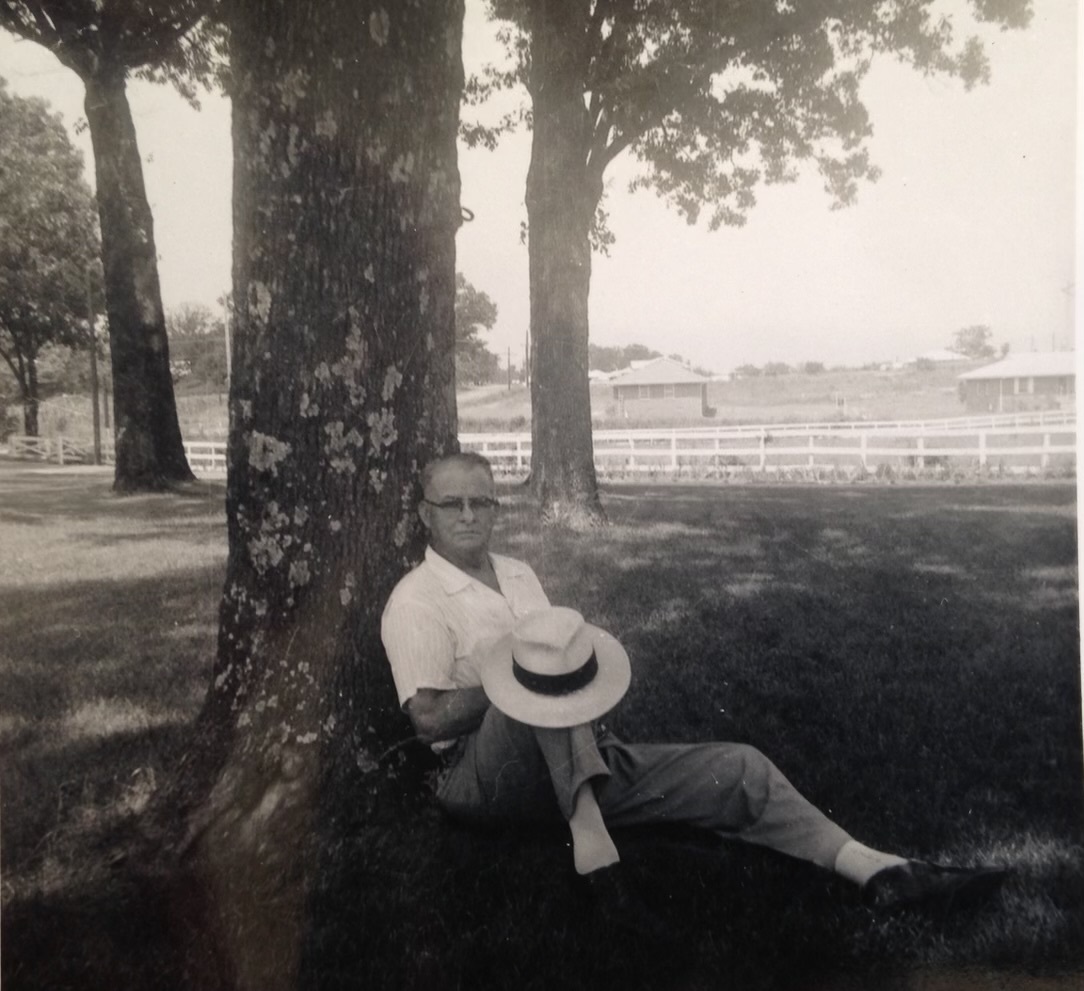
Forrest Clinton Brooks, born at Kolb's Farm (Courtesy of Dolly Brooks)
Park ranger Amanda Corman told the Picket the painting hangs in the visitor center vestibule.

When asked to describe the scene, Corman replied, “I cannot say that the painting depicts a specific portion of the battle; however, it is to reflect on the fighting that did take place at this location.” 

Doug moved to larger canvases later in life. While continuing use of oils on canvas, the painter began to do more with acrylics.

“I really like the large format. It’s like dancing on the canvas,” says Dolly, 67, of the painting now at the park. “He loved to play with the color and brush strokes (that) he could do.”

“It probably took him a week. “When it had the magic, he would take it off the easel.”

“The Confederate flag is muted,” she said. ““I love the horses that are coming in from the canvas on both sides. The more you look at it, the more you see.”

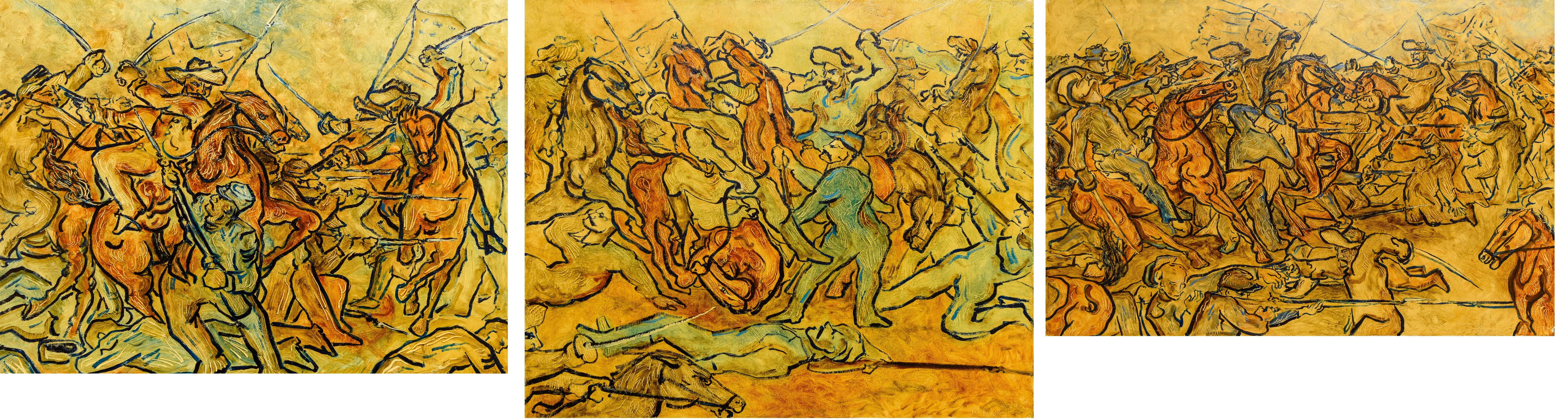
Tri-set depicting Civil War combat, click to enlarge (Courtesy of Douglas L. Brooks Collection)
Her brother was only able to make four paintings after returning to Georgia. “Doug often would paint through the night, if he was so inspired.”

The artist produced 15 or fewer paintings with a Civil War theme over his lifetime.

Dolly said she is touch with Corman about possibly gifting a smaller tri-set he made in the late 1980s for the park’s educational classroom.

He believed in coloring outside the lines

As collection caretaker, Dolly says her mission and charge is to bring her brother’s work to the public, and the Kennesaw Mountain gift is among the first on exhibit.

The retired teacher recently gifted two early works to the Georgia Museum of Art at the University of Georgia. (Self-portrait by Doug at left is courtesy of the Douglas L. Brooks Collection. He was about 34 at the time.)

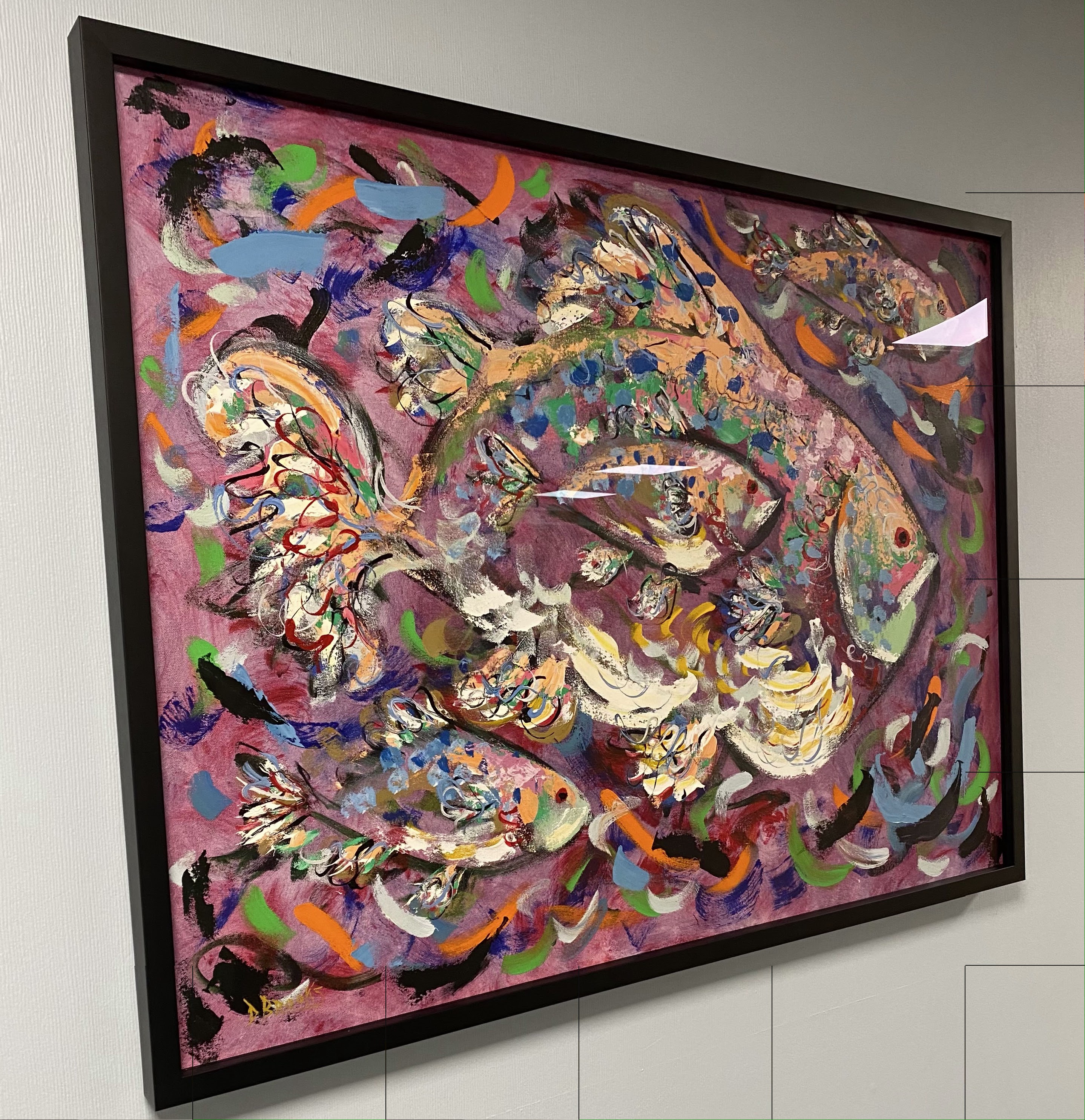
A larger canvas is now hanging at Imagine Preschool at the Providence Center in Rhode Island. A sign near the colorful painting of a fish – made by her brother in Alabama -- says, “May children always be encouraged to color outside the lines.” (Painting is second in this post)

Doug was not a professional artist, though he took lessons as a child from local artist Forrest Jacobs. He attended the University of Georgia from 1971-1972 and was in the art program led by Lamar Dodd. The student didn’t like the environment or academics, so he left. Later, after a stint in the U.S. Navy, he worked in the family business in Cobb County.

But the bachelor’s real passion was art, and Doug also produced drawings, pottery, plates and writings over 50 years. Dolly says viewers can appreciate a Southern and regional touch in the paintings, from sharecropper shacks to fishermen and night scenes. Many are joyful and playful, she says.

Dolly describes Doug as her best friend, a deeply spiritual man who believed strongly in storytelling. About 150 of the paintings are self-portraits, the first when Doug was 29 and the last from 2020. “I believe he knew he was not well.”

A Southern scene made by the artist (Courtesy of the Douglas L. Brooks collection)
Doug did not want anyone to profit from his work and his sister is not selling it at this time. Instead, Dolly says she is making gifts of his art that will be, as her brother said, flowers for walls.

“I look at his work and I just recognize the beauty of him," Dolly says. “His art will be seen by the world as he requested.”

Monday, October 16, 2017

'Priceless' items belonging to Georgia cavalry officer to be displayed at Fort McAllister, on land he once owned and defended

Lt. Col. McAllister's personal items (Georgia Dept. of Natural Resources)
A saber, spurs, uniform vest and other items that belonged to a Confederate officer who died in the largest all-cavalry battle of the Civil War will go on display at a coastal Georgia fort named for his father and where the officer served early in the conflict.

The items, which include a photograph of Joseph Longworth McAllister, were donated by Carolyn C. Swiggart, an attorney in Greenwich, Conn., to Fort McAllister State Park outside Savannah. The cavalryman is her fourth great uncle.

McAllister grew up on the Bryan County rice plantation, a portion of which became the site of the South’s Fort McAllister. He lived in Strathy Hall, just to the west of the Ogechee River defenses.

A display case is being fashioned to contain the items, with an opening expected before the park’s annual winter muster and battle on Dec. 9.

“(Visitors) can see the face of the person who lived there,” said Swiggart. “They can see items he personally touched and used. They can see he is a wealthy man who made certain choices.”

(Georgia DNR)
McAllister, 43, died June 11, 1864, at the Battle of Trevilian Station, a Confederate victory in central Virginia. The lieutenant colonel with the 7th Georgia Cavalry fought to the last, throwing an emptied gun at Federal troops just before he was cut down by bullets.

State officials are thrilled to receive the collection, which includes a grooming kit and rank insignia.

“When you look at the value of the history of those items, those are priceless items,” said Judd Smith, a historian with Georgia State Parks. “It is rare to get something with so many items. You might get one item, a hat or some sort of a letter…(the fact you have a collection that) comes back to where it belongs, from starting out there in 1864 and finally arriving back in 2016, is amazing.”

The display will note that the items were donated in memory of Swiggart’s son, who had an interest in the family history. Navy Lt. James H. Swiggart died in the crash of a private airplane in December 2015.

Fort McAllister's interior (Picket photo)
The header for the exhibit will be “Strike for God and our native land!” – reportedly yelled by McAllister shortly before his death. His gravestone and books and writings indicate he served valiantly in Georgia and Virginia, where he died within days of arrival.

“It is my hope that the items will provide a view of Col. Joseph L. McAllister to the visitors of Fort McAllister – he’s now someone that a visitor can envision as a person, not just a name on a sign,” said Swiggart. “Yes, he was a slaveholder and he fought for the Confederacy, and those decisions cost him his life. It's history. History cannot be changed. We can -- and should -- learn from the past and become better Americans from those lessons."

The items descended through Swiggart’s great-grandfather, Dr. Thomas Savage Clay of Savannah. He was the grandson of Matilda Willis McAlliser Clay, McAllister's sister. 

(All donation photos courtesy of Georgia DNR)

US MODEL 1860 CAVALRY SABER
This sword and scabbard – which have no engravings -- may have been carried by McAllister at the time of his death. It was returned to his family after the battle. During the first part of the Battle of Trevilian Station it appears the 7th Georgia Cavalry was mounted, according to Swiggart. She believes the officer gave his horse to a soldier before his final action. “A saber is typically a cavalry weapon most effectively employed while on horseback, and it would not have been any use to him when dismounted,” she said. It hung for decades at the Savannah home of Swiggart’s great aunt. The blade was “wrapped in aluminum foil, ostensibly to keep it from tarnishing.”


LEATHER SWORD KNOT
This item would have been attached to the weapon’s brass guard. It is too stiff to reattach without causing it damage, state officials told the Picket.


WAISTCOAT (VEST)
Since it is known that the officer was buried in his uniform, the vest is likely a spare. The item is made of blue wool; its brass buttons were manufactured in Waterbury, Conn. It bears McAllister’s insignia and, according to Swiggart, is a Confederate regulation pattern officer’s waistcoat.

PORTRAIT
McAllister wears civilian clothing in this photograph believed to be taken in 1859.

RANK INSIGNIA
Three stars indicate the rank of a colonel. State officials say this is a bit of a mystery, because records show McAllister’s official rank was lieutenant colonel (two stars). It’s possible the patch was awarded as a posthumous promotion or was a brevet (temporary rank) patch issued when he was made regimental commander.

Swiggart said her ancestor, while an amateur soldier, inspired his troops and got the job done. A fellow officer was resentful because McAllister was promoted above him back in Georgia.


I don't think there is any question about McAllister's enthusiasm for the Confederacy.  Whether it was founded in the hope of military glory for himself, or for economic survival -- I don't know," Swiggart said.


CONFEDERATE OFFICER’S SPURS
These were among personal effects and the saber returned to the family in Georgia. Swiggart believes they were an extra pair left at camp, since McAllister’s boots, hat, uniform buttons and insignia were removed by the enemy. “The spurs were given to me when I was a child, and my mother kept the other items in a trunk. The smell of camphor was a familiar one because my grandmother and mother used it to keep moths out of the clothing trunks.” 


GROOMING KIT
The late 1840s English- and Irish-made kit includes silver-topped jars featuring the engraved initials “J.L. McA.” Officials don’t believe the entire kid was carried on battle campaigns. Two items are absent: a small grooming razor and what appears to have been a nail file, items that would easily fit into a haversack.

Slaveholder ran rice plantation

McAllister came from a family that traced its American roots to Pennsylvania, with one member a hero of the American Revolution.

Research indicates a Capt. James MacKay purchased the property around what became Fort McAllister in 1748. He built nearby Strathy Hall and began rive cultivation.

George Washington McAllister, who came to Georgia to seek his fortune, bought Strathy Hall and Genesis Point in 1817. The family had one of the largest plantations in that part of Bryan County. “The McAllister family was pretty well-known,” said Swiggart, author of “Shades of Gray: The Clay and McAllister Families of Bryan County, Georgia, during the Plantation Years.”

McAllister property (left) marked in relation to fort (Georgia State Parks)
Washington McAllister’s son, Joseph, attended Amherst College, but did not graduate. He toured Europe for a long time and returned to join the family rice business. “He didn’t go the route his cousins, did, which was law. He stayed at the plantation,” said Swiggart.

The descendant points out that McAllister, who owned 271 slaves in 1860, had received them by inheritance, rather than purchase. “This is a major, major point.” Evidence shows he probably was not a harsh master and he ensured his slave’s care, she added.

Thomas S. Clay, in 1833, wrote an essay about the proper “moral improvement of negroes on plantations.” It called for proper housing, care and religious instruction of slaves.

The family was split on secession. Looking back, Swiggart wishes “they had sold the whole damn thing.” But the family believed it could not sell the plantations and the slaves, because it would destroy families and shred plantation community, she said. Thomas Butler King did that in 1859 and the sale became known as "The Weeping Time." The family believed slavery would become obsolete, that it was a burden, she said. Her great aunt said the South would have done better if Abraham Lincoln survived.

Strathy Hall and fort marked in red (Georgia State Parks)
But Joseph McAllister was prepared to fight.

After the Civil War broke out, he sold land to the Confederacy for the construction of the fort named for his father, who died in 1850.

Amateur soldier inspired troops

Soon after Confederates shelled Fort Sumter in Charleston Harbor, McAllister was commissioned a captain of an artillery unit at the fledgling Fort McAllister.

In April 1862, McAllister formed the Hardwick Mounted Rifles, comprised of volunteers from Bryan County. The regiment, one of several homegrown units in the Savannah area, helped guard against Federal invasion of the coast.

The Hardwick Rifles fired on sailors who were part of a significant Union attack -- made up of ironclads and mortar boats -- on Fort McAllister on March 3, 1863. The Federal fleet did little damage to the fort, and withdrew the next day. It was apparent the defenses would likely have to fall to infantry, which happened in late 1864 during Sherman’s March to the Sea.

McAllister after it fell to Union forces (Library of Congress)
After years of duty around home, the men finally got their chance to fight at the front in Virginia. McAllister and two companies from the Hardwick Mounted Rifles joined other units to form the 7th Georgia Cavalry in February 1864.

McAllister became regimental commander after the death of his predecessor, and the unit was ordered to support the Army of Northern Virginia. It left in late April and made a rugged journey from South Carolina and Virginia, lasting until early June.

McAllister wrote to his sister, Emma, about the trip and heat that killed a few horses and mules.

He writes of wanting to take part in “glorious fights.” He got along well with a conceited subordinate and recollected Virginians greeting the troops with flowers and pails of milk.

The bachelor shared a story about young women presenting the young cavaliers with bouquets, according to Swiggart’s book.

“Some funny notes attached to the bokets,” the officer wrote his sister. “They all seem to think that the matrimonial chances are daily lessening – and every note wants you to write – these as a matter of course are plain country girls just from school. Some pretty some ugly.”

But there also were moments of resolve.

“Keep up your spirits – to take care of me if I get a bullet in me – which I trust will not be the case – still we must all do our duty in this struggle and while I shall not foolishly expose myself, I will not disgrace our names.”

'Strike for God and our native land'

The 7th’s first major battle in Virginia came at Trevilian Station on June 11. Nearly 40 percent of the regiment would become casualties.

Union troops wanted to draw off Confederate cavalry so that forces could move on the James River. Maj. Gen. Philip Sheridan’s troopers raided Louisa County, threatening to cut a Confederate railroad.

Sheridan’s troops attacked Confederate divisions led by Wade Hampton and Fitzhugh Lee at Trevilian Station. For a while, the Rebels had to dismount and make a defensive stand.

“From this advantageous position, they beat back several determined dismounted assaults,” the National Park Service says of the battle. “Sheridan withdrew after destroying about six miles of the Virginia Central Railroad. (The) Confederate victory at Trevilian prevented Sheridan from reaching Charlottesville and cooperating with Hunter’s army in the Valley. This was one of the bloodiest cavalry battles of the war.”

McAllister’s led a counterattack on the first day’s fighting, cyring out to his men, “Strike for God and our native land!” Historian Eric Wittenberg, in Glory Enough for All: Sheridan’s Second Raid and the Battle of Trevilian Station, wrote that McAllister was surrounded and mounted when he was first hit by enemy.

McAllister threw an emptied revolver at the enemy and was shot four or five times. Many members of the 7th Georgia Cavalry were captured.

The gallant officer and Capt. John Hines, also of the 7th, are among about 85 Confederates buried in what is now called Oakland Cemetery in Louisa (below). His marker reads “Soldier. Scholar. Gentleman.” His enslaved body servant, Jack, returned his personal effects to Strathy Hall after the funeral.

Marker with McAllister reference (Photos courtesy of Ed Crebbs)
McAllister grave is to left of stone with flag

Group tries to publicize battle

The cemetery is one of several stops on the Virginia Civil War Trails driving tour in the central Virginia Community. Another group, the Trevilian Station Battlefield Foundation, is restoring a house used by Brevet Lt. Col. Gen. George A. Custer during the clash. Custer captured Hampton’s divisional supply train but suffered significant losses, including having his trains and personal baggage overrun.

Ed Crebbs, secretary of the foundation, told the Picket his group also offers a driving tour that comes out of Louisa and makes several stops. He said the foundation is trying to raise awareness of the two-day battle and draw more visitors to the rural crossroads.

“It’s underappreciated and almost unknown because it didn’t have the biggest names of the Civil War,” he said. “It did not have infantry. It did not have tremendous destruction with it.”

Visitors to Oakland Cemetery can take in an interpretive panel that includes the story of McAllister and the 7th Georgia Cavalry.

Donation 'brings it all home'

As Sherman’s troops moved on Savannah from Atlanta – months after McAllister’s death -- some houses and property were destroyed by Federal troops. Strathy Hall escaped such a fate. Swiggart said that’s because Union officers knew that ancestors of McAllister had residences and connections in Newport, R.I.

But the South’s loss in the war destroyed the family financially.  After the war, Strathy Hall and Genesis Point, located near the city of Richmond Hill, were sold to a nephew of McAllister's who owned them until 1924.

Fort McAllister fell into ruin until the 1930s, when it was restored as a site for the public through funding from auto magnate Henry Ford, who owned the land. It now belongs to the state. Strathy Hall a private residence, is surrounded by a subdivision.

Strathy Hall today (Kenneth Dixon, Wikipedia)

Smith said the Friends of Fort McAllister State Park paid for the design of the exhibit. The $30,000 wooden case will be secure and provide proper lighting “where it is not going to damage the artifacts over time.” The display will include interpretive signs and sit next to an exhibit about Strathy Hall and the McAllisters.

As Swiggart said, McAllister’s personal belongings will add to the story.

“From his owning the plantation that the fort sits on and the fact that not only did he serve in the war, but served for a time right there at Fort McAllister – (it) brings it all home, said Josh Headlee of the Georgia Department of Natural Resources’ Historic Preservation Division.

“I think Civil War artifacts are impressive in their own right, but when you have artifacts that belonged to someone that you know was there and you can relate their personal lives to it, that really makes a great and lasting impact,” the curator said.