Showing posts with label Palmetto Guard. Show all posts

Tuesday, February 13, 2024

Here's how an NPS-led team safely removed three Fort Sumter flags for a long rest. The big question now: Is it too risky to put 2 of them back at the fort?

Opening of Palmetto Guard flag mount (left) and removal of a Fort Sumter flag (NPS photos)
Anne E. Ennes, a conservator for the National Park Service’s Harpers Ferry Center, knows the value of planning before traveling to an historic site. Still, flexibility can be the name of the game once she arrives and handles some of America’s most-treasured artifacts.

Such was the case in mid-September when Ennes and other experts within the agency, working with contractors and professional art movers, painstakingly took three famous Fort Sumter flags off-exhibit for a much-needed rest from damaging light.

They worked with several variables smack dab in the middle of hurricane season. Two of the flags have been on display at the fort in Charleston’s Harbor, and getting them safely off the artificial island was part of a rather complex operation. None of the team members had previously handled the flags – they had been on display for nearly 30 years.

“The objects were immensely iconic and irreplaceable. We wanted this to go well. We had to go over by boat, dependent on weather, dependent on tides,” Ennes told the Picket. “You sweat out hurricane season.”

The gloved team over three days was able to de-install, roll and crate the fragile flags without causing damage.

US storm flag, top, garrison flag, lower left, Palmetto Guard (NPS)
The project got lucky with the weather but Ennes, a textile conservator who works at the center’s Museum Conservation Services, said she is in favor of reproduction flags – rather than the original 33-star storm flag and the Palmetto Guard flag – going back to the fort.

Fiercer hurricanes resulting from climate change, mixed with the challenges of moisture, humidity and storm surge in the Carolinas, make the museum on Fort Sumter a high-risk location for the flags, Ennes says. And a stable environment requires near-infallible air conditioning.

“You don’t want to deal with evacuating precious objects with a storm looming,” she said, adding it’s not her decision to make.

The Picket asked Brett Spaulding, chief of interpretation for Fort Sumter and Fort Moultrie National Historical Park, about the fate of the flags, given risk factors raised by conservators.

“At this time there has not been a decision made as to where the future home of the flags will be,” Spaulding wrote in an email last autumn. “Before they are put back on display, we will take into consideration many of the points that you identified and other considerations.”

Workers prepare to remove garrison flag from flat case (NPS photo)
Spaulding said the flags will remain off display for a minimum of five years.

In a November Facebook post, the park provided a brief update, saying: “Textiles should not be on display for long periods of time due to humidity fluctuations and light damage.”

The storm and Palmetto Guard flags had been on exhibit at the Fort Sumter museum on the island in the harbor. The massive and brittle garrison flag, only a small portion visible, was at the Fort Sumter Visitor Center at Liberty Square in downtown Charleston.

These flags tell an important story

The three flags are powerful symbols of a nation torn apart and brought back together. Gunfire wasn’t their only enemy: high winds, saltwater spray, humidity and light took a toll. All underwent conservation before they went on display, but that was many years ago.

The flags are among the most famous of the Civil War. The 33-star U.S. garrison flag flew over the fort until it sustained wind damage on April 11, 1861, hours before Rebel artillery effectively began the Civil War. Its smaller and sturdier successor, the storm flag, flew during the 34 hours of the attack.

The garrison flag in Charleston rests in a special case (NPS photo)
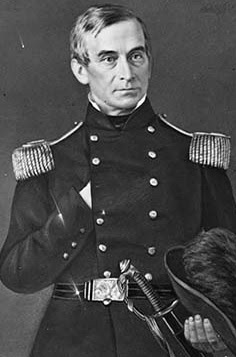
Both were removed from the island by Union Maj. Robert Anderson after he surrendered. The storm flag immediately became a patriotic symbol for the remainder of the conflict and raised the status of the Star-Spangled Banner to what we know today.

The garrison and storm flags were issued by the quartermaster in June 1860, nearly a year before the Confederate attack on Fort Sumter. The manufacturer of clothes, textiles and flags during that time was the Schuylkill Arsenal in Pennsylvania, said Spaulding. “However, the arsenal hired over 10,000 seamstresses and tailors during the Civil War so, unfortunately, we don't know exactly who made the (two) flags.” 

The Palmetto Guard flag was the first Confederate flag to fly over the fort after the departure of the US Army on April 14, 1861.

As victorious Confederates entered Fort Sumter, John Styles Bird Jr., a private in the South Carolina militia unit known as the Palmetto Guard, placed his unit's flag on the parapet facing Charleston. The fort remained in Confederate hands for the next four years until evacuation in February 1865.

Returned flag flies above the fort on April 14, 1865 (Library of Congress)
Interestingly, Bird received the flag from a Capt. Edward Mills, the spitfire captain of the ship Brig John H. Jones. The flag was flown in New York Harbor in late 1860 by the commercial vessel, which belonged to the Palmetto line of schooners traveling between New York and Charleston.

Tensions were high in the months before South Carolina and other Southern states seceded from the Union.

According to a December 1860 article in The New York Times, Mills “on being politely questioned on the subject of his flag, yesterday, told a gentleman, with more emphasis than civility, that if anybody dared to go on board of his vessel, and attempt to haul it down, "he was a dead man -- a corpse!"

You don't hurry this kind of work

All three of the flags have been kept in climatically controlled cases. They were protected by cellulostic materials to maintain preferred humidity. “You create the environment you want it to be in,” Ennes said. “They were dimly lit. The lighting wasn’t horrible at either place.”

Still, even small amounts of UV light fade and deteriorate textiles.

The NPS team decided to tackle the smaller Palmetto Guard first, before the U.S. storm flag. A large portion of the flag is missing and it was encapsulated years ago to mimic its original footprint. “It is very sheer,” said Ennes.

Some members of the team in front of the storm flag at Fort Sumter (NPS photo)
Experts removed the outer frame and the flag was unstitched from its mount. After a few other tasks, the Palmetto Guard and storm flags were carefully rolled and placed in archival tubes. The crews had to take extra care because there is no elevator at the fort and the crates had to be carried by hand down steps to a waiting boat.

The storm flag was stable but fragile, said Ennes, adding both flags were in fairly good shape but will need new mounts once they are back in public view. “Hopefully, they will go back on display after a long time in dark storage.”

Back on land, the garrison flag lies flat below a huge reproduction flag at the Fort Sumter Visitor Center at Liberty Square. Only a portion of the real flag is visible to visitors.

Conservators found it to be in a very delicate situation. “The threads and yarns are brittle and want to break when moved,” according to Ennes. “It was in worse shape than we imagined.”

“The garrison flag needs a little treatment before it goes on display. It would need some work at my lab,” she said, adding it can go back in the same case. For now, it is in a 26-foot storage tube.

A view of the mechanism that supports the rolled up garrison flag (NPS photo)
Complicating the picture at the visitor center was the failure of the HVAC system last year. Spaulding told the Picket a new system will go in place, but no firm timetable has been set, he said this week.

Even though no decision has been made on where the flags will be, “Wherever they go on display a working system is required," he said.

Ennes said the flags removal was a successful – the result of working slowly, patiently and carefully. The payoff comes with knowing artifacts will continue to tell a story.

“I am always amazed by the craftsmanship on all the things I work with.”

Tuesday, September 19, 2023

Much-needed R&R: Three Fort Sumter flags are headed for a cool, dark place after years on display. Here's more about the banners

US storm flag, top, garrison flag, lower left, Palmetto Guard (NPS)
Three Fort Sumter flags – among them the U.S. flag that waved during its bombardment -- have been on display for at least 20 years, powerful symbols of a nation torn apart and brought back together.

Gunfire wasn’t their only enemy: saltwater spay, humidity and light took a toll on the flags. Now it’s time to give them some down time. Today and Wednesday, gloved curators will carefully remove the fragile banners from exhibit.

“It is long overdue for them to be rested,” said Brett Spaulding, chief of interpretation for Fort Sumter and Fort Moultrie National Historical Park in Charleston, S.C. “Light is an issue for all textiles that are on display. To help preserve them, it’s common practice to rest artifacts.”

The museum on the island will be closed both days; the grounds of the fort and bookstore will remain open and ranger programs will operate normally, officials said.

Storm flag flies above the fort on April 14, 1865 (Library of Congress)
The flags are among the most famous of the Civil War: The 33-star U.S. garrison flag flew over the fort until it sustained wind damage on April 11, 1861, hours before Rebel artillery effectively began the Civil War. Its smaller successor, the storm flag, flew during the 34 hours of the attack.

Both were removed from the island by Union Maj. Robert Anderson after he surrendered. The storm flag immediately became a patriotic symbol for the remainder of the conflict and raised the status of the Star-Spangled Banner to what we know today.

The Palmetto Guard flag was the first Confederate flag to fly over the fort after the departure of the US Army on April 14, 1861. 

(NPS photo)
The storm and Palmetto Guard flags have been at the Fort Sumter museum. The garrison flag is at the Fort Sumter Visitor Center (above) at Liberty Square in downtown Charleston.

All underwent conservation before they went on display. “Despite taking great care to protect the artifacts they are best preserved when stored in a clean, dark, cool, and dry environment for periods of rest,” the park said in a news release. 

Here is more about the three flags:

U.S. 33-star garrison flag (wool bunting, 20 feet by 36 feet)

This was the larger of two U.S. flags to fly over Sumter in April 1861. When the Civil War began, the United States flag had 33 stars: one representing each state in the Union. After Fort Sumter, President Abraham Lincoln had to decide whether to leave all 33 stars on the flag or to remove those of the seceded states. Since Lincoln's mission was to preserve the Union, no stars were removed.

The garrison flag flew as tensions rose before the bombardment. By the evening of April 11, hours from the exchange of artillery, the larger banner suffered extreme wind damage and it was taken down. It has lost the most material of the three historic flags.

McCrone Associates, which partnered with the NPS to authenticate the flags, wrote this about the project:

“A crucial finding was that the fibers were characterized by “glass rod fracture,” indicative of severe photo degradation -- findings verified through micro chemical tests, as well. Thus, museum personnel were strongly advised to keep the rolling up and unrolling of the flags to an absolute minimum. 

"The severe climatic conditions of an ocean island, together with prolonged exposure to ultraviolet radiation from the sun, were responsible for irreversible damage to the integrity of the individual fibers, so that every movement of the flags resulted in countless more broken fibers. These facts, together with the constant whipping in the wind, accounted for the missing portions of the garrison flag.”

Remarkably, the blue canton of the tattered flag is largely intact.

U.S. 33-star storm flag (20 feet by 10 feet)

(NPS photo)
While it flew only three days over the fort, this banner was the sturdier banner and was taken by Anderson to New York City a week after the surrender for a rally. He was celebrated as a hero. The storm flag later was the object of fundraising across the country for the Federal war effort.

Anderson said of the flags in 1863, according to the Post and Courier newspaper:

 “I feel that no one can love and ... keep as carefully as I do this sacred relic, and it is my earnest wish that when Fort Sumter shall be again our own, I may be permitted by the government to there once more unfurl it, or should I die before that time, that it may be wrapped around my body when it is borne to its last resting place ...”

On April 14, 1865, five years after the garrison surrender, Anderson (left) returned to Fort Sumter as the storm flag was raised. Charleston had been under Union occupation for two months and the liberated black population had put on parades.

“Lincoln had pushed for the April 14 ceremony and was invited to attend, but with the break-neck speed of events in Virginia following the fall of Richmond, the president opted to stay in Washington instead,” according to Emerging Civil War. 

“The flag ceremony went on without him. That evening, at Ford’s Theater, John Wilkes Booth put a bullet in Lincoln’s head. Had the president gone to Charleston, how different might things have played out.”

In 1905, the garrison and storm flags were donated by Anderson’s family to the War Department.

Palmetto Guard Flag (9 feet by 6 feet)

From the National Park Service: As victorious Confederates entered Fort Sumter, John Styles Bird Jr., a private in the South Carolina militia unit known as the Palmetto Guard, placed his unit's flag on the parapet facing Charleston.

Palmetto Guard flag on display at Fort Sumter Museum (NPS)
The single star signified the independent Republic of South Carolina and the tree harkened back to the Revolutionary War. The fort remained in Confederate hands for the next four years until evacuation in February 1865.

John Styles Ashe, son of John Styles Bird Jr., donated it to the National Park Service. They were transferred to the National Park Service at Fort Sumter in 1954, according to the Post and Courier.

No timetable for them to be put back on display

Spaulding, the interpretive ranger, told the Picket in an email that there are no current plans to replace the flags. “Later this year, we will look to develop temporary displays to occupy the empty space.”

He said it is not currently known whether significant work is needed or will be done on the three flags.

“For right now they are only being stored and preservation will take place at a later undetermined time. At this time, no date has been set for the return of the flags” to exhibit.