During the Civil War, members of the Marine Corps were primarily assigned to blockade duty aboard U.S. Navy ships, which were critical in strangling the Confederate states’ ability to continue fighting. Without the blockade, supplies, arms, ammunition, and money coming in from cotton, the South might have been able to fight on indefinitely. The Corps had an especially critical role in the 1864 Battle of Mobile Bay. -- Article
Showing posts with label new orleans. Show all posts
Showing posts with label new orleans. Show all posts
Thursday, October 13, 2022


Monday, August 6, 2018
Beauregard statue time capsule opened
History was
revealed when a time capsule from beneath the P.G.T. Beauregard pedestal was opened
in New Orleans' French Quarter. The box contained newspapers, currency and other items. The time capsule was placed under the monument in 1913. Historians
said while there was some water damage to the artifacts, they believe much of
the items can be salvaged. The
equestrian statue of Beauregard was taken down by a crane more than a year ago
after a contentious public battle. •Article
Thursday, March 8, 2018
'Shoot him on the spot' letter that made Northerners rally around the flag is donated to Treasury Department
 |
| Click to enlarge (Treasury Department) |
On January 29, 1861 – a few months before the Civil War
began – Dix issued an order saying a Federal revenue cutter must not be allowed to fall into the hands of Southern
sympathizers in New Orleans. He concluded the message with, “If anyone attempts
to haul down the American flag, shoot him on the spot.”
While a telegram bearing the message was stopped in
Alabama, word got out and the line became a rallying cry in the North during
the war. A song was written in its honor and banners and coins carried Dix's command, according to The New York Times' Disunion blog.
 |
| Dix token (Wikipedia) |
Dix was an Army veteran, politician and U.S. senator from
New York before the war. During the conflict, he suppressed draft riots in New York in 1863 and helped arrange prisoner exchanges through the Dix-Hill Cartel. He served as New York governor in 1873 and 1874.
Today, he’s perhaps best-remembered for the letter he
sent to treasury officers who were being harassed in New Orleans following the
election of Abraham Lincoln.
 Buchanan would soon be out of office and secessionist
sentiment was growing across the South, and there were threats of seizure of federal
property. Buchanan's administration was considered to be vacillating and divided.
Just two weeks after becoming treasury secretary, Dix issued his order. It came as he worked to keep other ships in Federal hands. The Revenue Cutter Service was a predecessor of the Coast Guard.
The Rebel-sympathizing captain of the cutter McClelland had refused to move his ship north, according to the Disunion blog, and Dix dashed off his correspondence:
“Tell Lieutenant Caldwell to arrest Captain Breshwood,
assume command of the cutter, and obey the order I gave through you. If Captain
Breshwood, after arrest, undertakes to interfere with the command of the
cutter, tell Lieutenant Caldwell to consider him a mutineer, and treat him
accordingly. If any one attempts to haul down the American flag, shoot him on
the spot.”
 |
| Portrait of Dix (Treasury Department) |
Dix later wrote that he didn’t tell Buchanan about the matter beforehand, fearing he would not allow the letter to be sent. The official told the president about the message a few days later while they were discussing the revenue cutters.
Dix described the order, and Buchanan questioned him
about the “shoot him on the spot” line.
“Did you write that?”
“No, sir. I did not write it, but I telegraphed it.”
 |
| President Buchanan |
Dix later said the U.S. flag should never by hauled down
by a foe, according to memoirs written by his son.
“I did not think, when I seized the nearest pen …. And
wrote the order in as little time as it would take to read it, that I was doing
anything specially worthy of remembrance.”
Despite the letter, the flag did come down on the McClelland and the ship eventually fell into Confederate hands.
Despite the letter, the flag did come down on the McClelland and the ship eventually fell into Confederate hands.
Mnuchin expressed admiration for Dix's leadership at a "pivotal time" in U.S. history, the Associated Press reports.
Monday, April 24, 2017
Confederate monuments coming down in N.O.
A monument to a deadly white-supremacist uprising in 1874 was removed
under cover of darkness by workers in masks and bulletproof vests Monday as New
Orleans joined the movement to take down symbols of the Confederacy and the Jim
Crow South. In the coming days, the city also will remove statues of Confederate Gens. Robert E. Lee and P.G.T. Beauregard and Confederate President Jefferson Davis. • Article
Saturday, April 21, 2012
Two stamps issued next week
On April 24, the United States Postal Service will issue two new Forever stamps for the second year of its ongoing commemoration of the Civil War. The 1862 battles of New Orleans (April 24-25) and Antietam (Sept. 17) are featured for this year. The series will continue through 2015. • Article
Wednesday, March 28, 2012
They didn't truly fire blind on Ft. Jackson
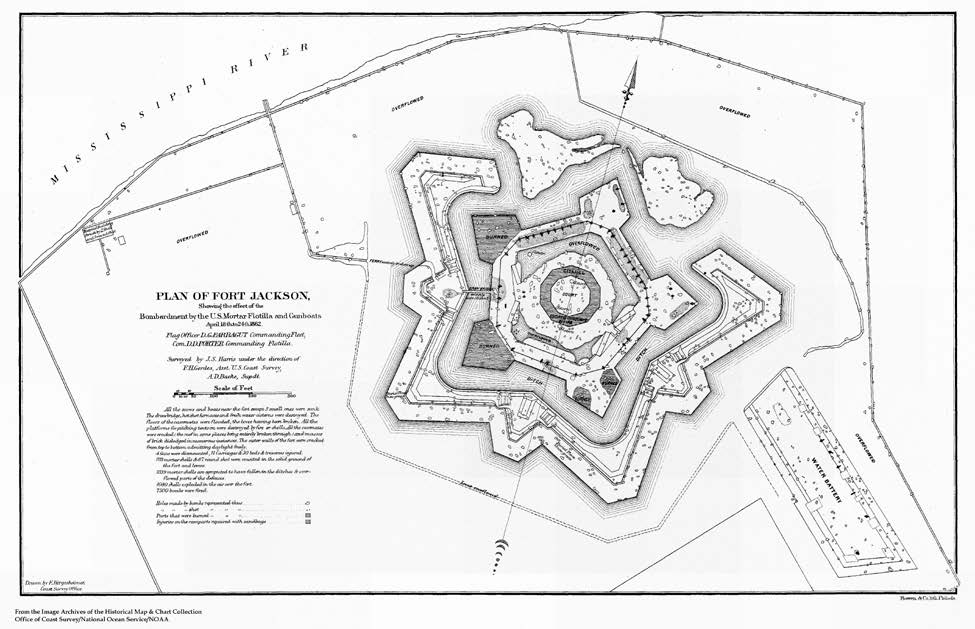
Verve and a mathematical calculations enabled Union mortar boats to fire on Fort Jackson -- a guardian fort below New Orleans -- outside the Rebel line of fire. The success helped paved the way for the taking of the largest city in the Confederacy.
 NOAA, in an article released Tuesday, provides details of the survey work of Coast Survey Assistant Ferdinand Gerdes, who it calls one of the unsung heroes of the Civil War.
Gerdes was employed by the U.S. Coast Survey, predecessor of NOAA.
Fort Jackson and Fort St. Philip, two Confederate forts essential to New Orleans’ defense, were located on opposite sides of the Mississippi 70 miles south of the city. Commander David Dixon Porter (below) got permission to damage their guns.
"By relying on mathematical calculations — using survey coordinate points established by Coast Survey teams, rather than judging distance by sight — Gerdes would give coordinates to Union flotilla gunboats so they could aim their weapons without seeing the target," NOAA said.
 Gerdes' team, under fire, established survey markers on the shore and made maps and charts. They measured a series of small triangles.
On April 18, 1862, Union boats began their attack on Fort Jackson. Over the next six days, an estimated 4,000 mortar shells rained on the fort.
"When the Confederates discovered where the shells were coming from and started firing back, the boats would have to move, which meant additional surveying — again, often under fire," according to NOAA.
WIth the help of damaging bombardments, the Union fleet, which included 6,000 troops, under Adm. David Farragut was able to get by the forts, chain barriers and a Confederate ironclad. Demoralized troops at Fort Jackson mutinied and both forts surrendered just days later. New Orleans, a key port, fell to Farragut's expedition.
Map credit: Plan of Fort Jackson, NOAA Coast Survey sketch, from the Coast Survey historical collection
• Collection of Civil War maps, charts and documents
 NOAA, in an article released Tuesday, provides details of the survey work of Coast Survey Assistant Ferdinand Gerdes, who it calls one of the unsung heroes of the Civil War.
Gerdes was employed by the U.S. Coast Survey, predecessor of NOAA.
Fort Jackson and Fort St. Philip, two Confederate forts essential to New Orleans’ defense, were located on opposite sides of the Mississippi 70 miles south of the city. Commander David Dixon Porter (below) got permission to damage their guns.
"By relying on mathematical calculations — using survey coordinate points established by Coast Survey teams, rather than judging distance by sight — Gerdes would give coordinates to Union flotilla gunboats so they could aim their weapons without seeing the target," NOAA said.
 Gerdes' team, under fire, established survey markers on the shore and made maps and charts. They measured a series of small triangles.
On April 18, 1862, Union boats began their attack on Fort Jackson. Over the next six days, an estimated 4,000 mortar shells rained on the fort.
"When the Confederates discovered where the shells were coming from and started firing back, the boats would have to move, which meant additional surveying — again, often under fire," according to NOAA.
WIth the help of damaging bombardments, the Union fleet, which included 6,000 troops, under Adm. David Farragut was able to get by the forts, chain barriers and a Confederate ironclad. Demoralized troops at Fort Jackson mutinied and both forts surrendered just days later. New Orleans, a key port, fell to Farragut's expedition.
Map credit: Plan of Fort Jackson, NOAA Coast Survey sketch, from the Coast Survey historical collection
• Collection of Civil War maps, charts and documents
Subscribe to:
Posts (Atom)