 |
| Georgia's Old Capitol Building (visitmilledgeville.org) |
(Part 2)
Much of the ground covered by the Union army on its
November-December 1864 March to the Sea from Atlanta to Savannah and beyond remains rural
and there are few visible signs that it occurred. But interpretive signs and museum exhibits do help tell the story.
 Many of those markers have been placed by the Georgia Historical Society and Civil War Heritage Trails of Georgia. The
latter will place a commemorative sign in front of the Old State Capitol in
Milledgeville on Nov. 22. The historical society plans a Dec. 11 March to the
Sea marker dedication at Madison
Square in Savannah.
Many of those markers have been placed by the Georgia Historical Society and Civil War Heritage Trails of Georgia. The
latter will place a commemorative sign in front of the Old State Capitol in
Milledgeville on Nov. 22. The historical society plans a Dec. 11 March to the
Sea marker dedication at Madison
Square in Savannah.
Events relating to the march recently occurred in
Kennesaw, Augusta and Sandersville, Ga. A Nov.16 symposium, “Yankees Marching By,” in Madison will focus on the impact of
the Civil War and March to the Sea on the town and Morgan County. A Nov. 22 commemoration will be held at Griswoldville
Battlefield near Macon. The lopsided Union victory was the only major battle of
the march.
The Picket asked Civil War experts, historians, an
archaeologist and a living historian/re-enactor about their thoughts on myths
and realities of the march, what associated sites should be visited and the campaign's
legacy today. Here are their responses to the second question, with a focus largely on Georgia.
Q. For the
scholar or casual follower of the Civil War, what location(s) in Georgia or
Carolinas would you recommend they visit to get a flavor of what occurred?
-- JIM OGDEN, historian, Chickamauga and Chattanooga National Military Park
While I wish it weren't so, visiting the March to the Sea
requires preparation, more than it should. I have to recommend Jim Miles' “To the Sea: A History and Tour Guide ofSherman's March (1989/2002)” as the best of what's out there right now to
get you to many of the March to the Sea sites. The one place along the route
I'd recommend visiting? Milledgeville. It
has many of the aspects of the era and of the march -- military, political,
social, economic, industrial -- together in one place. Union soldiers held a
mock session of the Georgia Legislature in the State House and rescinded the
Ordinance of Secession. The arsenal, magazine and penitentiary were destroyed. But
other industrial facilities and the majority of the town escaped destruction,
belying the common perception that Sherman burned everything in his path as he
marched across the Empire State of the South.
While Miles' book will help get
you to sites in Milledgeville and his narrative will give you some of the
history, take the time also to find and read James C. Bonner's "Sherman at
Milledgeville in 1864" in The Journal of Southern History, Volume 22,
Number 3, August, 1956, pp. 273-291. The Old Capitol and the Old Governor's
Mansion can be visited today. Information about visiting Milledgeville,
including a guide to the Historic District, can be obtained at http://www.visitmilledgeville.org/.
-- CHARLIE CRAWFORD, president of the Georgia Battlefields
Association
While one could literally retrace the March to the Sea,
it would be frustrating to follow the routes of two armies and a cavalry force
that were sometimes separated by 60 miles. A selective list would be:
-- The site of the Neal house in downtown Atlanta (now
the site of City Hall) – A marker here relates to the March to the Sea. Sherman
stayed in the Neal house before departing, and it is also the site from which a
famous photo of the 1864 city hall was taken.
-- Griswoldville Battlefield, northeast of Macon – Site
of the only infantry battle during the march.
Interpretive markers and maps illustrate how little resistance the
militia offered.
-- Milledgeville – The wartime capital. The old Capitol
(What? The Yankees didn’t burn it down?) and the old Governor’s mansion (What?
The Yankees didn’t burn it down?) still stand and have historical displays.
Sherman spent the night in the governor’s mansion.
-- Magnolia Springs State Park – Site of Camp Lawton, a
large POW camp built to house prisoners transferred from Andersonville, but (they)
moved again a month after they arrived once the Confederates realized they had
moved the prisoners into Sherman’s path. Historical displays and earthworks
remain, and recent archaeological digs have unearthed artifacts.
-- Ebenezer Creek – Site of the notorious incident (in
Effingham County) in which U.S. General Davis ordered the pontoon bridge taken
up, stranding thousands of slaves that had been following his column.
-- Fort McAllister State Park – Fort in Richmond Hill
(south of Savannah) that was the site of several wartime incidents. When the
Federals took it on 13 December 1864, they established communications with the
U.S. Navy. The Ogeechee River then became the principal supply route for the
Federals besieging Savannah, with King’s Bridge landing (now a recreation area)
becoming one of the busiest ports in the U.S. for a few weeks.
 |
| Green-Meldrim House (W. Waud-Library of Congress) |
-- Green-Meldrim House in Savannah – Where Sherman stayed
from late December 1864 to late January 1865. The adjoining square has
historical markers that address Sherman’s stay, the visit by Secretary of War
Stanton, the meeting with local African-American preachers and the issuance of
the “forty acres and a mule” order.
-- ANNE SARAH RUBIN,
history professor at the University of Maryland, Baltimore County and author of
“A Shattered Nation: The
Rise and Fall of the Confederacy, 1861-1868”
-- Milledgeville, Ga., see the Old Governor’s mansion and
statehouse, and get a feel for the way the march played out in a town
-- Ebenezer Creek, Ga., to think about the impact of the March
on African-Americans (freed slaves were abandoned by Union troops being pursued
by Confederate cavalry)
-- Columbia, S.C. --the enduring anger is still palpable.
-- Bennett Place, N.C. -- the site of the surrender
 |
| Federal troops quickly stormed Fort McAllister near Savannah |
-- HERB COATS, Georgia living historian/re-enactor
In Georgia, Griswoldville Battlefield (Georgia militia attacks a brigade of US infantry), Milledgeville with the Old State Capitol and Governor’s Mansion, Fort McAllister State Park, Savannah History Museum for a local history of the “siege.” (Fort McAllister's winter muster on Dec. 13 will re-enact the Federal victory at the fort on the anniversary of the date it occurred)
-- DAVID EVANS, historian and author of "Sherman's
Horsemen"
I would recommend a driving tour, similar to the one
Charlie Geiger compiled for "Cump & Company" back in the 1990s. This
will take you to the towns Sherman's army passed through, and some of them,
such as Madison, Milledgeville and Sandersville, have museums with exhibits
devoted to "The March." At the end, you get to see Fort McAllister on
the Ogeechee River and the splendid city of Savannah (with all that great
seafood).
 |
| Griswoldville Battlefield |
-- ANTHONY WINEGAR, chief ranger, Kennesaw Mountain National
Battlefield Park
I would drive from Atlanta to Griswoldville, then on to
Milledgeville. From there I would drive to Fort McAllister near Savannah. Tourists
would receive a good sense of the march from those locations. Andersonville is
always a good side trip although the prison was not liberated during the march.
Once you reach South Carolina, there isn't much to see. Sherman and his men
spared nothing there, as they viewed the state as the instigator to the war.
-- DAN ELLIOTT, president of the LAMAR Institute, which
conducts archaeological research from its base in Georgia
A skewed sample perhaps, but I would recommend the crest
of Rocky Face Ridge at Dug Gap (U.S. Forest Service property with a walking
trail, in northwest Georgia), Nash Farm Battlefield Park at Hampton/Lovejoy,
Georgia (a Henry County Park), and Monteith Swamp (a slow drive through the
swamp on Hodgeville Road, near Savannah). Of course, all of the artillery shell
craters on the grounds Fort McAllister State Historic Site are pretty
impressive to stroll around. It has been
more than 25 years since I went there, but I also would recommend the Cyclorama
at Grant Park.
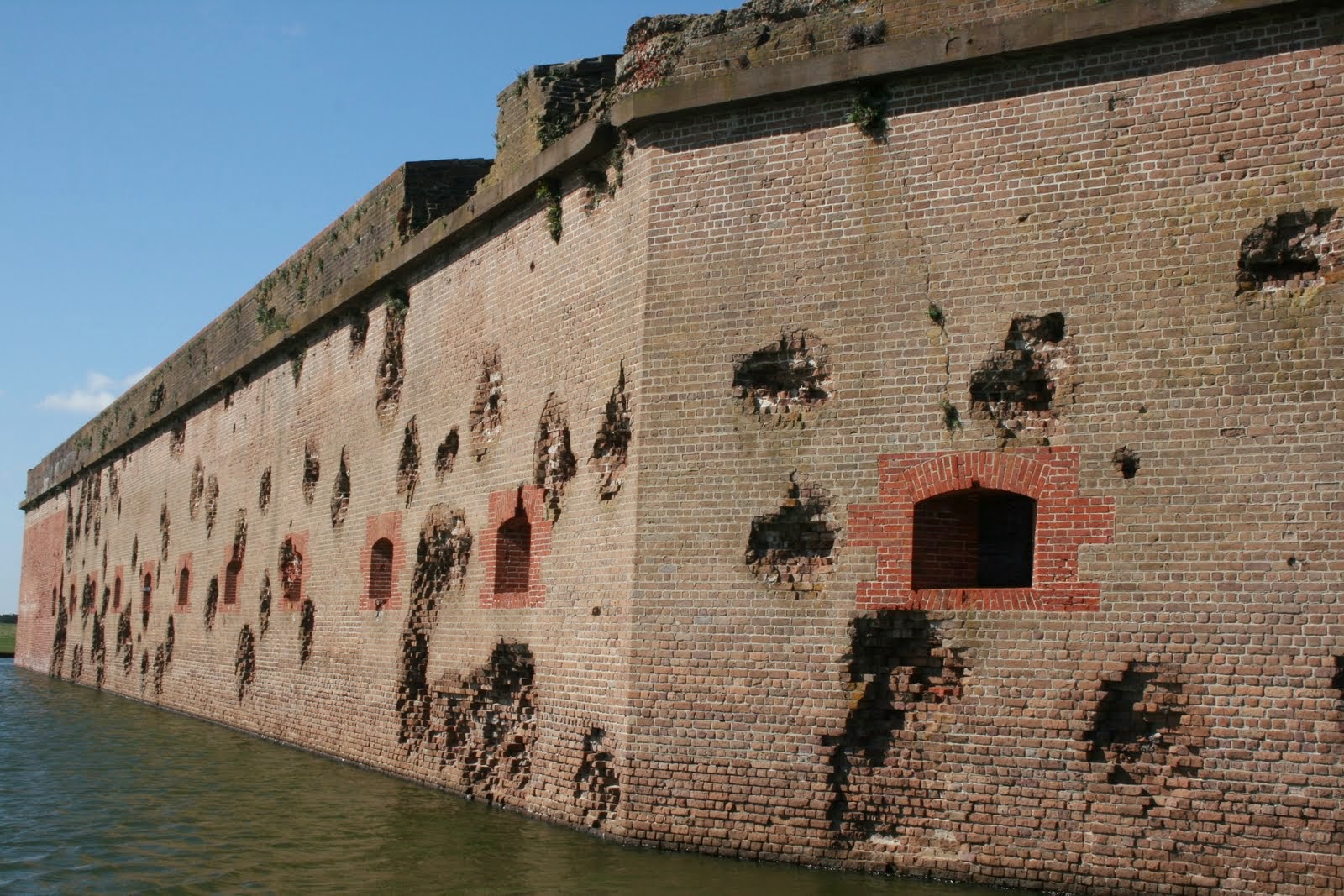 |
| Fort Pulaski fell relatively early to Union forces. |
-- JOEL CADOFF, park
ranger and spokesman for Fort Pulaski National Monument, near Savannah, Ga.
With the fall of the fort in April 1862, Savannah, by and large,
lost most of its significance as an important Confederate city long before
Sherman reaches it in December of 1864. Maybe it would have made for a bigger
story had Pulaski not fallen and Savannah had remained a vital blockade running
port. However, that was not the case. With Fort Pulaski in Federal hands, the
city was more important for its dock facilities to receive much-needed supply
after the long "march."
With Sherman's army nearing Savannah in mid-December, 1864, Fort Pulaski had partially been transitioned into a prison. That's where most of our
story lies during the time frame. We are running the diary of Henry Clay
Dickinson, 2nd Virginia Cavalry, on Facebook and Twitter. This is his entry on
the fall of the city:
December 21. 1864.
Firing
heavy again this morning and continued until the high wind prevented us from
hearing much. The day was quite cold and windy, and many said it was a very
long one. At sunset there were unmistakable signs that the Yanks had good news.
Presently the band began to play, three cheers were given and they soon brought
us news that Savannah had fallen. They say a captain is the bearer of the news,
that the city fell at 5 o'clock this morning, and that the captain
walked through the streets. We still can't believe this. It seems preposterous.
If true, Beauregard certainly is no longer himself. I have had rheumatism in my
left side, right leg and arm all the week and can hardly get about. Whilst
writing I breathe with great difficulty.


