Showing posts with label Tanyard Creek Park. Show all posts

Sunday, July 19, 2026

Battle of Peachtree Creek: Featherston's Mississippi brigade led the charge, suffered massive casualties as other units got lost or were delayed in the confusion

Gen. Featherston, park at center of fighting (Picket), brigade is fourth arrow from left (Georgia Battlefields Association)
Whether he was called “Old Sweat” because he was a seasoned veteran or for his tendency to perspire, Confederate Brig. Gen. Winfield S. Featherston was cool under fire.

From commanding the 17th Mississippi Infantry to a brigade, Featherston performed ably at First and Second Manassas, Ball’s Bluff, Fredericksburg, Vicksburg and during the Atlanta Campaign.

“I know of no negative comments or vices or disputes concerning Featherston throughout his Confederate military service,” says Civil War historian Robert D. Jenkins, executive director of the Blue and Gray Education Society. He authored a book about the Battle of Peachtree Creek, where Featherston figured prominently.

Before Saturday, I had never heard of the general. I came across his name while reading markers at Tanyard Creek Park in Atlanta, the center of the failed Confederate attack at Peachtree Creek, which occurred on July 20, 1864. The Atlanta Beltline, a 22-mile loop of trails, goes through the leafy park, which is situated in an upscale neighborhood in the Buckhead community.


The venue is popular with dog walkers, bicyclists and joggers. A creek, Tanyard Branch, runs north-south in what was the center of the Confederate assault on Union divisions waiting for them just below the east-west Peachtree Creek.

The Battle of Peachtree Creek saw Lt. Gen. John Bell Hood’s ill-fated debut as the head of the South’s Army of Tennessee. Hood had hoped to isolate and destroy Maj. Gen. George Thomas’ command before two other Federal armies could come to his help.

The men in gray began the assault mid-afternoon on July 20, 1864, and things got tough quickly. The hilly terrain and ravines made communication and coordination difficult. Confusion and late troop arrivals reigned.


Featherston’s Mississippi brigade, part of Loring’s division, led the charge over what is now called Collier Road and toward Peachtree Creek.

His troops broke through the Federal line near Collier Mill (Picket photo, above) and they fought against three times their number in hand-to-hand combat for some 20 minutes before having to retire, but continued to fight to contest possession of the ridge top until dark, Jenkins says.

His men stubbornly pressed assault at Peachtree Creek

“Featherston carried 1,230 men into Battle at Peach Tree Creek, and fought toe-to-toe with approximately 5,500 Federal soldiers of Ward’s division,” Jenkins wrote on The Atlanta Campaign History Discussion Group on Facebook after I submitted a query..

Marker at Tanyard Creek Park prominently mentions Featherston's role (Picket photo)
“(Featherston) would remark bitterly about the failure of the Tennessee division to his right and of Hardee’s corps for not supporting his breakthrough during that battle,” Jenkins, who lives in northwest Georgia, added.

The 43-year-old general’s regiments suffered the highest casualties at the battle of Peachtree Creek, and were among the highest casualties at Franklin, Tenn., later in 1864.

Charlie Crawford, president emeritus of the Georgia Battlefields Association, is an expert on the fighting at Peachtree Creek and other Atlanta Campaign sites. (The battle used to be called Peach Tree, not Peachtree.)

The lack of coordination and prompt movement doomed the assault, the historian says.

One of many battle markers in the Collier Road area (Picket photo)
Hood and others didn’t get the three missing brigades from Stewart’s Corps (one each from French’s, Walthall’s, and Loring’s divisions) into position in time. 

“Likewise, Maney’s division didn’t fight well, Cleburne’s division was held back to exploit the hoped-for breakthrough, and Bate’s division got lost in the swampy ground around Clear Creek.” Crawford says.

“Consequently, the participating brigades form Walthall’s and Loring’s divisions and the entirety of Walker’s division did almost all the fighting. In that sense, the Confederates were outnumbered, but it wasn’t by design.”

Three large markers (in background) detail the fighting (PIcket photo)
The end of the day saw a Union victory, just two days before the Battle of Atlanta. Confederates suffered about 2,500 casualties in just a few hours.

Of Featherson, Crawford says: “At least his brigade followed through on the attack when several others never got there.”

Why he was transferred to fight in Western Theater

Featherston, a native of Tennessee, saw military service early in life, fighting against Creek Indians. He moved to Mississippi, becoming a lawyer and served two terms in Congress before the Civil War.

After fighting well in Virginia and being wounded in combat, Featherston wrote a letter to Gen. Robert E. Lee in fall 1862 requesting that he and his brigade be reassigned to Mississippi for the defense of the Magnolia State, which was under pressure by Grant, says Jenkins.

1964 state of Georgia map put out to mark Civil War centennial (Picket photo)
“Lee responded by telling Featherston that he could transfer, but Lee could not afford the loss of his troops from his army,” he says.

“Some have mistakenly assumed that Lee was getting rid of Featherston, but in fact, Featherston simply wanted to go where he thought he could do the most good in the defense of his home state.

His brigade went onto additional fame in Virginia with another commander, but it was Featherston who started that brigade on its course of reliability and combat effectiveness, Jenkins argues.

George Barnard's photo of temporary graves at Peachtree Creek (Library of Congress)
Jenkins says Featherston was dubbed “Old Sweat“ because of his exposed forehead.

“He had an early receding hairline/baldness. His forehead would wrinkle, and he would sweat easily when under stress or in hot weather.”

(Some Featherston histories spell the moniker “Old Swet.”)

Featherston’s brigade was one of only seven that was in good enough fighting condition to be used as part of a rear-guard defense during their retreat following the Confederate disaster at Nashville, Jenkins says.

After the war, Featherston returned to Holly Springs, Ms., and resumed his law practice. He died in 1891 at age 70.

READ MORE ABOUT PEACHTREE CREEK:

https://civil-war-picket.blogspot.com/2021/07/three-men-clashed-at-peachtree-creek-on.html

https://civil-war-picket.blogspot.com/2021/05/the-atlanta-campaign-threw-thousands-of.html

https://civil-war-picket.blogspot.com/2014/05/peachtree-creek-2-charlie-crawfords.html

Tuesday, May 20, 2014

It was no walk in the park for Confederates on the attack at Battle of Peachtree Creek

Tanyard Creek Park in Atlanta's Buckhead community
Yesterday morning, while on a day off from work, I decided to fill in a hefty gap in my travels to Civil War-related sites in metro Atlanta.

I drove into Buckhead, a major commercial and residential district in Atlanta, to walk a portion of the Battle of Peachtree Creek battlefield and drive through affluent neighborhoods where vicious fighting occurred on July 20, 1864.

Let me tell you: Turning into Tanyard Creek Park is not for the faint of heart. Commuters and service trucks whizzing along a curvy stretch of Collier Road don’t give you much time to slow to find or turn into the entrance.

But once there, I was rewarded with a scenic, narrow park that is popular with dog walkers, bicyclists and joggers. The creek, Tanyard Branch, runs north-south in what was the center of the Confederate assault on Union divisions waiting for them just below the east-west Peachtree Creek.


I was armed with a 1964 centennial map produced by what was then called the State Highway Department of Georgia. The map, with a legend, details the battles of Peachtree Creek, Atlanta (July 22, 1864) and Ezra Church (July 28), all doomed assaults by Gen. John Bell Hood, a fearless, young commander who observers say had been promoted beyond his abilities.

Near the parking lot and steps leading down to a trail, bronze tablets, installed by the city in 1964, give an overview of the battle and precise details of troop locations and movements. Unfortunately, like many markers and monuments of the time, there is little in the way of the humanity of the story.

You will have to drive north a couple miles to the Atlanta History Center to get that.


A wide, concrete trail part of the ambitious Atlanta BeltLine transportation and economic development project is the focal point now of Tanyard Creek Park. Opened in 2010, the trail is considered one of the most scenic in the BeltLine system. 

“The neighborhoods around Collier Hills are now linked by a continuous mile long trail. The updated trail traverses the Howard Property, ‘Cathedral Woods,’ and Bobby Jones Golf Course in Atlanta Memorial Park, completing a gap between the existing trail in Ardmore Park and another that terminates at the intersection of Northside Drive and Woodward Way,” says the website.

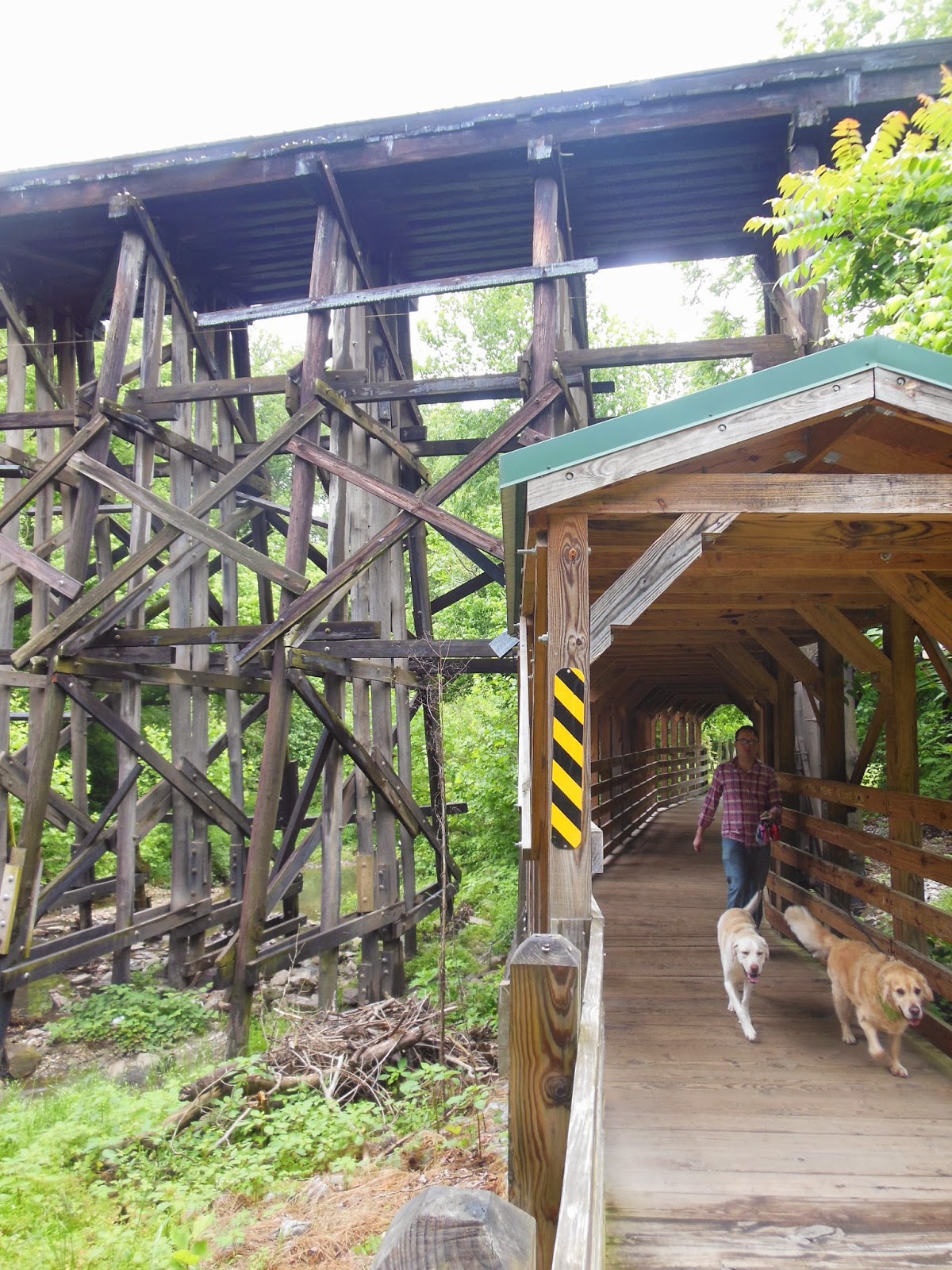
My midday walk was very pleasant. I crossed a couple bridges and a playground as I gazed up at streets on either side of the tranquil park. A meadow and the grass were well-maintained.


Not that everyone was thrilled with a trail going through a battlefield. A letter writer in a local newspaper in 2007 lamented: “I thought about how beautiful this park is, and how fitting a tribute it is to the men who lost their lives in the struggle for it – and then of the reality of how a bike path running through it would ruin those two things and render it just another piece of city real estate.”

With hindsight a few years after the trail opened, I am not sure I agree with his assessment. The trail system and other parts of the Atlanta BeltLine are bringing a strong sense of community and direction to many of the city’s neighborhoods. And the park is beautiful.

The scene and grave markers after Peachtree Creek
Still, I had a hard time imagining the scene of Confederate troops under Gens. William Hardee and Alexander Stewart hurrying into battle.

Hood had taken command of the Confederate Army of Tennessee just two days earlier after President Jefferson Davis had sacked Joseph E. Johnston, who had waged a defensive strategy against William T. Sherman. That strategy had resulted in the army’s gradual retreat from North Georgia to the vital city’s defenses, and Davis was convinced Johnston might give up Atlanta itself without much of a fight.

Hood, known as a fierce fighter, modified Johnston’s plan to attack Maj. Gen. George Thomas’ Army of the Cumberland near Peachtree Creek.

A marker on busy Collier Road in Buckhead.
The men in gray began the assault mid-afternoon on July 20 and things got tough quickly. The hilly terrain and ravines made communication and coordination difficult.

An About.com article provides this account: “While Major General William Bate's division on the Confederate right became lost in the Peachtree Creek bottomlands, Major General W.H.T. Walker's men assaulted Union troops led by Brigadier General John Newton. In a series of piecemeal attacks, Walker's men were repeatedly repulsed by Newton's division. On Hardee's left, Cheatham's Division, led by Brigadier General George Maney, made little headway against Newton's right. Further west, Stewart's corps slammed into Hooker's men who were caught without entrenchments and not fully deployed. Though pressing the attack, the divisions of Major Generals William Loring and Edward Walthall lacked the strength to break through XX Corps.”


Stewart continued the attacks, but Hardee canceled one by Maj. Gen. Patrick Cleburne when Hardee decided to aid Confederate cavalry elsewhere. Hardee was later criticized for his corps’ performance.

While there were near-breakthroughs, Hood’s aggressive attack, like the clashes to come, proved disastrous for the Confederacy. The estimated 4,700 casualties at Peachtree Creek included about 2,600 for the Rebels.

After leaving the park, I drove along several streets where the fighting and troop movements occurred: Northside Drive, Howell Mill Road and Wilson Road. While there are a few monuments amid the high-end neighborhoods, it’s the geography of the place that is most telling. The hills and ravines played to the advantage of the defenders – in this case, the Federals – at Peachtree Creek.

Train trestle in Tanyard Creek Park