Showing posts with label restored. Show all posts

Monday, January 5, 2026

Old number 9: Vandals and thieves tried to diminish this Civil War cannon. The weathered survivor, displayed for a decade at a Georgia battlefield, will be a star artifact at an upcoming Atlanta History Center exhibit

Key's battery howitzer at Pickett's Mill (Picket photo), number 9 on top of dented muzzle (Georgia State Parks), gun after it was recovered in Spalding County, Ga. in 2010, and artillery Capt. Thomas Key (Wikipedia); click to enlarge images
A dinged-up 12-pounder howitzer that survived numerous battles, years of vandalism and theft from a city park will be returned next month from a Georgia battlefield to the Atlanta History Center, where it will be featured in a new exhibition telling a bigger story about the Civil War.

The gun, manufactured in Boston in 1851 for the Arkansas Military Institute, has been on loan for nearly 10 years to Pickett’s Mill Battlefield State Historic Site northwest of Atlanta. It’s possible it was used to mow down Federal attackers who futilely charged through a ravine toward Confederates waiting for them in strength.

“Captain Key's howitzer is one of the most important artifacts /stories we have going into the new exhibit,” Gordon Jones, senior military and historian at the AHC, wrote the Picket in a recent email. “It'll be a cornerstone of the Atlanta Campaign area, right up there with the U.S. Army wagon, Confederate flag that flew over Atlanta, Cleburne sword, plus more new acquisitions.”

Jones was referring to Confederate Capt. Thomas Key, whose Arkansas artillery battery served in the division of legendary Maj. Gen. Patrick Cleburne during the Atlanta Campaign.

Key's Battery flag (Wikipedia
The AHC in 2016 lent the gun to the state park as it prepared to move the “Battle of Atlanta” cyclorama painting from the city’s Grant Park to the center’s facilities in the Buckhead neighborhood (The gun, below, during its move from the AHC to Pickett's Mill).

For the AHC and history aficionados, the audacious Key and his four-gun battery are remembered for being in the thick of things in numerous 1864 Atlanta Campaign battles – Dalton, Pickett’s Mill, Peachtree Creek and Jonesboro, among others..

Yet this bronze gun has a postwar history as interesting as its service during the war. It had several postwar homes and was vandalized while displayed outside in Grant Park. Indignities included a broken cascabel, hacksaw marks and scores of indentations.

The howitzer was subsequently stolen, turning up in a county south of Atlanta.

The AHC gained custody of the weapon and had it refurbished and placed on a carriage that was built in 1936.

Thomas Bailey, who makes and restores carriages and other artillery components, recalls working on the Key howitzer, which has an artillery shell jammed into its 780-pound barrel.

“It always stood out to me how beat up it was,” said the owner of Historical Ordnance Works in Woodstock, Ga. “Somebody tried breaking it up for scrap. There were saw marks on the trunnion.” He estimates the barrel had about 60 marks from a sledgehammer.

So you can say this gun is a survivor -- from the horrors of war and the ravages of vandals.

Key and his men always in the thick of things

The Key battery howitzer was one of two cast by Cyrus Alger & Co. for the Arkansas Military Institute. The number 9 is stamped on its muzzle face and the barrel is marked with an eagle atop a globe.

At Chickamauga, in September 1863, his superiors lauded Key for his gallantry and effectiveness, saying that in the fiercest part of the struggle he ran his battery by hand to within 60 yards of the enemy's lines.

Key and his cannons played a large part in the Confederate victory at Pickett’s Mill on May 27, 1864. Cleburne ordered Key to place two guns to the right oblique to enfilade the ravine. 

It’s uncertain whether number 9 was one of those two, but it certainly was among the four battery guns there.

Federal troops under Brig. Gen. William Hazen charged uphill in their attempt to take the top of a ridge. Key’s howitzers were ready for them. The battery fired about 182 rounds of spherical case and canister in two hours.

The Federal army suffered about 1,600 casualties at the battle, compared to 500 for the South. (At right, volunteer Michael Hitt at Pickett's Mill ravine in 2023, Picket photo)

On July 25, 1864, Key’s Battery was issued Napoleons captured from the Federals during the Battle of Atlanta and number 9 was sent to the Macon Arsenal. The Napoleons were considered a step up.

In his postwar book, Key wrote he regretted parting with number 9, which had been with his men at Perryville, Missionary Ridge, Resaca, New Hope Church,  Peachtree Creek and other battles.

“So it cannot be thought strange that I regret having separated from my command a gun that has been my companion under such trying and bloody circumstances.”

The howitzer made a lot of stops after the war

A 2016 newsletter produced by the Georgia Battlefields Association tells what happened to number 9 after the war:

At war’s end, the gun became property of the U.S. Army and was sent to the Washington Arsenal.

In 1880, upon a request on behalf of the state militia, number 9 was one of four guns (including two originally belonging to the Georgia Military Institute) sent to Rome, Ga. In 1887, Atlanta requested four obsolete guns for display in Fort Walker in Grant Park; the Rome guns were selected. (Fort Walker is not far from the old Cyclorama building).

“Over the years, the gun was vandalized: initials scratched, dented, pieces broken off, overturned, etc.,” according to the GBA newsletter, authored by Charlie Crawford, who then served as GBA president.

Michael Hitt, a volunteer historian at Pickett’s Mill and Civil War researcher, provided the Picket two vintage post cards (below) showing the gun when it was at Fort Walker.


In one photograph, the barrel lies on the ground and the left cheek of the gun carriage is heavily damaged.

“Maybe a tree or part of one fell on it,” Hitt said. “The other image shows it remounted, with a big dent on the muzzle, at an 11 o'clock position.”

Something unexpected found at residence

In the 1980s, Hitt – then a suburban Atlanta police officer -- restored three artillery pieces languishing at Fort Walker, part of the South’s defensive works in Atlanta. But vandals continued to damage the guns.

“There’s a lot of history connected with that fort,” Hitt, lamenting the lack of city protection, told The Atlanta Journal in 1984 (article below). “It’s like they abandoned it.”

Things somehow got worse.

“In 1985, all the guns were removed from Fort Walker,” according to the GBA. “Number 9 was removed from its carriage and displayed on a Grant Park monument, from which it was stolen in summer 1993.”

In February 2010, a tip about stolen goods led sheriff’s deputies to a Spalding County house, where they found stolen items, including a crate with a damaged cannon barrel inside. The whole affair was covered by The Atlanta Journal-Constitution.

Hitt at that time identified the gun as number 9 and said it was part of the Helena Artillery, also known as Key’s Battery. It was part of the Confederate Army of Tennessee.

While a small debate ensued on whether the gun belonged to Georgia, Arkansas or the U.S. Army, the gun eventually was reclaimed by Atlanta. According to the GBA newsletter, it sat in a crate in the foyer of the old Cyclorama building for a few years.

In 2014, the AHC struck a deal with the city to restore and relocate the giant painting, locomotive Texas and other artifacts in the Cyclorama building to a new wing in Buckhead. That meant the howitzer would move, too.

What a long strange trip it's been for gun

After it was cleaned up, the Key howitzer was shown off in the visitor center at Pickett’s Mill, which is in Paulding County, just northwest of Atlanta.

John Nash, head of the Friends of Pickett’s Mill Battlefield, recalls taking his cannon trailer to the AHC to take the gun and carriage to Pickett’s Mill. The carriage was among those built by Works Progress Administration (WPA) employees in the 1930s when the guns were at Fort Walker.

Now the gun is heading to Buckhead. (Editor's note: I learned about the upcoming move from a Facebook post on The Atlanta Campaign History and Discussion Group.)

The Atlanta History Center in May closed its longtime Civil War exhibit, “Turning Point,” to make way for two new galleries that will feature breathtaking artifacts and a broader discussion of issues that engage the republic to this day: our belief systems, victory, defeat, reconciliation and the evolving meaning of freedom.

Museum officials said they will announce the confirmed name of the new Civil War era exhibition and an opening date in the next week or so.

AHC CEO Sheffield Hale with Union 20th Corps wagon that traveled near what is now the AHC (Picket photo)
Some people on social media had expressed worry the gun would go back into storage at the AHC. Or they advocate it should stay at Pickett's Mill.

Josh Headlee, curator and historic preservation specialist with the Georgia Department of Natural Resources, which oversees state parks, said the weapon’s association with the battle made it a compelling artifact there.

“Rather than it sit in storage for all that time, the AHC was generous enough to reach out to us about the loan,” said Headlee. “Since the Key’s Battery played a prominent role in that battle, it has been a wonderful temporary addition to the Pickett’s Mill exhibits. However, Key’s Battery played an important role in the battles for Atlanta as well, so it’s just at home in their collection as it is ours.”

Hitt, a board member with the Pickett’s Mill friends group, agrees.

“I was able to get the Key battery howitzer (loaned) out from the AHC several years ago with the knowledge that it would be returned when it was needed for a display. Well, it is going to be part of a display now at the AHC and I don't have an issue with it. The gun's Atlanta story is just as interesting as the Pickett's Mill story.”


So there’s the story – for now – about old number 9. Living historians occasionally fire a reproduction Key’s Battery gun at Pickett’s Mill. The next event is scheduled for Jan. 17.

Those wanting to see the original gun at Pickett’s Mill before it leaves have only a few weeks. It will be back in Atlanta some time in February

The old GBA newsletter said the artifact might win a contest for most interesting story. “Go see the gun and marvel at its long, strange trip.”

Tuesday, November 25, 2025

Building a firm and stable foundation for a cut-up and relocated Civil War home is taking some time. But these Georgia entrepreneurs are hanging tough

Foundation work in Ball Ground, Ga. (Courtesy the Lusks), house before it was moved (Cobb Landmarks)
Putting back together a Civil War home they sliced into six pieces and transported 25 miles has been a challenge for an entrepreneurial couple in northwest Georgia, but they’re dedicated to the project for the long haul.

For the past few months, crews working for Lee and Brittani Lusk in Ball Ground have been working to set the Robert and Eliza McAfee House on a firm foundation. They need to get all the pieces properly aligned and stabilized before they can restore the interior of the 1840s central hallway cottage.

“It will all be fine, (it is) just difficult right now until we get foundation done,” Brittani Lusk wrote in a recent text message. “Most people don’t do things like this, so we have had to get creative.” The couple first ran into difficulty when they drilled the foundation.

The crew is finishing the piers for the foundation, and the house will rest above a crawlspace, as it did at its longtime location in neighboring Cobb County, said Lusk, adding the foundation work is nearing an end.

The main floor of the home will be higher at the new location, given the crawlspace is near ground level compared to it being dug into the earth at the old. (At left, Civil War Picket photo of sliced McAfee House in Cobb County shortly before it was moved.)

The sturdy home was moved to make room for commercial development -- the Lusks bought the structure for $1 -- but the future use of the Cobb County two acres it sat on is uncertain.

The landowner and RaceTrac had pursued rezoning that would allow for a 24/7 service station and convenience store, but the project was withdrawn this month amid opposition from neighborhoods near Bells Ferry Road and Ernest Barrett Parkway. RaceTrac can apply again, should it decide to do so.

The McAfee House served a few weeks in June and early July 1864 as the headquarters for Union Brig. Gen. Kenner Garrard and his three cavalry brigades during the Atlanta Campaign

The support blocks will be eventually bricked up (Courtesy Lee and Brittani Lusk)
The Federal troopers clashed almost daily near Noonday Creek with Confederates led by Maj. Gen. Joseph Wheeler. .

Cobb County, just northwest of Atlanta, was the scene of significant combat action and troop movement as Confederates tried to stall Maj. Gen. William T. Sherman’s relentless campaign on Atlanta, which began in May 1864 in North Georgia.

The large McAfee farm was believed to have been occupied by Confederates, too, during the action around Kennesaw Mountain.

The house had been empty for several years, and preservationists worried it would fall to the wrecking ball, given it had no historic protection. Eventually, the owner donated the house to the nonprofit Cobb Landmarks so it could find someone to move it before a development could be built at the busy intersection.

Stairs emerge from the crawlspace in the old location (Civil War Picket photo)
Cobb Landmarks earlier this year sold the house to the Lusks, who moved the pieces in May to adjoining Cherokee County. They have not announced the future use of the home, which is close to their residence.

Cobb Landmarks said it would have liked for the home to stay in Cobb County, but the Lusks made the best proposal and have a history of fixing up old homes.

Many observers expressed their displeasure at it being moved and the property developed, but are happy the home is being saved rather than razed.

Brittani Lusk said the timbers that hold up the home are very solid.

Tony Stanley studies the remarkable timbers used to the build the home (Picket photo)
A fascinating side note is three 48-foot long beams that run the width of the house as floor joists. Tony Stanley, who moved the home, said he has never seen that before, but he marveled at the size of the pine trees that were needed: the wood is about 12 inches by 12 inches.

Among other Ball Ground properties, the couple own the 1906 Wheeler House, a popular wedding venue; The Elm, business suites situated in an old elementary school (great pun); and an historic home they leased out to a restaurant that has since closed.

The couple say they have done dozens of restorations in the region.

READ MORE HERE:

https://civil-war-picket.blogspot.com/2025/08/an-1840s-georgia-house-with-civil-war.html

https://eastcobbnews.com/racetrac-proposed-on-former.../

https://civil-war-picket.blogspot.com/.../a-sturdy-metro...

https://civil-war-picket.blogspot.com/.../entrepreneurs...

https://civil-war-picket.blogspot.com/.../cavalry-clashed...

Thursday, July 31, 2025

From boarded up to reborn: This 1852 Western & Atlantic depot had a role in 'Great Locomotive Chase;' now it's reopened as a philanthropy center in NW Georgia

A nook overlooking rail line, the large boardroom and depot exterior work this week (Photos courtesy CFNW)
The old Western & Atlantic train depot has reopened in Dalton, Georgia, as a community gathering space where philanthropy aimed at solving 21st century challenges can gain steam in a 170-year-old building integral to the town’s identity.

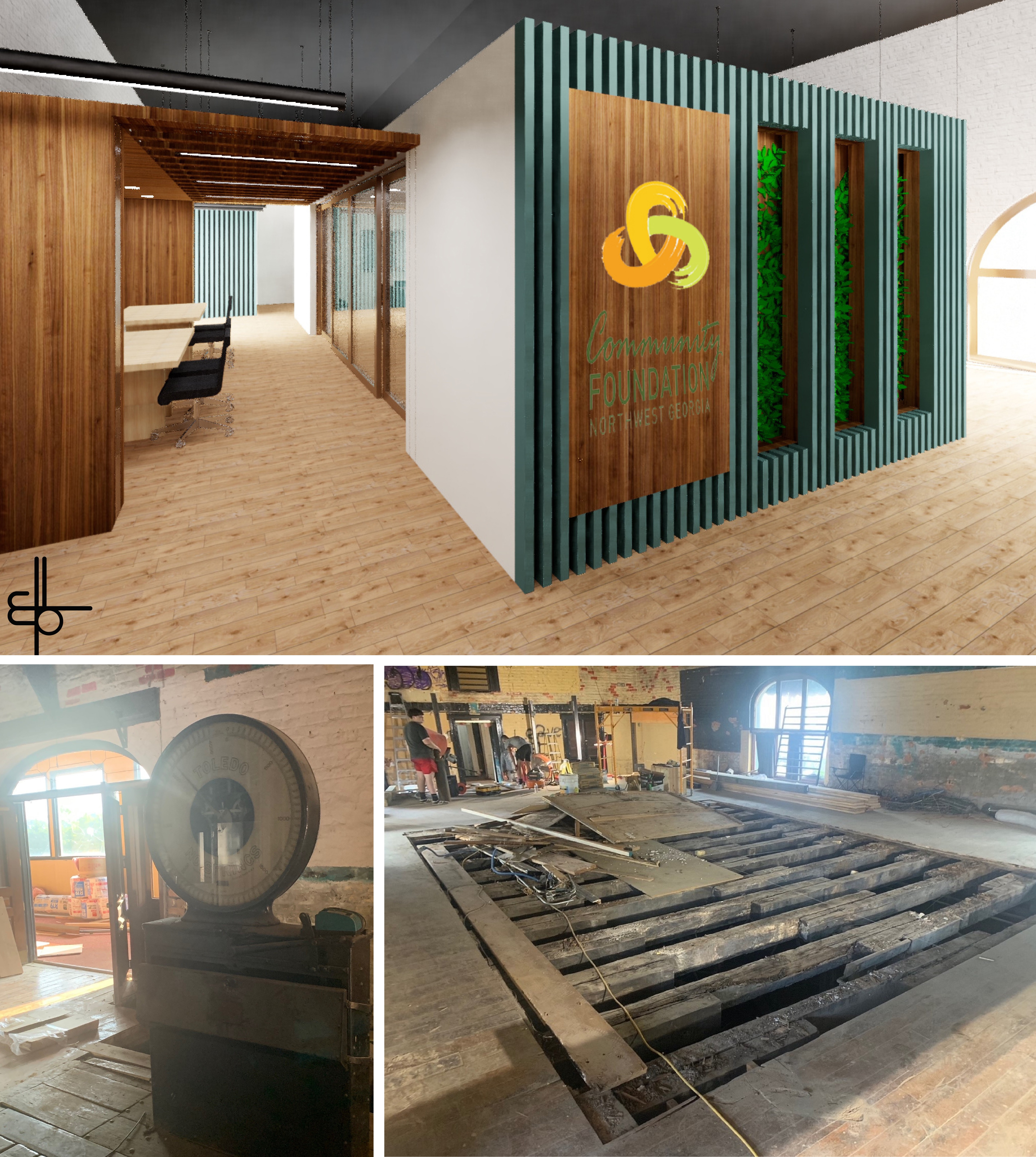
The Community Foundation of Northwest Georgia earlier this month moved a mile to a building that features 25-foot ceilings, charming brick and Civil War-era architectural features. But make no mistake, this will a very up-to-date environment -- from modern furniture to TV monitors that will prompt collaboration in today’s world.

“It’s been wonderful. It is beautiful office space,” foundation president David Aft told the Picket in a phone call this week. “It is a really neat place to work, and I have heard my whole life space has a huge impact on people’s creativity and the ease to get things done.”

A kitchen will provide refreshments for meetings (Community Foundation of NW Georgia)
The oldest commercial structure in the northwest Georgia city best known for its carpet industry is studied by Civil War enthusiasts for its brief part in the “Great Locomotive Chase. Federal raiders commandeered a locomotive above Atlanta and raced north, bent on destroying sections of the railroad. Confederates pursued them through several cities, including Dalton

Locals tend to think more about the Dalton Depot, a longtime restaurant and club which operated in the long brick building until about 10 years ago. Trains still roll by regularly.

Aft said visitors and those attending foundation meetings in the depot appreciate its homage to the station’s history (it last had passenger service in about 1971) and its compelling design and architecture.


The foundation’s five employees are working in an office nearly twice as big as its longtime more traditional offices across town. They will facilitate meetings in a glass-lined board room and smaller “collaboration zones.”

A large freight scale (above) and telegraph window greet visitors in the open center of the depot. The foundation resides in the south end of the structure.

The depot fell into hard times after the restaurant closed. The city contracted with the Georgia Trust for Historic Preservation to market the vacant and deteriorated building. Officials wanted $500,000, but eventually sold it to local Barrett Properties in 2018 for $300,000

The community foundation, which is leasing its space, occupies the former nightclub area. Barrett Properties is still marketing the other side, which still has remnants of dining booths.

Officials think a new restaurant might be a good fit.

Working with charitable givers, the nonprofit provides grants and funding for organizations in the area. Some of the endeavors involve mental health programs, historic preservation, neighborhood revitalization and other civic projects.

For now, the foundation is settling in as improvements to the brick exterior continue. Wood trim is being replaced and an old awning is coming down. (Above, the point of origin for surveys in Dalton)

He had to get a message through -- quickly

The Western and Atlantic Railroad line from Atlanta to Chattanooga, Tenn., was completed in the early 1850s and the Dalton depot opened in 1852 to provide passenger and freight service.

The depot was the hub for commercial growth in the Dalton area and the point of origin for surveys and maps. The 12,100-square-foot brick building is “a pretty high-style example of Georgia depot architecture” and has Greek Revival features, with stone lintels, brick pilasters and door entablatures.

Union raiders on the General set fire to a river crossing in North Georgia (Wikipedia)
The building had its moment of fame on April 12, 1862, when Northern raiders (the South labeled them spies) commandeered the locomotive General in Big Shanty. They chugged toward Chattanooga, intent on destroying parts of the railroad.

The pursuing locomotive Texas picked up a 17-year-old telegraph operator who rushed to the Dalton depot and wired Confederate troops to the north.

Although not all his message got through, Edward Henderson’s alarm sent troops toward the track. The Andrews Raiders were captured near Ringgold when the General ran out of steam. They had accomplished little. Many were hanged while others escaped. Several were the first to receive the Medal of Honor.

The depot remained in use as a rail stop for more than a century.

The setting: A comfortable place to convene, create

For Aft (left), the project mixes nostalgia, history and preservation. Not everyone is interested in each of those aspects, he acknowledged. But they are interested in community needs that include mental health programs, food banks, education and other civic projects.

The area’s Latino population has grown considerably while Whitfield County’s overall population growth has remained stagnant. Housing affordability and supply are big issues.

The foundation contends it setting needs to be comfortable, with a good flow that brings people together into the central room and then into corners featuring some privacy. Large TV monitors are being built into the space, and PowerPoints and other technology will provide visual representations of projects.

The hope is for outside groups to eventually utilize the convening spaces about four times a month. The foundation, naturally, will hold meetings in the depot the rest of the time. “We understand it will take maybe 12 months to fully activate the space and to get the staff understanding how others want to use the space,” said Aft.

The nonprofit’s leader said he has already talked with groups who might choose to hold meetings at the depot.

The 173-year-old building “has its own peculiarities to it,” said Aft, who quipped no ghosts have thus far made their presence known.

What is evident is the appreciation community members for the time and care into making a charming gathering place.

Aft summarizes their thoughts: “You made something important to me – you took care of it.”

Common area (left) and work spaces at Community Foundation of Northwest Georgia

Monday, August 26, 2024

City all aboard for restoration: Civil War-era depot made famous by 'Great Locomotive Chase' is on track to becoming a philanthropy center in NW Georgia

Rendering of changes to the exterior to better match original appearance (Montgomery & Peeples, Dalton)
A long-closed Western & Atlantic railroad depot that played a part in the Civil War’s “Great Locomotive Chase” is being reborn in a way that reaffirms its importance as a community gathering place in Dalton, Ga.

A philanthropic organization and developer are nearly midway through the restoration of the oldest commercial structure in the northwest Georgia city best known for its carpet industry. The goal is to have a unique setting where ideas and dreams for the public good can gain steam.

The Community Foundation of Northwest Georgia and Barrett Properties have partnered for the project, with the foundation planning to relocate its offices to a portion of the depot later this year or in early 2025.

David Aft, foundation president, told the Picket the reopened 1852 depot also will buttress revitalization in downtown Dalton. Officials want locals to spend their dollars there rather than nearby Chattanooga, Tenn., and to enjoy the Burr Performing Arts Park, among other venues.

Glass-walled conference room, the old freight scale and floor work showing old timbers
 (Montgomery & Peeples rendering and David Aft photos)
“Working to renovate a building mothballed for 10 years is part of that, to bring life into old facilities.” The depot, he said, was the hub for commercial growth and the point of origination for surveys and maps in the 19th century.

The resilient depot has had some hard times since its heyday. A 1977 nomination form for the National Register of Historic Places said Dalton citizens were aware of its value but “concerned about the deterioration of the building.” At that time, it was being leased to a railroad.

The depot housed a tavern for about 25 years, but officials closed the building in late 2015, citing conditions that “posed potential health hazards to the public,” including mold, according to the Daily Citizen-News newspaper.

The Western & Atlantic depot back when it was boarded up (Georgia Trust for Historic Preservation)
The brick building sat empty for nearly a decade. Now, workers are on site, making repairs and modernizing the space to create an open, welcoming environment.

“I’m excited to see downtown Dalton continue to blossom, and to see the Dalton Depot once again be a hub in downtown Dalton,” said Mayor Annalee Sams.

Andrews Raiders plowed through Dalton

The Western and Atlantic Railroad line from Atlanta to Chattanooga was completed in the early 1850s and the Dalton depot opened in 1852 to provide passenger and freight service.

The building had its moment of fame on April 12, 1862, when Northern raiders who had commandeered the locomotive General in Big Shanty, above Atlanta, were chugging toward Chattanooga, intent on destroying parts of the railroad.

Union raiders on the General set a fire at a river crossing in Georgia (Wikipedia)
The pursuing locomotive Texas picked up a 17-year-old telegraph operator who rushed to the Dalton depot and wired Confederate troops ahead in Chattanooga.

Although not all his message got through, Edward Henderson’s alarm sent troops toward the track. The Andrews Raiders were captured near Ringgold when the General ran out of steam. They had accomplished little.

According to the National Registration nomination form, “the depot might have been partially destroyed when Union troops entered Dalton and set fire to several buildings in 1862. It appears that the essential structure of the depot was not damaged and the restoration was confined to roof and interior repair. Since the ornamental brackets are stylistically later than the date of the rest of the building, it is likely that they replaced others lost in the destruction.”

The 12,100-square-foot brick building is “a pretty high-style example of Georgia depot architecture” and has Greek Revival features. It features stone lintels, brick pilasters and door entablatures.

The old ticket counter is among the surviving features (Georgia Trust for Historic Preservation) 
Safeguarding depot's historic features a priority

A February news release on the project said “Barrett Properties will be giving careful consideration to the preservation of historical elements that pay homage to an era’s character while innovative additions will infuse a modern and dynamic flair.”

The city years ago contracted with the Georgia Trust for Historic Preservation to market the building. Officials wanted $500,000, but eventually sold it to Barrett Properties in 2018 for $300,000. At that time, Barrett said the area would be suitable for another restaurant/bar and perhaps a small museum.

The city required bidders to submit a written preservation plan and abide by a signed rehabilitation agreement.

Work crews have been on the site since spring (David Aft photo)
The trust's primary goal was seeing that historic features in the building are saved. The depot’s southern end retains features interior ticket windows, a freight scale and other rail service features.

The foundation has a 20-year lease with Barrett Properties, said Aft, who answered Picket questions on behalf of his group and the developer.

What the foundation does with charitable gifts

The five employees of the Community Foundation of Northwest Georgia, working with charitable givers, provide grants and funding for organizations in the area. Some of the endeavors involve mental health programs, historic preservation, neighborhood revitalization and other civic projects.

Undated photo and another from 1922 (Courtesy of the Bandy Heritage Center for Northwest Georgia)
Some grants come in the form of endowments, financial funds and scholarships to nonprofit groups or individuals. The organization oversees more than $90 million in charitable assets, said Aft.

The main economic engine for Dalton and Whitfield County is the carpet industry, while diversification has yielded a solar panel factory and supply chains for auto manufacturing.

“We are one of the country’s last bastions of manufacturing,” said Aft.

The area’s Latino population has grown considerably. Housing affordability is a big issue, compounded by the dearth of available land because of mountainous terrain, said Aft, indicating nearby counties have made strides. The Greater Dalton Chamber of Commerce is working toward increasing residential units, including hundreds of apartments, he added.

Depot and other downtown buildings in 1932 (Courtesy of the Bandy Heritage Center for Northwest Georgia)
The foundation currently works from the top floor of a building about a mile from the depot.

“We have kind of outgrown our space,” said Aft, indicating the foundation needs a larger facility in which to meet with donors and working groups and to conduct strategy sessions. “When you have 20 people in for a workshop, we don’t have great bathrooms.”

New office will mix the old and the new

Aft touts the new space as ideal for meetings -- by mixing the depot’s historic architectural features and modern office design.

“The most significant feature is a room built within that space. It will have an ability to open its glass side walls into a bigger convening space,” he said. The office includes other meeting areas and work nooks. (Rendering at left by Montgomery & Peeples)

The foundation is moving into what once was a nightclub area of the depot. “There was a lot of live music. People used it for event space.” The other half was a restaurant.

Photos from the current work show wear and tear, including some graffiti on the walls.

“The entirety of the super structure and brick work is original. Much of the underpinning foundation is original,” said Aft, adding the current budget for the work is below $1 million.

(Barrett Properties is still marketing the other half of the building, perhaps for offices, event space or a restaurant.)

While the interior is receiving an overhaul and plumbing and heating and air are being modernized, work has not yet began on the exterior, which will have a few modifications to provide its original look.

Barrett Properties sent out samples of the brick mortar to use the right type while fixing damage created by wear and passing trains. Much of the brick has been repointed.

Three cornices need to be rebuilt. “It will look more like from the photographs of 50 years ago then now,” said Aft. (See collection of depot photos here)

The finished product will pay homage to the “Great Locomotive Chase” in some form, perhaps through markers.

“We understand the valuable piece of real estate we are part of,” said Aft.

(At right, David Aft photo of foundation, including old timber)

Tuesday, March 26, 2024

Black veterans formed GAR posts to remember their service, do public good. The Lincoln Presidential Library is ensuring precious post documents endure

(Clockwise from top left) Delany post charter, Maj. Martin R. Delany, damaged charter from other post
(charter photos: ALPLM), Gustavus or Henry Booth with 5th Mass. Cavalry; same unit as Lewis Thompson
(Richard Carlile Collection as printed in Military Images; click all to enlarge)
Pvt. Enos Bond and the 17
th U.S. Colored Troops fought at the Battle of Nashville. Pvt. Lewis H. Thompson’s 5th Massachusetts Cavalry took part in an assault on Confederates near Petersburg. And Sgt. Shederick Conaway of the famed 54th Massachusetts Infantry Regiment survived the pitched fighting at Fort Wagner, the climactic scene in the film “Glory.”

Years later, these three men and seven other African-American veterans in Chicago founded Martin R. Delany Post #663 of the Grand Army of the Republic, a fraternal organization of Union Civil War veterans. (Delany, an influential abolitionist and author, was the first Black field officer in the U.S. Army. Photo below)

The Delany post met for at least a few years to socialize, discuss their war experiences and trauma, and support monuments, memory and charity – no doubt proud to have helped end slavery in the United States.

The charter of Post #663, which cemented the bond among Conaway and the others, recently underwent conservation at the Abraham Lincoln Presidential Library and Museum in Springfield, Ill. Experts at ALPLM, which has 269 charters of GAR posts in its collection, have been cleaning, mending and rehousing scores of the documents.

“During their active lives (as documents) the charters were very often displayed, framed or unframed and exposed to light and unfavorable storage conditions,” Christopher Schnell, ALPLM manuscripts manager, told the Picket in an email.

Schnell says the GAR charters, made official with signatures and foil seals, are a boon for researchers and historians, and that’s why restoration is crucial.

“By working on individual documents, or by taking the time to examine an individual set of records, we can raise up the stories of underrepresented members of our collective past,” Schnell wrote in an article about the GAR foundational documents.

Member of 54th Massachusetts survived Fort Wagner

We don’t know exactly how the 10 men who started the Delany post may have known each other. Two, Lewis McGowan and Moses McGowan, served in the 109th USCT and may have been related. It’s also difficult to ascertain how many may have been born into slavery.

1850 census lists Robert Conaway and  his children, including Shederick
Conaway is believed to have been born free in New Bern, which on the eve of the war had one of the largest concentrations of free people of color in North Carolina, according to the Craven County visitors center. (One source says he was actually born in Newton, N.C.)

His family moved to Cleveland, where Conaway worked as a waiter before enlisting in the 54th Massachusetts.

A look at fold3.com, military and pension records and genealogy indexing services show multiple variations of the soldier’s first name (Shad, Shadrack, Shedrick, Shederick, Shaderick, Shadrick) and last name (Conway, Conaway).

List of Delany post members, including Conaway. Click to enlarge (Chicago History Museum)
Conaway was 19 when he enlisted in a Boston neighborhood in April 1863. One history says he was wounded at Fort Wagner.

The 54th Massachusetts saw action at Olustee in Florida (Conaway was in the hospital at the time) and on islands around the Charleston area of South Carolina.

Conaway participated with Company G in the Battle of Honey Hill west of Beaufort, S.C, in November 1864, according to Schnell.

The soldier, who was promoted twice, was mustered out in August 1865.

The soldiers home in Milwaukee, which still provides services today (Wikipedia)
“After the war he went back to work in Cleveland and Chicago restaurants and hotels, married, and had at least one child. Near the end of his life, he moved into the Soldiers Home hospital in Milwaukee suffering from ’asthma’ and ‘heart disease,’” Schnell told the Picket.

Conaway died in February 1894 at age 50. He’s buried at a national cemetery in Milwaukee. I have been unable to come up with a photo of Conaway or any of the other nine charter members.

GAR was widespread, powerful and integrated

The names of the Delany post’s charter members – Bond (a retired police officer), Conaway, the McGowans, Thompson, William Banks of 1st Michigan Colored Infantry, William French of the 109th USCT, Peter French of the 6th U.S. Colored Cavalry, Walter E. Johnson of 14th Regiment, Rhode Island Heavy Artillery, and Alexander Jackson, 17th USCT, were written into history through the September 1888 charter. (Schnell believes the post eventually had 26 members.)

The GAR got its start in Illinois in 1866 and posts spread across the United States, with a peak membership of 400,000 in 1890. The Delany charter was issued three years after the death of its namesake. Illinois had nearly 800 posts.

It had a profound effect on late-19th century politics, with its membership providing the Republican Party, the party of Lincoln and Grant, with a solid voting bloc in Northern states,” according to ALPLM. “The organization used this political power to encourage the federal government to establish a robust veteran’s pension program.” (GAR medal left, courtesy of ALPLM)

By being a racially integrated public institution, the GAR was extremely unusual for its time. Illinois had about 48 integrated posts, while Chicago has at least two all-Black (including Delany #663) and 37 all-white posts.

Historian Barbara A. Gannon, in “The Won Cause: Black and White Comradeship in the Grand Army of the Republic” (UNC Press, 2011),” wrote that “although black veterans still suffered under the contemporary racial mores, the GAR honored its black members in many instances and ascribed them a greater equality than previous studies have shown.”

Gannon told the Picket that before her book, people often described the GAR as a segregated group under the assumption that the posts were segregated by direction of the organization. Instead, she says, black veterans asked the state GAR to charter their posts and they had reasons for doing so.

“For example, they named their post after a famous African-American in the Civil War as was their prerogative.” Gannon says. “They did so to remind white Americans of their Civil War experience.”

According to Schnell, black posts participated alongside white and integrated posts in traditional GAR  activities “to observe Memorial Day cemetery exercises and church services to honor the Civil War dead, to march together in patriotic parades, such as one held in Chicago to commemorate the Constitution centennial in 1887, and to attend annual meetings, like when the Martin R. Delany post joined the 7,000 member Illinois delegation to attend the national ‘encampment’ at Detroit in 1891.”

James Lewis Henry (right, ALPLM photo), a veteran in the John Brown post in Chicago, was a statewide leader in the organization and helped organize suc activities. A free black man, Lewis fought in Federal cavalry units and later became a lawyer.

The Delany post, like others, maintained a small charity account for members in need, but other than holding meetings, “we don’t know about the inner workings of the group,” said Schnell.

The Chicago History Museum has a roster book and minute book for the Delany GAR post.

While the surviving charter at ALPLM is from 1888, the CHM roster book is marked 1879-1890. It’s possible the post’s first charter had to be replaced.

CHM reference librarian Maggie Cusick says the minute book is more narrative and contains about 60 pages of content.

One of the pages about the post’s activity is written by acting adjutant Bushrod Washington.

A soldier by that name served in the 26th USCT, according to the National Park Service. Washington, a Virginian, died in Chicago in 1890, just a month after making the entry.

One of the Delany post volumes at the Chicago History Museum (Courtesy of CHM)
Mending these important documents follows a formula

When GAR posts ceased operating (the date for the Martin R. Delany post is unclear), records were turned to headquarters and folded several times. Charters often were 17 inches by 22 inches. The Illinois State Historical Society for many years held them once the GAR became inactive. The ALPLM eventually took charge of the documents.

“When retrieving post records for researchers, ALPLM staff would occasionally find charters, or the remains of them, that had to be placed on hold for conservation before they could be viewed or imaged,” says Schnell.

In 2019, conservators Bonnie Parr and Ginny Lee began the exacting work of carefully “relaxing,” or unfolding long-folded documents, cleaning, mending, removing acid and rehousing them (Mylar sleeves and oversize folders stored in flat drawers).

While the Delany charter needed just basic cleaning and mending, other documents are in pieces, officials say. About 40 GAR charters in the most serious condition are yet to be treated. (At left, a Delany post record with names of members. Courtesy ALPLM, click to enlarge)

“There have been a few charters with notes to the effect that they are replacements for originals destroyed by fire (and even one destroyed by a tornado). I’ve wondered about those incidents and how they affected the GAR members of those posts,” says Parr.

As an example of her work, Parr sent a photo of the much-folder, yellowed and brittle charter for Post #468 in Downers Grove. She believes some of its wear is due to long-term light exposure while in a GAR hall.

Parr recently completed work on a charter for the Gov. Richard Yates Post #687, an African American chapter, in Jacksonville, Ill. She put the document in a humidity chamber – made up of a rack in a sink, with damp towels nearby. The sink was covered with plastic. During the day, she gradually unfolded the paper as it “relaxed” from high humidity. The paper was dried and flattened between blotters.

“My satisfaction comes from taking the folded paper – which can’t be handled without damage – through conservation treatments that unfold and stabilize the fragile paper so that it can be read and be accessible for research,” says Parr.

Post #687 charter before unfolding, treatment area and the dried document (Courtesy ALPLM)
Parr uses specific tools during the process of lining – which involves a support system for the document while undergoing the final stages of conservation.

“I use a sheet of acid-free Japanese tissue for the lining and wheat starch paste to attach the GAR document to the tissue. I let it air dry for several days,” she says.

"Then, I use a metal spatula to carefully lift the tissue/charter off the lining surface, trim the excess tissue from the edges, deacidify the document, place it in a polyester film (a chemically inert plastic) sleeve, and send it back to the Manuscripts Department (where it ‘lives’).

The #687 charter during the lining process and the final product (Courtesy ALPLM)
Schnell tells the Picket the GAR charters are among the most heavily used manuscripts at the library.

“People interested in family history use the records to search for their veteran forebearer. Local historians seek information about the veterans (and their activities) who lived in their communities in the past,” he says.

Museums have asked for reproductions of the documents for purposes of exhibit. The charter conservation project was started because a county historical society asked for a scan of their local post charter and it needed repair before digital scanning.

With restored charters as a starting point, we can continue the GAR’s work of honoring the sacrifices of Civil War veterans by going beyond the ink and paper to recover the stories of the people who once fought to restore the Union and end slavery,” Schnell wrote in his blog post.