Showing posts with label camp lawton. Show all posts

Wednesday, April 10, 2024

At Andersonville and elsewhere, crossing the 'deadline' meant death. Whatever the number of incidents, the existence of these barriers kept men in line

A.J. Klapp's drawing of a deadline shooting at Andersonville (Brown University Library)
Before the word deadline became synonymous with getting something done by a specific time, it was associated with a deadly feature of Civil War prisons. A captive crossing the deadline risked death, and there are instances of guards on both sides shooting them.

The deadline was intended to prevent the prison’s growing population from getting too close to the stockade wall, making escape more difficult. It was also supposed to reduce fraternization and trading between the prisoners and guards, according to the National Park Service.

Andersonville National Historic Site on Sunday marked the 160th anniversary of the completion of the deadline at the site (April 7, 1864). Stockade commander Capt. Henry Wirz had made this a priority.

The light railing was made from posts 3 to 4 feet long and driven into the ground. Horizontal pieces of wood topped the design, which was roughly 18-19 feet inside the stockade wall.

Confederate guards in sentry boxes kept a sharp eye for POWs who extended any part of their body past the deadline. (Not all camps had such features).

The first Union POW to die at Andersonville for crossing the deadline was Caleb Coplan (Copeland), a young Ohioan shot just two days after it was completed.

The prisoner was wandering the northeast corner of the stockade, apparently in search of material to patch his shelter or clothing, wrote William Marvel in “Andersonville: The Last Depot.” (Photo at left courtesy of John Banks' Civil War Blog)

“Something under the dead line caught his eye -- a scrap of flannel, some said -- and he ducked under the line to retrieve it. The guard brought his cumbersome old smoothbore to his shoulder and let fly with a charge of buck-and-ball. The range was too short to miss, and the .75-caliber ball bored through Coplan’s breast near the heart. Onlookers carried him to the hospital tents a few yards away, where he died the next day -- the first man killed at the dead line.” (Photo below of his grave at Andersonville courtesy of Kevin Frye.)

There would be more to come, at Andersonville and other prisons. Archaeology at Camp Lawton near Millen, Ga., has uncovered two Confederate bullets possibly fired at captives.

Those who have researched these prisons express caution about try to tabulate the number of shootings at the deadline.

Prisoners often exaggerated the number; at Andersonville this claim amounted to hundreds. “Sometimes this was done on purpose and sometimes they were simply mistaken or remember incorrectly,” says Teri A. Surber, park guide at Andersonville.

Regardless of where they occurred, shootings at the deadline had a profound psychological impact on POWs.

Surber and Michael Gray, a history professor and author of “Crossing the Deadlines: Civil War Prisons Reconsidered,” said Union prisoners might receive more pension money by showing they suffered during confinement. There was an incentive to lie about being a prisoner or witnessing horrific incidents, they say.

Bob Crickenberger, president of the Friends of Point Lookout (a Union prison in Maryland), said people should be leery of  hearsay stories told years after the war, particularly those that begin with, “I was told”, “I heard,” or “it’s been said.”

“Unless a prisoner was there and was an eyewitness to the shooting, and there were many witnesses, should (a story) be taken as truth. Kind of like all those folks that said Sherman burned their farms when they were miles out of the way when he came through.”

Was this .57-caliber bullet fired at a POW at Camp Lawton? (Georgia Southern U.)
Gray notes that in the last two years of the war, prisoners were often manned by older, extremely young or disabled soldiers and training was an issue. “You are going to send the best men to the front.”

By any measure, life in a Civil War prison was marked by privation and despair. Matters worsened after prisoner exchanges ended by mid-war, resulting in a huge increase in camp populations on both sides.

Between the skill of the guards and the desperation of prisoners, there are documented cases of shootings at the deadline or elsewhere in a camp. Firm numbers are impossible to ascertain, but here’s a look at several, including Elmira, Camp Lawton and Point Lookout:

ANDERSONVILLE/CAMP SUMTER (Georgia – Confederate camp)

A.J. Riddle photo of prisons in August 1864 (Library of Congress)
At Andersonville alone, nearly 13,000 men died over 14 months – an average of more than 30 a day in that span. (Overall, 30,000 Union and 26,000 Confederate soldiers died in captivity during the Civil War). A relative few were shot by guards.

Drawings of men being shot at the deadline were widely reprinted in Northern newspapers, and today, the term is almost synonymous with Andersonville prison,” according to the NPS.

Surber said there are eight documented cases of a guard shooting a prisoner.. A firm number will likely never be known.

"The only time guards shot at prisoners was when they crossed the deadline or if someone near them crossed it. There is an instance where a man reached over the line to get something, and the guard accidentally shot the man sleeping next to him," the park guide says.

(If someone had a gunshot wound from a battle, they were usually listed as having died of "wounds.")

“One confirmed shooting that I would say was the (wounding) of a man the prisoners called ‘Chickamauga.’ Robert Kellogg and several others wrote about the incident in their diaries or memoirs and also testified about it during the (Henry) Wirz trial. Another is Pvt. William Stewart, 9th Minnesota Infantry, whose cause of death is recorded as ‘gunshot.’"

During the trial, prisoner George Gray testified that Wirz himself shot Stewart and took some money from him. Wirz (left) denied anything to do with Stewart. “There were rumors that guards were given a 30-day furlough for shooting a prisoner, but there is no actual evidence of that,” Surber says, adding there is no evidence Wirz shot prisoners.

Albert Harry Shatzel of the 1st Vermont Cavalry wrote that he saw a shooting at the deadline.

“One of the poor Boys shot dead by Guard while geting a cup of watter,” Shatzel wrote, according to Civil War blogger John Banks. “The Ball passed through his head. He stuck his head under the Dead Line to get some watter but he will never go there again. Dam the laws of such men as those are hear for they consider it an honor to murder a man …all in all they are not to blame for they a Furlough of 35 days for every man they kill.”

Surber provided a list of the rare successful escapes at Andersonville.

None of the 33 dug out from the inside; they were already outside or on a work detail when they made a break for freedom.

The answer to how many were shot while trying to escape is fairly easy,” Surber says. “None, as far as we know. All eight of these men were shot for crossing the deadline and were inside the prison. Of course, it is possible that someone could have been shot while trying to escape, as would be the practice of the day, but there is no way to know for certain.”

(Photo above, re-creation of POWs arriving at Camp Sumter / NPS)

CAMP LAWTON (Georgia – Confederate camp)

POW Robert Knox Sneden's map shows deadline and sentry boxes (Library of Congress)
Camp Lawton operated for about six weeks in the fall of 1864. Prisoners were sent from Andersonville amid worries Union raiders would try to liberate the camp. Of 10,000 troops held at Lawton, at least 750 Federal soldiers died.

Ryan McNutt, director of the Camp Lawton archaeological project at Georgia Southern University, said historical sources are not complete enough to come up with a full count of POWs shot by guards.

“As ever, there are confused and scattered references,” he tells the Picket. “(POW John) McElroy states that he couldn't recall anyone being shot at Lawton for crossing the deadline, and he raised it as a curiosity since every other camp he was at had at least a few instances of executions by guards. However, Cpl. Aldrich said, ‘Once in a while the guards would shoot a poor fellow just to keep his hand in it, still, there was not as much shooting as at Andersonville. One poor fellow was shot within 10 feet of my tent one night and he was not within 10 feet of the deadline.’"

John K. Derden, author and professor emeritus of East Georgia College, said while there are diary accounts mentioning shootings, he found only one incident that was seemingly corroborated. Regardless, there were fewer shootings than at Andersonville.

James Vance wrote in his diary for Nov. 6, 1864). “2 men shot 1 killed. The first ones.” Sgt. Amos Yeakle wrote in his diary the same day, “There was one shot dead by the guard and one wounded for getting over the dead-line.”  

Work more than a decade ago at Confederate barracks area (GSU)
Derden, author of “The World’s Largest Prison: The Story of Camp Lawton,” contends prisoners might hear a guard firing to clear a musket and assume the round was meant for a Federal soldier.

“As for the climate in the prison, I believe that things were a bit less fractious because of the lack of overcrowding, the water situation that allowed prisoners to bathe and even swim, and (at least initially) the somewhat better food supply. Also, Commandant Vowles was generally well liked by the prisoners as opposed to their bitter attitudes toward Wirz at Camp Sumter.”

Regarding the deadline, archaeology seems to indicate about a 30-foot clear space between shebang remains and the wall, says Derden.

McNutt said students have recovered at least two Confederate bullets that may have been fired at the inside of the Lawton stockade. The team in early 2023 found a poorly cast ball, likely fired from a Springfield Model 1842 percussion cap musket (photo below, courtesy of Camp Lawton project).
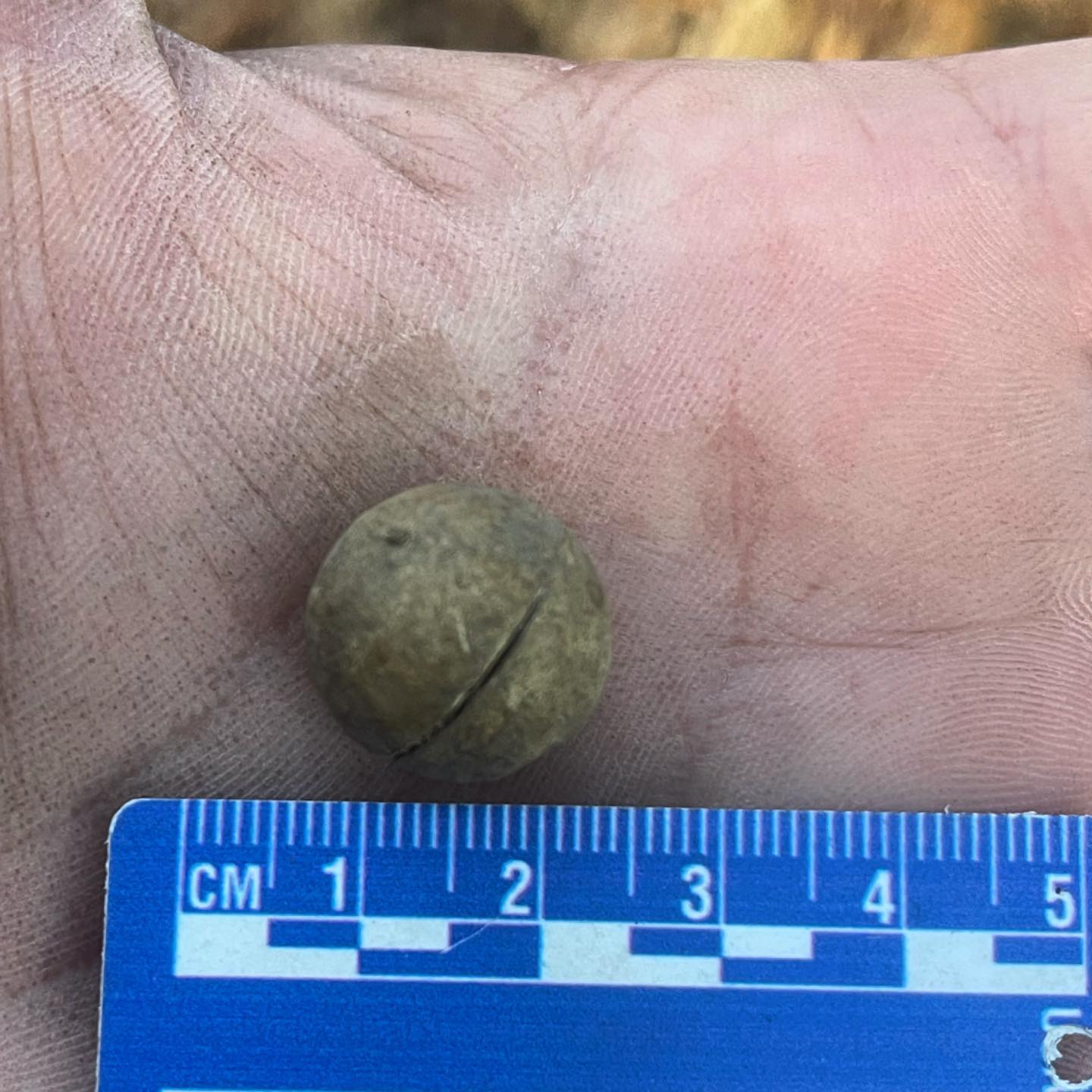
Produced in large numbers, and floating around most of the arsenals in the South, these were still used despite the lack of accuracy and range in both the front lines and on the home front by militia. With a maximum range of 365 meters, and an average effective range from 90 to 275 meters, the location of the ball is well within range of the guard towers. And while most of the POWs at Camp Lawton recalled few instances of guards shooting POWs, our fired musket ball, along with other fired rounds from previous work inside the stockade, is a sobering reminder that Lawton still had many ways to die,” the professor writes.

Students led by Lance Greene, his predecessor, in 2010 found a spent .57-caliber bullet at the stockade. The round “has clear signs of rifling from being fired: deformation on the tip seems to show it only striking sand, though this doesn't preclude it having impacted a human,” McNutt says

Later analysis showed three groves and a right-hand twist indicating it was probably fired from a Pattern 1853 Enfield rifled musket. “Deformation on the nose matches experimental archaeology of impacts into soft surfaces, like sand or loamy soil,” according to McNutt. 

ELMIRA (New York – Union camp)

Confederate POWs at Elmira (Library of Congress)
Elmira did not have a deadline, even though it was a stockade prison. The camp was dubbed “Hellmira” by prisoners because of its 24 percent mortality rate. Gray said there are records of a Union guard shooting a Confederate prisoner.

According to the Star Gazette newspaper, Granville Garland shot A.P. Potts of the 38th Georgia Infantry during a July 31, 1864, disturbance. Potts survived.

Inmates at Elmira weathered hunger, illness and melancholia and, even worse, exposure to the cold weather, according to the National Park Service.

POINT LOOKOUT (Maryland – union camp)

(Library of Congress)
The overcrowded prison saw 4,000 Confederate prisoners succumb to various causes, especially disease. Some were killed by guards, according to experts and histories. About 52,000 Union soldiers went through the prison.

The camp’s deadline was a ditch inside the prison approximately 15 feet from the parapet wall. The ditch was a foot wide by a foot deep.

Official records show African-American guards, some formerly enslaved, sometimes shot prisoners for crossing the deadline or trying to escape, says Gray. The prison is known for its racial tension.

“One commanding officer claimed that the black guards were more zealous than the white when it came to enforcement of prison regulations and were apt to fire first while calling for the corporal of the guard,” says Crickenberger.

He estimates 19 prisoners were shot and killed or wounded by white and black guards between November 1863 and August 1864 alone. Prisoners reported that there were instances where guards fired at prisoners without inflicting casualties. (Photo, Friends of Point Lookout)

“They shot frequently but missed more often than they hit,” Crickenberger says. “Regardless of the accuracy of the guard, such incidents kept prisoners on their toes making them wary and continually fearful of being shot either night or day.”

A Confederate prisoner drew notable watercolors of life at the prison, including interactions with guards. It should be noted that black POWs held at Andersonville faced discrimination from friend and foe alike.

The friends group has helped restore the fort, the southwest corner of the stockade and assists with living histories and demonstrations of camp life.

ROCK ISLAND (Illinois-Iowa – Union camp)

The deadline at Rock Island consisted of a series of white stakes (left, photo Rock Island Arsenal Museum) that were illuminated by lanterns at night, according to the NPS.

The barracks were enclosed by a stockade fence 1,300 feet long, 900 feet wide and 12 feet high. Sentry boxes were placed every 100 feet.

During the 20 months the prison was open, 1,960 prisoners and 171 Union guards died.

The North had reduced rations in retaliation for the treatment of Union prisoners at Andersonville. Conditions at Federal prisons often were deplorable.

Tuesday, October 31, 2023

Andersonville's Civil War weekend will include archaeologist's talks on how POWs coped with the trauma, resisted their captors

Former POW Thomas O'Dea's depiction of sickness at Andersonville (NPS)
A conflict archaeologist will speak this weekend at Andersonville National Historic Site in Georgia about emotional trauma endured by Civil War prisoners of war and how they reacted.

The site 10 miles northeast of Americus is having its annual Civil War weekend on Saturday and Sunday. Activities include cannon and musket demonstrations and activities geared toward young visitors.

Andersonville is the emblem of POW suffering at Union and Confederate camps during the Civil War. Of 45,000 men held there, 13,000 Union service members succumbed to horrible conditions.

Ryan McNutt (right), assistant professor of anthropology at Georgia Southern University, will be lecturing on resistance, masculinity and mental health in POW populations at both Andersonville (Camp Sumter) and Camp Lawton, another Confederate site in Georgia. McNutt directs the GSU archaeological project at the latter site.

For more than a decade, GSU students have conducted excavations and conducted research at a state park and former federal hatchery near Millen, Ga. About 10,000 Union prisoners were held at Lawton for about six weeks in 1864. They had been moved there from Camp Sumter.

Disease, hunger and unusually cold and moist conditions that year exacted a toll at Camp Lawton, with 700 or more prisoners dying before they were shipped off in the middle of the night to other Confederate prisons.

Susie Sernaker of Andersonville NHS told the Picket that McNutt’s lectures, at 1 p.m. both days in the park theater, will help spread public knowledge about the travails of those held at Lawton.

McNutt and his students have focused on the location of Confederate and Union structures at  and the difficulties prisoners and guards faced -- and their interactions.

The professor’s research interests include utilizing technology such as LIDAR and GIS to answer questions about battlefield and conflict sites, power and dominance in the landscape and the impact of violence on non-combatants. 

A study conducted a few years ago found that postwar-born sons of many Union POWS had shorter lives than sons of soldiers who weren’t held captive. Basically, the study found that fathers’ prison hardships, including food shortages, altered the function of his genes in ways that could be passed on to sons.

Excavation at Camp Lawton site in March 2023 (Picket photo)
The free programming this weekend at Andersonville lasts from 10 a.m. to 4 p.m. on Saturday and 10 a.m. to 3 p.m. on Sunday.

“Kids can drill like Civil War soldiers, build miniature shelters, and discover more about the Civil War period at Andersonville by participating in our Junior Ranger program,” the park said in a news release. “Living historians will be portraying Father Whelan, the women of Andersonville, Confederate guards, and Union prisoners, all to help the history of Camp Sumter, better known as Andersonville Prison, come to life.”

Cannon firing demonstrations will take place at 10:30 a.m. and 1:30 p.m. on Saturday and at 10 a.m. and 3 p.m.  on Sunday. Musket firing demonstrations will be at noon and 3 p.m. on Saturday and 11:30 a.m. on Sunday. 

For more information on the event or to find out how you can become a living history volunteer at the park, call 229-924-0343. 

Tuesday, April 4, 2023

Rolling the dice: Discovery of piece of gaming object at Georgia's Camp Lawton an example of the 'shadow economy' at POW sites

Views of the remains of the die, which may have had numerous sides (Camp Lawton Project)
Somewhere at an archaeological site in Georgia are the remains of a sutler’s cabin, where captured Federal soldiers could buy a whole range of goods, temporarily lifting them from misery that took the lives of 800 comrades.

The Camp Lawton sutler’s cabin and the grounds around it offered more than food and clothing. It was part of the prison’s shadow economy for six weeks in autumn 1864. Soldiers -- either with U.S. greenbacks they still held, or equipment and personal items – could obtain alcohol from guards, tobacco and play games of chance.

Ryan McNutt, who leads the Camp Lawton project at Georgia Southern University, and a couple dozen students have spent the spring looking for evidence of the cabin. Thus far, there have been no definitive finds. Maps produced in the 19th century gave different positions for the structure.

Patrick Sword and Audrey McGill at dig site (Picket photos)
On one bright note, part of a carved die was found a few weeks ago during digging, evidence of apparent gambling in the trade-and-sell part of the stockade.

Patrick Sword, a graduate student from the Atlanta area, is studying the shadow economy at Lawton. I met him and other students in late March during a brief visit to the site on the fenced grounds of an old federal fishery adjoining Magnolia Springs State Park.

The stockade was laid out in a grid fashion (left, click to enlarge) and much of the commercial activity took part on Market Street, Sword said. He is hoping to find more evidence of the shadow economy, but the team in recent weeks has found mostly modern stuff, including trash dumped by members of the Civilian Conservation Corps, who helped construct the state park in the late 1930s.

McNutt says the die is made of lead, probably fashioned from a small caliber round, likely a pistol or a .54-caliber ball. He says the artifact is probably one-half or one-fourth of the original die.

“Six-sided die are the most common, but there are also 10-sided, 32-sided, and 20-sided. If it's from a six-sided die, it is a half, split down the center to leave a quasi-pyramid shape,” McNutt wrote in an email after my visit.

In its six weeks' existence, the 42-acre Confederate stockade held about 10,000 men before it was closed when Union forces approached. Over the past dozen years, teams from Georgia Southern have found evidence of the stockade wall, Rebel officers’ quarters, brick ovens and sleeping areas for the POWs. Thus far, they have been unable to find the hospital or burial area.

Camp Lawton was one of several prisons in south Georgia that briefly held Federal prisoners sent from the larger Andersonville camp. They were moved back and forth because Confederate officials feared they would be freed by Sherman’s March to the Sea.

McNutt and his students in their spring dig have found a lot of postwar material, but also have come across cut nails, buckles, a bullet and files from the Civil War period. On the day of my visit they were working near a stream that divided the camp, and served as a drinking source and latrine a bit downstream.

“We get good historic Civil War stuff and then a modern fishing weight,” the associate professor tells me.

McNutt (right, on site) believes much of the area they were working on is where Union prisoners who served as an internal police force operated.

Not many prisoner items have been found here, unlike in the hill above. “No one is allowed to camp right near the stream.”

The professor is interested in the relationship between guards and prisoners. They were known to have traded at here and other sites, and morale among the former was low at Camp Lawton, not surprising given the Confederacy’s decline. Guards sometimes foraged away from the property.

Prisoner of war camps are “excellent places to hide contraband, personal items you are not supposed to have," McNutt told me several years ago when he became project director. 

The National Park Service, which maintains the much larger site at Andersonville, has an online page detailing life and diversions for Federal prisoners held there. It, too, had a sutler’s cabin, but it had other shops selling items to the captives as well.

Food, of course, was always on their minds.

Sutler's cabin in rear at Andersonville in 1864 (Library of Congress)
Here is an NPS description of Andersonville:

“Many of the Andersonville prisoners who arrived in the stockade in April and May were well supplied with money. The Federal armies were reclothed and paid off in the spring of 1864 for the spring campaigns. Many of the new recruits and reenlisted veterans had bounty money with them when captured. Greenbacks could be pressed into the sole of a shoe, or placed inside a brass button. Money was concealed about the person in various ways. Some swallowed their rings and others put their money into bowls of large Dutch pipes with a little tobacco sprinkled on top. When searched, they would pretend to be busy lighting their pipes and thus escape suspicion.

“Gambling was carried on quite extensively; faro, dice, and $10.00 stakes were commonly played for. Trade was carried on with the guards on the outside of the wall by talking through the cracks and throwing articles over the fence. Another trade was carried on as well, as noted by prisoner John Northrup, Co. D, 7th Connecticut Infantry: "There is one commodity never had in any market. It is ahead of any Dutch brewery extract; it is meal beer made by letting corn meal sour in water. The vendor cries, 'here is your nice meal beer, right sour, well-seasoned with sassafras.'"

POWS trade new rations for something more palatable (NPS)
McNutt believes there may be beer and rum bottle remains at the Camp Lawton site.

Trade, bartering and gambling were common at virtually all Civil War prisoners, both North and South, though there appeared to be some restrictions later in the war.

At Point Lookout in Maryland, where Confederates were held, a prisoner made compelling illustrations of camp scenes. All depicted guards were African-American soldiers.

“The drawings highlight the concerns and experiences of prisoners of war; most scenes show prisoners playing cards, buying food, or engaging in barter with food vendors,” the historical society says in a description of its collection.

Exchanging buttons for pepper at Andersonville (Library of Congress)
Confederate officer Henry Clay Dickinson wrote about gambling he witnesses while a prisoner of war at Fort Delaware, Delaware, in 1864, according to a Civil War Monitor article on gambling.

“The gambling saloons were a curious feature in prison, and were not only numerous but well patronized. Captain Coffee, of Mississippi, was the prince of faro dealers, being always gentlemanly in his manners and always attracting the greatest crowd. He never played cards until he was captured, except for amusement, and I am told that a Yankee guard was his first victim. The bettor wagered either in Confederate or Yankee money. He always had a large and anxious looking crowd around his booth. Some quartermasters having been captured, the amount of Confederate money in prison was very large, and changed hands frequently.

“I heard that Coffee once sent to Dixie from Point Lookout ten thousand dollars. How much United States money he (Coffee) made I cannot say, though at one time, when the Yanks were about searching quarters and persons, he hid in the grass one hundred and eleven dollars in gold, a gold watch, and several hundred dollars in notes, which, of course, some Yank, who knew he was flush, had seen him hide and took care to not let him find it again.”

Rusted metal likely from the 20th century (Picket photo)

Tuesday, February 21, 2023

At Camp Lawton stockade site in Georgia, archaeology students searching for sutler's cabin find POW buckles, nails and more

Nails may have had multiple uses, a Federal trouser buckle (Camp Lawton Archaeological Project)
Archaeology students trying to learn more about a Confederate prison that operated for less than two months in southern Georgia are exploring where Federal soldiers were held captive, and they’ve thus far turned up buckles, nails, a Rebel musket ball and intriguing turtle remains.

Georgia Southern University Associate Professor Ryan McNutt said this season’s dig on the site of Camp Lawton began in January and will go through April or early May. This is the first time the project has been on the Federal side of the stockade since 2014.

Hundreds of POWs died at Lawton during its brief existence in fall 1864. Prisoners were shuttled among several Southern prisons, most notably Andersonville as Union forces advanced on Savannah. The camp was built near Millen; a portion lies within Magnolia Springs State Park and the rest is on the grounds of a former federal fish hatchery.

Since the announcement in 2010 of the discovery of the Lawton site, GSU has studied several areas to get a better understanding of prisoner and guard life. McNutt responded this month to a series of questions from the Civil War Picket. His responses have been edited.

Q. One (Facebook) post said a prime focus is the sutler's cabin. Was it within the prison area (where Federal soldiers roamed)? What does the record say about the cabin, its purpose and operation? Why would you like to find evidence of the cabin?

Sutler cabin (top) at Camp Sumter/Andersonville (Library of Congress)
A. The sutler cabin seems to have been across the stream from the gate, and directly in line with it on the main west-east running road (in modern cardinal directions, not Robert Knox Sneden's). The record is frustratingly quite vague.

We know there was one, as there was at Andersonville (photo above, log structure with slanted roof), as POWs discuss it.

Sneden (see Union POW’s drawing below of Camp Lawton) seems to place it in the same general location, though in at least several instances he places it on opposite sides of the road leading to the bridge. 

Detail of Sneden's drawing shows sutler cabin, police area in center (Library of Congress)
The sutler at Andersonville seems to have been a James Selman Jr., followed by a James Duncan, who may have been a Confederate guard and was possibly replaced again by a James Selman. One of these individuals likely ran the sutler's (cabin) at Camp Lawton. They were authorized by the prison commandants to sell to the prisoners authorized items. From their stories, prisoners with money that they were able to hang on to, or make, could buy eggs, flour, bacon, cornbread, beans, baking soda, and blackberries; soap, shaving equipment, clothing, tobacco, tobacco pipes, cigars, reading material, and so on -- for eyewatering prices that were much higher than regular marker prices. Examples: Fifty cents an egg, six dollars for a pound of bacon, and 25 cents a spoon for baking soda.

We're looking for evidence of the cabin as part of a graduate student's thesis work, which is focused on shadow and underground economies inside prison camps. As one of the only sources of goods coming into the prison, it's like the sutler's cabin was the center point of much of the legal and illegal trade between prisoners, guards and prisoners and the sutler. 

We're hoping to find evidence of this in the material culture around the cabin, to get an idea of how heavily trafficked and used it may have been. Sneden certainly seems to imply the area around the cabin was always crowded. 

Students sift through soil (Camp Lawton Archaeological Project)
Q. What else are the students concentrating on this spring?

A. Essentially, just the area around the bank on the west side of the stream. Interestingly, while Sneden shows it lightly occupied, he does show an area of shebangs labeled 'Police' with no explanation, as well as potentially a chapel, though this might be reading too much into Sneden's maps and images.

We're also getting a better idea of how densely the camp was occupied, where we have evidence of POW activity, and in a very real way, the extent of past impacts on the site during its transition from timberland to state and then federal fish hatchery, and CCC work.

We used Lidar data to pinpoint potential anomalies that might be the sutler's cabin, and the students are learning how to locate those on the ground, test them and get an understanding that even with the most accurate technology you can get, archaeologists still have to dig to confirm our guess of flat areas and odd shapes that show up in Lidar.

Q. Can you briefly summarize what has been learned thus far in this field school? And what more you want to work on for the remainder of this session.

Q. So far we've got clear indications of a lightly occupied area of the stockade, and our current grid is likely just off of where the sutler’s cabin should be, but we have another area just west that might have more promise. We're working from our known to our unknown, from areas that were lightly tested in the past to areas that the project has never looked at before. We're almost finished with our current grid, which has clearly showed some POW occupation. Turtle bones and shells (left) possibly came from a hearth, and we have a few other spots that might be POW shelters. We'll explore these with test units, and we'll establish another area over our area of interest that might be closer to the sutler's cabin and the main road.

But we also clearly have empty spots, with no artifacts at all that seem to indicate the presence of roads and paths shown on the plan created by the Confederates as the camp was being built, and Sneden's water colors. 

Q. Social media photos by the project show numerous buckles -- trousers, knapsack or elsewhere. Are these believed to be from Union POWs? What about the iron nails --- suspected use for them?

A. So far, we have one whole and one partial trouser buckle, as well as three that are likely haversack or knapsack buckles. We also have some different files -- metal and wood working, that seem to have been fairly degraded when they were dropped. As well as one piece of ceramic and some fragments of glass bottles. One of which was likely a pickle or sauce bottle. These were all probably dropped by POWs. The trouser buckles are standard issue on several Federal trouser types, and the buckles match Federal issued equipment. While this isn't to say they are absolutely from POWs, the Confederates present at the camp do not seem to ever have been issued anything close to uniform items.

Some of the iron nails (right) are interesting, in that they fall into two groups. A couple (of them) are big enough to be structural and used to pin the corners of wooden structures together. Most, however, are of the size to come from express boxes (like those used on US Sanitary Commission aid boxes), and may represent the distribution of this material to the POWs, who are then repurposing the boxes.

The nails may have just been dropped -- most of them seem to have been pulled and bent, and aren't modified in any clear way. But we haven't done a full analysis yet.

We've also found a host of unknown items, and some personal effects such as what is possibly part of a match safe, and maybe even a cigar case. 

 [An] unexpected moment was one of our artifacts that is also the most puzzling. An iron strap with copper rivets, and a hinge on one side, and a threaded rod on the other, it still has preserved leather around several of the rivets. And it looks as though whatever it is, it may be period.

(The GSU team also found what appears to be a spent Confederate bullet. The Picket will have a separate article about this soon.)

Cast copper alloy buckle with iron tongue (Camp Lawton Project)

Q. Anything else readers might want to know?

A. I'd be interested in being contacted by anyone who might have an ancestor inside the stockade who left any memories, or anyone with photos of Magnolia Springs State Park and the stream going back to the CCC activity. Individuals are also always welcome to email me (rmcnutt@georgiasouthern.edu) with any questions, and I'll get back as soon as I can. They're also welcome to stop by the site, even if we're not running a public day. (The GSU team usually is on site Mondays, Wednesdays and Fridays during this field school.)

COMING SOON: Recovered Confederate bullets at Camp Lawton raise questions about how often and why guards fired upon prisoners there, at Andersonville and other sites. 

Previous coverage:

Friday, July 1, 2022

Percussion caps and friction primers: Q&A on students in Georgia who found evidence of wild cavalry chase, valiant rearguard stand

Big Buchkead Church, percussion cap (top right) and artillery primer (Camp Lawton project)
Members of the archaeology program at Georgia Southern University have pinpointed where a Ohio cavalry regiment helped successfully hold off charging Confederate horsemen during Sherman’s March to the Sea, the head of the project says.

Students at the university in Statesboro participated in a summer field school from May 15-June 16 at the site in Jenkins County.

Associate professor Ryan McNutt, who heads up the school’s Camp Lawton Archaeological Project, said about 1,000 artifacts were recovered. “I think we’ve made a very good start to confirming the location of portions of the Buckhead Creek battle lines, and this is something that future work will only develop and refine.”

The project for several years has been researching the remains of a nearby Confederate prison camp that was in operation for several weeks in fall 1864.

In 2020, the university was awarded a $116,247 grant from the National Park Service’s American Battlefield Protection Program to document and evaluate the archaeological integrity of two skirmish sites toward the end of Gen. William T. Sherman’s march to Savannah: Buckhead Creek and the subsequent Lawton (Lumpkin’s) Station.

Students tackled the Lawton Station fight first, finding evidence in early 2021 of an engagement.

The program decided to study Buckhead Creek this year, concentrating on property around an historic church caught up in the fighting.

The Battle of Buckhead (or Buck Head) Creek on November 28, 1864, involved cavalry forces under Union Brig. Gen. Judson Kilpatrick and Confederate Maj. Gen. Joseph Wheeler (below, right). It took place across what are now Jenkins and Burke counties.

Kilpatrick (above, left) was in the area to destroy railroad between August and Millen and burn a trestle. Another objective was to release the Camp Lawton prisoners, but Union forces discovered they had been moved to other sites. Federal forces were able to destroy a mile of track.

On the 28th, Wheeler “almost captured Kilpatrick, and pursued him and his men to Buckhead Creek. As Kilpatrick's main force crossed the creek, one regiment (the 5th Ohio Cavalry), supported by artillery, fought a rearguard action severely punishing Wheeler and then burned the bridge behind them,” says a National Park Service summary of the fighting. “Wheeler soon crossed and followed, but a Union brigade behind barricades at Reynolds' Plantation halted the Rebels' drive, eventually forcing them to retire.”

The Picket’s questions about Buckhead Creek and McNutt’s written responses below have been edited for brevity and clarity.

Q. Was all of the work at the church? Why there -- any particular historical accounts you wanted to map?

A. All of our work took place around the Big Buckhead (Baptist) Church, on property owned by the Jenkins County Historical Society, for which we had permission to conduct archaeology on. This was for a few reasons. First, primary sources mention the church extensively as a landmark during the conflict over the creek crossing, and the Union withdrawal to Reynolds' Plantation. Secondly, the church’s property encompasses the end point of the causeway from Buckhead Creek Bridge, on line with the historic pilings visible from the modern bridge, and straddles the route of the historic road Gen. Kilpatrick and his 3rd Cavalry Division retreated along. The (Federal) rear guard artillery action is the bit that likely occurred around the church.

Q. What date was the skirmish or skirmishes your team was studying? Were most of those engaged cavalry?

A. The battle occurred November 28, 1864 -- the action at the church occurred at noon on this date, which we know from a letter from the colonel commanding the 5th Ohio Volunteer Cavalry who documented the regiment’s involvement in his report. All troops engaged were cavalry, with one light artillery regiment (the 10th Wisconsin) on the Union side as part of Kilpatrick’s 3rd Cavalry Division. Wheeler’s Confederate forces are less clear. He seemed to have some artillery attached, and we found some potential evidence of ad hoc Confederate canister shot that seems similar to items recovered from the Battle of Pea Ridge, but this is very tenuous at the moment and needs more lab analysis and documentary research. (Photo of left, Camp Lawton project)

Q. One of your Facebook posts said "pistols were used in the skirmish at Buckhead Creek Church alongside long arms and artillery pieces." Did you find artifacts from all three?

A. We found evidence of .22-caliber rimfires from a Smith & Wesson Model 1, and a lone percussion cap that fits a Colt Army 1860 .44-caliber revolver (or its equivalent). Artillery was identified primarily through fired friction primers, which were all localized in one area of the grid, in a position to deliver enfilading fire on the causeway and bridge across the road. We have some potential evidence of canister tins, and one possible piece of canister shot, but confirming the identification of these is an ongoing process tied to their conservation. Evidence of long arm use so far comes from exclusively percussion caps, in the top hat style, but there are some odds and ends that might be arms-related as well.

Brass rimfire casing for a revolver (Camp Lawton Archaeological Project)
Q. How far below the surface were the artifacts typically found?

A. Fairly deep -- almost all the munitions were recovered between 20 and 25 cms (8-10 inches below surface.

Q. How many in total were recovered? Any personal items or were all arms-related?

A. We recovered probably around 1,000 individual artifacts, and this included some historic glass, lantern parts, ceramics, numerous machine-cut nails, several boot nails and a few potential horse shoe nails, as well as the arms related items.  Many of these domestic items likely relate to the use of the site by the church, which has been continually used a place of worship since before the Revolutionary War and was certainly in existence from 1787. There were no clearly identified personal items from soldiers, but that may be a result of a long-term metal detector activity on the site.

Q. Any related to horse tack?

A. We almost certainly have some iron items that are related to horse tack, but they’re not obviously military in origin.

Reproduction percussion caps have maker's mark less patina (Camp Lawton project)
Q. You found lots of percussion caps. Were those mostly from pistols?

A. In fact, they’re almost all from long arms, and likely Sharps, which were the carbines the 5th Ohio was issued with -- we found about 23 top hat style percussion caps, in a distinct line with several clusters, that likely indicates a skirmish line (given that the clusters are about 3-4 meters apart across the site, and in an angled line facing the causeway and old bridge site).

Q. The friction primers – Union or Confederate? Their use?

A. These are likely all Union, given their location. Friction primers were a gunpowder-filled copper tube inserted into the touchhole in the rear of the cannon barrel into the gunpowder charge. A roughened wire was fixed into a spur that was filled with antimony sulfide and potassium chlorate, which essentially acted like a matchhead when the wire was pulled through the spur.

A lanyard would have run from the wire to the hands of the gunner and yanking the lanyard pulled the wire out, ignited the friction primer, and fired the gun. The used exploded copper tube was then explosively hurled into the air and to the rear of the gun (depending on the cannon tube’s elevation).

For our purposes, the exact location of these friction primers is quite important, because we have primary accounts describing the presence of artillery at the Battle of Buckhead Creek Church, and general indications of their positioning.

Wartime photo of 5th Ohio Cavalry (Library of Congress)
The 5th Ohio Cavalry Regiment, Company G, had obtained two 12-pound mountain howitzers, and these were positioned to the right and left of the road running from the bridge at Buckhead Creek past the church and were loaded with canister to sweep the causeways leading up to, and away from the bridge. Another possibility is the 10th Wisconsin Light Artillery, who were attached to Kilpatrick’s 3rd Division, and were also involved in the rear-guard action at the creek, and who were also armed with mountain howitzers. Using the location of these friction primers and working out the potential distance these would have been hurled from where the guns were fired, we may be able to actually identify where precisely the Union artillery pieces were placed next to the church and add these to the battle interpretation. Moreover, these small copper pieces of conflict also indicate that there is quite a lot of integrity of the battlefield surviving.

Q. You posted on social media the discovery of buck and ball loads (left). What are those?

A. We found two, possibly three pieces of shot from buck and ball loads. Buck and ball loads were essentially two or more .32-caliber shot loaded into a paper cartridge with a .69-caliber ball. When fired, it had the effect of a shotgun, spreading the lethality of impact across a wider target.

Both of our shot has banding from the barrel of the firearm, and impressions from the .69-caliber ball, which is how we know they’ve been fired, since shot can only pick up those alterations from contact when it goes semi-molten from the powder charge when fired.

Wheeler himself requested buck and ball cartridges to be sent to Millen for his resupply, and when Sherman’s army took Savannah at the end of the campaign, part of the captured Confederate munitions included a total of 11,500 buck and ball cartridges.

Q. What types of equipment were used during the school?

A. We used exclusively metal detecting. There are several potential earthwork features that might be ad hoc Union fortification -- rifle pits, a potential tiny lunette -- that we need to return to and examine with GPR (ground-penetrating radar).

Q. Regarding open and public days, any particular questions or themes raised by visitors?

A. One of the consistent themes raised is how heavily metal detected the area has been in the past, and how surprised they were that were finding items. And also a deep appreciation for us working in the area, and raising the profile of both the battlefield, and the church. Despite its great historical importance, it’s not listed on the National Register (of Historic Places), and part of the final reporting of this project will be to nominate the church itself to the National Register as historically significant.

Dr. McNutt with visitors to the excavation site (Camp Lawton Archaeological Project)
Q. I imagine is analysis is to come, but do you have any takeaways from what was found/observed during the five weeks? Anything become clearer about the fighting around the church?

A. I think we’ve likely pretty much confirmed that we uncovered evidence of the 5th Ohio Volunteer Cavalry’s actions at Buckhead Creek. They were a regiment who served in the 2nd brigade of General Kilpatrick’s 3rd Division. Originally, the entire 5th Ohio formed the rear guard, dispersing Confederate attempts to cross the bridge over the creek with canister shot from two 12 pounder mountain howitzers from Company G commanded by Capt. John Pummill.

John Pummill may be individual at left with 5th Ohio howitzer (Library of Congress)
At noon on November 28 , 1864, they opened fire at the charging Confederates charging over the bridge and ‘when the smoke of [their] discharge cleared away’ the causeways were swept clean. Co D of the 5th Ohio destroyed the bridge, but Wheeler himself said his command used the pews from Buckhead Creek Church to rebuild it.

The 5th Ohio began a slow withdrawal to join Kilpatrick at Reynolds' (Bellevue) Plantation, leaving the 3rd battalion consisting of companies E, I, H, and K lead by Capt. (Alexander) Rossman to defend the rear at the creek crossing. Finally, only Company K was left, fighting dismounted as skirmishers. By this point in the war, Company K held only 61 men, who tenaciously held off Wheeler’s forces. And this accords well with what we’re uncovering in the archaeological record. Contrary to popular belief, only three regiments in Kilpatrick’s entire 3rd division were armed with Spencer repeating rifles. All the rest possessed either Springfield rifle muskets, or carbines of various effectiveness.

The 5th Ohio, which is our most likely candidate for the troops whose positions we’re investigating, were armed with Joslyn carbines at the start of their service, transitioning to Burnsides and then Sharps. As well as the standard issue Colt Army 1860 .44-caliber revolver, most importantly for our purposes, all of these carbines used top hat style percussion caps to ignite their breech loaded cartridges -- the exact style we’re finding in abundance, spaced at regular intervals facing the still visible causeway, strongly indicating a skirmish line. Potentially, the line of Company K. I think we’ve got really good evidence for the position of at least one of the 5th Ohio’s artillery pieces, and accompanying skirmish line. (Damaged percussion cap in photo)

Q.  What do you think students most experienced/learned at this field school?

A. I think we’ve made a very good start to confirming the location of portions of the Buckhead Creek battle lines, and this is something that future work will only develop and refine. Most importantly, I think we’ve clearly demonstrated that portions of the creek battle site have really good archaeological integrity, with surviving artifacts, battle lines and detritus from the action, despite the extensive metal detecting activity in the area. This is incredibly important for these aspects of the conflict that spun off from Sherman’s March to the Sea, given that the battle of Waynesboro, and so many other of the smaller skirmish sites have vanished under development and urban expansion. I think this publicity and confirmation of intact historic terrain and battlefield material should help heighten the visibility of the battle, and encourage tourism to Jenkins County to witness a landscape in very good condition for visualizing one of the last major battles in Sherman’s March to the Sea.

Dr. McNutt (back row, left) with members of the summer field school team
Our students learned how important this local history is to the people of Jenkins County, and how it intersects with heritage tourism and real world impact. And of course, they also learned the value of hard work in 111 degree heat, and how much team work and strict scientific approaches are necessary to uncovering the past. Most of our percussion caps were in areas that were untouched because they covered over with extensive modern garbage, and it’s only through dedication and discipline that we uncovered them.

Moreover, I think the battle at Buckhead Creek Church really drove home to the students the concept of the Civil War as the first industrialized war, with a stark contrast between black powder muzzle loaders and buck and ball loads utilized by the Confederates, and breech-loading carbines and lever action repeaters and pistols with cased ammunition being used by the Union.