An online
database of Union soldiers held for about six weeks at a prison in Georgia has
grown to 3,808, more than one third of the site’s population.
Through research,
online sites – such as findagrave and familysearch -- and the Andersonville
Departure Register, archaeologist Debbie Wallsmith has increased that number
from a listing of 399 prisoners who died at Camp Lawton.
Visitors at
Magnolia Springs State Park northwest of Savannah can assume the identity of a
POW at the state’s Camp Lawton History Center. They learn more about the experience of being at
Lawton and then find out that prisoner’s fate. The Confederate camp also was known
as Millen, a town a few miles away.
Exhibit hall at Magnolia Springs History Center (Ga. DNR)
In a recent newsletter from
the Georgia Historic Preservation Division, Wallsmith provided an update on her
ongoing effort to learn more about the prisoners and their Confederate guards.
She called the project an “obsession” ina 2014 interview with the Civil War Picket.
The average age of enlistment
for the Union captives was 24, although the range went from 15 to 45.
“Of 625 survivors with known
dates of deaths, 466 died before 1900, including 138 while imprisoned elsewhere
before the end of the war; and 10 others who died aboard the Sultana, a
steamboat that exploded on the Mississippi River while transporting soldiers
home.” One POW died in 1944.
Up to 10,000 Union men, most sent from the infamous Andersonville prison camp, were held at Lawton in late 1864 before
they were moved elsewhere. Death estimates range from685 to 1,330. The
database includes more than 3,400 Lawton survivors.
Wallsmith concluded her
update with a summary of a few of the most famous Lawton prisoners, including
Thomas P. “Boston” Corbett, who killed John Wilkes Booth, and Peter “Big Pete”
McCullough, a Missouri soldier known as the “Hanging Judge of Andersonville”
for seeking punishment for six fellow Union prisoners who were part of the “Raiders,”
a group that preyed on comrades.
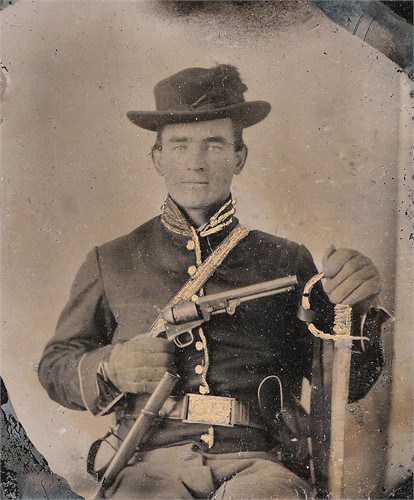
Cpl. Alexander T. Butler of
the 7th Tennessee Cavalry, Company B, (above) lived to be almost 75 and
married four times after returning home. Butler farmed after the war and
received a pension because of illness.
Eppenetus Washington
McIntosh of the 14th Illinois Infantry survived the Sultana disaster.
McIntosh “found it difficult
to stay in one place and spent most of the remainder of his life as a traveling
minstrel, and sold post cards that featured a drawing of his emaciated
appearance after being released from Andersonville,” Wallsmith wrote.
Wallsmith asks those with questions or possible
contributions to the database contact her at 770-389-7864 or debbie.wallsmith@dnr.ga.gov
A moody photo
of the Chancellorsville battlefield in Virginia is the grand prize-winner in
the 2015 Civil War Trust photo contest. A dozen submitted images will grace the
organization’s 2016 calendar, which helps support land preservation.• See this year’s and previous winners.
Burning of Columbia, Feb. 1865 (William Waud, Library of Congress)
Historic
flooding earlier this month in Columbia, South Carolina, put a temporary hold
on the removal of objects from a river where Union Maj. Gen. William T. Sherman is believed to have dumped captured munitions.
“Prior to the
flooding, we did work on removing the metallic objects for several days,” said Ginny
Jones, senior public affairs specialist for SCANA, parent company of utility
SCE&G. “Nothing we found at that time was of historical significance. We
plan to resume work on the project on Nov. 2.”
The State
newspaper has reported that sonar and metal detection have located where the
weapons were likely dumped into the Congaree River near the Gervais Street
bridge. But no one is certain the objects are associated with the Civil War.
Sherman, on
his way to North Carolina after seizing the South Carolina capital, kept what he
wanted of Confederate ordnance and threw the rest into the river in February 1865.
“It is
certainly possible that historical objects could still be found; we still just
don’t know what’s there until we dig it up,” Jones said in an email to the
Civil War Picket.
Gervais Street bridge (NPS)
EOTI, a
Tennessee company, has been contracted to help deal with any Civil War-related
munitions that are found. “That likely would involve placing a cover over any
explosives consultants find, then detonating the material in place,” the
newspaper reported, quoting a SCANA official. “The cover would keep the
explosion contained to protect the public and the surrounding environment.”
EOTI referred
Picket questions to SCANA.
SCE&G is
conducting a remediation project in the Congaree River because of the detected
presence of tar. It says tests show it to be coal tar created by manufactured
gas plants that operated throughout Columbia more than century ago.
The State, in
a preview of this phase of the work, said workers will go through soil in the
river and remove 74 objects.
Officials
previously told the newspaper that any recovered cannonballs, scabbards, sabers or
cartridges will likely be housed at the S.C. Confederate Relic Room.
The Civil War Picket this week spoke with Julie
Morgan, archaeologist for the U.S. Army Corps of Engineers in Savannah, Ga. We
asked her about concerted efforts since January to recover the CSS Georgia ironclad, a
Confederate vessel, and associated artifacts from the Savannah River as part of
a channel-deepening project. Responses
have been edited for brevity and organization by topic.
Q. When do you expect mechanized
recovery to wrap up?
A. We expect Oct. 23 (today) will be the last day for the
mechanized. We are striving for 100 percent coverage of the site. It is highly
likely that we will have left some artifacts down there. We are trying to get
up as much as we can.
Q. What has been the biggest surprise?
A. The grapple bringing up the (9-inch Dahlgren) cannon is
right up there, No. 1. In this part of the project, I am amazed by the variety
of artifacts we are getting, with the techniques we are using. This is
definitely not the norm to use clamshell or grapple. It would not be how you
normally do it (previous phases in the project included retrieval of items by hand, baskets and lifts). We are just finding items from the smallest – a few buttons,
marbles -- to 24-foot long foot railroad iron (armor). Machinery, large
timbers, we have found the whole spectrum. We are getting a lot of ceramic, whiteware, spoons, everyday items. It is very surprising we are finding
such small artifacts and these very large pieces.
Q. The biggest disappointment?
A. We were not able to recover the large casemate section.
We are not doing it this time. We just really weren’t prepared with the
equipment that we have. We will step back and reassess and come back in the
future. We had a methodology, using the best information possible. As we got
more involved, we realized the way we had planned was not the best way. We did
not have the assets to recover the west and east casemates. We have recovered a
few pieces of the east casemate. I think we have some really get data. We can reconstruct
a section of the southeast casemate. Although we are using unconventional
methods, we are recording everything. We will have a very good idea of how the
vessel was constructed: the interior considerations, how the wood backing was
put together, a lot more about the vessel itself.
Possible Civil War medallion that may have been attached to strap (USACE)
Q. How have the artifacts, at least
preliminarily, informed you of the
operations of the CSS Georgia?
A. I think we can all agree that based on the machinery we
have recovered it was definitely underpowered. That was alluded to in archival
research. We know just from the pieces. The Georgia was a large and heavy
vessel. We are scratching our heads, thinking, ‘Why did they use this (item)?’
A lot has to do with maybe they were using what they could just find, products
that were readily available. There is no way to know at this point why they
chose what they did. We have no estimate on the ship’s length.
Railroad iron was used for armor (USACE)
Q. Any evidence of measures taken to
combat the constant leaking on the Georgia?
A. No. And you have to realize when we find this machinery
it is not like the whole engine falls on the deck. There are so many pieces. We
will have to figure out how they go together. At this point, we are getting
pieces to the puzzle but we have not had chance to do that yet.
Q. How about the life of the crew? Did
you find evidence of types of food, alcohol?
A. We have found items that suggest it was a pretty dull
assignment. We found marbles and a domino. They had to find ways to keep
themselves occupied. We are finding spoons, whiteware (ceramic). We will have
an opportunity to look at our large database and we may get a better picture.
We are starting to confirm it was a pretty dull assignment. We found bits and
pieces of wooden barrels. We have found only one complete bottle of alcohol,
for extra porter and ale. I imagine sailors haven’t changed much over the
years.
Discovery of Dahlgren was a surprise for some (USACE)
Q. How can you describe the experience
the two dozen, mostly young archaeologists are receiving?
A. These are all professional archaeologists. Some may be
working on degrees. They do this for a living. If they were all terrestrial
archaeologists we would call them “shovelbums” who go around to different
projects. This is a very unique project. Because they are young, I can’t say
this will be the highlight of their career, but it will rank right up there,
working on a Confederate ironclad.
Q. What is like to go through all the
muck and debris?
A. Sometimes the pieces are very, very small. It was pretty
exciting to find something we can attribute to the CSS Georgia. The buttons are
very exciting, as were the bayonet and sword handles. We are getting
prehistoric ceramic. The crew is on its hands and knees somedays (on a recovery
barge) looking through the muck and clamshell debris.
Hilt for artillery short sword
Q. Can you describe a typical day out
on the barges?
A. It’s pretty fast-paced and the crew is very, very
efficient. We are averaging 50 to 70 grabs a day. In the areas we are getting
heavy machinery and iron it might be a slower day where we may have to use
cranes. We have an amazing crew that is dedicated and enthusiastic. It is hard
work, manual labor, but it is very rewarding. Saturday, we will start cleaning
off the barge and will go back to our base crew that started in January. We
will have reburial next week. Some of the final dives will make sure nothing
major is missed. Toward the end of the
next week we will take barges off the site
(near Old Fort Jackson) and start unloading.
Q. What’s next?
A. Once we are off site, we will finish up inerting
(rendering safe) the ordnance and getting all ordnance to Texas A&M
(University) for conservation. We have found with so much (material) it may
take in excess of three years for of all the conservation in this project.
Archaeologists will start writing up the report and start the analysis of these
artifacts. We will have a technical report at the very end of this project.
A shard of recovered pottery (USACE)
Q. When do you expect to research/write a
formal analysis? What variables will be included?
A. This is a data recovery project. We are going to be
reburying some of the artifacts. We will have to address those artifacts in the
report. It will be pretty straightforward. Because of the conditions of the
vessel, site, damage, (the remains) not being complete, there may be some
questions we may never be able to answer.
Q. What percentage of items will be
conserved?
A. I can’t speculate. Items that are unique are going to
the conservation lab in Texas. Railroad items that are bent, twisted or are a
segment, we bury those. Essentially, if it cannot tell us more of the story it
goes back to reburial (in the river).
Q. Recovery has been ongoing for
nearly a year. Can you summarize what’s been accomplished?
A. Looking at the sonar images we always had a pretty good
idea of what was left of the vessel itself. Through the past few weeks in
mechanized we are finding much more about the CSS Georgia. You look at the
images, now we are beginning to get pieces that will tell us so much more about
this vessel and the people involved.
Ceramic, bottle
Q. How many artifacts recovered thus
far?
A. Up to 1,700 before the mechanized phase (which brought
in many more). We don’t give individual numbers. We are giving them lot
numbers. Our last count was over 50 tons sent to Texas A&M, including five
cannons.
Q. Which artifact most speaks to you?
A. We found a bottle very complete. It was one of my
favorite artifacts. Just seeing the domino, marbles, things of daily life that
these sailors these had or used. We have found so much that after a while it
becomes a blur. What day did we find that or this? I like items that help you
learn more what life was like for these people, sailors.
To mark the 150th anniversary of the Civil War,
The National Civil War Chaplains Museum at Liberty University in Virginia has
added two relics — a diary and a flag — to its exhibit on a group known as the
U.S. Christian Commission.• Article