Showing posts with label cribs. Show all posts

Monday, March 7, 2022

Cannons and cribs: Archaeologists provide details on Revolutionary War weapons and Confederate water obstructions found in Savannah River

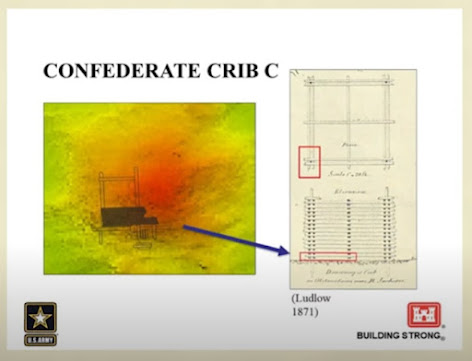
Planks at the bottom of this obstruction are shown in dark area (USACE)
Over the years, underwater archaeologists have found that amid all the junk littering the bottom of the Savannah River is a trove of treasure.

Such was the case in 2021, when they spotted 15 Revolutionary War-era cannons and explored obstructions placed in the river 85 years later during the Civil War.

Contractors working for the US Army Corps of Engineers surveyed and dived two Confederate “cribs” -- or tall wooden boxes filled mostly with brick – that discouraged the approach of Union ships to the port city. Forces towed the wooden obstructions, believed to be 40 feet by 40 feet, and put them in place near Fort Jackson and the ironclad CSS Georgia, a floating battery that was part of the Savannah River defenses.

Archaeologists last month provided details of the Revolutionary War and Civil War artifacts during a public event at the Savannah History Museum. Three cannons were recovered last year, while the other 12 were pulled up in January.

The Army Corps’ Savannah district funded the hard-hat dives as part of the busy Georgia port’s channel deepening.


About a half dozen severely degraded cribs are on the South Carolina side of the river. Crews focused on what are called cribs C and D.

Commonwealth Heritage Group divers found some planks used to build Crib C.

“On top of the planks it was tons of bricks that we dug through, and then underneath the planks it was sterile sand and Miocene clay, which is the base of the river,” said archaeologist Stephen James. “That basically told us we were at the bottom of the crib.”

They found an intact corner at Crib D. While C won’t be impacted by the deepening, the remnants of D were documented and then largely destroyed by dredging, James said. “There is very little of the cribs left.”

The Confederacy used a wide array of weapons and obstructions to deter advances on Savannah from the sea. Besides forts and warships, wooden cribs, pile dams, torpedoes (mines), snags, logs and shipwrecks were employed.

Divers located an intact corner on this obstruction (USACE)
Time and dredging have taken their toll on the cribs over the past 160 years. But that’s not all.

After the Civil War ended in 1865, the city wanted to reopen the port and it hired salvage companies to remove river obstructions, including the cribs and pieces of the scuttled CSS Georgia. 

“They had their own demolition. Surprisingly, they had divers back then, had pretty heavy-duty machinery to pull that stuff down,” said Will Wilson of Commonwealth Heritage Group. Of course, not all of the objects were removed or recovered in the 19th century.
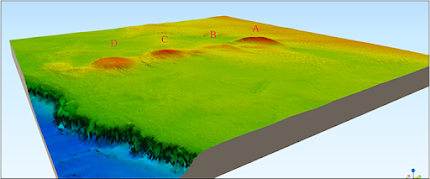
Topographic view of four cribs from survey. Dredged channel is in blue (USACE)
The Corps is in charge of the ongoing deepening of the Savannah harbor and the dives are part of an investigation of historical resources that have been or could be affected.

Officials referred to period maps and descriptions from Union Corps of Engineers Capt. William Ludlow and a Capt. Boutelle for information on the cribs.

The CSS Georgia is on the National Register of Historic Places and the cribs are eligible for inclusion, officials say.

Monday, January 24, 2022

While in poor shape, four Civil War river obstructions -- or cribs -- in Savannah remain intact in places, Corps officials say

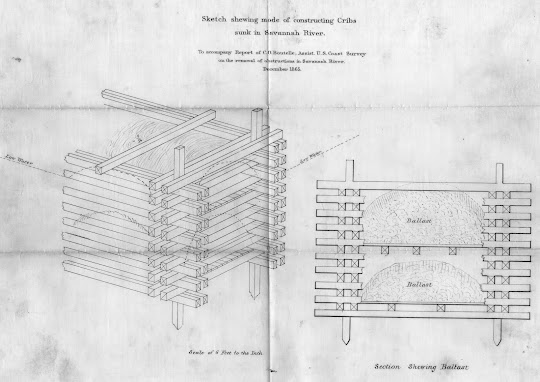
Design of cribs placed in the Savannah River -- click to enlarge (National Archives)
Divers in Savannah, Ga., recently spotted intact portions of two cribs – or tall wooden boxes filled mostly with brick – that were dropped into the river during the Civil War to discourage the approach of Union ships to the port city.

Confederate forces towed the wooden obstructions, believed to be about 40 feet by 40 feet, and put them in place near Fort Jackson and the ironclad CSS Georgia, a floating battery that was part of the Savannah River defenses.

“They were severely degraded. They were not in great shape,” U.S. Army Corps of Engineers Savannah District archaeologist Andrea Farmer said of the condition of what are termed Crib C and Crib D. But a few portions, including the corner of one crib, had remained mostly intact.


Contract divers using sonar last fall located four of the cribs on the South Carolina side of the river. Cribs A and B were previously explored and the dives in November and December concentrated mostly on C and D, Farmer told the Picket earlier this month.

The Corps is in charge of the ongoing deepening of the Savannah harbor and the dives are part of an investigation of historical resources that have been or could be affected. The Corps recently concluded the recovery of artifacts from the CSS Georgia, which was scuttled by its crew in December 1864 shortly before Federal forces took Savannah and was in the current shipping channel.

While tourists to the popular coastal destination gaze upon the supertankers coming from or to the Atlantic Ocean, they likely have no idea what lies beneath the surface: Remnants of vessels, pieces of Native American pottery that washed down stream, and other items deposited over the centuries.

View of cribs from multibeam survey. Dredged channel is in blue (USACE)
Divers in the past year have located numerous cannons in the river in this area, likely from the Revolutionary War era. They are trying to determine how they came to be in the water.

The Confederacy used a wide array of weapons and obstructions to deter advances on Savannah from the sea. Besides forts and warships, wooden cribs, pile dams, torpedoes (mines), snags, logs and shipwrecks were employed.

Unlike the cannons, the four cribs will be left in place. They are not expected to be directly affected by future channel deepening because they are on the northern edge of the project, Farmer said.

Corps officials referred to period maps and descriptions from Union Corps of Engineers Capt. William Ludlow and Capt. Charles Boutelle for information on the cribs. Boutelle, working for the U.S. Coast Survey, made a December 1865 survey of obstructions in the Savannah River.

Topographic view of four cribs from survey. Dredged channel is in blue (USACE)
“It is assumed, based on the lack wood cribbing left, that only the base or lowest portion of the cribs remain, and the extant portions differ by crib,” Farmer wrote in an email. “It looks like normal crib construction. There is nothing unusual or special about the cribs.”

She said the cribs initially would have been at or near the surface but years of deterioration have reduced them mostly to debris a few feet about the river bottom.

Crib A may be the most well preserved, as it seems to have the greatest amount of material based on the current height of the obstruction. Cribs C and D contain more material than Crib B, both in terms of extant structure and rubble/brick fill based on the areas that have been excavated.”

The Corps said it hopes to provide photos of the dives soon.

Examination of harbor from the city to Elba Island (USACE)