Showing posts with label captured. Show all posts

Monday, December 4, 2023

Was this wagon wheel shattered in explosion as Sherman's troops took S.C. capital? Experts hope to learn more when they conserve hundreds of artifacts

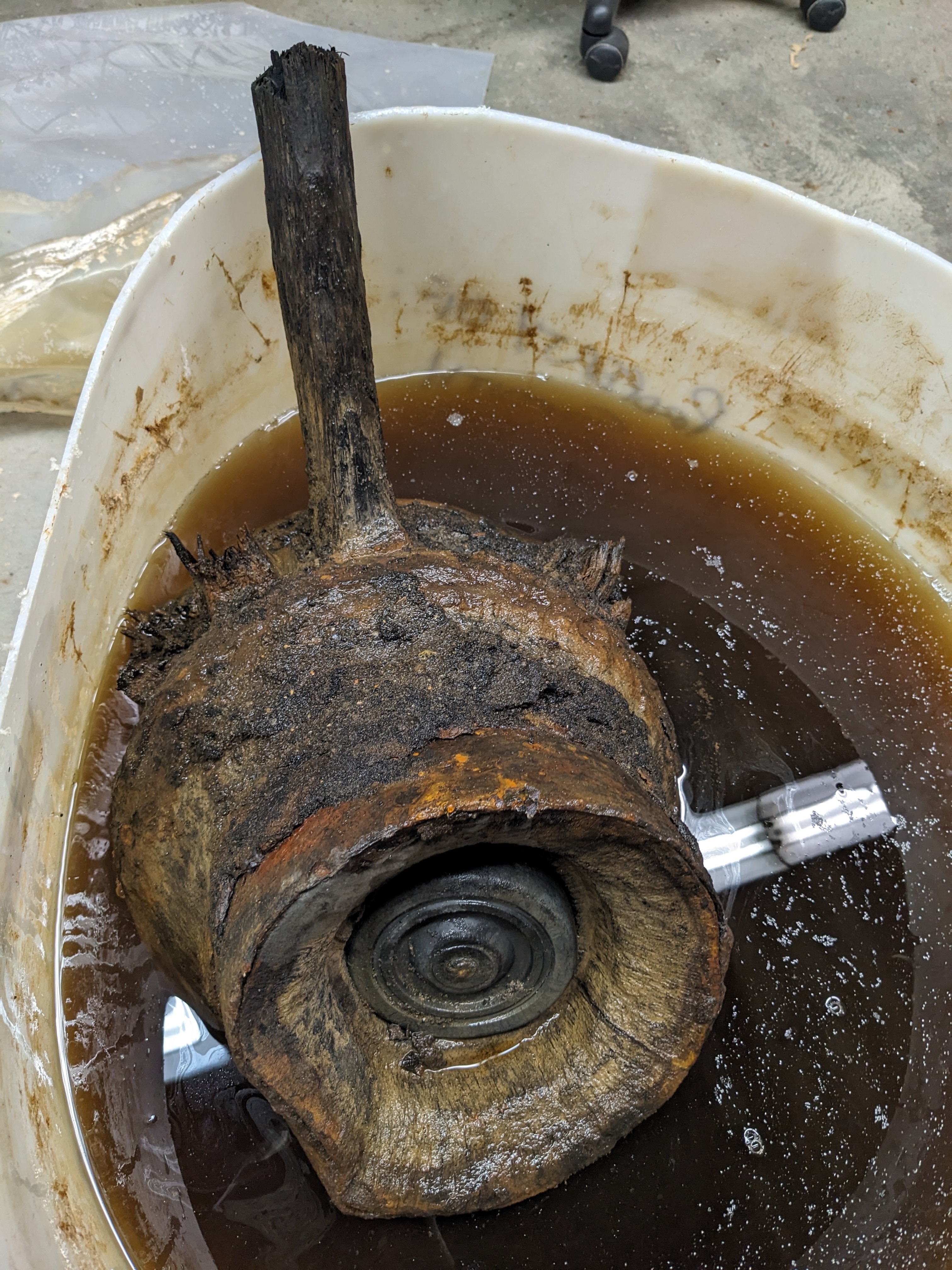
The wheel hub recovered from the Congaree River (Courtesy of Sean Norris, TRC Companies)
A metal detector first noticed the round object buried in the bed of the Congaree River in Columbia, S.C. Archaeologists surmised it was a just another rubber tire -- one of many found during an extensive river cleanup.

After all, some 2.5 tons of debris – including trash, tires and scrap metal – were carted off during the removal of toxic, century-old coal tar along the shoreline, Dominion Energy announced last month.

Crews decided to dig out the object by hand, expecting an item made well past the Civil War-era.

“Once it was exposed, we knew we had something much more interesting than that,” said Sean Norris, program archaeologist for TRC Companies, a subcontractor for Dominion Energy.

The item was the shattered hub of a wagon wheel, and it’s possible it was damaged in an explosion when Union troops who took the city in February 1865 dumped tons of captured Confederate ordnance into the Congaree. (Photo below, courtesy of South Carolina Confederate Relic Room and Military Museum)
The artifact was found an area where numerous rounds of Civil War ammunition were recovered.

“We had a few folks from the (South Carolina Confederate Relic Room and Military Museum) take a preliminary look and our consensus was that this wheel fit the time frame for a Civil War-era wagon. The location in association with other artifacts of that time period lead us to believe that this wheel was deposited around the same time the other ordnance was dumped in the river,” Norris said in an email.

“The official records mention the explosion and the destruction of a wagon and a team of mules in a couple correspondences. It seems possible that what was left of the wagon after it was destroyed was thrown in the river along with everything else that was being dumped. There would be no specific reason for the wagon parts to be discarded elsewhere.”

Wartime reports indicated three Federal soldiers, including Capt. Williamson M. Davis, died in the explosion. Another 20 or so troops were injured.

The wheel, which shows signs of charring, currently rests in a plastic vat at the Relic Room in Columbia as it awaits conservation.

The museum typically has it covered with a wet towel and plastic bag to keep in moisture. Exposed wood -- if left to dry before conservation -- can disintegrate, experts said.

Archaeologists recovered about 500 Civil War artifacts during the project. Most of those will go to the Relic Room after treatment, which could take up to 18 months, said Chelsea Sigourney, curator of exhibits and collections.

Exhibit on burning of Columbia (Courtesy South Carolina Confederate Relic Room and Military Museum)
“Some artifacts will be stabilized in distilled water and later go through electrolysis” at the South Carolina Institute for Archaeology and Anthropology (SCIAA), Sigourney told the Picket.

“I’d like to be able to have a small exhibit about what is collected from the dig, but that is a project for the future. I wouldn’t even attempt to set a date for that until we hear conservation is complete,” the curator said.

The Relic Room has exhibits that mention Sherman’s occupation and the burning of the capital.

Remnants of Rebel sword, canister and iron spike points (James Legg, SCIAA)
James Legg, public archaeologist for SCIAA, said the agency will handle the bulk of the conservation work. 

“I think I currently have about 200 Civil War artifacts and an assortment of other metal artifacts. This is essentially what the EOD (explosive ordnance disposal) teams recovered during excavation, and it was convenient to bring it on over here to SCIAA in anticipation of the TRC contract,” Legg told the Picket.

“TRC still has a collection of similar or somewhat smaller size that was recovered during the off-site screening process. They may conserve some or all of that group,” he said.

Numerous cannonballs were recovered (James Legg, SCIAA)
The Civil War-related artifacts found during the project include some 6-pounder, 12-pounder and 10-inch projectiles, a large number of canister and grape shot balls, canister plates, small arms ammunition and a Confederate sword blade. Only the lead bullets will not require conservation

“The entire collection (or the half or more that I do) will take about a year to complete, once we begin. I will use electrolytic reduction, manual cleaning and other neutralization techniques before sealing each piece,” Legg wrote in an email.

He said it was unclear who would do the work on the wagon wheel. 

Allen Roberson, executive director of the Relic Room, said he has submitted a proposal for funding of an exhibit room on the discoveries.

Details of Sherman's campaign (Courtesy South Carolina Confederate Relic Room and Military Museum)
“Some of that dig is fascinating,” Roberson told the Carolina News and Reporter. “I think the archaeological recovery is almost as insane as what you pull out of the river.”

He told the news outlet that the exhibit may open in a year and a half to two years.

Norris said most of the river artifacts are at a TRC Companies laboratory, awaiting conservation and curation. He expects analysis of the wheel to begin in the new year.

Archaeologists did not find any other wheels, metal hubs or large pieces of wood near the wheel.

Wednesday, April 7, 2021

No longer kept in a drawer: Descendants donate Medal of Honor to Massachusetts town where hero recipient was laid to rest

Cecelia Miles, Col. Perry, veterans agent Donald Hirschy (Town of Dighton)
Cecelia Miles and her siblings came to realize that a Medal of Honor awarded to their great-grandfather for his actions during the Civil War shouldn’t be just a family heirloom, tucked away in a drawer.

Nearly a decade after Pvt. Frederick C. Anderson’s grave was found in Dighton, Mass., Miles recently drove from the Sioux Falls, S.D., area to the cemetery to present it to the town.

Dighton officials on that same day renamed an Elm Street span the Pvt. Frederick C. Anderson Memorial Bridge.

Anderson, a member of the 18th Massachusetts Volunteer Infantry, received the honor for capturing the flag and color bearer of the 27th South Carolina during an August 1864 battle in Virginia.

Miles, a university associate professor, told the Picket she knew about the medal and Anderson while growing up in Florida, but the subject was not discussed much.

Anderson who died in 1882 at age 40 in Providence, R.I., was believed to be buried in Somerset, Mass. But Charles Mogayzel, a Korean War veteran and advocate for Medal of Honor recipients, in fall 2011 discovered the grave in Dighton. It had Anderson’s name but did have a Medal of Honor designation.

The late Mogayzel’s niece contacted Miles, who was putting together some information on her ancestor, through Ancestry.com.

“I wrote her back saying you may not believe this, but I actually have the medal. They were completely gobsmacked,” said Miles, who traveled to Dighton in 2011 for a ceremony at which a Medal of Honor marker was installed.

According to a Dighton proclamation, Anderson was born in Boston but was orphaned by age 8. At 14, he was relocated by the Orphan Train, a welfare program, to Raynham, Mass., and was put to work on a farm.

Military, veterans officials at renamed bridge (Town of Dighton)
He enlisted shortly after the Civil War began and participated in several battles with the 18th Massachusetts. According to the Taunton Gazette, regimental records showed that Anderson was about 5-foot-3 and had blue eyes and sandy hair.

The soldier earned the Medal of Honor for capturing the colors on Aug. 21, 1864, at the Battle of Globe Tavern, also known as the Second Battle of Weldon Railroad. The taking of regimental flags often disrupted communication among enemy troops.

The battle was a significant victory for the Union, netting a Confederate supply line and a portion of a railroad near Petersburg. Anderson received the medal from Maj. Gen. George Meade a month later.

Anderson was discharged at war’s end and settled in Somerset, where he and his wife raised three children, one of whom, Cecelia Ann, was Miles’ grandmother.

Miles, who traveled to Massachusetts with her husband, was presented a U.S. flag during the March 30 ceremony at the Dighton Community Church cemetery.

Col. Perry presents flag to Cecelia Miles (Town of Dighton)
“So many people who have never been in the armed forces don’t have the appreciation for what it takes to be awarded any decoration for military service,” Air Force Col. Bob Perry said, according to a press release from the town. “The Medal of Honor requires extraordinary dedication, valor and courage while under fire. Pvt. Anderson clearly demonstrated all of those traits.”

Officials said the medal will most likely be displayed in a glass case at Town Hall after the building receives some upgrades.

Miles said she is pleased the public will be able to see the medal and learn more about her great-grandfather, a Civil War hero. The ceremony, she said, was emotional.

“Everyone there was so pleased and proud. It just connected me to a much longer line of history and meaning than I had understood before.”