The conserved socks in Montgomery (Alabama Archives) and an example of the First National Flag (Wikipedia)
It wasn’t
enough for Alabama cavalry trooper Henry Clay Hames to have a simple pair of white
socks to keep his feet warm and dry. Loved ones wanted to be sure he delivered
a message, even if it was normally covered by his boots.
High up on
each sock, below the ribbing, were stitched versions of the first national flag
of the Confederacy, commonly known as the “Stars and Bars.”
The Alabama Department of Archives and History in Montgomery has had the distinctive hosiery
for generations. Hames’ daughter, Mary, donated them after his death in 1917. (At right, before conservation)
But it doesn’t
appear they were ever displayed -- until now.
“I
don’t think past curators saw the significance,” said Ryan Blocker, a curator
in the museum collection of the Alabama Archives.
Blocker
recalls when a comrade sent her a photo asking her to identify the small flags.
The two red bars are vibrant, but the blue canton and white stars are largely
indiscernible.
She recalls thinking, “’Oh God, that is a first national flag. These are patriotic socks made by family and sent to him.’”
It’s unclear who darned the socks or when Hames – who may have been a courier --
received the items. (Photo above and at left from Alabama Archives)
While they reflect defiance, the socks don’t hold a candle to
known examples of socks made for Union soldiers that feature the U.S. flag up
high and Confederate flags on the heel. You know, being trampled. You can see
examples here and here.
The socks -- made of either wool or cotton -- went on display
last month after the Museum of Alabama reopened after months of renovation and
upgrades.
The pair is in a home-front exhibit case in the “Alabama Voices”
gallery, which features numerous Civil War artifacts.
(I will write a post soon
about technology upgrades to the gallery. For now, let me just say visitors can touch what is called a digital label to pore over closeup photos and information about artifacts.)
The agency in early November also opened a new gallery entitled “Alabama
Military Stories," which covers multiple wars.
Blocker said Hames’ socks were recently conserved. “They are
such a fascinating piece.”
Although the blue canton has faded, faint traces survive, she
said. “As
for the stars, it looks like they were embroidered onto the canton area. Some
of them only have a little of the thread left.”
The
curator sent me a photo (right) showing where she tried to pinpoint the remaining
stars, which are in a circle. “Could there have been more stars? Possibly. When
these rotate off display, I hope to have (textiles expcert) Terre Hood
Biederman examine them in person and give us a breakdown of the construction.”
Hames grew up in Troup County, Ga., on the Alabama border.
While he is believed to have enlisted as a private in 1863, I have not learned where that
occurred (perhaps Virginia) or why he joined up with Alabama units.
Hames lived in West Point, Ga., before and after the war. His
first wife, Fannie (or Fanny), and his daughter, Mary, died in 1882, He remarried in 1893
to Sarah “Sallie” Samples and they moved to Montgomery.
He died there in 1917,
age 72, and is buried in Greenwood Cemetery. (Photo left, courtesy Bham85, Findagrave)
Some records on Hames are puzzling, according to Blocker. His
pension application lists the 9th Mississippi Cavalry but Fold3 and
other records do not show him serving in the regiment.
Records indicate Moses’ Squadron was supposed to join the 9th
Mississippi Cavalry, but the order didn’t come to fruition because of the end
of the Civil War. The soldier was 20 years old.
“It had been carried out
to some extent, I believe, for Hames to have listed the 9th as his company of
service in his pension application,” Blocker said in an email.
The gravesite contains a granite marker and memorial plaque (Historic Blakeley State Park)
Whether resting under cornfields, dense woods or are ensconced in marshes and swamps, the
remains of young men who gave all dot battlefields across the South,
their names lost to history.
Many Civil
War sites have markers for the unknown buried in mass graves or
cemeteries. Historic Blakeley State Park near
Mobile, Ala., on Saturday will dedicate a memorial that speaks to those who
have never been found, or – as in this unusual case – only a partial remain has
been discovered.
The park on
Tuesday buried a forearm bone that
likely belonged to a Union soldier and it installed a granite marker with the
words "Unknown Soldier, Civil War." Several feet away is a new metal
plaque that reads:
“Here lie
the remains of an unknown soldier who died during the siege of Spanish Fort, about
four miles south of Blakeley, in 1865. This stone is a memorial to all of those
unidentified soldiers, Federal and Confederate, who perished during the Campaign for Mobile and
yet lie in unmarked graves.”
Note and display case that contain the forearm bone (Historic Blakeley State Park)
The
brief ceremony, which will include a prayer by park director Mike Bunn, is
scheduled for 1:30 p.m. CT Saturday during Veterans Day events at the site
along the Tensaw and Apalachee rivers. Cannon will fire as a salute to the fallen.
The
relic was sent to the park earlier this year after a Gettysburg, Pa., shop
bought a collection of artifacts and discovered the partial remains in the
groupings.
The
arm bone is believed to belong to a soldier who was part of the fight for
Spanish Fort, just below the Confederacy’s Fort Blakeley. Both sites were captured in
April 1865.
Bunn (right) said he believes the forearm piece was found with other artifacts by a relic
hunter in or near a Federal trench in Spanish Fort. The park director said he
does not know the finder’s name but believes he died several years ago. “He had
a pretty big collection.” The items were sold by family members to the
Gettysburg business.
With
the bone, which was wrapped in bubble wrap, was a note: “Found in Extreme
Northern end of Union Army lines at Spanish Fort (near Basin Batteries).
December, 1973.”
A water artillery battery near the end of the Yankee line was in swampy
ground at a body of water called Bay Minette. “All of that stuff is gone,”
Bunn said of this part of the Spanish Fort siege line.
There’s
plenty of mystery about the bone remaining, despite a story that appears to
have a good ending.
Robert Knox Sneden map showing battle zones in and around Mobile, Ala. (Library of Congress)
Relic hunters frequently pored over the area, which is on private land,
as a subdivision was built in stages.“I can’t confirm all the details, but I don’t believe the
section this came from was developed at the time. Probably dug as they were
clearing land for it, though,” Bunn added.
It’s
possible the bone was part of a mass grave. Bunn doesn’t know whether the rest
of the skeleton was left intact, scattered by animals or taken by other
collectors.
Relic hunters today are more likely to report human
remains to authorities or leave them in place, officials said.
Officials see
no need for DNA testing of the remains at this point.
A long row of Rebel fortifications at Fort Blakely (Civil War Picket photo)
Bunn wanted to place the grave near a main park road and impressive
remnants of Confederate defenses.
“We know not every person in the (Mobile) campaign has been found and
marked,” Bunn told the Picket of his aim to honor them.
Other events
Saturday include firearms demonstrations, a guided river cruise highlighting
the fighting at Fort Blakeley, Spanish Fort and elsewhere in the Mobile area
and historian and author Kent Masterson Brown’s lecture on Meade at Gettysburg.
That talk will be at the fort’s Redoubt 6, not far from the new grave. Details can be found here. The park charges admission.
Note and display case holding the forearm bone, field that will hold grave (Historic Blakeley State Park) and Robert Knox Sneden map showing battle zones in and around Mobile (Library of Congress)
Early this
year, employees at a shop in Gettysburg pored through relics it purchased from
the family of a collector. Normally, such merchants in the Pennsylvania town
synonymous with Civil War collectibles might receive display cases containing a
belt buckle, bullets, unit badges or something rarer that turned up on a
battlefield.
But this one
was different, very different.
Tucked inside
a box protected by bubble wrap was a handwritten scrap of paper, reading: “Found
in Extreme Northern end of Union Army lines at Spanish Fort (near Basin
Batteries). December, 1973.”
The note
refers to the Federal siege and capture of Spanish Fort in April 1865. Back-to-back victories at Spanish Fort and Fort Blakeley led to the surrender of Mobile, Ala., a
vital Confederate port.
With the note
and in the box was a human bone -- part of a forearm.
The
Gettysburg shop, of course, had no intension of putting the relic up for sale.
What to do?
In this case, you contact a
subject matter expert for advice. If you live in southern Pennsylvania, that expert is Greg
Goodell, longtime museum curator at Gettysburg National Military Park.
After being contacted, Goodell acted as a middle man to ensure the bone would find a home and
be laid to rest in a respectful way.
The curator
contacted sites in the Mobile area, eventually reaching Mike Bunn, director of
Historic Blakeley State Park, home to the Fort Blakeley battlefield. Bunn
stepped forward and said he would bury the bone in a field and place a granite
marker that reads “Unknown Soldier, Civil War.” (design at left)
Next to the
headstone will be an engraved interpretive plaque.
The
Gettysburg business sent the item to Alabama a couple months ago.
Bunn wants to
place the grave near a main park road and impressive remnants of Confederate defenses.
He anticipates a Veterans Day ceremony to dedicate the memorial.
“We know not
every person in the (Mobile) campaign has been found and marked,” Bunn told the Picket
of his aim to honor them.
There’s
plenty of mystery about the bone remaining, despite a story that appears to have a good ending.
The arm bone is believed to belong to a soldier, mostly likely Federal. What happened to the rest of him? No one knows. Officials see no need for DNA
testing of the remain at this point.
I asked
Gettysburg communications specialist Jason Martz how often such a thing has
happened at the federal park.
“In plus-20
years, it has happened fewer than five times,” Martz replied.
Federal siege paid off in two Alabama battles
Although Union Adm. David
Farragut had bottled up Mobile in summer 1864, the city remained in Confederate
hands.
Union troops, a third of which were U.S. Colored Troops
regiments, laid siege of Blakeley for about a week. A similar operation against
outnumbered Confederates took place at Spanish Fort, just to the south.
The forces under Federal Maj. Gen. Edward Canby (right) first surrounded
Spanish Fort on March 27, 1865. Most of the Confederate troops escaped to
Mobile or Blakeley and the fort fell on April 8.
Two Union commands
combined to storm Fort Blakeley the following day, unaware of Gen. Robert E.
Lee’s surrender in Virginia. They carried the field.
Confederates evacuated Mobile and the mayor surrendered the city on
April 12.
The Union lines at Spanish Fort were mostly to the east and
north of the Rebel defenses.
Most of the battlefield lies within Spanish Fort Estates, a
large residential community dating to the late 1950s and early 1960s. While
most of the fortifications are gone, there are several discernible lines of
breastworks running through front yards.
Bunn said he believes the forearm bone was found by a relic
hunter in or near a Federal trench at Spanish Fort with other artifacts. The
park director (below) said he does not know the finder’s name but believes he died
several years ago. “He had a pretty big collection.”
A water artillery battery near the end of the Yankee line was
in swampy ground at a body of water called Bay Minette. “All of that stuff is gone,” Bunn said
of this part of the siege line.
Relic hunters frequently pored over the area, which is on
private land, as the subdivision was built in stages.
The paper indicates the bone discovery in December 1973. “I can’t confirm all the details, but I don’t believe the
section this came from was developed at the time. Probably dug as they were
clearing land for it, though,” Bunn added.
It’s possible the bone was part of a mass
grave. Bunn doesn’t know whether the rest of the skeleton was left intact,
scattered by animals or taken by other collectors.
Relic hunters today are more likely to report
human remains or leave them in place, officials said. “At least they did not chuck it. I am
sure others have,” Bunn told the Picket of this bone.
Bunn said the
exact circumstances regarding the bone and its precise location are impossible
at this point to pin down.
Siege operations at Spanish Fort, note map is not displayed north-south (Library of Congress)
“If it was a
burial, it probably would have been a shallow grave.” Circumstantial evidence
points to a Federal soldier, though the U.S. military after the war worked
diligently to relocate such remains to new national cemeteries.
“There could
be a chance he was a Confederate,” said Bunn.
Shop knew the park service would have an answer
Martz, with
Gettysburg National Military Park, said the local business – which he and Bunn
did not identify -- had a conversation with Goodell (below) after the discovery.
“The shop was
basically in a position to be a good Samaritan and didn’t know what to do with”
the bone, Martz told the Picket.
“When someone
in the position of the local shop doesn’t know where to start, they start with
an organization like the National Park Service. It is easily one of the most
recognizable and trusted organizations in the country come to,” he said.
In this case,
there was no need to go to law enforcement.
Martz
described the man who had the bone as an avid Civil War artifacts/relics
collector. “When he passes, the family doesn’t know what to do with a
collection. They find a reputable shop.”
Then the
shop’s inventory process begins.
“They start
to go through it piece by piece. ‘Oh wait a minute.’ There is one extra thing
they are not comfortable with.”
Nothing in
this case has any connection with NAGPRA “as far as we know,” said Martz.
The takeaway
is the Gettysburg shop did the best thing by reaching out to Goodell so the
bone could be sent to the best place – Alabama, said the park spokesman.
Remains not eligible for state veterans cemetery
Bunn turned
to the Historic Blakely Foundation and a GoFund me campaign to raise money for
the headstone and plaque. So far, $350 of the estimated $600 expense has been
raised.
The new grave
will be in a field that holds a cemetery that dates to 1819. It will be in a
separate area and will be viewable from the road. Bunn expects a ceremony in
November, with a gun salute and presence of a U.S. flag. “It is a long overdue,
proper respect,” he added.
The state cemetery contains about 5,000 graves (Alabama Dept. of Veterans Affairs)
The park
director consulted with Joseph Buschell, director at the nearby Alabama State Veterans Memorial Cemetery in Spanish Fort. Alabama operates the location because the U.S. cemetery in Mobile is closed to new interments
and the closest national cemeteries are in Biloxi, Ms., and at Barrancas near Pensacola,
Fla., each more than 70 miles away.
The Spanish Fort cemetery would not have been able to accept the
remains without a name and proof of military service, including an honorable
discharge, Buschell said.
On behalf of
Historic Blakeley, Buschell contacted a company in Pensacola to make a
government-grade marker. “It is assumed to be a soldier.”
Regarding
Bunn, Buschell told the Picket: “I think what he is going to do with this is
pretty noble.”
Over this
blog’s 15 years, I’ve written about myriad items belonging to Civil War
soldiers and sailors – from swords, hats and frock coats to journals, letters
and Bibles.
While each
resonated in its own way, one item especially stands outto me. It’s the homespun,
brown-and-white checked shirt made for a skinny teen boy from Demopolis,
Alabama.
The time and care that went into making it showed that Henry Winston
Reese Jr. was dearly loved by his prosperous family. (Click photo to enlarge)
I researched Reese
for a February 2016 post. I learned the University of Alabama student joined
the Confederate army without his parents’ permission and died, barely 17, from
wounds received two months earlier at the Battle of Champion Hill (Mississippi, May 1863).
Living
historian and weaver Terre Hood
Biederman and Ryan M. Blocker, a curator in the museum collection of the
Alabama Archives, were among those who spoke with me about Reese and the
shirt, a homemade product demonstrating Southern resolve.
I’ve since heard from a couple descendants, including one who said her family tries to keep the names Reese and Winston going.
The garment, along with Reese’s boots (below, both photos courtesy Alabama Archives), remain on display at
the Alabama Voices gallery at the Museum of Alabama in Montgomery. A pouch,
also donated by the family to the Alabama Department of Archives and History in
1978, has been kept in storage.
Alabama Voices cover’s the breadth of the state’s history,
including the Civil War, industrialization, the world wars and civil rights
(more about that later).
It’s a near certainty that Reese was not wearing the shirt -- which is likely made from cotton, rather than wool -- when he was mortally wounded while fighting with the 31st Alabama Infantry. But it somehow survived. Curators don’t know whether the shirt was made by a family member or an enslaved person.
Reese's father, a physician, had more than 100 slaves,
according to the 1850 U.S. Census, and his growing family lived in a Gothic
Revival home called Forest Hill on the outskirts of Demopolis.
Winston Reese was the first of a half dozen children born to the doctor and his wife, Julia, who died a year after the Civil War ended.
I recently reached out to Blocker to ask whether she has learned anything more about Reese or his family. She has not. (Incidentally, I have been unable to obtain an image of Reese.)
I asked
Blocker about the significance of artifacts like the shirt.
“They help us understand and humanize, if you
will, the people who lived long ago. A mother makes a shirt for her oldest
child who is attending school away from home,” she replied in a recent email.
“Her son, an impulsive and idealistic teenager
… goes against the wishes of his parents and joins the army," said Blocker. "Stories like this
are played out time and time again, even in modern times. With this shirt, we
get a glimpse of the lives of those who came before. In that glimpse, we
realize that we are not that different.”
The shirt was likely made from cotton (Courtesy Terre Hood Biederman)
The shirt features rounded pockets, a French cut and purple and white glass buttons. Untold hours went into picking, washing and carding and spinning the dyed fiber. Then came the arduous tasks of weaving the fabric on a large loom and hand sewing the pieces.
While similar battle shirts worn by soldiers were commonly made of wool, this shirt
reflects the concept of homespun as a patriotic statement, asserting that the
South could stand alone in producing its needs, Biederman told me this week.
“It is fashionably cut, made for a teen living
in the comfort of a college dormitory, not a soldier sleeping rough, and thus
is likely made of cotton,” she wrote in an email. “The shirt has been on
exhibit since this question was raised, and not available for analysis.”
Artifacts belonged to other Confederate soldiers
The gallery’s
Civil War section contains numerous artifacts. Blocker said the story of an Alabama-made sword belonging to 1st Sgt. Socrates Spigener is among those especially compelling. The
soldier was born in 1844 in Coosa County and joined Hilliard’s Legion, which became
the 59th Alabama
Spigener was
killed in Virginia days before the end of the Civil War.
“His sword
was picked up from the battlefield and sent home to the family,” said Blocker. (Photos: Alabama Archives)
The family
wrote a tribute and pasted it to the scabbard (click photo above to read): "This was the
sword of Socrates Spigener, the baby child of Joel and Sylvia Spigener. He was
Lieut. in the Confederate War of 1862. He fought bravely and was killed in
battle near Petersburg, about the 6th of April 1865.”
Blocker said
the archives also has a rare red artillery kepi and its original oil cloth
cover.
The cap belonged
to 1st Lt. Maynard Hassell, State Artillery Company A, Garrity’s Battery. Hassell was born in 1831 in New York and moved to Lowndes County,
Ala., at a young age. He enlisted in 1861.
The officer was killed by a cannonball at Lovejoy Station in Georgia in summer 1864. He was
awarded the Confederate Roll of Honor for his “courage and good conduct on the
field of battle.”
Hassell's kepi and oil cloth cover (Alabama Archives)
The lieutenant's personal belongings were sent to the family after Hassell was killed in battle, Blocker said.
“The kepi was
sent to us, along with a small journal, in 2013 as we were completing work on
the Voices gallery,” said Blocker. “The gentleman that donated the material was
a descendant of Hassell and wanted to make sure the material was returned to
Alabama.”
The journal
is not a daily notation of his personal experiences; rather, it has extensive
notes about payments to soldiers, battles fought and munitions used during the
battles.
The struggle for civil rights played out in Alabama
While
Hassell, Reese and Spigener fought to keep the status quo of antebellum
society, the Alabama Voices gallery includes artifacts that tell the story of
the long struggle for equal rights among Black citizens.
Blocker said
one of her favorite such items is a collection box from Hall Street Baptist Church
in Montgomery. Founded in 1903, the church played an integral role in the 1955-56
Montgomery Bus Boycott by purchasing a station wagon to transport members to
and from work and other appointments.
Another
standout is a chair and vanity stool from the Selma home of Jean Jackson and
her husband, D. Sullivan Jackson, a dentist. (Collection box, chair and stool left, Alabama Archives)
“Dr. Martin
Luther King stayed with the Jacksons and made their home his headquarters during
his visits to Selma. Dr. King and Ralph Abernathy, used the chair and vanity to
put on their shoes for the march to Montgomery. They were photographed seated
in the Jackson’s living room in the Ebony magazine displayed on the stool,”
said Blocker.
Other items in the gallery include a Billy club used by a Birmingham police officer, a Ku Klux Klan robe,
shoes worn by Gov. George Wallace when he was shot in 1972 during his
presidential campaignand photographs of
notable Alabamians, including entertainer Lionel Richie and professional athlete Bo Jackson.
The
Alabama Voices Gallery is located on the second floor of the Alabama Department
of Archives and History building in downtown Montgomery, 624 Washington
Ave. The museum is open open Monday through Saturday, 8:30 a.m. to 4:30 p.m. CT. Here is a schedule of gallery closures for renovations.
Conceptual drawing of the interior, subject to changes (AtkinsRéalis Group Inc.)
The new home of the National
Museum of the United States Navy – which has some of the Civil War’s
most-treasured naval artifacts – will feature a conference center, retail space
and enhanced public access, officials announced in Washington, D.C., on Friday.
Secretary of the Navy Carlos Del Toro and
others gathered at the planned campus at Tingey Street and M Street just outside the Washington Navy Yard.
Speakers said the museum will go from a traditional site to a more engaging
campus, all the while ensuring the story of sailors' courage and sacrifice will continue to be told.
“It is intended to be a self-funded
tourist destination that aims to intrigue, inform and inspire generations of
visitors,” the Naval History and Heritage Command said in a news release.
The news release did not indicate when the new site might open. The Picket reached out the Navy and the foundation about any plans to display Civil War artifacts, and they said any firm plans for their future have not been made.
One of several ship's models in the current Building 76 (U.S. Navy photo)
Visitors have to provide ID and have limited access to the area because it is on the secure Washington Navy Yard. The new location will be outside the yard, meaning access will not be restrictive.
The main naval battles explored are New
Orleans, Mobile Bay, Hampton Roads and the engagement between USS Kearsarge and Confederate commerce raider Alabama near Cherbourg, France.
Numerous items related to that clash are on display, including the shattered sternpost of the Kearsarge (below), a ship’s bell and a toilet.
Most of the objects from Alabamathat
were considered underwater archaeological recovery pieces have been removed
from display, says Wesley Schwenk, registrar for the museum in Washington. They
are retained in storage for preservation purposes.
Items that have been on display in “Securing the Seas”
include a watch bell from USS Merrimack, a Confederate frame torpedo, mustard
and pepper bottles from USS Monitor, ship models, a sword belonging to Rear
Adm. David D. Farragut and a 12-pounder howitzer.
A drawing on the foundation’s website appears to show an
historic Navy building within the new campus.
“The new museum will also
become the cornerstone of a Navy Campus based on a sustainable business model
designed for long-term durability of the project,” the foundation says. “In
addition to freeing up critically needed space at Washington Navy Yard, the
mixed-use Campus will create opportunities for vitally needed revenue streams
to support museum programs.”
The website touts the city’s “hottest
neighborhood” and 22 million annual visitors to the District of Columbia.
“The
new National Museum of the U.S. Navy will provide a dramatically improved
opportunity for the American public to be inspired by the long history of valor
and sacrifice of American sailors in the defense of our country, and to learn
the vital importance of seapower to our way of life,” said NHHC director Samuel
J. Cox in the news release.
Officials with the foundation cautioned the design of the museum may look very different from conceptual plans on its website.
Kristina Higgins, a public affairs officer for the Navy History and Heritage Command, said submitted design concepts are being considered.
Conceptual drawing of the interior, subject to change (AtkinsRéalis Group Inc.)
“The exhibits in the new museum will be completely researched, designed and installed from a blank slate, drawing upon community input and the very latest scholarship and interpretations in the field of U.S. Naval History,” Higgins said in an email. “To the extent that current exhibits support the interpretations designed for the new building, they may be moved.”
Officials said the museum will include items from the full breadth of naval history.
“Not every
item currently on exhibit in the NMUSN will be moved on to the floor of the new
museum as new galleries are designed” according to Higgins. “Some pieces may
not fit with the new story being told, and therefore they will be placed in our
off-exhibit collection to be used at a later date.”
Building 76
will be used as office space, conservation and storage of off-exhibit items in
the short term. Long-term plans will be dependent on the needs of the
Washington Navy Yard, officials said.
The weather was near-perfect on Saturday as I donned a healthy dose of sunscreen and visited two Rebel forts that guarded Mobile, Ala., during the Civil War.
Both forts saw action and surrendered in August 1864 during the Federal
campaign for control of the port of Mobile and the waterway.
The battle was made famous by Union Rear Adm. David Farragut and his paraphrased command, “Damn the
torpedoes! Full speed ahead” as his fleet maneuvered past Fort Morgan into the
bay. (Click video above to see firing of gun)
On the way to
Fort Gaines, our boat skirted natural gas platforms and large tankers,
including one that steamed past, with dolphins leaping from the water at the
bow.
The main
event over the weekend was Fort Gaines’ “Thunder on the Bay” marking the 160th
anniversary of the Battle of Mobile Bay.
An encampment, living history, cannon fires and scores of reenactors in period
uniforms greeted a sizeable crowd. A battle was held on Saturday, with a tactical
exercise the next afternoon.
Pleasure boats a couple hundred yards from the fort took in the fun and musket and artillery fire. Natural gas platforms also added a modern backdrop.
Among the participants were the Walton Guard, 6th Alabama
Cavalry and the Alabama Division of Reenactors. The 5th Alabama
Infantry Regiment Band, which maintains a busy schedule, provided music.
It had been a while since I attended a re-enactment. This one was action-packed and there was plenty of flanking movement as Federal troops moved from the beach and to the fort. Saturday's battle ended with solemn music, including Taps.
A new retaining wall is built at the 91st Pennsylvania monument (GNMP)
Gettysburg
National Military Park estimates Little Round Top will reopen to the public in
late spring or early summer, nearly two years after a massive rehabilitation project
began, according to a park spokesman.
The popular
site closed on July 26, 2022, to the disappointment of visitors who planned
trips but welcomed by others who lauded the project.
The hill is
where Union forces fought off a furious Confederate assault on July 2, 1863,
during the three-day battle in Pennsylvania.
Park officials have said they are addressing ongoing problems at the overcrowded site. They
cited erosion, overwhelmed parking areas, poor accessibility and related safety
hazards, and degraded vegetation.
“This project will also enhance the visitor experience with improved interpretive signage, new accessible trail alignments, and gathering areas. These improvements will allow visitors to better immerse themselves into the historic landscape that is essential to understanding the three-day Battle of Gettysburg,” a 2022 news release said.
A
park page on the projectsays the aim is to “reestablish,
preserve, and protect the features that make up this segment of the battlefield
landscape.”
Some 164 feet above the Plum Run Valley to the west, the hill became the
anchor of the Union’s left flank and a focal point of Confederate attacks on
the afternoon of July 2. The 4th,15th and 47th Alabama regiments made a series of legendary assaults
against the 20th Maine.
“The (Maine) regiment’s sudden, desperate bayonet charge blunted the Confederate assault on Little Round Top and has been credited with saving Major General George Gordon Meade’s Army of the Potomac, winning the Battle of Gettysburg and setting the South on a long, irreversible path to defeat,” according to the American Battlefield Trust.
Wednesday’s update on social media indicated Little Round Top may be open in time for 161st anniversary programs and events in early July. The Picket reached out to park spokesman Jason Martz..
"Maybe. That is our hope, but it's too soon to speculate," Martz said in an email.
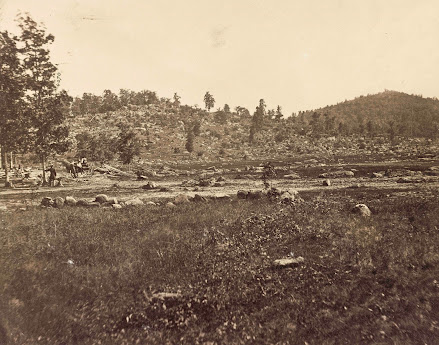
Little Round Top seen from Plum Run Valley (Library of Congress)
Little Round Top traditionally is the top destination for park visitors, he said, followed by the visitor center and museum and Devil's Den.
When asked
about archaeological investigations during the work, Martz said a lot of battle
material was found, including “a few unique items, but nothing that would move
the needle too much one way or the other. The archaeological process is long and
drawn out and final details won't be available for quite some time.”
A Dyer artillery round was found in February 2022, with park officials saying then they
believe a Confederate cannon fired at Federal position and
mistakenly dropped them on friendly Texas regiments trying to navigate the
difficult terrain.
Martz said
officials have enough details to largely close the loop on that story and will
provide an update in the future.