Showing posts with label U.S. Navy. Show all posts

Tuesday, May 31, 2022

Picket exclusive: 20 artifacts from the CSS Georgia are now on display at the National Civil War Naval Museum. Read all about them!

6-pounder gun, partial anchor, bottle top (National Civil War Naval Museum)
Serving on the Confederate ironclad CSS Georgia wasn’t a peach of an assignment. The vessel was too underpowered to move and needed constant pumping so it wouldn’t sink. Sailors, meanwhile, drilled and labored in Savannah’s brutally hot environment. And they never saw any action – at least the combat kind.

Visitors to the National Civil War Naval Museum in Columbus, Ga., are able to view artifacts that speak of weaponry, diversions and discipline for those who served on the floating battery, which was scuttled by its crew in December 1864 when Sherman’s army neared the city.

The U.S. Navy -- via the Naval History and Heritage Command -- recently loaned and shipped more than 20 conserved artifacts to the museum. Officials expect more shipments in the years ahead. (Picket photo at left shows propeller in foreground, with shaft just beyond)

Most of the ironclad’s wreckage was removed a few years back as part of the U.S. Army Corps of Engineers’ deepening of the Savannah River to make room for larger tankers. 

Thousands of artifacts underwent treatment at Texas A&M University, which shipped them to the Navy Yard in Washington, D.C. for storage. 

The Navy has been in contact with museums over possible loans regarding the CSS Georgia, but the National Civil War Naval Museum has been the only one to sign on thus far, officials said.

A portion of a sword sheath found on the river bottom.
Because the remains of the CSS Georgia were in a river that swept all kinds of manmade items downstream, it’s impossible to know how many artifacts pulled up during the project date to the Civil War. But, ostensibly, most do.

The Civil War Picket received the following inventory from the Naval History and Heritage Command and used information from an archaeological report on the project and other sources to describe the items that are now in Columbus. 

All photos are courtesy of the National Civil War Naval Museum except where noted.


Leg irons
: 15.5" x 5.0", 1.88 pounds
A few sets of these encrusted devices were recovered from the wreck site, likely used to discipline sailors who got into trouble on or off shore.
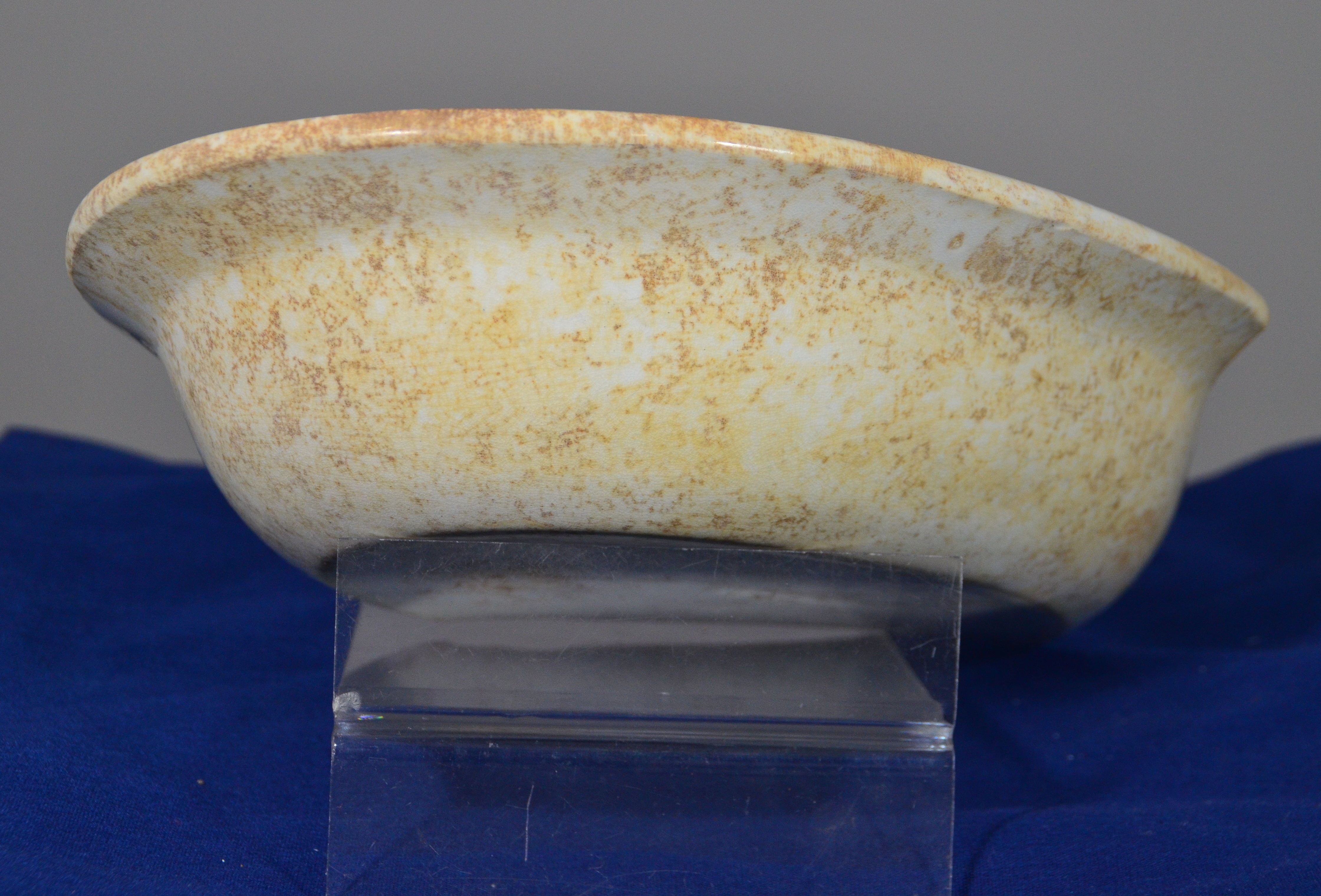

Ceramic ironstone bowl, partial, white glaze
: 9.25" x 7.0" x 2.25", 1.2 pounds
Hundreds of whole or broken pieces of ceramics were found on the river bottom, including four forged from ironstone.

Metal iron hook and eye: 11" x 7.5", 3.88 pounds

Copper alloy sabot: 6.5" (diameter) x 1.375", 7.8 pounds

The sabot, designed to ensure an artillery shell was in the proper position in the barrel, was described this way in the final report on the project:

“The shallow copper saucer, bowl or basin appearance of the aft face of a Brooke copper ratchet disc sabot. Interestingly, this is a spent or fired sabot indicated by the grooving on its exterior side. The hammer marks may have been a result of fitting the sabot onto the shell prior to firing.”


Light blue bottle
: 9.5" x 2.25" (diameter), 0.54 pounds, believed to have held wine

Colorless bottle, partial with broken neck: 6.0" x 1.75" (diameter), 0.5 pounds -- Photo of top of post
This “is a thick-walled, strangely shaped bottle with a small base of a diameter that would allow it to fit into one of the rings; glass fragments similar to this bottle were found in several units across the site. Seven glass bottle stoppers, divided into four categories, were recovered, and may belong to cruet or decanter sets.”


6-pounder iron cannon, Noble Brothers Foundry
:
125.25" (artifact length) 132" x 36" x 28" (crate), 1,240 pounds

This piece of ordnance is one of five recovered in 2015, and it was originally located on the spark deck aft. It is the only one of its type discovered in the river, and it was manufactured in Rome, Ga. It was presented to the Confederacy by the “Ladies of Rome.” The left trunnion is marked August 1862.

James Noble, an Englishman, organized the company with his six sons in 1855. By January 1862, the firm was heavily engaged in the production of cannon and battery equipment. “The Noble Brothers experienced considerable success in the casting of bronze and iron field guns. Between April 1861 and October 1862, some 58 field pieces were delivered to the Confederacy. Of these, at least 15 were cast iron 6 pounders.”

A dispute with the Confederate government in late 1862 ended all ordnance contracts with the foundry.

The Corps report says: “The Noble Brothers’ plant was destroyed when Sherman’s troops entered Rome on May 18, 1864. The large smokestacks of the foundry were blown up and the shops burned. The Union troops attempted to dismantle the lathe using sledgehammers, with little success. The hammer marks are still visible today and the fire caused minimum damage to the lathe. The massive machine stayed in production until the mid-1960s.”

Iron gun port, partial: 24.0" x 14.5" x 4.125", 192 pounds (photo above, with cannon)

(Civil War Picket photo)

Complete triple-bladed propeller
: 6' (diameter) 55" x 82" x 73" (crate), 2,700 pounds

From the final archaeological report prepared for the Army Corps:

“It is not known what kind of engine the CSS Georgia employed, but it is known that the LGA Steering Committee searched for one far and wide. In a letter written on June 11, 1862, John Elliot states that the vessel had a double engine and twin propellers. The engines were only able to make about 2 knots under full steam. All agreed they were inadequate for propelling the vessel against the swift currents or tides of the Savannah River. The engines did, however, serve a functional purpose, as one writer in 1862 stated, ‘Our iron floating battery is a splendid failure. She has been taken down between the forts and they are obliged to keep her engines at work the whole time to prevent her sinking, she leaks so badly’ It is thought that the vessel’s leaking was most likely a result of building her with unseasoned wood, a common practice in Confederate vessel construction.”


Complete propeller shaft
: 12' x 5.68" (diameter) 132" x 36" x 28" (crate), 1,510 pounds

The triple-bladed propeller is mounted on a 6-inch diameter shaft approximately 12 feet 6 inches in length. Because two of its three blades were buried, jetting was conducted to uncover the blades prior to lifting. Once lifted onto the barge deck, the shaft was cut free from the 8-foot blade with a saw for ease of transportation and conservation. A single strut indicates the vessel would have had two propellers, and historical sources indicate that the CSS Georgia was powered by “a double engine and twin propellers,” according to the Corps report.


Leather shoe sole and upper fragments
: 4 pieces, “10 5/16" x 3.5" x 0.02" (sole), 0.14 pounds

Some 68 boot or shoe fragments were recovered from the site. Most are small fragmentary pieces of leather with no complete shoe or boot, the soles of several examples being the most intact portion of recovered footwear.


Leather shoe heel with partial sole
: 4.1" x 2.6" x 0.98" (heel thickness/ 0.02" (sole thickness), 0.16 pounds

Leather fire hose, partial with small bag of leather fragments: “9.75 x 4.5 x 1.02”, 0.56 pounds

Copper alloy sword sheath: “2.52 x 1.6 x 0.6”, 0.06 pounds

Numerous small arms including a mostly complete pistol, eight Enfield bullet cartridges, 90+ bullets of varying caliber for pistol and rifle, two bullet molds, two gunflints and two sword and five bayonet hilts were recovered.


Copper alloy gun sight, forward with "N 714" (mark): “3.98" x 1.34" x 2.36", 1.16 pounds

A naval gun had to be raised to an appropriate degree of elevation to achieve the necessary range to strike a distant object at sea. This sight was placed on the front of the barrel.

Small partial iron anchor: “40.5" x 21.0" x 10.0", 180 pounds

The use of this particular anchor is unknown.

Kaolin pipe bowl, with floral decoration: “1.61" x 0.91" x 0.87", 0.02 pounds
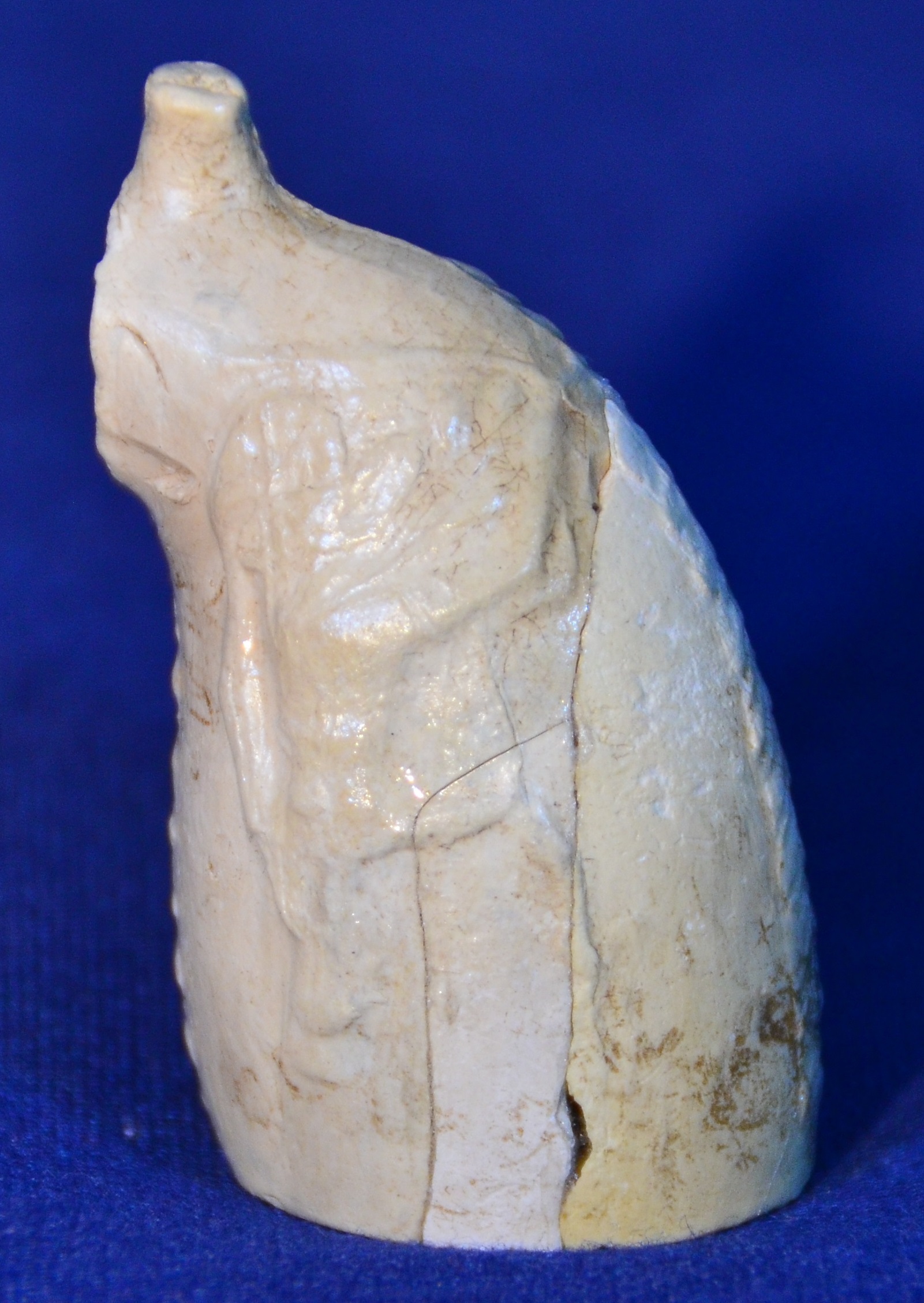
Eight kaolin smoking pipes were recovered in the wreckage of the CSS Georgia. Similar to the prehistoric ceramics, and some percentage of the glass and historic ceramics recovered from the site, “the kaolin smoking pipe bowls are potentially intrusive (non-Civil War), although some if not all could easily have been personal property of those on board.”

Worm-eaten wood wedges: 2 pieces, “3.5" 1.54" x 0.94" (larger fragment), 0.06 pounds

Coal fragments: 2 pieces, “2.56" x 1.73" x 1.06" (larger piece) / “1.73" x 1.57" x 0.83" (smaller piece), 0.18 pounds

The CSS Georgia could have easily carried 100 tons of coal, but it’s unknown how much it carried at the time of its scuttling. Bunkers would likely have been located outboard of the boiler on both sides of the hull.
-----------------

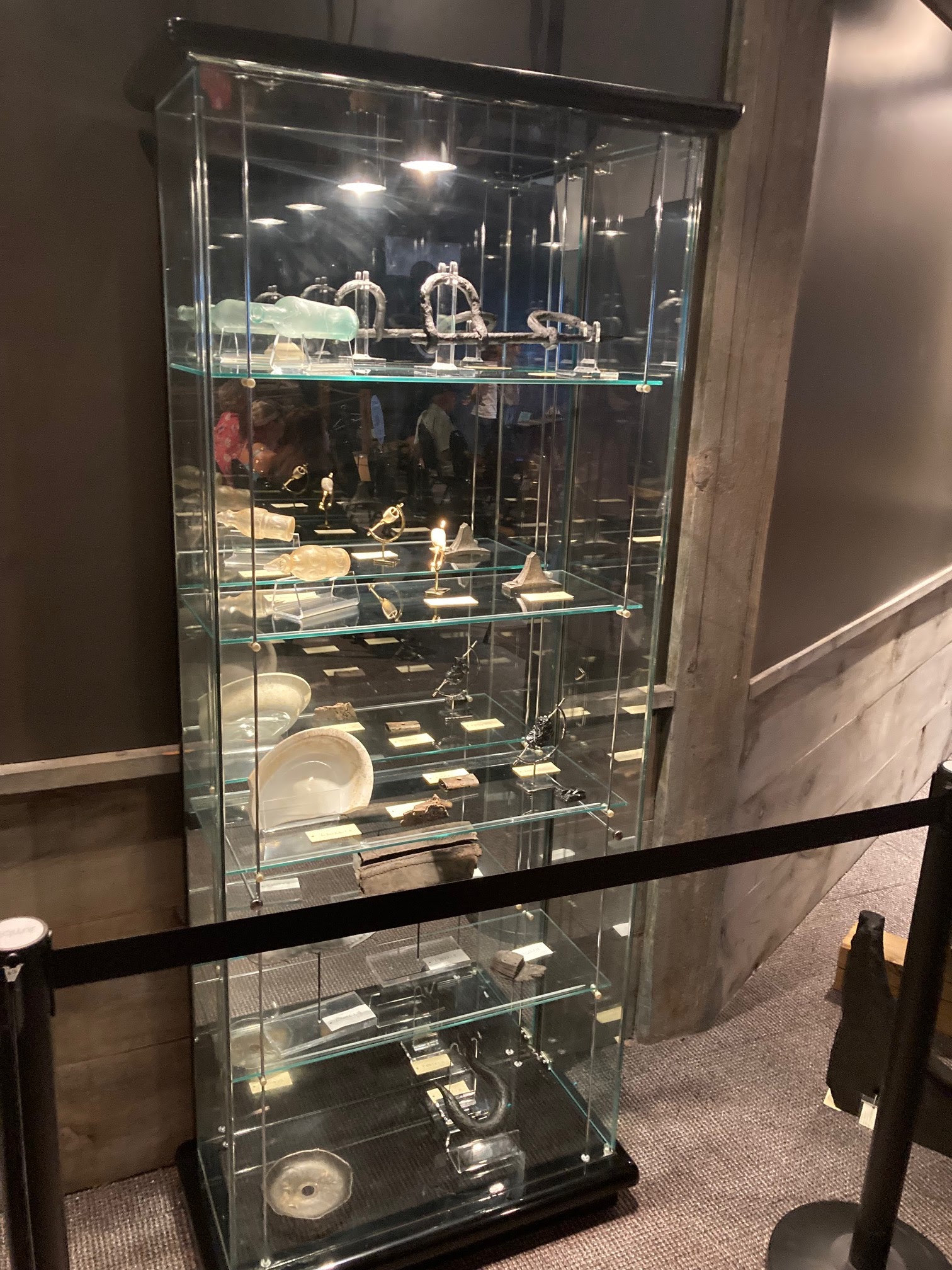
The Picket recently visited the museum, which put smaller artifacts in a large glass case. Signage and interpretation are still in the works.

Smaller CSS Georgia artifacts (Picket photo)

Sunday, May 8, 2022

CSS Georgia: Navy sends batch of ironclad artifacts pulled from Savannah River to National Civil War Naval Museum for display

CSS Georgia propeller is raised from Savannah River in 2015 (Dept. of Defense)
Updated May 18:

The National Civil War Naval Museum has received a first shipment of artifacts belonging to the CSS Georgia, the ironclad vessel that was part of Savannah’s effective river defenses.

The U.S. Navy recently lent about 20 conserved items to the Columbus, Ga., museum, which has worked for years to receive items from the Confederate floating battery. The CSS Georgia was scuttled by its crew when Union forces took Savannah in December 1864.

Museum executive director Holly Wait told the Picket that the shipment included a propeller, shaft, cannon, part of an anchor, part of a gun port, pipe stem, sword sheath, several glass bottles, an eye bolt, gun site and an elevation screw.

“It was a really big feather in our cap to get such a collection as this,” museum director of history and collections Jeff Seymour told the Ledger-Enquirer newspaper.

The Civil War Picket has written extensively about the CSS Georgia and reached out to the Naval History and Heritage Command for comment and further details.

"NHHC hopes that through display of the CSS Georgia artifacts at NCWNM, the public will benefit from a greater understanding of archaeology, conservation, Civil War history and US Navy history," said Lt. Anthony Ivester, public affairs officer for the command.

Conserved and shipped 6-pounder from CSS Georgia (Courtesy of NCWNM)
Most of the ironclad’s wreckage was removed a few years back as part of the U.S. Army Corps of Engineers’ deepening of the Savannah River to make room for larger tankers. Thousands of artifacts have undergone treatment at Texas A&M University, which shipped them to the Navy Yard in Washington, D.C. for storage.

The project, which involved contractors and U.S. Navy divers, recovered more than 30,000 artifacts, including 241 pieces of ordnance, five cannons and two large casemate sections. The latter were documented and left in the water.

In 2017, Navy officials invited several museums, including from Savannah, to the recovery site. The Columbus museum is the first to receive the artifacts from NHHC, which is the custodian of naval artifacts and history.

"We have received previous inquiries from other institutions, but there are no other active agreements for CSS Georgia artifacts," said Ivester.

The Navy and the museum reached an agreement on the loan in March and the items were shipped on May 3, officials said. For now, the CSS Georgia artifacts will be displayed in the museum's main gallery, Wait said.


When asked about long-term plans for a display, Ivester said:

"NCWNM has agreed to coordinate with NHHC as they develop the exhibit for the CSS Georgia artifacts. Archaeological artifacts are best compatible with certain materials and NHHC can provide specialized guidance on which materials are suitable for their continued preservation while on display."

Wait said the shipment was the first of a few expected over the next three to five years.

“The Navy has a standard 3-year loan agreement to confirm that items are cared for properly.  However, all our conversations with them have included our long-term plans," she wrote in an email.

The NHHC described the present loan as short-term, with the possibility of renewal.

Wait said the CSS Georgia will be the seventh Civil War vessel to be exhibited in the country. The museum has two others: the ironclad CSS Jackson and the twin-screw wooden ship CSS Chattahoochee.

Gordon Watts, who has dived on the CSS Georgia and was involved in its recovery and study of artifacts, told the Picket: "I think it is fantastic that museum personnel have been able to obtain a collection of artifacts from the Georgia. Now at least some of the numerous artifacts recovered from the wreck will be available for public access. Congratulations to the National Civil War Naval Museum on a significant addition to their already impressive exhibits."

Sunday, August 9, 2020

New US Navy archival complex in DC will ensure artifacts from CSS Alabama, other Civil War ships will survive for a long time

1851 buildings at Washington Navy Yard; items from CSS Alabama (US Navy)
Construction of a modern archival complex at the Washington Navy Yard will enhance protection for conserved artifacts from several Civil War warships -- most notably the raider CSS Alabama.

U.S. Navy officials this week held a formal groundbreaking for the project. Current facilities built in 1851 were not designed to house artifacts and many lack environmental controls.

“For several years, the Library and Archives have fought to protect Navy’s intellectual property and heritage from the ravages of heat, humidity, water leaks, and cold. Records and photographs stored in these areas were subject to mold and damage, requiring Navy to pay for mold remediation for records and photos,” said Dr. Kristina Giannotta, assistant director of the Naval History and Heritage Command’s Histories and Archives Division, in a press release.

The new complex will house the Navy’s Operational Archives, Department of the Navy Library, Rare Book Room, Navy Art Collection, and the Underwater Archaeology Conservation Laboratory. The lab ensures overseas historic preservation of military ship and aircraft wreck sites. 

USS Kearsarge sinks CSS Alabama (Library of Congress)
It’s Civil War holdings include items from the USS Tulip (lost in boiler explosion in Potomac), USS Westfield (scuttled with explosives in Galveston Bay), CSS Alabama (sunk in battle off France), CSS Georgia (scuttled at Savannah, Ga.), USS Housatonic, sunk by the submarine Hunley off Charleston, S.C.; and USS Hatteras, sunk by the Alabama off Galveston.

CSS Alabama artifacts include cannon, a bronze bell, a leather shore, Brazilian coins, glass stemware and, yes, a flushing toilet.

The lab also has conserved Enfield rifle barrels from the USS Tulip. The Tulip artifact collection includes military uniform components, navigation equipment, ceramics, personal items, medical items, ship’s hardware, tools, ordnance and artillery

USS Tulip rifle barrel and ramrod (U.S. Navy)
Lt. Cmdr. Daniel Day, a public affairs officer for NHHC, told the Picket: “With regard to the move, all of the items have been professionally and archival packed, and are being stored in a climate controlled facility until the renovations are complete and can then be placed in the new complex.”

Day said items in the NHHC holdings include the Navy’s first signal book, John Paul Jones’ calling card, unpublished World War II administrative histories, deck logs and photos.

According to reports, the $41 million renovation will be complete by 2022.

The UA lab, of course, has items from other conflicts. Among them is a brass trumpet from the USS Houston, which was lost in the Battle of Sunda Strait during World War II, and artifacts from the USS Salute, a WWII-era minesweeper.

Adm. Mike Gilday (left) at groundbreaking (U.S. Navy(
Chief of Naval Operations Adm. Mike Gilday spoke at the groundbreaking ceremony.

“This new project underscores the vital role the Naval History and Heritage Command serves in preserving our Navy’s institutional memory,” Gilday said in a statement. “With this archival complex we will continue to remember and present an accurate history of our Navy and tell the stories of those who have gone before us for generations to come.”