Showing posts with label George Barnard. Show all posts

Thursday, February 20, 2025

Wrecking the railroads in Atlanta: What's going on this fascinating Barnard photo showing Sherman's men at work? Experts weigh in on this, other images

Barnard's fascinating photograph showing Union engineers (Library of Congress)
I’m a fan of Garry Adelman’s Civil War Page on Facebook. The director of history and education for the American Battlefield Trust regularly posts photographs from the collection of the Library of Congress and other sources.

I love his descriptions of Federal soldiers posing for the camera. Among them:

“Blue-eyed dandy”

“Jaunty caps”

“Photobomber”

“A dude checking his iPad”

You get the idea. But an image he posted on January 4 of soldiers destroying Atlanta railroad in November 1864 especially got my attention. George Barnard, a contractor for the U.S. Army, took many photographs of the fallen city after he arrived two months earlier, but I had never seen this one, for some reason. While most of these fellas were just standing around, others were engaged in a flurry of activity before the end of occupation and the commencement of the March to the Sea.

Labeled “Gen. Sherman’s men destroying the Railroad, before the evacuation of Atlanta, Ga.”, the photograph was taken in downtown Atlanta not far from skyscrapers, Underground Atlanta, Mercedes-Benz Stadium and the former CNN Center. (Detail from Georgia Battlefields Association walking tour map below)


It shows two groups of men destroying railroad track and machinery, vital to Confederate transportation in the Deep South. The larger contingent gazes at what appear to be pipes or boilers. The freight depot for the Western & Atlantic Railroad is in the background.

What exactly is shown here? I decided to reach out to Barnard authority Keith Davis and  Atlanta-area experts for their thoughts: The Atlanta History Center, Civil War author Steve Davis and The Atlanta Campaign History and Discussion Group and Uncle Billy’s Boys (Western Federals), both on Facebook.

Also consulted was the Georgia Battlefields Association, which will conduct two walking tours of Civil War Downtown Atlanta in March, using Barnard photos as reference points.

Why was Barnard in Atlanta in 1864?

Barnard, a pioneer in the field, served as the official photographer of the Military Division of the Mississippi, led by Maj. Gen. William T. Sherman. He wasn’t primarily a photojournalist. A number of his works were reproduced in the illustrated papers of the day, and some stereographs were sold to a popular market. 

On July 28, 1864, Capt. Orlando Poe, Sherman's talented chief engineer, wired Barnard (right), who was in Tennessee: "Hold yourself in readiness to take the field if telegraphed to that effect." A few days after Atlanta fell, on September 4, Poe telegraphed Barnard to join him, shortly after Hood’s Confederate troops, cut off from supplies, abandoned the city.

The Atlanta of the Civil War was a boom town, just beginning to acquire the muscle and mettle that one day would make it the behemoth of the South. In 1860, on the war’s eve, it had fewer than 10,000 residents, making it the fourth-largest city in Georgia, behind Savannah, Augusta and Columbus.

With its nexus of four railroad lines, Atlanta quickly showed its importance to the Confederacy and Federal forces who finally reached its outer fortifications in July 1864. The city quickly descended into chaos as Rebel troops were moved around and supply lines threatened.

Davis, author of several books on the Atlanta Campaign, including What the Yankees Did to Us: Sherman’s Bombardment and Wrecking of Atlanta,” has written extensively about Barnard’s documentation of the Union conquest of Atlanta, with scores of scenes showing destruction, fortifications, a slave mart and Sherman himself.

In the volume “100 Significant Civil War Photographs: Atlanta Campaign,” Davis (left) said Sherman and Poe wanted their troops to destroy only manufacturing and railroading capacity, which was concentrated in the downtown business district. Federal soldiers, Davis wrote, started their own fires as early as Nov. 11, 1864.

“We are fritened (sic) almost to death last night,” young Atlanta diarist Carrie Berry wrote. “Some mean soldiers set several houses on fire in different parts of the town.”

Barnard ranks among the top echelon of Civil War photographers – Gardner, O’Sullivan, Cook, Rees, Reekie, Gibson and Brady.

The three photographs I will be discussing here – showing destruction of the city’s railroad infrastructure – were taken by Barnard in mid-November 1864. They likely were taken within a short time of each other, and may include some of the same troops.

What’s going on in this picture?

It’s hard to get a consensus because there were few detailed photo captions in those days and it’s just plain difficult to know for sure, given several pieces of iron or steel jammed together.

Poe, in his set of images, wrote of this one: “View in Atlanta just before the ‘March to the Sea’; showing manner of destroying Railroads and Machines.” 

Jackson McQuigg, vice president of properties for the Atlanta History Center, which houses the giant Cyclorama painting and Civil War exhibits, said he thinks the largest item in the foreground is a stationary steam engine (used for power generation).


The boiler is at right, while the stack is flopped over and laying on its side on top of the engine itself,” he writes. “Even though the caption said that Sherman’s men are destroying ‘the railroad’ I see rails at left … it sure looks like that’s mostly pipe on the ground in the front. Maybe those were locomotive boiler flues?”

Charlie Crawford, president emeritus of the Georgia Battlefields Association, theorizes the foreground may depict a boiler on the right and a detached exhaust chimney (long tube) lying on a flat car. 

“It could be an exhaust chimney for any piece of machinery that creates heat by using controlled flame,” he wrote. “The boiler is the item on the right of the flat car. It still has an end cap, unlike the hollow tube. Could well be that the exhaust chimney was paired with the boiler before the machinery was disassembled.”

Commenters on Adelman’s Facebook added these guesses:

The ‘toolbox’ looks to be a toolbox on top of a steam piston from a locomotive. A boiler appears to be behind the smokestack and toolbox.....and there appears to be steam pipe fittings on the platform as well.....possibly a disassembled locomotive.

What it is resting on to the right of the picture appears to be a steam engine cylinder and valve box.


As for the rest of the photo -- the men toward the back?

Michael Rose, curator of decorative arts and special collections at the Atlanta History Center, said the smoke emanating from the back half of the photo (above) are three fire pits built to heat the rails. The idea was to warp and bend the rails and render them useless.

I suspect the men are waiting for the heat to do its job so they can do theirs before moving on to more,” Adelman wrote in his Facebook post.

Later in this post, I examine two more destruction photos.

What exactly is that writing on the iron?

Zoom in on the flat car or platform and you will see a horizontal piece of iron with writing. It’s tough to make out (and for me to brighten) but here are some posts from commenters on the Adelman Facebook post.


"Laimbeer & Co. Atlantic Dock, Brooklyn, NY, 1855" which was one of the main warehouse companies located at Atlantic Dock.

“ATLANTIC DOCK BROOKLN NY 1855”

Rose said he can make out Brooklyn, N.Y.

“But not what comes before it, undoubtedly the manufacturer’s name. It does look like it includes “Atlantic” – but not in a way that look like Western & Atlantic R.R.”

Who are these soldiers?

According to Steve Davis, Sherman initially assigned three regiments of the provost guard to oversee the destruction: The 111th Pennsylvania, 2nd Massachusetts and the 33rd Massachusetts.

Their task to destroy track, the roundhouse, depots, the railroad car shed and more, said Gordon Jones, senior military historian and curator at the Atlanta History Center.

The general changed his mind and brought in professionals -- Poe’s 1st Michigan Engineers and Mechanics and the 1st Missouri Engineers – to carry out the work. The 58th Indiana also pitched in, according to Crawford.

Poe (right), chief engineer of the Military Division of the Mississippi, supervised demolition of the main passenger depot in downtown Atlanta and many other buildings. He is remembered as a visionary engineer, for both military and civilian service.

In his memoirs, Sherman wrote of “Poe’s special task of destruction.”

Not only did Poe carry out the order to burn Atlanta in 1864, he built the roads and bridges that made Sherman’s March to the Sea possible, according to the National Park Service. “At the end of the war, he was named brevet brigadier general. Since no system of medals existed at the time, the brevet rank, meaningless in terms of real authority, served to recognize gallant conduct or other meritorious service.”

Where was the photograph taken?

Downtown Atlanta was an extremely busy hub for railroads serving the city and much of the South. The photograph was taken fairly close to the juncture of the Western & Atlantic and Macon & Western railroads.

GBA map of downtown; W&A depot is shown at far left (Click to enlarge)
Local historian and tour guide Michael Hitt says the soldiers are on the Macon & Western railroad.

“In the background is the W&A RR depot,” says Crawford. "Depot site would now be just west of Ted Turner Drive and just northeast of “The Gulch.” Photo was taken from WNW of the depot, about where CNN Center used to be.”

The W&A roundhouse would be to the left, outside the image, said Rose.

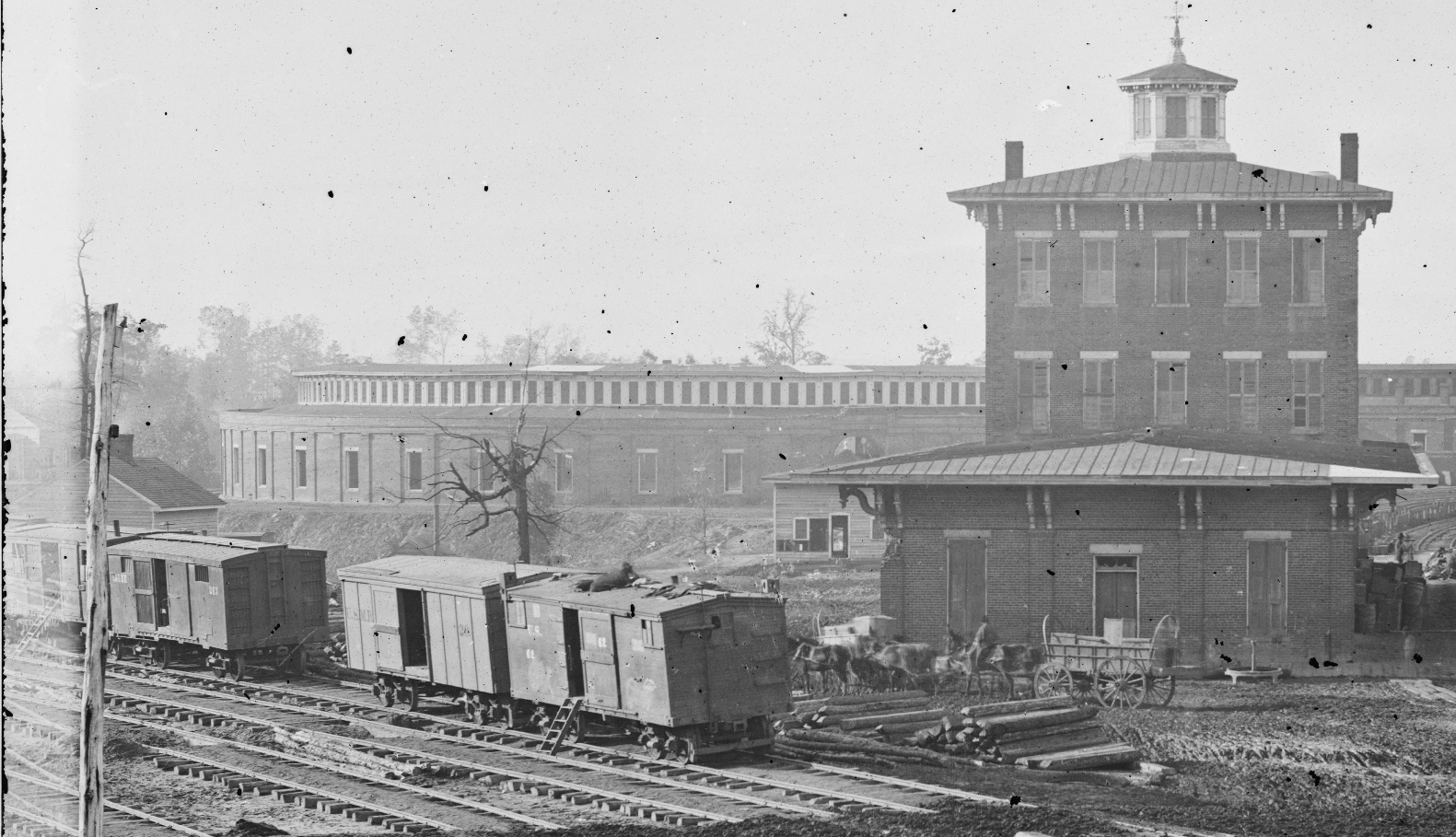
The Barnard photo below -- taken before its destruction by Yankee troops -- shows a different angle of the depot, this time with a large roundhouse in the background. The facility was used for servicing locomotives. (Photo: Library of Congress)

Barnard, of course, wanted to make money from his work. Anthony & Co. published several of his photos. A December 2014 article in the newsletter for the Center for Civil War Photography featured the photo of the machinery among others depicting destruction in the city.

“As Yankee engineers proceed with their destructive work, smoke drifts past the ruins of a destroyed building in this original Anthony stereo view. Indeed, there was plenty to dread as night fell on Nov. 15, wrote John Kelley and Bob Zeller. “It was, (Maj. Henry) Hitchcock wrote, “the grandest and most awful scene.”

When was the photograph taken?

Regarding the shot of the men standing around the metal pieces, Steve Davis believes it was taken around Nov. 10-11, days before much of the city was torched.

Keith Davis (left), a leading expert on Barnard, told the Picket the photos of soldiers destroying railroad were likely taken on both Nov. 14 and 15. Sherman’s troops began leaving the city before noon on the 15th to begin the march to Savannah, Ga.

“On the following morning, the general staff, Barnard, and the remainder of the Union forces marched out of the shattered city,” Davis wrote in a book about Barnard.

“So, I have to think that Barnard was extremely active on Nov15; thus, making it correct to date these as Nov. 14-15, rather than strictly the 14th,” he told the Picket.

Crawford doesn’t believe the photographs could have been taken Nov. 15.

We can date these photos because they depict activity, and we know the car shed and rail lines were destroyed on 14 November. Since the armies left town on 15 November, the photos must have been taken on the 14th. Barnard may have taken images as the armies were leaving, but the destruction was completed on the 14th."

The one major gap in Barnard’s Atlanta photography is that no images exist showing the vast panorama of destruction after the fires of Nov. 15 and 16, according Kelley and Zeller in the “Battlefield Photography” newsletter.

What about the two other soldier photos?

Union engineers destroying track; Western & Atlantic depot behind (Barnard, Library of Congress)
You probably are familiar with two more photographs showing groups of men heating and damaging rail so that the South cannot quickly get the trains running again after the Federal army ends its two-month occupation of Atlanta.

The first photograph described here was taken very close to the main image we have been discussing. Barnard must have moved his camera forward. If you look closely, you can see the men working amid iron rail, wooden ties and other infrastructure.

The photograph with all the machinery shows a particularly tall soldier. I am trying to place him in this photo, and I wonder if he is the man wearing a hat with a round crown, his face not visible to the camera. But the hats don’t exactly match. I welcome guesses from anyone reading this. These men are believed to be from the 1st Michigan and 1st Missouri engineers.

The second photograph, a vintage original stereo view, depicts men heating track near the destroyed car shed, about 700 yards east-southeast from the machinery shot.
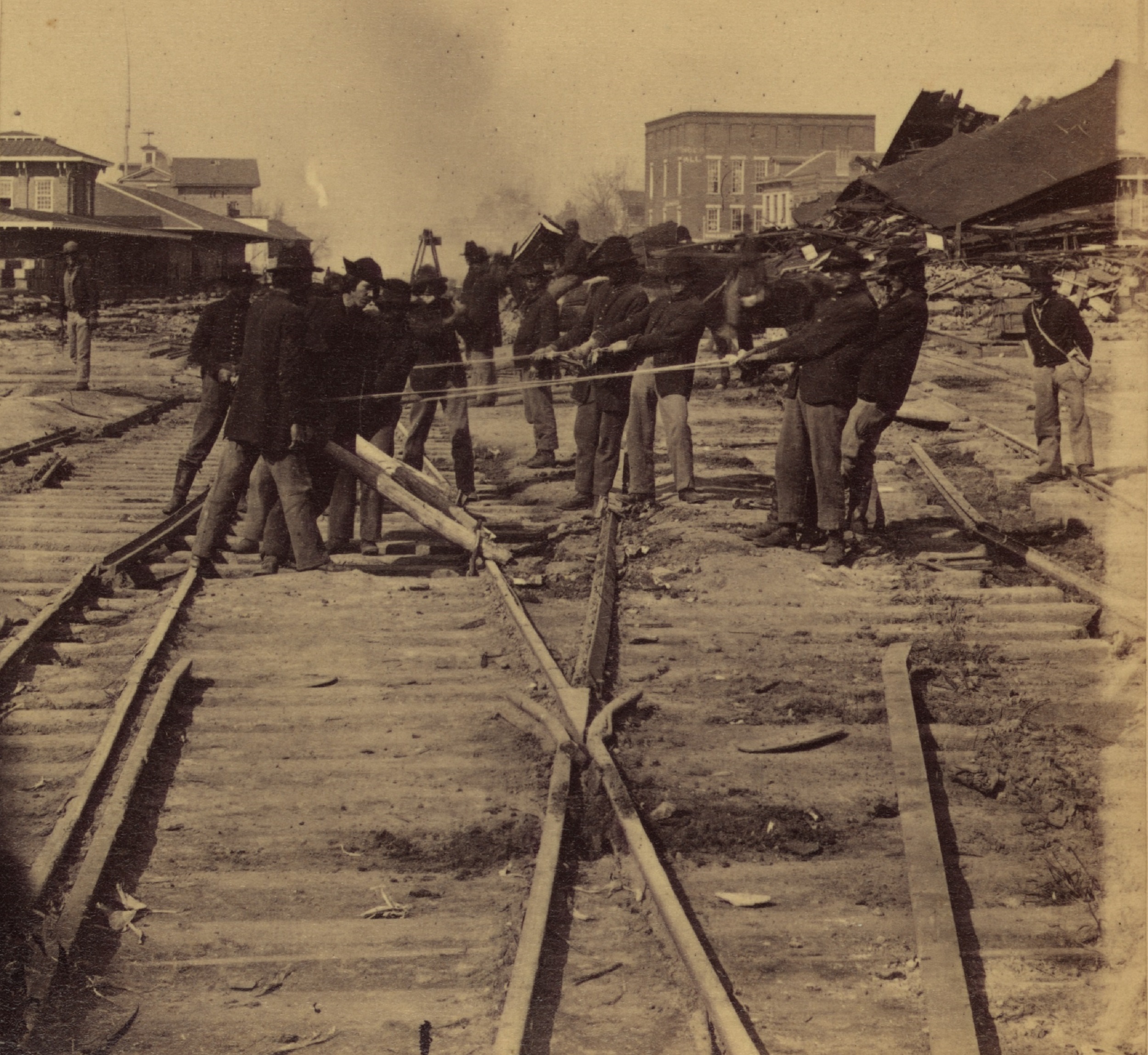
Sherman's men do their work; behind right are remnants of car shed (Barnard, Library of Congress)
Union troops used large iron bolts and others items to knock down the arch supports before setting fire to the remains. This was a devastating loss for Atlanta. The car shed was a cooperative venture of the four railroads that served the Georgia city and the Confederacy. The station had been a fixture for about 10 years.

This scene is mostly covered today by the Central Avenue overpass downtown. Smoke from burning railroad ties rises in the background, according to Kelley and Zeller, who date the photograph to Nov. 15. The view is to the west, said Crawford. (Below is a photo of the car shed before its destruction)

“This has been a dreadful day,” Carrie Berry wrote on Nov. 15. “Things have been burning all around us. We dread to night because we do not know what moment that they will burn the last house before they stop.” (Her journal is at the Atlanta History Center)

Modern view (below) is above where car shed was built (Library of Congress and Georgia Battlefields Association)
Those who visit downtown, especially around Underground Atlanta, will notice many street levels have changed in the past century.

“Present day photos are difficult because construction of the viaduct system in the 1920s put the roads 20 to 30 feet higher than the terrain shown in the 1864 photos,” said Crawford. “You can still look down from a few vantage points onto the existing freight line and the two MARTA tracks that occupy some of the space that the multiple rail lines once traversed.”

You can get an idea of the modern landscape from the photo (above) of Lot R parking area that is above where the car shed was formerly.

Sharing blame for all that destruction 

Let’s briefly step back for a little background on what’s been termed in folklore as the Burning of AtlantaAbout 40 percent of the city was in ruins when Sherman began his March to the Sea. But don’t lay all the blame solely at his feet.

“It started when Confederate military planners stripped and leveled buildings and homes on the city’s outskirts to build the extensive fortifications that Sherman found impenetrable,” reads an online presentation, “War in Our Backyards,” produced by The Atlanta Journal-Constitution and the Atlanta History Center for the 2014 Civil War Atlanta centennial.

Hood's troops blew up ammunition train before leaving (Barnard, Fleischer's Auctions)
“During the summer siege, Union artillery fire hit many of the city’s major structures, setting many afire. Miles of trenches dug by both sides scarred fields and roads. When the Confederates made their retreat, they blew up their ammunition train, damaging scores of homes, and burned the massive Atlanta Machine Works factory,” the AJC said.

Looters, arsonists and the need for material for Union forts took their toll until November 1864, when Sherman “ordered the destruction and burning of all facilities with potential military value, including ripping up rail lines and destroying Atlanta’s transportation infrastructure.” He ordered out the remaining civil population, who were offered a one-way train ride either north or south.

Steve Davis has written about how the fires spread to residences, and some Union soldiers decided to start some residential blazes of their own.

You can see sites in March walking tours

Sadly, virtually nothing from wartime downtown Atlanta remains today and only a guided tour and some imagination can provide an adequate picture.

Crawford has led the GBA walking tour for 18 years. I went on a version in 2014 with former The Atlanta Journal-Constitution editor Scott Peacocke in July 2014. I enjoyed it and wrote about the experience here. “It rained buckets,” Crawford reminded me.

Scott Peacocke, Charlie Crawford and Mary-Elizabeth Ellard in 2014 (Picket photo)
Free walks will be held on March 8 and March 22 as part of the Atlanta Preservation Center’s Phoenix Flies program of tours and other events.

Crawford works from a downtown then-and-now map and a PowerPoint presentation with Barnard photos. The slides include pointers and basic information. He then takes participants around the area to see the “now” view to correspond to the old images.

“It’s always fun to hear people say that they had seen some of Barnard’s photos and always wondered where they were taken,” he said.

Particularly popular are references to the book and movie “Gone With the Wind", including a scene in which Scarlett O’Hara approaches the car shed, which had been turned into a receiving hospital under care of Dr. Meade.


She walks through the expanse created by multiple rail lines, and hundreds of injured Confederate soldiers, some on stretchers, some on the red soil or tracks, writhe in agony or lie motionless. It is a powerful scene, punctuated by a tattered Rebel battle flag.

Crawford said he gets a variety of reactions and questions during his tours.

“Discovering that not all of Atlanta was destroyed is difficult for some to accept. Seeing that the state Capitol is now on the former City Hall site seems to give most people something they can surprise their family with.” 

----

Georgia Battlefields Association will again lead free Phoenix Flies tours GBA of Civil War downtown Atlanta. Participants must preregister for the March 8 and 22 walks, which take about 2 hours and 45 minutes. The tours are limited to 25 people. Click here for more information. Registration for Phoenix Flies begins Feb. 21.

Wednesday, April 17, 2024

A rare copy of photographer George Barnard's album recording William Sherman's campaign is up for auction. Here's why he was a master of memory and artistry

Rebel works in front of Atlanta and a scene of ruined depot in Charleston (Fleischer's Auctions)
Keith F. Davis recalls visiting a New York City gallery in 1977. On display was the full set of 61 images from George N. Barnard’s “Photographic Views of Sherman’s Campaign,” a volume that documents the general’s game-changing conquest of Atlanta, Georgia and South Carolina.

What Davis saw set him off on a journey of discovery.

“They were quiet, without obvious action, and many were primarily ‘landscape’ photographs,” he says. “They were more about memory and meditation than ‘action’. All in all, I felt puzzled and challenged by this work, because it didn’t easily conform to what I had expected to see.”

Davis felt challenged by the photographs and began a deep study of them and the man, eventually leading to a book on the subject. Today, Davis is the leading authority on Barnard, who ranks among the top echelon of Civil War photographers – Gardner, O’Sullivan, Cook, Rees, Reekie, Gibson and Brady.

“None of them surpassed Barnard in terms of technical or creative skill,” says Davis (photo, left), a photography curator, author and collector. “It’s hard to say that any one of them was 'the best' but Barnard was second to none.” 

A rare copy of “Photographic Views of Sherman’s Campaign,” thought to belong to Maj. Gen. William T. Sherman and signed in 1886 by his son Philemon, will be up for bid during Fleischer’s Auctions’ May 14-15 sale in Columbus, Ohio. (Sherman died in 1891.)

The Barnard album is among the top Sherman-related items in the auction. Notable items from the family, many of whom live in western Pennsylvania, include the general’s copy of the memoirs of Ulysses S. Grant, with his annotations, a trunk and saber used early in the Civil War, shoulder straps with rank insignia, photographs of Sherman and his daughter Minnie and a family Bible.

These items … may represent the most important sale of Civil War artifacts in recent memory,” company president Adam Fleischer said in a statement. “It is my sincere hope that through this process, these items will find themselves in the hands of individuals or institutions who will preserve them, ensuring that General Sherman's story endures and continues to enrich our collective understanding of such a pivotal era in American history."

The auction includes relics of the Revolutionary War, the African-American experience (including a broadside used to recruit soldiers during the Civil War) and the Wild West.

Steve Davis, author of several books on the Atlanta Campaign, including What theYankees Did to Us: Sherman’s Bombardment and Wrecking of Atlanta,” told the Picket that Union Quartermaster General Montgomery Meigs took interest in Barnard’s work and asked him to photograph Nashville. The photographer also traveled to Knoxville and Chattanooga, Tenn.

Barnard, a pioneer in the field, served as the official photographer of the Military Division of the Mississippi, led by Sherman.

On July 28, 1864, Capt. Orlando Poe, Sherman's chief engineer, wired Barnard, "Hold yourself in readiness to take the field if telegraphed to that effect." A few days after Atlanta fell, on September 4, Poe telegraphed Barnard to join him.

“A week or so later -- we're unsure of the date -- Barnard arrived in Atlanta and was soon taking pictures of the city, its surrounding fortifications and the battlefields of July,” said Steve Davis.

Interestingly, a famous Barnard photograph of Sherman astride a horse (above, Library of Congress) is not included in the book.

On October 1, 1864, Sherman wrote his wife Ellen, "I sent you a few days ago some photographs, one of which Duke was very fine. He stood like a gentleman for his portrait, and I like it better than any I ever had taken." Sherman wore formal attire for the camera session – sash, sword and all.

“Barnard's famous picture of him sitting on Duke in a Rebel fort west of the city is iconic,” says Steve Davis (photo, left).

The volume -- featuring 10 x 13 inches images -- includes scenes of the occupation of Nashville, battles around Chattanooga and Lookout Mountain, the Atlanta Campaign, Savannah, Ga., and South Carolina. In May 1866, Barnard traced the route of Sherman's North Georgia campaign, taking pictures at Resaca and elsewhere.

When Barnard arrived in Atlanta he took more, including his famous views of the downtown area that had been burned by the Federals before they left on November 15-16, 1864, says Steve Davis.) Many copies of the volume are held by museums and other institutions.

Charlie Crawford, president emeritus of the Georgia Battlefields Association, said Barnard's contract with the Army called for him to principally take photos of fortifications, and he took many.

“We're lucky that he had time to take photos of the Ponder house, car shed, etc.” says Crawford, who has led many tours of areas that were key in Civil War Atlanta.

“His 1866 photos destroy the myth that all of Atlanta was burned to the ground, since many of the same buildings appear in his 1864 photos,” says Crawford. “As Steve Davis writes in his book, destruction was concentrated along the rail lines, where many of the factories and warehouses were located.”

Remarkable clouds above railroad destruction in Atlanta (Fleischer's Auctions)
The Picket asked Keith F. Davis about Barnard’s techniques, artistry and legacy. He responded by email. The responses have been edited.

Q. What is the significance of this collection of his works? Apparently, relatively few of the volumes were made.

A. In its ambition, seriousness and artistic quality, Barnard’s album is one of the greatest photographic works in American history. Of course, it is one of two comparable productions of the immediate post-Civil War period. Alexander Gardner’s “Sketchbook,” with 100 original albumen prints, was issued in early 1866. Barnard’s “Sherman’s Campaign,” with 61 original prints was completed in the fall of 1866. Both were marketed to a wealthy and elite community of buyers -- largely former Union officers -- and sold by prospectus. Neither of these expensive works was ever intended for anything like “general” or “popular” sale. They were rare, deluxe collectibles, not “books” in any traditional sense. These are very different albums -- they cover different aspects of the war, with no overlap at all, and they cover their respective territories in distinct ways.

Barnard’s album was produced in an original edition of 100 to 150 copies, and priced at $100. Not very many have survived today, intact and in good condition. Some were lost or damaged over the years, and since the 1970s, a significant number have been cut up so that prints could be sold individually.

Q. Why did you choose to write about Barnard? What is his contribution to wartime journalism?

A. I became fascinated by Barnard (photo right by Brady, National Portrait Gallery) in 1977, when I was studying with (curator and art historian) Beaumont Newhall, getting my MA at the University of New Mexico. Dover had just issued a paperback reprint of Barnard’s album, with an introduction by Beaumont. I remember him talking about his work in class. In the summer of 1977, I saw an exhibition of a complete (disbound) “Sherman’s Campaign” album at a gallery in New York City -- perhaps the first time the full set of pictures had ever been displayed. I was struck by the quality of Barnard’s contact prints (made from 12x15” wet-collodion negatives) and, most importantly, by the “weirdness” of the whole set. I thought I knew something about the history of war photography, but these pictures seemed distinctly different from whatever “tradition” I knew. They were quiet, without obvious action, and many were primarily “landscape” photographs. They were more about memory and meditation than “action.” 

All in all, I felt puzzled and challenged by this work, because it didn’t easily conform to what I had expected to see. That triggered a deep fascination for Barnard’s life and work. I ended up getting an NEH research fellowship for this work in 1986, and published my book “George N. Barnard: Photographer of Sherman’s Campaign” in 1990, accompanied by a traveling exhibition in 1990-91. I was completely fascinated by the challenge or “problem” of Barnard and in my dozen or more years of intensive research, ended up greatly expanding what was known about him.

My real understanding of 19th century American photography in general certainly grew from, and around, this project. (Davis also covered the topic in a Civil War chapter in "The Origins of American Photography: From Daguerreotype to Dry-Plate” below, 2007)

Barnard wasn’t primarily a “photojournalist.” A number of his works were reproduced in the illustrated papers of the day, and some stereographs were sold to a popular market. Primarily, however, he was working as a civilian employee of the Union Army’s Engineering Department, creating images that were primarily used for internal military use.

Of course, these boundaries were fluid: Barnard was friends with Theodore Davis, a skilled sketch artist and writer for “Harper’s Weekly”; he maintained connections to the commercial firm of E. and H. T. Anthony, which marketed war images to the general public; and, of course, he was a self-motivated entrepreneur who conceived, created and marketed his album to the elite audience described above.

Q. Can you speak to his technical and creative skills?

A. Barnard was extremely accomplished in both technical and aesthetic terms. He had been a daguerreotypist for more than a decade, then had worked for the Anthonys in New York City, and for Alexander Gardner in Washington, D.C. So, he was hugely experienced. In the field, he preferred his 12x15” view camera, making negatives of that size, and final prints that trimmed down to about 11x14”. And, as we know, he was an American pioneer in printing-in clouds from a second negative -- there are numerous instances of this in his “Sherman’s Campaign” album.

This technical labor was clearly not needed for strictly “documentary” purposes. Rather, he did it for aesthetic reasons, to make images that were both informative and artistic. And that gets to the key nature of his album. Rather than a “simple” work of documentation, it is instead something more complicated: a factual collection of places/views that combines memory, poetry and artistry in order to evoke something about the war’s justification, its horrific costs, and its relation to American character and values. There is a poetic and essentially literary aspect here that makes this album unusual and special.

Barnard's eerie image of McPherson's death site includes horse skull (Fleischer's Auctions)
In part, the nature of the album is a result of when and how the images were made. Barnard held a number of his original negatives from 1864. Once he decided to proceed with the album, he made a re-photographic trip back over the same ground in the spring of 1866 -- to record sites he had not photographed in 1864 and, in general, to enlarge his visual record of the ground that Sherman had covered.

He only printed-in skies in 1866; earlier prints from the same images exist, and they do not have the printed-in skies. Thus, the album blurs two distinct time frames: the 1864 views with troops visible, defensive works in optimum condition, etc; the 1866 prints of some of those negatives, now with cloudscapes; and the new 1866 views, without any evidence of military presence, of battlefields, defensive works, etc., as they stood a year and a half after the events of the war.

Q. Do you know whether he knew Sherman, and if so, to what extent? I understand Barnard worked for the Army and came to Atlanta soon after the surrender.

Barnard used clouds to bring drama to a scene, such as at an Atlanta fort (Fleischer's Auctions)
A.
Barnard certainly knew Sherman, and vice versa, but they were not close friends or associates -- the social gap between general and staff photographer was just too great for that. But we know that Sherman supported Barnard’s project when he heard about it, and wrote a warm letter of endorsement. Barnard was aided in all of this by his superior, Orlando M. Poe, who was Sherman’s chief engineer. Poe supported Barnard consistently: he allowed Barnard to keep some of his wartime negatives for his own postwar use, and in 1866 he contacted Sherman and other generals to promote (and solicit buyers for) Barnard’s album.

Q. Do you have any anecdotes about his time in Atlanta and in the Carolina?

A. Barnard was a distinctly intelligent, ethical and upright man. He supported the Union cause wholeheartedly and was an abolitionist from the start. There is also, however, clear evidence that the death and devastation of the war shocked him to the core. He accompanied Sherman’s troops on the March to the Sea but – notably -- made not a single photograph along the way. They were moving quickly, sure, but if he had really wanted to make images, he could have found a way to do it. This says something to me about his dismay at what he saw Union troops doing along the way.

Capitol in Nashville and view from Lookout Mountain, click to enlarge (Fleischer's Auctions)
Q. Which of the photographs in the book particularly stand out?

A. In terms of my favorite individual images, that’s a bit difficult, since I love the totality of the album, but I have always been particularly fond of:

-- The Capitol, Nashville

-- Chattanooga Valley from Lookout Mountain

-- Scene of Gen McPherson’s Death

-- Rebel Works in Front of Atlanta No. 3

-- Destruction of Hood’s Ordnance Train

-- Ruins of the RR Depot, Charleston

Tuesday, July 22, 2014

Walking tour: Wartime downtown Atlanta, in vivid words and photographs of city then and now

Federal soldier reads near former slave market (George Barnard/LOC)
Modern view, MARTA Five Points Station

Over the course of time, I have driven or walked most of the surviving thoroughfares that ran through wartime Atlanta -- a young city with so much promise, yet destined to endure so much devastation.

Those avenues weren’t paved in 1864. Peachtree, Whitehall and Alabama, for instance, came in only two choices: Dusty or muddy.

I have witnessed downtown’s many ups and downs over the nearly 30 years in which I have worked for two employers. Hotels, conventions, concerts, sporting events and museums bring throngs of people to the area. But people also walk among panhandlers and pass many commercial and retail establishments no longer in their heyday.

Still, there is always the promise of a new day, as touted by the city’s emblem, a rising phoenix and the words “Resurgens,” or resurgence. Georgia State University, which has expanded its campus footprint in recent years, is an example of regeneration in the core district.

The Atlanta of the Civil War was a boom town, just beginning to acquire the muscles and mettle that one day would make it the behemoth of the South. In 1860, on the war’s eve, it had fewer than 10,000 residents, making it the fourth largest city in Georgia, behind Savannah, Augusta and Columbus.

Scott Peacocke, Charlie Crawford, Mary Elizabeth-Ellard

Residents of nearby Decatur thought the people of Atlanta, largely made up of laborers and carpenters, to be uncouth, said Mary-Elizabeth Ellard, a board member of the Georgia Battlefields Association. Prostitution was the 10th most common occupation.

While the war effort led to a doubling of the city’s population, it was not uncommon to see chickens pecking and cows grazing between homes. The “suburbs” weren’t that far away from the transportation, manufacturing and supply center that had been under martial law since May 1862.

With it nexus of four railroad lines, Atlanta quickly showed its importance to the Confederacy and Federal forces who finally reached its outer fortifications in July 1864.

This past Sunday, two days before the 150th anniversary of the Battle of Atlanta, which raged only a couple miles to the east, I participated in a downtown Atlanta tour led by Ellard and Charlie Crawford of the GBA. Joining us was Scott Peacocke, a friend and former colleague at The Atlanta Journal-Constitution. Even with umbrellas, we became nearly soaked as rain poured down during the second half of our walk. No matter, we were in our element.

Click GBA map to see wartime, modern features downtown

Peacocke and other AJC staffers have just wrapped up a superb sesquicentennial online project, “War in Our Backyards,” in conjunction with the Atlanta History Center.

As the detailed presentation points out, 40 percent of the city was in ruins when Sherman began his March to the Sea. But don’t lay all the blame solely at his feet.

“It started when Confederate military planners stripped and leveled buildings and homes on the city’s outskirts to build the extensive fortifications that Sherman found impenetrable. During the summer siege, Union artillery fire hit many of the city’s major structures, setting many afire. Miles of trenches dug by both sides scarred fields and roads. When the Confederates made their retreat, they blew up their ammunition train, damaging scores of homes, and burned the massive Atlanta Machine Works factory,” the AJC said.

Looters, arsonists and the need for material for Union forts took their toll until November 1864, when Sherman “ordered the destruction and burning of all facilities with potential military value, including ripping up rail lines and destroying Atlanta’s transportation infrastructure.” He also ordered out the remaining civil population, who were offered a one-way train ride either north or south.

Crawford near site of Episcopal church that was shelled in 1864.

Virtually nothing from wartime downtown Atlanta remains today and only a guided tour and some imagination can provide an adequate picture. I was very impressed by the GBA’s expertise and materials compiled by Crawford.

Our walk was aided by images taken by George Barnard, a contract photographer for the Federal army who arrived after the city fell on Sept. 2, 1864. The remainder of this blog post contains many Barnard photos and current views -- though some of those views can only be approximated because of buildings and the construction of bridges and viaducts that in effect changed the elevation of much of downtown. All of the Barnard photos here are in the Library of Congress collection.


We began our tour near the picturesque Candler Building, where a Confederate commissary once sat, and proceeded to Ellis and what was then Ivy, where the first Union siege shell landed on the afternoon of July 20, 1864. It was a 20-pound Parrott round fired by DeGress' Battery a couple miles away. A false story began in 1888 saying a little girl and her dog were killed, said Crawford. It is true that between 20 and 25 civilians died over the coming weeks from shelling, with about 100 injured. "As more shells fell, more people got the message." The fear of falling shells was accompanied soon by gnawing hunger as food supplies became increasingly scarce.


George Barnard took this panorama view (click to enlarge) from the Female Institute. In his image, the Medical College is to the far left. The home of John Boutell stood where the Budget car rental building is now. Boutell was a building designer and carpenter. We proceeded to the Calico House, which resembled fabric of that name. Near Grady Memorial Hospital stood Peck & Day, which made thousands of Joe Brown Pikes, named for the Georgia governor who ordered the manufacture of these impractical homeland defense weapons. The state government's Sloppy Floyd Building is located where Spiller & Burr made finely crafted pistols and revolvers for the Confederate government. They could not, however, be mass produced. Getting items to the front lines also was a major problem for the Southern war effort.


The passenger station served several rail lines and was a vital part of the city. After Atlanta fell on Sept. 2, it was used, too, by Federal forces before its destruction. The view above is looking northwest from Calhoun Street (Piedmont Avenue).


Most Federal troops camped outside downtown Atlanta after its fall, but a few regiments were based there. Above, tents of the 2nd Massachusetts fill the back lawn of Atlanta City Hall. Milledgeville was Georgia's capital during the Civil War. Eventually, City Hall was moved and the state Capitol was constructed on the site during the 1880s. (The current Capitol view was taken during a previous tour).


Our by-now drenched group made its way to Whitehall Street, which was lined with all kinds of businesses and offices vital to the Confederacy. Barnard's view at top is looking east along Alabama Street. Atlanta National Bank is the small white building and the Georgia Railroad Roundhouse is in the distance.


Barnard's photograph, taken in fall 1864, shows the Atlanta Intelligencer newspaper office. In the background is the Atlanta Hotel and Masonic Hall. Union troops are believed to be atop the boxcars at the far left. The vantage point is the corner of Whitehall and Alabama streets.


According to an Atlanta Preservation Center exhibit, Barnard's task was not easy. "He and his staff traveled dirt streets and rough roads in a covered wagon -- carrying equipment, chemicals, and, critically, chemicals ... that were made of glass."


Sherman wanted to be sure Atlanta lost its war-making capabilities. The destroyed car shed (top) is shown in November 1864. Union troops used large iron bolts to bring the foundation down before setting fire to the remains. This was a devastating loss for Atlanta.


The 111th Pennsylvania camped in front of Trout House and Masonic Hall. The Trout House was a hotel and meeting place before and during the Civil War. It was destroyed. Georgia State University now covers much of this part of downtown.

After a couple more stops, we concluded the tour back near the Candler Building.

I asked Crawford, president of the GBA, why he conducts so many tours in North Georgia and metro Atlanta.

“You don’t get to preserve land unless people think you should preserve land,” Crawford replied. 

The tours raise awareness and educate the public about a site’s importance for the future, he said.