Sunday, November 1, 2020

Gordon Watts has dived many historic shipwrecks. Here's what the archaeologist wants you to know about the CSS Georgia recovery

Possible configuration of ironclad, drawn from research over the years (USACE/Savannah

Post-Civil War salvage operations, dredging damage in more recent times and a dearth of historical records make it impossible to come up with firm conclusions on many aspects of the CSS Georgia, a floating battery that defended the entrance to Savannah’s port during the Civil War.

Archaeologists and historians pored over data that resulted from 2015 and 2017 recovery operations in the Savannah River, and from earlier dives. While they learned much about the underpowered ironclad, a report they issued earlier this year says the derisively nicknamed “Mud Tub” will continue to hold mysteries because some vital parts are missing or so disarticulated that it is impossible to come up with a complete picture of the vessel’s design and operation.

There are, however, some critical findings.

“The most specific information concerns the dimensions and construction details of the armored casemate with evidence indicating it was approximately 120 feet long by 44 feet wide,” Panamerican Consultants wrote in a report to the U.S. Army Corps of Engineers.

Three pieces of casemate were lifted during the recovery and they were studied extensively. (Other portions of the armor were in a tangle on the river bed or had been salvaged in the two decades after the war. The armored roof likely was salvaged, experts say.)

Propeller during 2015 recovery (Department of Defense)

Researchers also were stymied by the disappearance of the lower hull and the loss of much of the original machinery. The two steam cylinders, one of two propellers and other engine parts were found and have been or are being conserved by Texas A&M's Conservation Research Laboratory.

The builders and supporters of the locally built ironclad had hoped it was would be able to tangle with Union vessels should the need arise. But early trials proved the CSS Georgia couldn’t generate enough power to deal with swift currents and tides. Instead, it served as a floating battery off Fort Jackson, anchored at an angle to deliver firepower downstream. It never fired a shot in anger and was scuttled by its crew as Union forces rushed to Savannah in late 1864.

The report includes this wry passage:

“The engines did, however, serve a functional purpose, as one writer in 1862 stated, ‘Our iron floating battery is a splendid failure. She has been taken down between the forts and they are obliged to keep her engines at work the whole time to prevent her sinking, she leaks so badly’ (Swanson and Holcombe 2003:75). It is thought that the vessel’s leaking was most likely a result of building her with unseasoned wood, a common practice in Confederate vessel construction.”
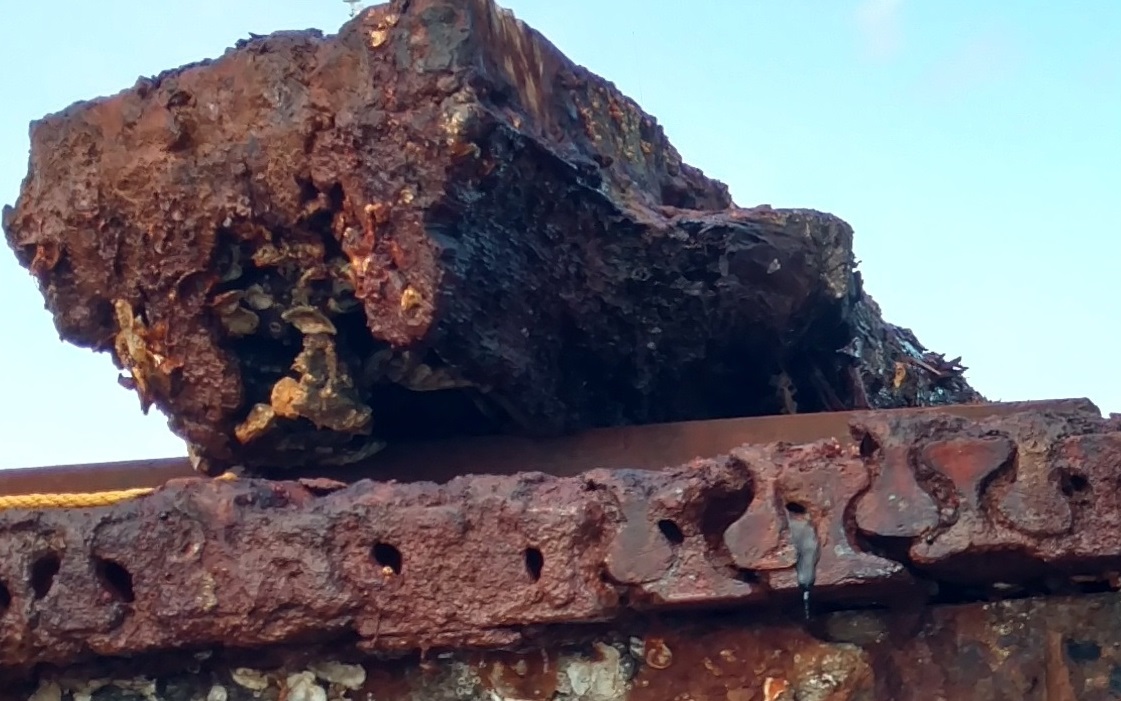
Railroad iron (bottom row) used as armor in casemate (Picket photo)

The massive report provides an inventory of recovered artifacts and states that archaeologists garnered insight that does help with understanding of the CSS Georgia.

The conclusion lays out the challenge.

“Although the CSS Georgia played a critical role in the Confederate defenses of Savannah, historical documentation associated with the ship is marginal at best. Design, engineering, and construction data are virtually nonexistent. Life aboard the ‘floating battery’ was apparently so mundane that most surviving correspondence from those aboard ship relates to dispersions associated with the vessel’s speed and handling or the miserable living conditions within the casemate and hull. Many questions associated with the design, construction, and operation of the Georgia may never be answered.”

Over the years, the Picket has corresponded with underwater archaeologist Gordon P. Watts Jr. about the project. We spent some time with him in summer 2017 at the recovery site. He has been involved in dozens of shipwreck investigations, including the USS Monitor.

Watts, who has worked on the CSS Georgia site over several decades, recently answered some questions from the Picket. He was a co-author of the final report on the project. His answers have been edited for brevity:

Gordon Watts in 2017 during CSS Georgia recovery (Picket photo)

Q. What do you think should be the public’s chief takeaways on your findings regarding the CSS Georgia?

A. The design and construction CSS Georgia has always been a mystery due to the lack of historical documentation. While the CSS Georgia site was a salvage site and not a wreck (site), our investigation generated considerable information about the design and construction of the casemate and the steam machinery.  In addition, the investigation produced an extensive and valuable collection of artifacts associated with CSS Georgia's ordnance and life aboard the "Mud Tub.” Our report is the most comprehensive documentation of any archaeological record of vessel structure and life aboard a Confederate ironclad to date. While no museums have apparently expressed serious interest in exhibiting structural material or artifacts recovered from the site, a massive collection has been conserved and is being stored so public exhibit options will be available in the future.

Q. There has always been a lot of mystery about the CSS Georgia: Its length, weight, propulsion system, design, etc.  Were you able to make firm conclusions on any of those?

A. Due to the fact that the site reflected the evidence of salvage activity and not a wreck, firm conclusions about the CSS Georgia's design and construction were limited. However, information about the casemate, the only structural evidence at the site, and recovered elements of the steam machinery permitted the casemate to be reliably computer reconstructed. Based on the configuration of the casemate and recovered steam machinery, several possible hull design concepts were identified and computer-reconstructed. 

Q. The report says the ironclad had two engines and two propellers. Besides the vessel, being underpowered, do you know enough yet to determine the efficacy of the propulsion system? Were there any surprises, or signs of ingenuity? 

A. Due to funding limitations and scheduling for analysis and reporting, no comprehensive assessment of the machinery efficiency, or lack thereof, has been carried out to date.  Elements of the steam machinery, engine cylinders, frames, flywheel, a propeller and shaft and other parts provided the most comprehensive evidence of why CSS Georgia was, as historical sources confirm, seriously underpowered.

Q. Your report describes the Georgia as being unique. In what way?

Casemate was out of water briefly in 2017 (Picket photo)

A. Unique in the fact that CSS Georgia was an ironclad "floating battery" and never really functioned as a warship like other Confederate ironclads.

Q. It appears from the introduction and conclusion that the profusion of the artifacts is among the most important things about the project. The report says their discovery filled in some knowledge gaps. How so?

A. Recovered machinery filled in one of the largest gaps in knowledge about CSS Georgia.  Evidence of small arms confirmed much about the weapons, personal and military, that were in use aboard the battery. Buttons provided insight into uniforms and clothing. Tools provided insight into the operation, maintenance and repairs requiring the attention of engineers and mechanics.

Q. You have been on many wrecks. What stands out about the CSS Georgia, when it comes to the nature of its artifacts?

A. Artifacts from the CSS Georgia site reflect activities associated with the priorities of a salvage operation likely terminated prematurely.

Q.  Are there any artifacts still being conserved or analyzed that could substantially add to the vessel’s story or to add principal questions?

A. Conservation is still ongoing in the facility at TAMU. Many elements of the steam machinery remain to be cleaned, conserved and documented. Those artifacts will likely continue to enhance our knowledge of the battery and its operation.

Watts' drawings of railroad iron used for armor (Picket photo)

Q. The report says the Georgia likely had a flat barge hull. Was that surprising?

A. We are not at all sure about the configuration of the hull. A barge configuration would have been the simplest to construct and would have certainly contributed to her poor performance as a vessel. However, we have no physical evidence to confirm historical suggestions to the nature of the hull design. It is possible that wreck remains near the South Carolina shore could be associated with CSS Georgia. To date, no archaeological diver investigation of the structure at that site have been undertaken.

Q. Anything else to add about the project? Are there remaining mysteries?

A. Archaeological investigation can resolve questions. However, it is frequently the case that archaeological investigation is just as likely to identify many questions previously not even considered. With the "Mud Tub," I suspect that there will always be unsolved mysteries. Our investigation certainly confirmed both to be the case.

Wednesday, October 21, 2020

A staggering haul: Final report on CSS Georgia recovery details thousands of artifacts pulled from Savannah River

Dahlgren cannon, bayonet hilt, eagle breast plate (USACE-Savannah)

It’s been more than three years since the last of  an estimated 13,601 artifacts brought ashore from the Confederate ironclad CSS Georgia wreck site were loaded onto a truck and sent from Savannah, Ga., to Texas A&M University for conservation.

Archaeologists who worked with US Navy divers in 2015 and 2017 to clear the remnants of the floating battery used to guard the city’s defenses from autumn 1862 to December 1864 earlier this year filed a final report on their efforts.

They detail what’s known about the ship’s design, construction, propulsion, armaments and life aboard the “Mud Tub,” which was scuttled as Sherman’s forces neared Savannah.

Gordon Watts, who helped prepare the report written by Panamerican Consultants for the U.S. Army Corps of Engineers, recently reminded the Picket that the wreck site a hundred yards off Old Fort Jackson was not undisturbed.

Rather, 20th century dredging disturbed the site and salvage operations not long after the Civil War removed a quantity of artifacts that might have filled in gaps about the underpowered CSS Georgia. A portion of the final report includes a fascinating passage by CSS Georgia documentary maker Michael Jordan about that salvaging and why one man involved tossed some of the recovered material back into the river out of frustration with the contract and officials.

The sheer number and array of artifacts -- which includes interlocking railroad iron used to for armor -- found in the river make up a large part of the massive report. In a future post, we will feature a brief Q&A with Watts and discuss a few answers to key questions raised about the CSS Georgia before the diving and mechanized recovery even began.

Here’s a summary of some of what was found in 2015 and 2017 as part of the Corps’ efforts to remove barriers in the Savannah harbor to make way for a significant deepening of the vital shipping channel:

Material associated with the CSS Georgia: 440 tons

Recovered artifacts: 32,782

What was or is being conserved: 13,601 artifacts weighing 165 tons

What was reburied in the river: 19,181 artifacts weighing 274 tons

Largest portion of surviving casemate (USACE)
Total dives (including contracts and Navy: 314

Number of cannon recovered: 5 (others were previously found). Divers and crews on a barge pulled up two IX-inch Dahlgren cannon, a small cast iron 6-pounder and two 6.4-inch single-banded Brooke rifles. Three have been cleaned and are ready for shipment to the National History and Heritage Command, which stores the artifacts at the Washington Navy Yard. The second Dahlgren and Brooke will be finished shortly.

6-pounder case following conservation with shot and wood sabots (USACE)
Large-caliber shells: “In total, 246 large caliber shells and bolts were brought up, as well as complete and partial stands of grape shot, evidence of canister rounds and smaller 6-pounder solid shot, including a remarkably well preserved box filled with 6-pounder shot. Totals for the larger munitions include 127 conical shells for the 6.4-inch Brooke rifle, 69 spherical shells for the IX-Inch Dahlgren smoothbore, and 49 bolts for the Brooke rifle.”

Discarded military munitions: 246

Single-shot percussion or flintlock pistol (USACE)
Firearms: 1. It was a single-shot either percussion or flintlock pistol. “Although there is no mention of single-shot pistols being standard issue to the Confederate soldiers as seen in the inventory the use of non-standard issue weapons is not unheard as the Confederate military used whatever was available and soldiers often utilized their own personal, non-issued weapons. The absence of the other pistol and rifle types in the artifact assemblage is not surprising, as these were most likely wanted and easily carried by the abandoning crew members.”

Small arms rounds: 153 of varying caliber and make were recovered from the CSS Georgia.

Casemate: South section recovered, East and West sections reburied

Propellers recovered: One, the other may have been previously salvaged

Steam cylinders found: Both

Clothing buttons: 24 (metal, glass, wood, bone and composite)

Tools: 38, including augers, axes, chisels, drills, files, hammers, pliers, scrapers, and wrenches

Hammers: 5

Kaolin smoking pipe bowls: 8 (example, photo right)

Bayonet hilts: 6, all being saber or sword-type bayonets. “Ironically no examples of Enfield bayonets have been recovered, as this was the type of rifle found on the ship.”

Swords: Two model 1832 foot-artillery swords were recovered. The M1832 foot artillery sword was developed and manufactured by Nathan P. Ames, and had multiple variations in blade size and shape. The identifiable portion of this sword is the grip, with the straight set perpendicular to the grip.

Among the most significant artifacts were pieces associated with brass gun sights and percussion locks.

“These were used in tandem to provide a greater degree of accuracy and instant discharge of the gun during naval engagements. Instruments of this type are relatively rare in archaeological settings because brass instruments like these were typically melted down and repurposed after the Civil War. The group of brass naval gun sights and percussion locks recovered from the CSS Georgia represents one of the largest, if not the largest, ever recovered from a Civil War site.”

Jim Jobling, lab manager at Texas A&M's Conservation Research Laboratory, puts the number of artifacts sent to Texas a bit higher than the number listed by Panamerican. He says the lab has conserved 13,761 out of 18,399 items. About 10,500 have been shipped and the lab has another 3,200 ready to go.

Panamerican Consultants, which is based in Memphis, Tenn., said the recovery generated extensive data on the ironclad.

“Three sections of casemate, disarticulated railroad rail armor, elements of steam machinery, and ordnance comprise the major surviving elements of the vessel. Small artifacts, vessel hardware, and fastenings are also present in association with those elements.”

Buckles like this were made  in nearly all states (USACE)
The top right image in this blog post is an eagle-embossed breast plate shown before conservation. These cast brass items were issued to Union soldiers and attached to their cartridge box shoulder belt.

On the front side, there is a depiction of an eagle holding arrows of war and olive branches of peace in its talons. On the reverse side, there are two sets of holes for the hooks that were necessary for attaching the plate to the cross-chest lanyard of a cartridge box. These were made by multiple manufactures from the early 1850s to the end of the Civil War. Soldiers often referred to the plate as a “shoulder belt plate.”

Part 2: A conversation with archaeologist, diver Gordon Watts about the wreck

Jim Jobling sprays down engine cylinders (USACE)

Friday, October 2, 2020

Man who created and sold a fake Civil War-themed desk gets probation. His victims say the pain endures. Why did he do it?

(Courtesy of John Banks'
Civil War blog)

Harold Gordon says he fashioned and sold a fake Civil War memorial desk because debilitating medical problems left him in a financial crisis. The federal government contends he methodically duped a renowned art dealer, and by extension a museum and curator -- and caused lasting harm to their reputations.

The cost of Gordon’s scheme is detailed in federal court documents filed before he was sentenced Tuesday in US District Court in Connecticut to five years’ probation and restitution.

The government had argued a sentence of 12 to 18 months in prison followed by supervised release would be within guidelines. The judge cited the retired self-employed antiques dealer's health when issuing the sentence.

Gordon, who claimed to have bought the ornate desk from the descendant of a Connecticut soldier, pleaded guilty in January 2019 to one count of wire fraud.

“Harold Gordon has caused me severe embarrassment, loss of my nationally recognized reputation as a foremost expert and an unmeasurable loss in business,” folk art expert and “Antiques Roadshow” appraiser Allan Katz said in a court document.

Gordon, 71, a master woodworker, admitted to converting a secretary desk at his Templeton, Mass., home into an extravagant fake.

According to the government, Gordon, by “engaging in mendacity at every turn,” told Katz that the circa 1876 desk was made for the family of a Connecticut soldier, John Bingham, who died at the Battle of Antietam in 1862. Gordon’s calculated efforts included providing false provenance for the piece of furniture, authorities said.

“He further falsely stated that the surviving members of the soldier’s regiment, including Wells Bingham (John’s brother), had decorated the secretary desk to give as a war memorial to the fallen soldier’s family,” prosecutors said in a presentencing memo.

Desk in Hartford in 2017 (Courtesy of John Banks' Civil War blog)

While the Bingham boys did fight with the 16th Connecticut Infantry, the story about the desk wasn’t true. Gordon’s exacting work on the desk was convincing, down to the Civil War-era tools and materials he used in the scheme.

Standing 8-feet tall, the desk, made of walnut, oak and maple, has drawers, a bookcase and intricate artisanal touches. The handcrafted the words “Antietam” and “Sept. 17, 1862” were made from barnyard bone and Gordon fashioned a cloth star out of period fabric to make it resemble a remnant of the 16th Connecticut’s battle flag, prosecutor asserted. A clock at the top includes the words “The Union Preserved.”

Gordon sold the desk to Katz – who had studied the desk for its authenticity – in March 2014 for $64,500. Katz made a video detailing the desk and it was put up for sale for $375,000, according to news reports, at the Winter Antiques Show in New York. The Wadsworth Atheneum Museum of Art in Hartford, Conn., purchased the desk for an undisclosed price in early 2015. Katz later paid another $25,000 to Gordon because of the tidy profit from that sale, prosecutors said.

(Courtesy of John Banks’ Civil War blog)

At the time, the museum said it was “thrilled to add this stunning piece” to its collection of folk art and Civil War-era items.

Civil War blogger John Banks, who has followed the story of the desk for several years, detailed what’s known about the Bingham brothers in a 2011 post. The East Haddam residents were just teenagers when they joined the Union army. John, 17, son of a farmer, died in the fighting at a cornfield at Antietam. Wells survived the war

The story of the amazing artifact unraveled in 2018, according to reports, when the editor of the Maine Antique Report noticed the Bingham desk appeared to be similar to an unadorned desk photographed at Gordon’s home. The woodworker then admitted the desk’s story was bogus.

Gordon was boastful about the fraudulent piece and said that he “had created a new art form,” the government contended. “It’s the apotheosis of my own making,” Gordon said in an interview, according to a March 2018 New York Times article.

Detail of Abraham Lincoln (John Banks)
In a memo filed with the court, a federal public defender detailed a litany of health conditions, including a stroke, Gordon has endured. “In 2014, at the one of the lowest points in his life, he sold a prized possession: a Victorian-era secretary desk which he had elaborately decorated and for which he had created a semi-fictional historical backstory.”

Gordon apologized Tuesday via video conference, according to the Hartford Courant.

His lawyers argued that when he first began work on the fake, he had no intention of selling it. He worked from a desk that indeed dated to the Civil War period, they stated.

“He put the piece in his living room and intended to keep it. But when his medical conditions intensified in 2012, impeding his ability to work, and his medical expenses mounted, he grew desperate,” they argued in documents.

Katz, in his written statement, said Gordon “has caused me severe embarrassment, loss of my nationally recognized reputation as a foremost expert and an unmeasurable loss in business.” He said the master craftsman spent two years working to deceive him and basked in the attention he gave in interviews about his fraudulent handiwork.

Gordon’s lawyers have said their client was not motivated by money or prestige.

Katz made full restitution to the Hartford museum, which said forgers like Gordon do great damage to the cultural marketplace. “The opportunism of this forgery was both craven and bald in its intent to maximize financial gain and to ensnare a number of institutions and organizations in the process,” the CEO for the Wadsworth Atheneum said.

The unidentified curator involved in the transaction no longer works for the museum.

“Mr. Gordon has deeply impaired my credibility as a scholar and curator. As a result of Mr. Gordon’s crimes, my achievements and relationship with the Wadsworth Atheneum have been completely incinerated. I will never be able to return to this institution that once valued my service and applauded my efforts as a curator,” she wrote.

The Picket reached out Thursday to Gordon’s federal public defender but did not hear back. His lawyers wrote that Gordon had no previous criminal history and he hopes to make restitution to Katz.

The desk had been on exhibit at the Hartford museum for about three years before the ruse was detected. The Wadsworth Atheneum said Friday it had no new comment on the matter. It confirmed it not longer has the desk.

U.S. District Judge Jeffrey A. Meyer ordered Gordon to also pay $84,500 in restitution to Katz, who retained the item. The latter said in a 2019 interview that he and his wife “plan on donating it to an institution that might be receptive to having it.” 

According to the Courant, Meyer said he would have sent Gordon to prison if it were not for his health problems, which include cardiovascular and Parkinson’s disease.

Thursday, September 17, 2020

Remembering Ed Bearss: Marine veteran, Civil War historian, author, speaker and one-of-a-kind Pied Piper of the battlefield

Bearss at Allatoona Pass, Ga., in 2010 (Georgia Battlefields Association)
Whether leading a battlefield tour, giving a lecture or appearing on Ken Burns’ 1990 PBS miniseries “The Civil War,” historian Ed Bearss commanded attention.

Edwin Cole Bearss, who died Tuesday at age 97, was a legendary figure in the Civil War world. Tour participants hung on his every word as he walked the grounds and gave precise details of what happened there, usually without notes. His voice, itself riveting, was described as thunderous or booming.

The historian incredibly led tours until late last year, when it became evident his health would not permit him to continue. Charlie Crawford, president of the Georgia Battlefields Association, told the Picket then that no other expert could emulate Bearss.

The American Battlefield Trust this week detailed his career as a decorated Marine severely wounded during World War II, National Park Service historian, author, preservationist and lecturer. Among his accomplishments with the NPS was the discovery and raising of the USS Cairo in the 1960s, when Bearss was historian at Vicksburg National Military Park. 

The Picket asked Crawford for a memory relating to Bearss. Here is his response:

(American Battlefield Trust)
"As you know, stories about Ed are legion. Jack Waugh's 2003 biography of Ed is titled "History's Pied Piper," and we witnessed this effect many times in the years that Ed led Georgia Battlefields Association tours and when we would attend American Battlefield Trust events where Ed led tours.

In the last few years, Ed asked that we request a wheelchair and meet him at the airport arrival gate when he came to Atlanta to lead one of our tours. Ed realized he was having trouble navigating the crowded airport corridors, even though he didn't use a wheelchair when he was on a battlefield.

At Utoy Creek in 2018 (GBA)
Bill (-----) usually had the task -- more of an honor than a task -- of meeting Ed, and Ed would often engage the wheelchair attendant in conversation while transiting from the gate to baggage claim. Ed's knowledge would amuse and amaze the attendant, and Bill would notice that other travelers would adjust their pace so that they could hear what Ed was saying.

Of course, they didn't have to be too close to Ed because he had a "trumpet voice," to use his own characterization. So the crowd around Ed would grow as he transited. Some people would approach Bill at baggage claim and ask the identity of the man in the wheelchair and how it was that he knew so much.

Occasionally, someone would recognize Ed and ask if he remembered a tour they were on years ago. Of course, he always did and usually responded with an anecdote about that specific tour. He truly was a pied piper."

Bearss, after living 50 years in Arlington, Va., had recently moved to Mississippi, where he has family, according to the trust and the funeral home in Pearl handling his arrangements.

Tuesday, September 8, 2020

'Doc' Holliday's father and adopted brother served during the Civil War. Here's the Georgia city where the Western gunfighter's legend began


Did John Henry “Doc” Holliday kill nearly a dozen men, or perhaps only a few? Was Holliday’s tuberculosis contracted from his mother? Was he involved in a deadly incident at a Georgia swimming spot that foreshadowed a penchant for violence?


These questions and many more swirl around the dentist, gambler and gunman who became the stuff of legends (and dime novels and movies) relating to the Old West. One thing we know for sure: Holliday’s story begins in Griffin, Ga., where he was born in August 1851 and lived for more than two years during the Civil War.

I came upon Holliday by surprise last month when I was in Griffin to visit the site of Camp Stephens, a training center for Georgia troops during the conflict. Griffin is about 40 miles south of Atlanta.

There, along a road on the edge of surviving entrenchments, is a marker topped by a photograph of the young Holliday. It describes how his father, Confederate Maj. Henry Burroughs Holliday, once owned the land on which the camp was built.

Henry Burroughs Holliday
Henry B. Holliday

The elder Holliday briefly served as quartermaster for the 27th Georgia Infantry during the war before he resigned due to poor health.

While I have long known that “Doc” Holliday lived in Valdosta, Ga., for a few years, I was unaware he was from Griffin, where he has been remembered in a barbecue festival, a downtown bar bearing his name, a now-closed museum and “Doc Walk,” seven markers that detail aspects of his life in the town.

A local brochure aptly subtitled “Where the Legend Begins” offers a walking/driving tour for those interested in learning about Holliday’s boyhood roots.

There are so many stories about Holliday that end with, “We don’t know for sure.” An example: Some believe he is buried in Griffin, while most historians list his resting place as Glenwood Springs, Colo., where he died at age 36.

“He is mostly myth and legend. He is mostly smoke and mirrors,” says Cindy Barton, founding archivist at the Griffin-Spalding Archives and a Holliday researcher.

“Doc” Holliday grew up in comfort in Griffin. His father was a successful businessman and public servant who owned several properties on Tinsley Street, where the boy was born to Henry and Alice Jane McKey Holliday. He was baptized at the town’s Presbyterian church.

“One recollection I read said he was just an average person, he wasn’t anything that would cause attention,” says Barton. Some claim that Holliday learned to play cards and use a gun when he was growing up and visiting his uncle’s home near Atlanta.

Val Kilmer as "Doc" in "Tombstone"
A sister, Martha, died at just 6 months old before Holliday was born.

“This, however, didn’t mean the Holliday house was empty of family -- Henry Holliday had come to his marriage with one son already, a Mexican orphan boy he had found during his service in the war with Mexico and had taken home as a foster child,” wrote Holliday expert and author Victoria Wilcox in True West magazine. “Francisco Hidalgo (aka E’Dalgo) was near 15 years old when John Henry was born, but still living in Henry’s home, a kind of adopted older brother to Henry’s new son.”

When the Civil War broke out, Henry Holliday joined the 27th Georgia, serving at Manassas and Richmond, Va., while Hidalgo enlisted in the 30th Georgia Volunteer Infantry. (Like "Doc," Hidalgo died from tuberculosis, in 1873.)

Henry Holliday left the Confederate army in mid-1862, suffering from “watery dysentery,” according to Wilcox, and moved his family to Bemis, a community just north of Valdosta, in 1864. Alice Holliday died of tuberculosis two years later, and Henry remarried shortly thereafter, moving to Valdosta, where “Doc” attended Valdosta Institute.

“Holliday’s years in Georgia are shrouded in mystery,” states an article in the New Georgia Encyclopedia. “Family folklore involves Holliday in a shooting incident on the Withlacoochee River, northwest of Valdosta, in which he may have shot and killed one or more African Americans. Although no contemporary record of the event exists, the story fits the violent nature of his later years out West.”

(Courtesy of Griffin Spalding Archives)
No one knows for sure what happened. Some accounts said Holliday and a relative fired over the heads of those who were swimming.

At 19, Holliday attended the Pennsylvania College of Dental Surgery, graduated in 1872 and briefly practiced at the Atlanta office of Dr. Arthur C. Ford. Barton says Holliday was known to be a talented dentist during his brief career.

Holliday returned to briefly to Griffin, and it’s possible he practiced there for a short time. The dentist sold property he inherited from his mother and moved to Dallas in 1873, where he practiced with Dr. John Seegar.

“He quickly made a name for himself as a card player, and often quarreled with other gamblers,” according to the New Georgia Encyclopedia. “In 1875, Holliday was arrested for trading gunfire with a saloon owner. Although the charges were eventually dropped, this incident along with several gaming charges, caused him to leave Dallas.”

The rest, as they say, is history.

Remnants of training fortification at Camp Stephens (Picket photo)
Holliday lived in several towns across the West, was involved in many violent encounters, and befriended Wyatt Earp. His most famous moment was the 1881 “Gunfight at the OK Corral” in Tombstone, Az. How many men did Holliday kill in all? No one knows for sure.

Barton says gambler and writer W.R. “Bat” Masterson helped create the Holliday legend. In 1907, Masterson wrote of the wayward dentist: “Holliday had a mean disposition and an ungovernable temper, and under the influence of liquor was a most dangerous man.”

“Holliday seemed to be absolutely unable to keep out of trouble for any great length of time,” Masterson continued. “He would no sooner be out of one scrape before he was in another, and the strange part of it is he was more often in the right than in the wrong, which has rarely ever been the case with a man who is continually getting himself into trouble.”

Holliday’s exploits ended in November 1887, when he died of tuberculosis. His father, Henry, died in Valdosta in 1893.

Barton, who researched and wrote text for the “Doc Walk” markers, finds Holliday’s family history as interesting as his Old West legacy. But there’s no disputing where his fame lies.

“He grew up in a turbulent time and he became a man made famous by circumstance,” she says.