Sunday, October 20, 2019
Cornfield relics can help in battlefield mapping at Maryland site
By using metal detectors and
ground-penetrating radar to locate artifacts, archaeologists in Maryland hope
to create a more comprehensive map of how each skirmish during the Battle of
South Mountain played out. As a result of their findings, a historic military
geographer will then be able to map out which roads and
areas the troops traveled through still exist and document them more fully. • Article


Sunday, October 6, 2019
Civil War-era bell passed down by family is back home in Appomattox
After almost
50 years spent in the basement of Ora McCoy’s Appomattox, Va., home, a family
bell passed down through five generations has found a new life ringing in
history along the East Coast. Originally unearthed for the commemoration of the
150th anniversary of General Robert E. Lee’s surrender at Appomattox Court
House in 2015, the bell found its way to other park ceremonies. McCoy’s
great-grandparents, Daniel and Phoebe Scruggs, once lived as slaves on the
Scruggs family farm in Appomattox. They have owned the bell since the Civil
War, passing it from hand to hand until it found its way to McCoy. In September, after a stint at the Fort Monroe
National Monument, the bell came home. • Article
Thursday, September 19, 2019
Red Jacket: A reconstructed cannon, a colorful coat, a high school and a beer tell the story of the Columbus Guards, a Georgia militia unit
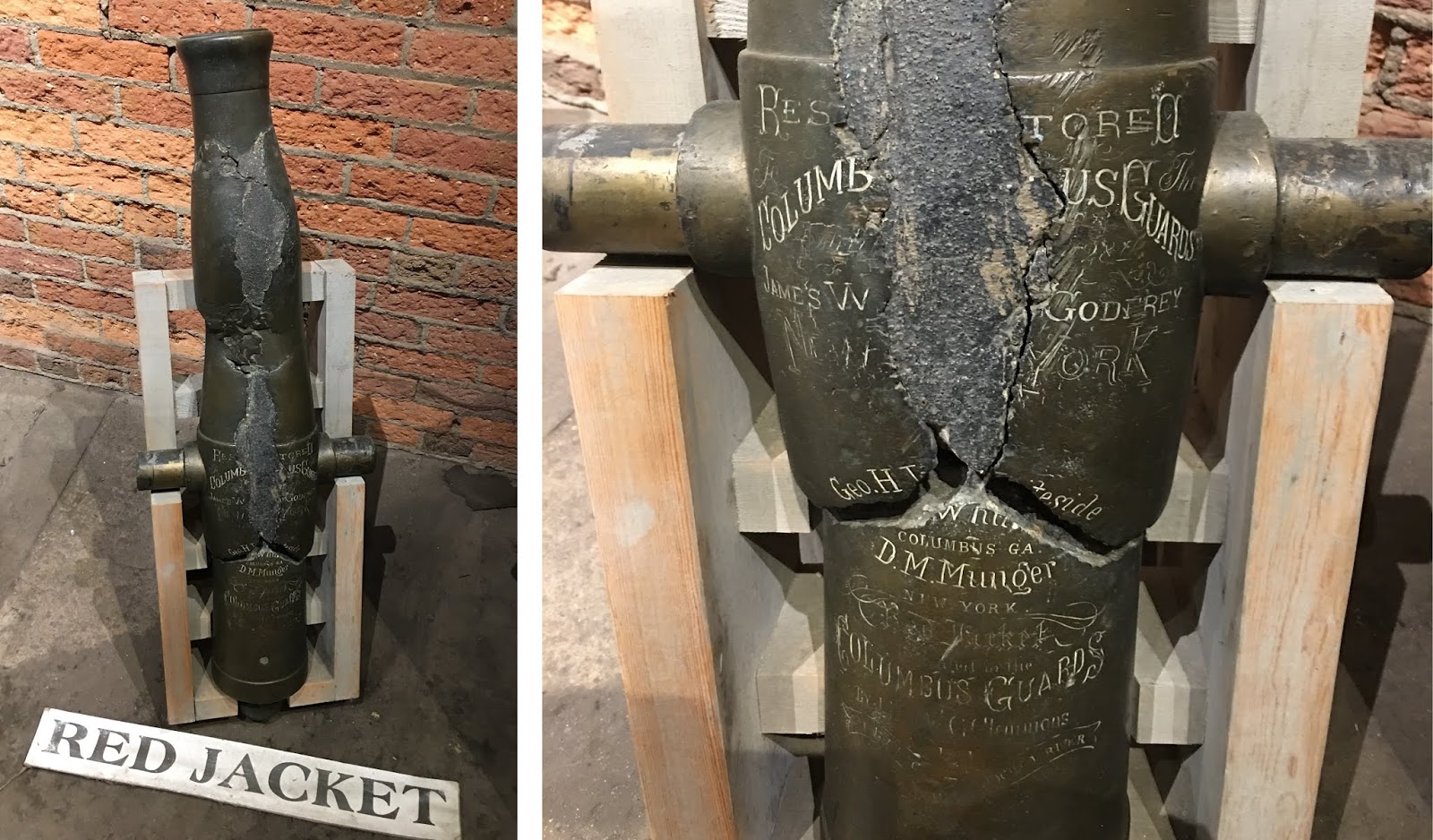 |
| The Red Jacket cannon (Courtesy of Columbus Georgia Convention & Trade Center) |
Named for the bright red coat worn by members of a 19th century militia unit that used the artillery piece to fire salutes, “Red Jacket” rests in a brick room at the Historic Iron Works, also known as the Columbus Georgia Convention & Trade Center. The room showcases items important to the city’s history and growth.
 |
| Courtesy of the Columbus Museum |
What the
visitor can’t fully make out is the fractured condition of Red Jacket, which
belonged to the Columbus Guards and was fired during celebrations. In its early
days, Red Jacket fired a salute when Georgia seceded from the Union and was
hauled to Montgomery, Ala., for the February 1861 inauguration of Jefferson
Davis as president of the Confederacy.
An historical marker not
far from the Iron Works, which was a major manufacturing site for the South,
summarizes the gun’s rather unique story:
“Red Jacket was purchased by Mrs. Laura
Beecher Comer in 1861 and presented to the Columbus Guards. During the war
period it was used to fire salutes to Confederate victories in the Army and
Navy. When a Federal army approached Columbus in 1865, some members of the
Columbus Guards, fearing the little gun would be captured, threw in into the
Chattahoochee River near the city wharf. Four years later, it was accidentally
drawn up on the fluke of an anchor. The finders sold it as junk and it was
carried to New York City and bought by J. W. Godfrey, an armorer. A newspaper
reporter saw Red Jacket and wrote a description of it in a New York paper. The
clipping was sent to L.H. Chappell, then Captain of the Columbus Guards, in
1884. Correspondence ensued and Mr. Godfrey restored the gun to the Columbus
Guards. In 1930 Red Jacket was stolen from its carriage on Upper Broad Street
and conveyed to the river bank. When fired, it burst into many pieces. Alva C.
Smith, secretary-treasurer of the Historical Society of Columbus, found all the
pieces and had the gun mended and rebuilt.”
Whew.
Today, the
Red Jacket name lives in several places in this west Georgia river city that
borders Phenix City, Ala. There are the Jordan Vocational High School Red Jackets, a replica
cannon and Red Jacket beer at a brew pub not far from the Iron Works, and the
sole surviving example of the Red Jacket coat itself, on rotating display at
the Columbus Museum.
City provided much to Confederacy, fell at war's end
The Columbus
Guards, local histories say, provided more men for Confederate service than any
other local militia unit and its members took part in more than 30 battles with
the Army of Northern Virginia.
 |
| One of the giant halls at the Iron Works in Columbus (Picket photo) |
Apart from
that, Columbus was an important manufacturing site for the Confederacy, second
only to Richmond, Va.. Factories and shops produced cannon, engines, guns,
swords, textiles and more. The Confederate navy had a shipyard just below the
Iron Works. The ironclad CSS Jackson (Muscogee) was built and tested on the
Chattahoochee River, only to be burned by Union forces after they took the city.
Columbus fell
in April 1865 in what is believed to be the last battle in the Federal campaign
through Alabama and Georgia.
Today, the
rebuilt Iron Works, the Columbus Museum and the National Civil War Naval Museum on Victory Drive are
the principal reminders of the Civil War.
 |
| Replica of the Red Jacket and beer bearing its name (Picket photo) |
Cannon Brew Pub, one of many restaurant and retails establishments on Broadway in
downtown Columbus, sports a replica of the Red Jacket cannon out front.
The
restaurant (above), which opened in the mid-1990s, serves several brews, including Red
Jacket Ale, which features “the rich taste of extra malt and hops.”
You can
sample that along with the Red Jacket Monte Cristo sandwich. The cannon is fired for the start of
road races and other special events, managers say. The business has numerous
other artifacts and references to the Civil War.
Jacket makes a statement: 'It's quite striking'
 |
| Photos Courtesy of the Columbus Museum |
A few miles
inland along Wynnton Road, at the Columbus Museum, is the only known surviving
jacket from the militia unit. Made from wool and featuring a cotton lining, the
garment was worn by Watkins Banks, one of seven local brothers who fought for
the Confederacy and one of three to die.
The Columbus
Guards formed in 1835 and served in several conflicts, most notably the Civil
War. It was considered among the best-drilled militia units in the South and
was an integral part of upper-class society.
The museum’s website says this: “Banks wore this jacket at Davis’ inauguration in
Montgomery, Alabama, and also during the Guards’ departure from Columbus to
join the Confederate army.
Banks identified his jacket by writing ‘Wat. Banks’ and ‘1861’ on the coat’s interior lining, notations which are still clearly visible.
Banks identified his jacket by writing ‘Wat. Banks’ and ‘1861’ on the coat’s interior lining, notations which are still clearly visible.
Six original
buttons remain, the rest were likely cut as mementos for the family after he was
killed near Atlanta in 1864. New buttons were cast. The buttons bear the initials “CG” and an eagle.
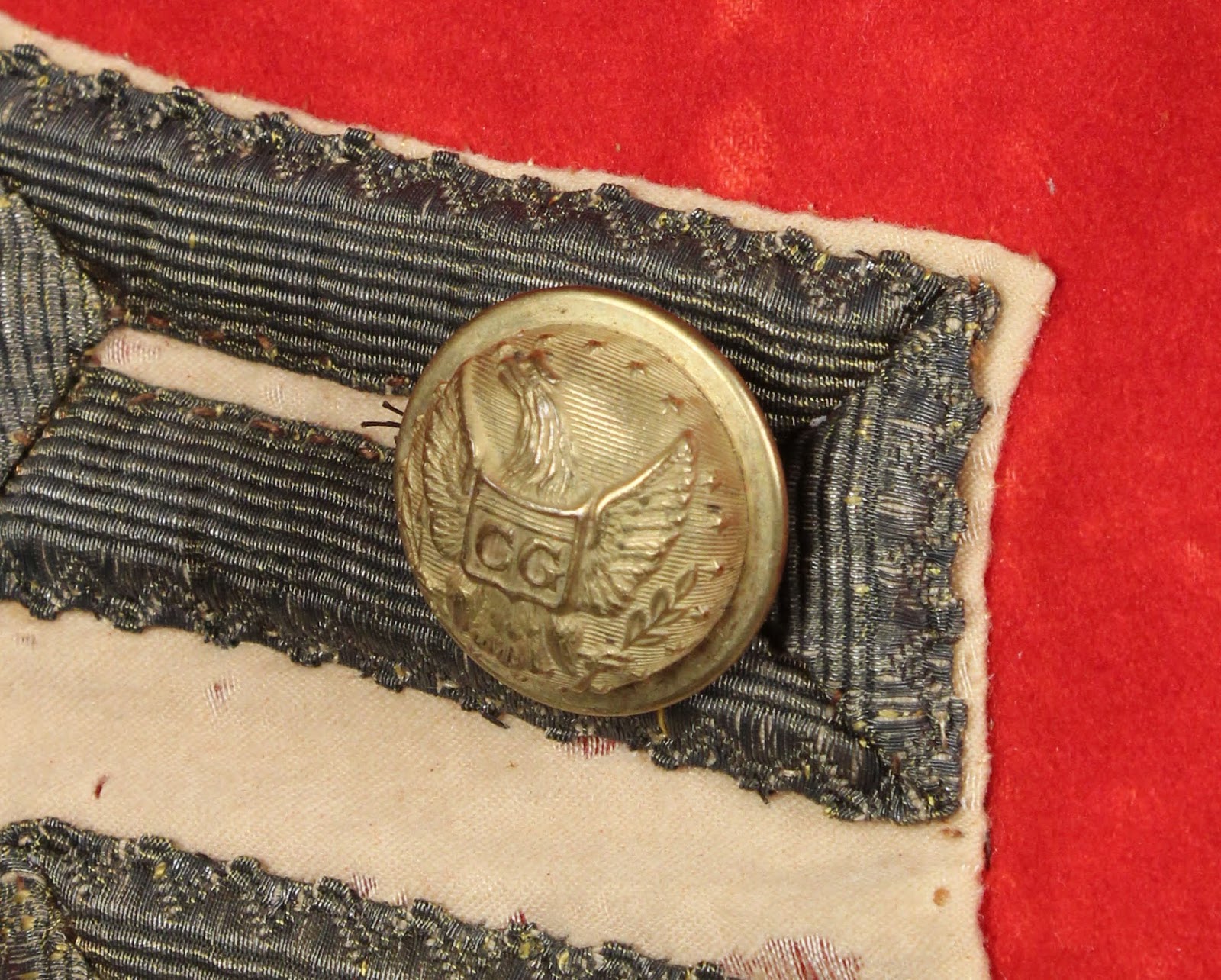 |
| Button from Watkins Banks' jacket |
The garment is
featured in an exhibit about this Chattahoochee Valley city’s history.
“It’s quite striking in the gallery, where it rotates with Confederate
Col. Peyton Colquitt’s gray coat,” said Rebecca
Bush, curator of history and exhibitions manager at the museum.
“Inevitably, some people are happy to see whichever
jacket is currently on view, while others are disappointed that the other
jacket is resting to give it a break from potential light damage,” she said. “In
a way, it’s a nice problem for the museum to have.”
According to
one history, Banks and about 135 others joined Company G of the 2nd Georgia Volunteer Infantry when the war broke out. The unit wore the jacket for
a few months before receiving their new issue of gray. The regiment, which
served in Lee’s Army of Northern Virginia, had its most famous moment at
Antietam, where it held the heights above Burnside’s Bridge with the 20th
Georgia.
Banks’ great-great-great
nephew, John Sheftall, who lives in the old family home in Columbus, says Banks
fought in Virginia, returned home and at some point joined Nelson’s Rangers
with a brother. He was the son of John and Sarah Banks, who lived with their
large family in a home called The Cedars in the Wynnton area.
 |
| Watkins Banks (left) and cousin Willis Butt (Courtesy of Columbus Museum/John M. Sheftall) |
In 1863, Watkins
Banks paid for a substitute, lived in Columbus and then returned to service
during the Atlanta Campaign. The private was killed in August 1864 outside
Atlanta. The bachelor’s obituary states the 31-year-old was then serving with Georgia State
Troops, Sheftall told the Picket.
These Red Jackets try to sting sports foes
The town’s
Civil War history also is represented at another site a few miles from downtown.
During the
1940s and 1950s, Jordan Vocational High School, a fixture in a middle-class Columbus neighborhood,
displayed two cannon that came from the
CSS Jackson.
They were
moved to the old Confederate Naval Museum in the 1960s, said Jeffrey Seymour,
director of history and collections at the National Civil War Naval Museum on Victory
Drive.
 |
| Courtesy of the National Civil War Naval Museum |
“These are the two VII in. Brooke Rifles that we have,”
he said. “One of these is the one that we fire (above). The other is sitting out in
front of the building. Both were recovered from the river.”
“There is a belief held by many Jordan people that the Red Jacket
was named for the iron guns overheating. Not sure where that story came from,”
said Seymour, adding that the small gun was associated with the Columbus
Guards, not the Confederate navy.
 |
| Jordan HS has used the Red Jackets name and logo for years (Picket photos) |

A page on the
school’s website says Red Jacket was placed outside of the old city library and
the Muscogee County Courthouse, where it remained many years before the 1930
caper. Another Civil War weapon, a brass cannon made in Columbus and dubbed the
Ladies Defender, also was placed at the courthouse after the war. Today, the
Ladies Defender is in the same room as the Iron Works as Red Jacket.
Jordan’s sports teams, along with the marching band, still feature the Red
Jackets name and wear maroon and white uniforms. The school’s alma mater appears
to capture the spirit of the little cannon and the Columbus Guards.
With the Carmine and
the Grey afloating,
On high JVHS.
Your name and fame we’re shouting
As we cheer you to success.
As you march unfaltering forward,,
your future great we hail.
May your glory never lessen
And your courage never fail.
the Grey afloating,
On high JVHS.
Your name and fame we’re shouting
As we cheer you to success.
As you march unfaltering forward,,
your future great we hail.
May your glory never lessen
And your courage never fail.
 |
| Courtesy of Columbus Georgia Convention & Trade Center) |
Saturday, September 14, 2019
Atlanta on the move: A stone railroad marker that survived the Civil War got a new home while a replica was put in place
 |
| Replica Zero Mile Post and interpretive signs in downtown Atlanta (Picket photo) |
 |
| Lt. Col. Poe |
The loss of the structure was just one of many blows to the city when Union Gen. William T. Sherman ordered the destruction of buildings and supplies that could possibly help the Southern cause after his men left town on their campaign to bring the Civil War to civilians.
Not far from the northeast corner of the shed stood a stubby granite
post that is associated with the birth of the city. Since 1850, the so-called Zero Mile
Post marked the southeastern terminus of the Western & Atlantic Railroad, one of several rail companies vital to the growth of a young Atlanta.

A replica post (right), interpretive panel and revamped metal sign were put in place earlier this year.
The Georgia Building Authority decided to move Zero Mile Post because a building in which it was enclosed needed to be torn down for a viaduct improvement project.
The relocation idea was opposed by the Atlanta City Council and preservation
and civic groups, which argued that the landmark should stay put. They complained
about the move’s secrecy.
 |
| George Barnard's view of the car shed in 1864 (Library of Congress) |
 |
| The view today (Picket photo) |
The history center and the Georgia Building Authority said the relocation
would protect the post and improve its accessibility to the public. The authority feared motorists or pedestrians
might damage the post because it would be exposed after the building
was razed, officials said.
The Georgia Battlefields Association called the debate a “different sort
of preservation issue,” given you could see both sides of the argument – while the post’s
significance was due to its location, how to protect it once it was
out in the open?
 |
| Sherman's men destroy track; car shed rubble at right (Library of Congress) |
Now, those curious about Zero Mile Post, the Civil War and the city’s
rich railroad history can go to two locations, in a scenario that might appear
to be a compromise.
 |
| (Georgia Battlefields Association) |
The replica milepost is accessible under the Central
Avenue Bridge near its intersection with Wall Street.
The interpretive panel and an updated Georgia Historical Society marker detail the landmark’s significance. Sunlight filters into the dark and dank parking street and parking area where the replica marker juts out from a bed of gravel. (Click here for text of GHS sign)
The interpretive panel and an updated Georgia Historical Society marker detail the landmark’s significance. Sunlight filters into the dark and dank parking street and parking area where the replica marker juts out from a bed of gravel. (Click here for text of GHS sign)
The building that surrounded the post for three decades was
torn down. It had been used as a tourist trolley and police station.
Markers like Zero Mile Post informed
train crews where they were along a route. One side of this marker is engraved with "W&A RR OO" – the
W & A indicating the Western & Atlantic Railroad and the double-zero
designating the beginning of the rail line.
The other side of the marker is
engraved “W&A RR 138.” That indicates the 138 miles from downtown Atlanta
to the W&A’s endpoint in Chattanooga, Tenn.
The original 800-pound marker
measures 7 feet 5 inches, and weighs approximately 800 pounds. That is how the
Atlanta History Center displays it, as opposed to 42 inches exposed in its old
location.
 |
| Mile post before it was enclosed (Atlanta Journal-Constitution) |
 |
| Wartime sites, including car shed (Georgia Battlefields Assn.) |
“It's
worth noting that the replica is on the exact spot of the original. GBA surveyors used GPS to locate the original site (where) the old marker was installed; they came back when we installed the replica."
 |
| Building that housed Zero Mile Stone has been demolished (Picket photo) |
Saturday, September 7, 2019
Sons of Union Veterans honoring man for restoring Mass. graves
Gordon
Shepard is being recognized by a national Civil War descendants’ organization
for his restoration of Union graves. Shepard, a
U.S. Army veteran, completed a restoration project on the Civil War section of Riverside
Cemetery in Saugus, Mass., in April. The plaques
in the Civil War section were mismatched. Some were taller than others and
almost all of them differed in style and font. Shepard found one that was
legible and used a combination of the different styles, and used the stone as a
model when he recreated the markers. Shepard found an old picture of the monument and learned that two small
ledges once held stacks of cannonballs. He reached out to another veteran
volunteer, Nick Milo, who helped him replace them with stacks of granite balls.
• Article
Subscribe to:
Posts (Atom)