In September,
in the shadow of the battlefield at Gettysburg, twins Rebecca and Ruth
Brown opened Civil War Tails, possibly America’s most whimsical war museum. Their
collection of scale-model battle dioramas includes Fort Sumter, the battle of
the ironclads and their masterpiece, four years in the making, Pickett’s
Charge, 1,900 cat soldiers in all. • Article
Tuesday, June 28, 2016


Sunday, June 19, 2016
'Horror of the melee': Stroll at Spotsylvania's Mule Shoe conjures epic scenes
 |
| (National Park Service map) |
You likely
have heard of the Bloody Angle at Spotsylvania Court House. But did you know that scene of
vicious combat was just one part of the Mule Shoe Salient, a bulge in the
Confederate fortifications at the Virginia battlefield?
A few members
of my family recently took a brief driving tour of the May 1864 site and I spent a
few minutes walking paths at the Bloody Angle. It was a pretty, late-spring day
and I worked up a bit of a sweat.
 |
| Line of earthworks near route of Upton advance |
We got a
quick orientation at the exhibit shelter on the beginning of the driving tour.
The next stop recalled the May 9 innovative charge of Col. Emory Upton’s Union
troops, a day after a failed attempt to dislodge Confederates from Laurel Hill.
Upton’s fast-moving column breached the Rebel line briefly, but Lee’s troops
began digging in.
Soon,
thousands of men faced off around the Mule Shoe, which provided a tempting target for Federal commanders.

The photo above shows the area
where Lee mistakenly removed artillery pieces when he thought Grant’s Yankees
were withdrawing. It was a big mistake. Winfield Hancock’s Federals burst through on May
12 and Confederate columns rushed to hold the salient.
According to
the Civil War Trust: “After the initial breakthrough … Lee shifted
reinforcements into the salient just as Grant hurled more troops at the
Confederate works. Fighting devolved into a point-blank slugfest – amid a
torrential downpour – which lasted for 22 hours.”

 |
| Monument to 126th Ohio Volunteer Infantry |
The 24-hour stubborn
Rebel defense of the Bloody Angle, a 200-yard western stretch of the salient,
bought time for Lee's engineers to construct a new line of earthworks to the rear. The exhausted men left the salient to their new positions, leaving a scene of unparalleled carnage.
Grant
left the field a few days when an effort to move on this new position was rebuffed by
massed artillery, according to the trust’s summary.
Spotsylvania,
which followed the Wilderness, was the third bloodiest battle of the war, with a
staggering 30,000 casualties (18,000 Union). It lasted nearly two weeks (May
8-21) and saw vicious hand-to-hand combat at times.
 |
| Look closely and you can make out raised fortification |
The National Park Service, which maintains the site, calls this part of the Overland Campaign inconclusive. Grant continued his efforts to flank Lee’s army.

 |
| South Carolina and New Jersey monuments |
 |
| Confederate troops rushed toward background to reinforce |
Friday, June 17, 2016
At Massaponax: A church that was the site of famous Grant council of war is ministering to 'changing and evolving' world
 |
| Ulysses Grant leans over George Meade's shoulder (Library of Congress) |
 |
| Grant stood near shrubbery area in this modern view |
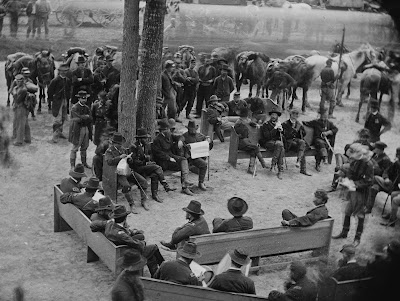
I’ve long
been fascinated by a rare series of Civil War photographs showing a council of
war – outside a Virginia church on a late spring day in 1864. The images are
simply remarkable.
On May 21,
1864, Timothy O’Sullivan, traveling with the Federal Army of the Potomac, set
up his heavy camera at a window on the balcony of Massaponax Church and
photographed Generals Ulysses Grant and George Meade and others as they relaxed
on church pews, wrote orders and surveyed a map after the bloody fighting
at Spotsylvania Court House.
In one candid
view, Grant leans over Meade’s shoulder to study a map as they plot the next
phase of the Overland Campaign -- a move toward the North Anna River. In another,
Grant sits with a cigar clenched in his teeth. Also present is Assistant
Secretary of War Charles Dana and staff officers. Wagons of the Federal V Corps
rumble by in the background.
 |
| Grant (seated between two trees) enjoys a cigar (Library of Congress) |
 |
| Best modern angle I could do without being on the balcony |
My parents and I paid a
quick visit to Massaponax Baptist Church a few weeks ago after visiting part of
the Spotsylvania battlefield earlier in the afternoon. The church is at the corner of a very busy U.S. 1 (then called Telegraph Road) and Massaponax Church
Road. Unfortunately, the sanctuary was closed. Still, it was interesting to
walk around where these giants of the Union plotted strategy.
Today, the
church has one foot in history and the other very much in the 21st
century, meeting the needs of those near and far.
On a video
posted on Facebook this week, incoming pastor Dusty Carson encouraged the
congregation to pray for the Orlando massacre victims and their families. “We
are called to love. The greatest act of love we can do is pray for them.” He
said that Jesus Christ will help heal the battered community.
Shirley
Wilson, a deacon at the church, answered the phone when I called to ask about
the Baptist church’s ministries today.
The
congregation’s diverse 100 members – many of whom commute to work in the
Washington, D.C, metro area -- sponsor a food pantry that serves 150 to 200
families. They also provide school supplies for homeless and low-income
children and take part in the Samaritan’s Purse ministry, an international
relief effort.
“The world is
changing and evolving,” Wilson told me.
 |
| Another Timothy O'Sullivan, before council of war (Library of Congress) |
 |
| (Picket photo) |
There are two
Sunday services: 9:15 a.m. is traditional and the 10:30 a.m. service, which draws more
worshippers, is considered contemporary.
Being in a
heavy traffic zone can be a plus, Wilson said. “Lot of good things happen
because of that.” People who drive by and see the food pantry operation
sometimes send money.
I asked
whether many people interested in the Civil War and the O’Sullivan photographs
stop by. “All the time,” she said. “We think it is a fantastic thing.” Graffiti
left by Federal troops is protected and visible on the balcony, although much
of it has faded over time. “We tried to save most of it.”
The church
was established in 1788. The current brick sanctuary was erected in 1859.
Pastor Joseph Billingsley was famous for preaching long sermons of about two
and a half hours.
“This did not
sit well with the congregation,” the church website says. “On one occasion, it
is said that they wedged the door to exclude him, but he preached his sermon in
the church yard.”

 |
| Fuller views of Grant consulting and writing order (Library of Congress) |
In 1863,
during the middle of the conflict, Massaponax gave letters of dismissal to
black members and they formed smaller churches. Confederate and Union forces alternately
used the church as a stable, hospital and meeting place during various
campaigns.
For a time,
the graffiti was covered by whitewash that covered “unsightly marks and the sad
stories were forgotten.”
Back to that day
in 1864: Grant realized on May 21 that Confederates remained in strong
positions at Spotsylvania and he decided to move to the southeast to try to get
them out in the open.
John
Cummings, in his Spotsylvania Civil War Blog, has written about the morning
that Grant and his subordinates stopped by the church.
According to
Cummings, Grant wrote one dispatch from Massaponax, to Gen. Ambrose Burnside.
One of the O’Sullivan photographs shows Grant scribbling on a paper pad.
GENERAL: You may move as
soon as practicable upon the receipt of this order, taking the direct ridge
road to where it intersects the Telegraph road, thence by the latter road to
Thornburg Cross-Roads. If the enemy occupy the crossing of the Po in such force
as to prevent your using it, then you will hold the north side at Stanard's
Mill until your column is passed, and move to Guiney's Bridge. General Wright
will follow you and will cover the crossing of the Po for his own corps. At
Guiney's Bridge you will receive further directions if you are forced to take
that road. If successful in crossing at Stanard's your march will end at
Thornburg.
U. S. Grant,
Lieutnant-General.
U. S. Grant,
Lieutnant-General.
The
Metropolitan Museum in New York, which has a copy of one of the photographs
(which are stored at the Library of Congress), says of that day:
“The chaotic study is one of the most daring made by any
Union photographer. … Evidence suggests that it had been a disastrous day for
the Union troops, as the losses were heavy and no strategic advantage had been
gained. In the background are rows of horse-drawn baggage wagons and ambulances
transporting supplies for the next day’s engagement and the wounded to field
hospitals.”
A soldier in one of the photographs
went on to receive the Medal of Honor for postwar gallantry. You can read about that here.


 |
| View of busy U.S. 1 (Jefferson Davis Highway) |
Wednesday, June 15, 2016
'Breathing on Dry Bones': Iowa county, descendants dedicate Littleton monument
 |
| (All photos courtesy of Will Thomson) |
Will Thomson, designer of a monument that honors the six Littleton brothers of Iowa who served and
died during the Civil War, wrote the following about the dedication on Tuesday
afternoon. We thank him for the contribution.
The dedication of the
Littleton Bothers Monument took place at Toolesboro, Iowa, yesterday, June 14,
at 4 pm under sunny skies with Gov. Terry Branstad and about 250
guests in attendance. Company A, 49th Reg. Iowa Veteran Volunteer Infantry --
“The Governor’s Own Iowa Rifles” provided color guard and flag ceremony and Ms.
Elaine Pacha played “To the Colors” and Taps during the ceremonies.
The Wapello High
School band performed "The Battle Hymn of the Republic” and “The Star
Spangled Banner.” Gov. Branstad spoke and the keynote address was given by Dr.
Tom Morain, history professor at Graceland University. The “Governor’s
Own Iowa Rifles” presented award certificates to Project Chair Tom Woodruff and
Ed Bayne, who together had rediscovered the tragic history of this Iowa
family’s sacrifice to freedom.

Almost two dozen
Littleton family descendants (above) were present at the ceremony, and (historian) John
Busbee served as master of ceremonies. A reception followed at the
Wapello site of the Louisa County Historical Museum.
The ceremony itself
was an admixture of pride, celebration and somber contemplation. The assembled
guests and speakers were at various points choked up by the emotions of the
day, and much reference was made to the rediscovery of the story and the acknowledgment
of the saga of the bravery and loyalty of the brothers for a cause that still
resonates today. Dr. Morain’s speech was entitled “Breathing on Dry Bones,” a
reference to the valley of dry bones seen to be restored to life in the Book of
Ezekiel.
 |
| Gov. Terry Branstad with color guard member |
Over 202 individuals
and businesses contributed to create the 32,000-pound monument, which is
surrounded by a hexagonal plaza and ringed by six new oak trees, one for each
brother named and marked with a large granite stone.
Monday, June 13, 2016
On Flag Day, Iowa community will honor 6 brothers who died during the Civil War
 |
| (Courtesy of Will Thomson) |
Gov. Terry
Branstad will be among the dignitaries attending Tuesday’s afternoon dedication
in Louisa County of a monument to six Iowa brothers who died during the Civil War.
The Littleton siblings – George, John, Kendall, Noah, Thomas
and William – will forever be memorialized in Toolesboro, the small farm
community where they grew up after their parents moved from Maryland and Ohio.
Final preparations in the past weeks for the 4 p.m. ceremony include
the planting of six memorial trees and the installation of benches near the 11-foot
monument, made of Mesabi Black granite.
Tom Woodruff,
who has been instrumental in the project, told the Picket that the effort has
restored his faith in people. “People from our community in Iowa who came
together to make it possible. But overriding all that is to know
these very ordinary young brothers were given their place in
history."
Janie Blankenship, associate editor of VFW Magazine, told the Picket in 2014 that
it is believed that with six deaths, the Littleton family had the most sons to
die during an American war.
Des Moines historian John Busbee told Radio Iowa the monument will symbolize ordinary
soldiers who were the foundation of the Federal army. “It wasn’t the officers. It was the
boots-on-the-ground front line people that so many families with their
descendants connected to the Civil War can identify with.”
Buses at the Louisa County Historical Society Museum in
Wapello will transport those interested to the monument site Tuesday. A
reception will follow at the museum.
Subscribe to:
Posts (Atom)